fbpx
01 / 05
What Is Progress? (Or, Progress Towards What?)

Blog Post | Progress Studies

What Is Progress? (Or, Progress Towards What?)

How we define ultimate progress depends on axiology; that is, on our theory of value.

Summary: The definition of progress varies from worldview to worldview. While material progress, social progress, and human progress are interconnected, the notion of progress isn’t universally agreed upon and often hinges on differing standards of value. However, there are are key throughlines that unify different reasonable notions of progress more than is initially obvious.


In one sense, the concept of progress is simple, straightforward, and uncontroversial. In another sense, it contains an entire worldview.

The most basic meaning of “progress” is simply advancement along a path, or more generally from one state to another that is considered more advanced by some standard. (In this sense, progress can be good, neutral, or even bad—e.g., the progress of a disease.) The question is always: advancement along what path, in what direction, by what standard?

Types of Progress

“Scientific progress,” “technological progress,” and “economic progress” are relatively straightforward. They are hard to measure, they are multi-dimensional, and we might argue about specific examples—but in general, scientific progress consists of more knowledge, better theories and explanations, a deeper understanding of the universe; technological progress consists of more inventions that work better (more powerfully or reliably or efficiently) and enable us to do more things; economic progress consists of more production, infrastructure, and wealth.

Together, we can call these “material progress”: improvements in our ability to comprehend and to command the material world. Combined with more intangible advances in the level of social organization—institutions, corporations, bureaucracy—these constitute “progress in capabilities”: that is, our ability to do whatever it is we decide on.

True Progress

But this form of progress is not an end in itself. True progress is advancement toward the good, toward ultimate values—call this “ultimate progress,” or “progress in outcomes.” Defining this depends on axiology; that is, on our theory of value.

To a humanist, ultimate progress means progress in human well-being: “human progress.” Not everyone agrees on what constitutes well-being, but it certainly includes health, happiness, and life satisfaction. In my opinion, human well-being is not purely material, and not purely hedonic: it also includes “spiritual” values such as knowledge, beauty, love, adventure, and purpose.

The humanist also sees other kinds of progress contributing to human well-being: “moral progress,” such as the decline of violence, the elimination of slavery, and the spread of equal rights for all races and sexes; and more broadly “social progress,” such as the evolution from monarchy to representative democracy, or the spread of education and especially literacy.

Others have different standards. Biologist David Graber called himself a “biocentrist,” by which he meant

… those of us who value wildness for its own sake, not for what value it confers upon mankind. … We are not interested in the utility of a particular species, or free-flowing river, or ecosystem, to mankind. They have intrinsic value, more value—to me—than another human body, or a billion of them. … Human happiness, and certainly human fecundity, are not as important as a wild and healthy planet.

By this standard, virtually all human activity is antithetical to progress: Graber called humans “a cancer… a plague upon ourselves and upon the Earth.”

Or for another example, one Lutheran stated that his “primary measure of the goodness of a society is the population share which is a baptized Christian and regularly attending church.”

The idea of progress isn’t completely incompatible with some flavors of environmentalism or of religion (and there are both Christians and environmentalists in the progress movement!) but these examples show that it is possible to focus on a non-human standard, such as God or Nature, to the point where human health and happiness become irrelevant or even diametrically opposed to “progress.”

Unqualified progress

What are we talking about when we refer to “progress” unqualified, as in “the progress of mankind” or “the roots of progress”?

“Progress” in this sense is the concept of material progress, social progress, and human progress as a unified whole. It is based on the premise that progress in capabilities really does on the whole lead to progress in outcomes. This doesn’t mean that all aspects of progress move in lockstep—they don’t. It means that all aspects of progress support each other and over the long term depend on each other; they are intertwined and ultimately inseparable.

Consider, for instance, how Patrick Collison and Tyler Cowen defined the term in their article calling for “progress studies”:

By “progress,” we mean the combination of economic, technological, scientific, cultural, and organizational advancement that has transformed our lives and raised standards of living over the past couple of centuries.

David Deutsch, in The Beginning of Infinity, is even more explicit, saying that progress includes “improvements not only in scientific understanding, but also in technology, political institutions, moral values, art, and every aspect of human welfare.”

Skepticism of this idea of progress is sometimes expressed as: “progress towards what?” The undertone of this question is: “in your focus on material progress, you have lost sight of social and/or human progress.” On the premise that different forms of progress are diverging and even coming into opposition, this is an urgent challenge; on the premise that progress is a unified whole, it is a valuable intellectual question but not a major dilemma.

Historical Progress

“Progress” is also an interpretation of history according to which all these forms of progress have, by and large, been happening.

In this sense, the study of “progress” is the intersection of axiology and history: given a standard of value, are things getting better?

In Steven Pinker’s book Enlightenment Now: The Case for Reason, Science, Humanism, and Progress, the bulk of the chapters are devoted to documenting this history. Many of the charts in that book were sourced from Our World in Data, which also emphasizes the historical reality of progress.
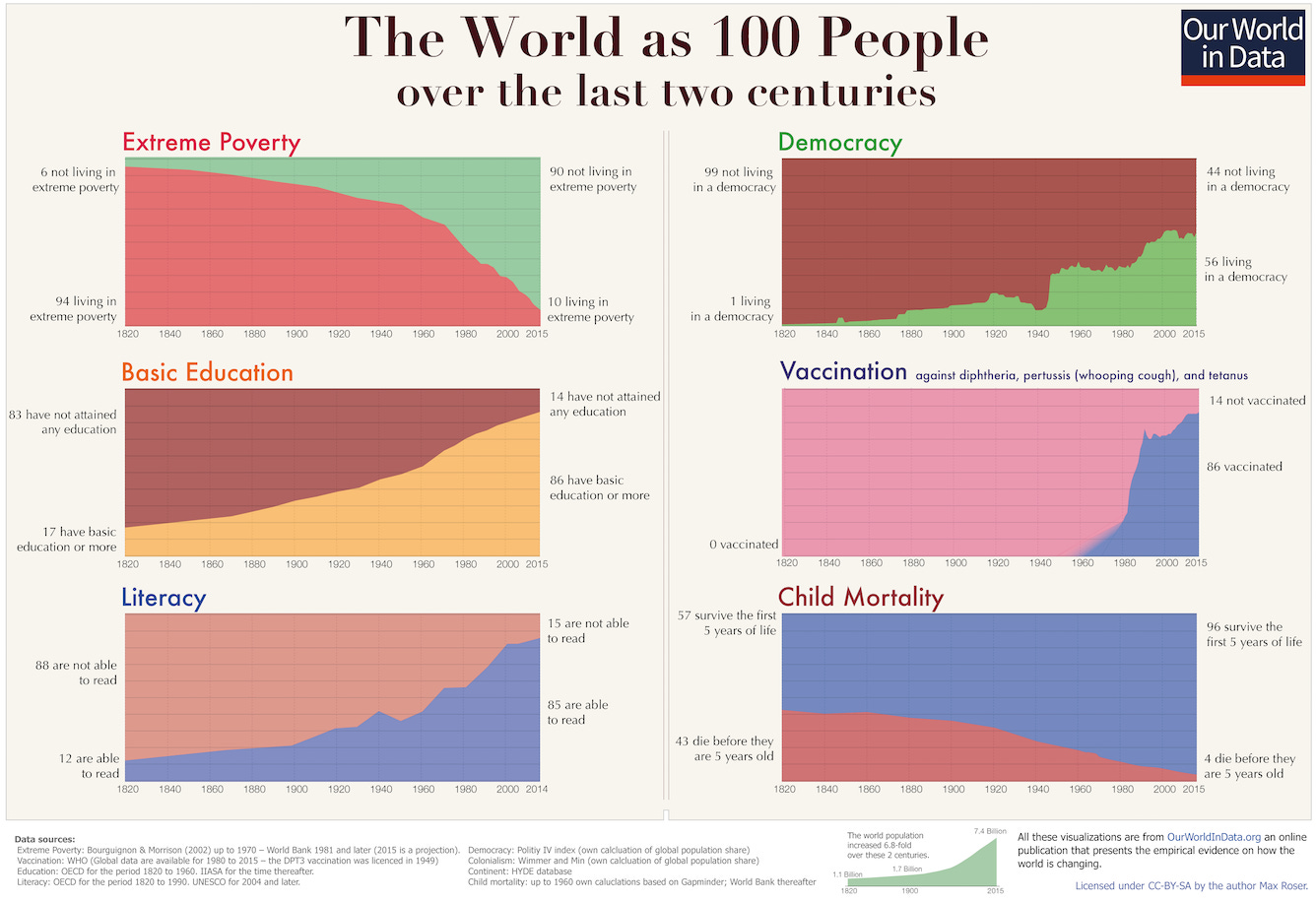
This graphic highlights levels of progress through improvements in variables such as vaccination.

So-Called “Progress”

Not everyone agrees with this concept of progress. It depends on an Enlightenment worldview that includes confidence in reason and science, and a humanist morality.

One argument against the idea of progress claims that material progress has not actually led to human well-being. Perhaps the benefits of progress are outweighed by the costs and risks: health hazards, technological unemployment, environmental damage, existential threats, etc. Some downplay or deny the benefits themselves, arguing that material progress doesn’t increase happiness (owing to the hedonic treadmill), that it doesn’t satisfy our spiritual values, or that it degrades our moral character. Rousseau famously asserted that “the progress of the sciences and the arts has added nothing to our true happiness” and that “our souls have become corrupted to the extent that our sciences and our arts have advanced towards perfection.”

Others, as mentioned above, argue for a different standard of value altogether, such as nature or God. (Often these arguments contain some equivocation between whether these things are good in themselves, or whether we should value them because they are good for human well-being over the long term.)

When people start to conclude that progress is not in fact good, they talk about this as no longer “believing in progress.” Historian Carl Becker, writing in the shadow of World War I, said that “the fact of progress is disputed and the doctrine discredited,” and asked: “May we still, in whatever different fashion, believe in the progress of mankind?” In 1991, Christopher Lasch asked:

How does it happen that serious people continue to believe in progress, in the face of massive evidence that might have been expected to refute the idea of progress once and for all?

Those who dispute the idea of progress often avoid the term, or quarantine it in scare quotes: so-called “progress.” When Jeremy Caradonna questioned the concept in The Atlantic, the headline was: “Is ‘Progress’ Good for Humanity?” One of the first court rulings on environmental protection law, in 1971, said that such law represented “the commitment of the Government to control, at long last, the destructive engine of material ‘progress.’” Or consider this from Guns, Germs, and Steel:

… I do not assume that industrialized states are “better” than hunter-gatherer tribes, or that the abandonment of the hunter-gatherer lifestyle for iron-based statehood represents “progress,” or that it has led to an increase in human happiness.

The idea of progress is inherently an idea that progress, overall, is good. If “progress” is destructive, if it does not in fact improve human well-being, then it hardly deserves the name.

Contrast this with the concept of growth. “Growth,” writ large, refers to an increase in the population, the economy, and the scale of human organization and activity. It is not inherently good: everyone agrees that it is happening, but some are against it; some even define themselves by being against it (the “degrowth” movement). No one is against progress, they are only against “progress”: that is, they either believe in it, or deny it.

The most important question in the philosophy of progress, then, is whether the idea of progress is valid—whether “progress” is real.

“Progress” in the 19th Century

Before the World Wars, there was an idea of progress that went even beyond what I have defined above, and which contained at least two major errors.

One error was the idea that progress is inevitable. Becker, in the essay quoted above, said that according to “the doctrine of progress,”

the Idea or the Dialectic or Natural Law, functioning through the conscious purposes or the unconscious activities of men, could be counted on to safeguard mankind against future hazards. … At the present moment the world seems indeed out of joint, and it is difficult to believe with any conviction that a power not ourselves … will ever set it right.

(Emphasis added.)

The other was the idea that moral progress was so closely connected to material progress that they would always move together. Condorcet believed that prosperity would “naturally dispose men to humanity, to benevolence and to justice,” and that “nature has connected, by a chain which cannot be broken, truth, happiness, and virtue.”

The 20th century, with the outbreak of world war and the rise of totalitarianism, proved these ideas disastrously wrong.

“Progress” in the 21st Century and Beyond

To move forward, we need a wiser, more mature idea of progress.

Progress is not automatic or inevitable. It depends on choice and effort. It is up to us.

Progress is not automatically good. It must be steered. Progress always creates new problems, and they don’t get solved automatically. Solving them requires active focus and effort, and this is a part of progress, too.

Material progress does not automatically lead to moral progress. Technology within an evil social system can do more harm than good. We must commit to improving morality and society along with science, technology, and industry.

With these lessons well learned, we can rescue the idea of progress and carry it forward into the 21st century and beyond.

This article was published at The Roots of Progress on 3/9/2024.

Blog Post | Progress Studies

Why Our Economic Intuitions Are Often Wrong

Such tendencies stem from our evolutionary psychology.

Summary: Many common economic misconceptions stem from evolved psychological instincts shaped in small, zero-sum tribal environments rather than modern market systems. These “folk-economic beliefs” lead people to misinterpret trade, immigration, profit, and regulation in ways that conflict with core economic principles, often resulting in support for counterproductive policies. Because these intuitions are predictable products of human evolution, they help explain why flawed policy ideas persist. Recognizing their origins can help counteract misleading instincts while reinforcing those that support cooperation, openness, and exchange.


Economic models, rooted in assumptions of rational agents maximizing utility under constraints, have long provided elegant frameworks for understanding human behavior in markets and societies. Yet, a persistent friction exists between these idealized portrayals of human beings and the ways humans actually navigate economic choices. People frequently champion policies that contravene basic economic principles, including minimum wages presumed to boost income without increasing unemployment, rent controls expected to enhance housing affordability without reducing supply, or tariffs that run counter to comparative advantage and affordability. 

People also often harbor counterproductive intuitions, including a belief that markets erode social bonds, despite evidence that markets foster cooperation and thus generate wealth. Those tendencies stem not primarily from information deficits or irrationality, but from our evolutionary psychology. Our economic intuitions were shaped over thousands of years in a world of tight-knit coalitions and zero-sum intergroup rivalry, rendering modern market dynamics counterintuitive. As such, markets are often rejected even when they are beneficial.

Perhaps the most parsimonious theory explaining why people often behave in economically harmful ways is the evolutionary cognitive model of folk-economic beliefs, proposed by anthropologist Pascal Boyer and political scientist Michael Bang Petersen. Folk-economic beliefs are those convictions about economics held by laypeople untrained in the discipline, which frequently diverge from fundamental economic tenets. These encompass mental representations of varied topics, from prices, taxes, and tariffs to welfare and immigration policies. 

Economists have traditionally critiqued those as irrational beliefs or mere byproducts of ignorance, but an evolutionary lens reveals them as predictable outcomes. Ensuring fairness in trade, sustaining social ties, forming stable coalitions, and resolving ownership disputes are all responses to ancestral challenges.

If this theory is right, both actual economic behavior and theories generated to explain one’s own economic behavior are predictable outputs shaped by evolution. When folk-economic beliefs are wrong, they are wrong in predictable ways. We talk about impersonal markets as if they were tribal conflicts. We treat economies built on innovation and surplus as if they were competitions over a fixed pile of resources.

Consider the intuition that international trade is harmful because another country’s gain must come at our expense. From the perspective of standard economics, this belief contradicts the well-established principle of comparative advantage. People benefit from specializing in what they produce most efficiently relative to other goods, even if a trading partner could produce everything more cheaply in absolute terms. For example, a surgeon who happens to type faster than his or her secretary still benefits from hiring the secretary and devoting more time to the operating room. Likewise, America could manufacture its own consumer electronics, but every dollar and worker devoted to assembling phones is one not devoted to designing the software, chips, and financial services where American companies dominate globally. The result is more total output and mutual gain. 

But our evolutionary psychology wasn’t built for comparative advantage, especially not across nations or tribes. Human groups historically competed for territory, food, and status in genuinely zero-sum ways. If a rival coalition grew stronger, it often meant danger for one’s own group. When modern individuals read that another nation is exporting more goods to us or running a trade surplus, our tribal instincts activate automatically. Nations are cognitively represented as tribes, and the success of one tribe is interpreted as a threat to another. The idea that both sides could benefit simultaneously—one of the central insights of the founder of economics, Adam Smith—runs against these deeply ingrained intuitions.

The same coalitional logic helps explain folk intuitions about immigration. People opposed to immigration often claim that immigrants steal jobs from native workers while also claiming that immigrants siphon welfare benefits without working. At the level of policy argument, these beliefs are apparently contradictory. But at the level of psychology, it is an expression of a single concern: Outsiders are draining scarce resources, whether the resource is employment or benefits. Humans evolved in groups where membership conferred access to shared resources—food, protection, or status—and where vigilance against free riders was essential to sustaining cooperation. Newcomers were therefore automatically treated with suspicion until they proved themselves contributors rather than exploiters. 

When this ancestral heuristic is applied to modern societies, it produces the intuition that outsiders must be consuming resources that properly belong to the in-group. Whether the imagined resource is employment or welfare benefits—or even whether the resources are truly being drained at all—matters less than the perceived threat that group boundaries are being crossed without reciprocal contribution.

The psychology of free-rider detection also helps explain the peculiar ambivalence that many people feel toward welfare programs. While people readily endorse the idea that society should help those who fall on hard times through no fault of their own, they also often worry that welfare encourages laziness or dependency. These views appear inconsistent only if one assumes that the public is applying a unified economic theory. In reality, they reflect two separate intuitions inherited from ancestral exchange systems. 

Communal sharing evolved as a form of insurance against bad luck—injury, illness, or an unsuccessful hunt—where helping unlucky group members benefited everyone in the long run. But the same systems also evolved to punish individuals who accepted benefits without contributing. Modern welfare debates, therefore, activate both intuitions simultaneously: compassion toward the unlucky and hostility toward perceived free riders.

Another common folk-economic belief concerns the relationship between labor and value. Many people feel instinctively that hard work should determine how much something is worth. In the hunter-gatherer economy that prevailed throughout most of human history, where the value of goods was closely tied to the labor required to obtain them, strenuous physical effort was intrinsically linked to value production itself. Hunting, gathering, building shelter, or crafting tools all involved visible effort, and individuals who contributed more effort typically produced more resources. When applied to modern economies, however, the same intuition can generate confusion. A programmer writing code, an entrepreneur coordinating supply chains, or an investor allocating capital may create enormous value without performing visible physical labor. Yet because our ownership psychology is sensitive to effort and physical transformation, profits earned through organization or innovation are often framed as morally suspect, particularly in socialist ideology, as if they are thought to represent extraction rather than creation.

Some common opposition to the profit motive itself is explained by evolutionary psychology. In face-to-face exchange within small groups, unusually large gains might indeed signal exploitation or hoarding of limited resources, especially since producing anything of value typically required communal effort. Someone who consistently benefited more than others from trades might be suspected of manipulating information or violating norms of fairness. Modern markets, however, often reward individuals precisely when they discover new ways to produce value—whether by inventing technologies, improving logistics, or coordinating complex networks of production. Because these gains arise in impersonal systems where the beneficiaries are distant strangers rather than known partners, the profits they generate can appear less like the rewards of innovation and more like evidence of exploitation. Our evolved moral intuitions struggle to track value creation in dispersed and opaque market economies. 

Likewise, many popular beliefs about regulation reflect ancestral intuitions that authorities can directly control outcomes. If the chieftain declared that food should be shared in a particular way, the order could be enforced through social pressure or direct monitoring. Everyone knew everyone else, contributions were visible, and deviations from the rule could be punished immediately. This experience makes it intuitively plausible that governments—which our minds intuitively represent as tribal coalitions—can simply command economic results. If rents are too high, they can seemingly be capped. If wages are too low, they can seemingly be raised. In naive folk economic theories, prices behave like promises: If the authority decrees a new price, the outcome should follow.

Take rent control. The intuition behind it is straightforward and morally compelling. If landlords raise rents beyond what tenants can afford, people may feel exploited: The owner of a scarce resource is extracting more money without providing more housing. A government rule limiting rents, therefore, appears to be a simple act of fairness. Ostensibly, the authority steps in, declares that rents may not exceed a certain level, and housing becomes affordable again. But in a large market economy, rent is not just a moral claim between two parties; it is also a signal that coordinates investment and construction of new housing. When rents are capped below market levels, the signal changes. Developers build fewer apartments, landlords convert rental units into other uses, and maintenance becomes less attractive when returns are limited. Over time, the supply of housing shrinks, and the shortage intensifies the very scarcity that drove up rents in the first place. The policy fails because the mechanism through which housing supply adjusts is invisible to the mental model that produced the intuition.

The same dynamic appears in debates over minimum wages. If workers are paid very little for difficult or unpleasant jobs, the situation feels unfair. But in a modern labor market, wages also function as signals that coordinate hiring decisions across the entire economy. When the legal wage floor rises above the productivity level of some jobs, employers do not simply pay the higher wage and continue as before. They reduce hiring, substitute machines for labor, or restructure tasks so fewer workers are needed. When the price signal changes, behavior adjusts in ways that the regulation does not anticipate. That often results in the direct opposite of the desired effect.

Our minds are not utility-maximizing computers that simply deviate from optimal choice due to insufficient information or computing power. They are toolkits. Our brains have evolved specialized cognitive inferences, or intuitions, that solved specific recurrent problems in our ancestral environments: “Who is trustworthy enough for exchange?”; “Who belongs to us, and who is a rival?”; “Who is contributing, and who is free riding?”; “Who owns what, and by what right?” These intuitions can be triggered by modern economic situations that resemble ancestral ones, even when the actual circumstances are entirely new. 

Folk-economic beliefs persist not because people are irrational, but because they are reasoning with tools that evolved for cooperation in small bands rather than coordination among millions of strangers. The challenge for modern societies is therefore not simply to correct mistaken beliefs, but to build policies that work with—rather than against—the grain of human psychology. 

Modern market societies represent one of humanity’s most remarkable cultural achievements. They sprang into existence by harnessing a set of different ancient social instincts—ones that enable cooperation on an unprecedented scale. Systems of property rights, contract enforcement, and voluntary exchange allow millions of strangers to coordinate their efforts in mutually beneficial ways. 

The claim here is not that markets are infallible. It is that our evolved intuitions often misidentify the nature of the problem and thus point us toward remedies that make matters worse. In modern economies, visible losses are concentrated, immediate, and emotionally salient, while gains are diffuse, gradual, and spread across millions of consumers and workers. A serious defense of markets should therefore acknowledge adjustment costs and real harms without conceding the larger error: namely, the belief that mutual gain, price signals, profit, and exchange are themselves forms of exploitation.

Some of our evolved instincts—like valuing reciprocity, rewarding contribution, and building reputations for trustworthiness—remain essential foundations of prosperous societies. Markets themselves depend on these deeply rooted norms of cooperation and exchange. Other intuitions, however—such as zero-sum thinking about trade, suspicion toward profitable innovation, or faith that authorities can simply command prices—reflect cognitive shortcuts suited to environments of scarcity and small-group control rather than decentralized abundance.

Recognizing that distinction should not slide into a blanket dismissal of public concern. Not every market outcome is benign, and not all economic anxieties are mere illusions. Trade, technological change, and broader shifts from manufacturing to services can impose real, concentrated losses on particular workers, firms, and regions, especially on lower-skill laborers whose jobs are exposed to offshoring or displaced by new forms of production. A person who loses a job to foreign competition is not simply trapped by faulty intuition. He is often responding to a real personal setback, even if the economy as a whole still becomes more productive and prosperous. The same is true in recessions or cases of fraud and negative externalities. 

The question, then, is how societies can address those real costs without defaulting to the very intuitions that misdiagnose their causes. 

Human beings are unusual among species in our ability to revise intuitive judgments through abstract reasoning and accumulated knowledge. Economic theory, empirical evidence, and institutional experimentation provide ways of testing whether our intuitions about markets actually match the systems we inhabit. Over time, societies that learn to distinguish between intuitions that promote cooperation and those that misread economic signals tend to design more effective institutions. 

Much of the progress of the last two centuries reflects this process of institutional learning precisely. Expanding trade networks, protecting property rights, encouraging innovation, and allowing prices to coordinate decentralized decisions have produced levels of prosperity that would have been unimaginable in the environments where our economic intuitions evolved. Understanding the evolutionary roots of folk-economic beliefs, therefore, helps explain why certain policy ideas remain politically attractive despite poor outcomes—and why sustained progress often depends on institutions that counteract some of our most natural intuitions while reinforcing others that support cooperation, openness, and exchange.

This article was originally published at The Dispatch on 4/21/2026.

Blog Post | Economic Growth

What Unifies the Enemies of Civilization?

Socialism, environmentalism, scientism, relativism, dogmatism, and doomerism all have one thing in common.

This article was excerpted from an upcoming documentary.

Summary: Anti-merit, authoritarian, collectivist ideas like socialism, environmental extremism, and doomerism are enemies of human progress because they impede innovation, limit personal freedom, and prevent societal growth. Fostering decentralized creativity, by contrast, improves the continued ability of human civilization to advance.


We have enemies.

Our enemies are not bad people—but rather bad ideas.

Our enemy is stagnation.

Our enemy is anti-merit, anti-ambition, anti-striving, anti-achievement, anti-greatness.

Our enemy is statism, authoritarianism, collectivism, central planning, socialism.

Our enemy is bureaucracy, vetocracy, gerontocracy, blind deference to tradition.

Our enemy is corruption, regulatory capture, monopolies, cartels.

Our enemy is institutions that in their youth were vital and energetic and truth-seeking, but are now compromised and corroded . . . blocking progress in increasingly desperate bids for continued relevance, frantically trying to justify their ongoing funding despite spiraling dysfunction and escalating ineptness.

Our enemy is the ivory tower, the know-it-all credentialed expert worldview, indulging in abstract dogmas . . . luxury beliefs, social engineering, disconnected from the real world, delusional, unelected, and unaccountable—playing God with everyone else’s lives, with total insulation from the consequences.

Our enemy is speech control and thought control—the increasing use, in plain sight, of George Orwell’s “1984” as an instruction manual . . .

Our enemy is the Precautionary Principle, which would have prevented virtually all progress since man first harnessed fire. The Precautionary Principle was invented to prevent the large-scale deployment of civilian nuclear power, perhaps the most catastrophic mistake in Western society in my lifetime. The Precautionary Principle continues to inflict enormous unnecessary suffering on our world today. It is deeply immoral, and we must jettison it with extreme prejudice.

Our enemy is deceleration, de-growth, depopulation—the nihilistic wish, so trendy among our elites, for fewer people, less energy, and more suffering and death . . .

We will explain to people captured by these zombie ideas that their fears are unwarranted and the future is bright.

We believe we must help them find their way out of their self-imposed labyrinth of pain.

We invite everyone to join us . . .

The water is warm.

Become our allies in the pursuit of technology, abundance, and life.

—Marc Andreessen, The Techno-Optimist Manifesto

Although our society is becoming more dynamic over time, some creativity-suppressing memes that had dominated our static ancestors survive to this day, albeit under different guises. As we saw, those memes ensured that societies like Sparta made practically no progress at all. Thankfully, in our time, such memes don’t stop us from improving our lives and the world more broadly. But they do slow us down, and if left unchecked, they could come to dominate our dynamic society and revert it back to the static societies of old. We, therefore, have a duty not only to recognize them for the threat that they are but to do everything in our power to eradicate them entirely.

Socialism advocates for centralized institutions, like States, to take the means of production away from citizens against their will. Socialists falsely assume that States can better allocate wealth in the form of consumer goods and services better than the private sector. But in the absence of free markets, States cannot determine prices and so cannot discover how resources can be best allocated. Resources like wood and gold could go toward producing all sorts of consumer goods, and market prices signal to entrepreneurs which resources should go into producing which consumer goods. That is, entrepreneurs use prices to “calculate” whether or not a particular venture will improve consumers’ lives. For instance, entrepreneurs might want to buy wood to build houses that they wish to sell. But they can only determine whether such a venture is profitable—that is, if it makes people better off—if they know the prices of the wood they’d buy and the houses they’d sell. But centralizing all of society’s resources into the hands of a single institution obliterates the possibility of prices. As economist Ludwig von Mises wrote, “The paradox of ‘planning’ is that it cannot plan, because of the absence of economic calculation. What is called a planned economy is no economy at all. It is just a system of groping about in the dark. There is no question of a rational choice of means for the best possible attainment of the ultimate ends sought. What is called conscious planning is precisely the elimination of conscious purposive action.”

The impossibility of socialist-style central planning came to light in 1989, when Boris Yeltsin, then the president of the Soviet Union, visited a grocery store in the United States. Back in Russia, people waited in line for food and other goods, but in the capitalist United States, Yeltsin could buy as much of any of the countless items he wanted, and the lines were nothing like they were back home. In recognition of the stark contrast, Yeltsin told some Russians who were with him that if Russians saw what American supermarkets were like, “there would be a revolution.”

Many socialists think that wealth is a fixed pie. They see rich people and poor people and think that such inequality is unfair or unjust. Because they think wealth is fixed, they are sure that the moral thing to do is to forcibly transfer wealth from the rich people to the poor people. They think that the State ought to do such things—hence, they want the State to own the means of production, use them to create goods and services, and allocate them in a fair and just way to the people.

But wealth is not a fixed pie. Mankind was born into utter poverty, and now billions of people are wealthy enough to have the free time to read articles such as this one. So, yes, poverty is a tragedy. But with enough progress, we can all become as wealthy as today’s billionaires—indeed, most modern Westerners are wealthier than the kings of old, who died of diseases we’ve long since cured and who lacked basic comforts such as air conditioning.

The answer to poverty is not socialism, which only makes it more difficult to create more wealth. But trends indicate that young people in the West don’t know that—an Axios poll showed that 41 percent of American adults in 2021 held favorable views toward socialism.

Extreme environmentalism, or the so-called degrowth movement, aims to minimize humanity’s environmental impact by having fewer children, consuming less energy, and releasing less carbon into the atmosphere. As documented in a June 2024 New York Times article, anthropologist and prominent degrowth advocate Jason Hickel once wrote, “Degrowth is about reducing the material and energy throughput of the economy to bring it back into balance with the living world, while distributing income and resources more fairly, liberating people from needless work, and investing in the public goods that people need to thrive.”

The author of the New York Times piece, Jennifer Szalai, further writes, “The distinctive argument that Hickel and other degrowthers make is ultimately a moral one: ‘We have ceded our political agency to the lazy calculus of growth.’”

But there is nothing moral about slowing down growth for the planet’s sake or of rebalancing our relationship with nature. Growth is not some abstract thing that greedy capitalists have made a deity of. Growth means more wealth for people in the form of lifesaving and life-enhancing technologies, from shelter to protect us from the violent forces of the Earth to mass food production to bring starvation to an all-time low.

Some environmentalists are willing to sacrifice the well-being of humans for the sake of the Earth and its nonhuman inhabitants. But they fail to appreciate that it is only humans who stand a chance at saving the planet and every species in existence! After all, the sun will eventually engulf the Earth, and most species have gone extinct, never mind what humans have done. But only humans are capable of developing the technology to protect the Earth from the sun’s death and revive any species we so choose. This might sound like science fiction, but already we deflect asteroids from the Earth and create cells with synthetic genomes. The gap between those feats and the ones you think are science fiction is not insurmountable—but human civilization will need to grow to achieve them.

So, even by the environmentalists’ own standards, people are the primary moral agent in the world. Any side effect we cause can, in principle, be reversed in the long run. Incidentally, the primacy of people serves as a devastating criticism against those who advocate that we have fewer children—after all, more people means more creativity and more boundless potential to make progress.

And if something like climate change is judged by its effects on people, things have never been better thanks to growth. The Earth doesn’t care about us—but we care about each other. As philosopher Alex Epstein notes, “If you review the world’s leading source of climate disaster data, you will find that it totally contradicts the moral case for eliminating fossil fuels. Climate-related disaster deaths have plummeted by 98 percent over the last century, as CO2 levels have risen from 280 ppm (parts per million) to 420 ppm (parts per million) and temperatures have risen by 1°C.”

Yes, fossil fuels have changed the Earth. But they’ve also given us enough energy to create solutions to an uncountable number of problems, including developing safe, manmade environments that shield us from Mother Earth’s dangers. Degrowth would rob us of such creations and leave us cold, dark, and vulnerable. “On a human flourishing standard,” Epstein writes, “we want to avoid not ‘climate change’ but ‘climate danger’—and we want to increase ‘climate livability’ by adapting to and mastering climate, not simply refrain from impacting climate.”

You may laugh at those environmentalists who throw paint at art, but they’ve been effective at halting the development of nuclear power, a potential source of abundant energy that we’ve known how to build for decades. We can’t calculate how much suffering could have been ameliorated had we been free to build nuclear power plants across the Earth.

Scientism is the false idea that scientific knowledge trumps all other kinds of knowledge—that science alone can answer all our questions. But moral, economic, political, and philosophical problems can’t be answered by science alone. This is why the phrase “follow the science,” as we heard so often during the 2020 pandemic, doesn’t make sense. Scientific knowledge can inform our choices, but it alone cannot tell us what to do next, either in our personal lives or in politics more widely. For instance, science might offer us an explanation for how and why COVID-19 spreads, the conditions under which masks reduce spread, and the effect of age and body fat percentage on the risk of infection. But science cannot tell us whether the trade-offs associated with government-mandated lockdowns are worth it, whether the government should invest public funds into drug companies for the development of a vaccine, whether all questions pertaining to a pandemic should be left to the most local level of government or to the most global level of government, whether a grandparent ought to risk infection to visit his grandchildren, or whether a businessman should run an underground (and illegal) speakeasy during lockdowns so that he can afford rent. The answers to such questions require more than just scientific knowledge—they require political, economic, and moral knowledge. Knowledge about what one ought to want in life, knowledge about the trade-offs involved in our decisions, knowledge about the intended and unintended consequences of governmental policy, knowledge about legal precedent, and knowledge about what our political institutions are capable of doing. None of this could possibly be found in a science textbook. Those who claim otherwise are guilty of the sins of scientism.

As the Nobel Prize–winning economist F. A. Hayek, inventor of the term “scientism,” wrote, “It seems to me that this failure of the economists to guide policy more successfully is closely connected with their propensity to imitate as closely as possible the procedures of the brilliantly successful physical sciences—an attempt which in our field may lead to outright error. It is an approach which has come to be described as the ‘scientistic’ attitude—an attitude which . . . is decidedly unscientific in the true sense of the word, since it involves a mechanical and uncritical application of habits of thought to fields different from those in which they have been formed.”

But if we cannot acquire moral, economic, or political knowledge via the methods that work so well in physics, how do we get such knowledge? The same way we always do: by conjecture and criticism. We guess what the right policy is, how we ought to act in the world, and how the economy works. And we criticize all those guesses—maybe not with the rigorous experiments we conduct in the physics laboratory, but experimentation is just one way of criticizing ideas.

Ironically, with the staggering advances made in the hard sciences over the past century, scientism has been on the rise. Quite simply, people think that they can take science’s successes and carry them over into every other field of human endeavor. In political and cultural battles, it is often thought that he who knows the most science must be in the right. If only we put the most scientifically minded people in charge of the world, it is thought, then they could solve all our problems from on high. But science alone cannot tell us whether children have a right to take hormone blockers, whether circumcision should be legal, or how long patents should last. That is no reason to despair—with or without the microscope, we can continue to make progress with creative guessing and criticizing.

Relativism comes in many forms, but perhaps the most dangerous is moral relativism—the idea that there is no difference between right and wrong or good and evil. “Who’s to say who is in the wrong?” the relativist ponders high-mindedly. “What Hamas did to Israel on October 7th is barbaric, but we must end this cycle of violence,” a relativist would say, implicating both sides. “Russia may have invaded Ukraine, but Ukraine is conscripting its own citizens. Therefore, both sides have committed wrongdoing.” “If Hitler was a villain for his genocide, then so was Churchill.”

Relativism might seem open-minded and fair, but it is neither. For it is not open to the possibility that one party is in the right and the other in the wrong. It is not open to the idea that one society is open and dynamic and the other closed and static. It is not open to the notion that one country cherishes life while the other worships death. Nor is relativism fair—the relativist does static societies no favors by denying that they could become as prosperous as dynamic ones should they choose to do so. In their own way, relativists trap evil under the weight of their own suppressive culture when they could have cleansed it with the light of better ideas. And the relativist distorts the self-confidence of dynamic, progressive societies by muddying their understanding of why they’re so successful in the first place, mitigating their ability to make even further progress and spread the right ideas to static societies. The relativist is no highfalutin hero—he keeps evil on life support long past its expiration date.

Perhaps relativism is thriving in the West right now because people can afford to make such an egregious error. But not forever. For the enemies of the West are the enemies of civilization more broadly. They will not stop their anti-human ambitions, no matter how much relativists deny that that is what they are. Nor will it be relativists who ultimately stand up to them but rather those who distinguish between right and wrong, stasis and progress, victory and defeat.

Dogmatism refers to an idea that is considered, implicitly or explicitly, uncriticizable. The final truth. Known with certainty. Never to be changed. People tend to associate religious doctrines with dogmatism, but the connection is not a necessary one. After all, some religions have evolved to cohabitate with the rapid progress we’ve undergone since the Enlightenment (to be sure, other religions, tragically, have not yet done so—and whenever someone admits to “taking something on faith,” dogmatism is surely at work). But dogma is not confined to the cathedral. For instance, many political ideologies are thought to have perfect foundations by their adherents. And even in science, our best theories could, in principle, spread by dogmatic means. Karl Popper described Sigmund Freud’s psychoanalysis as dogmatic. As philosopher Bryan Magee described psychoanalysts, “We should not . . . systematically evade refutation by continually reformulating either our theory or our evidence in order to keep the two in accord. . . . Thus they are substituting dogmatism for science while claiming to be scientific.” Even in the hard sciences, we could imagine a world in which people are not persuaded that Albert Einstein’s theory of relativity is true but rather are pressured to accept it as an uncriticizable foundation of our scientific worldview.

Because all our ideas contain errors, dogmatism always prevents us from improving on the ideas locked in dogma’s cage. Couple that with the fact that any error, no matter how small, could result in the eventual extinction of the human race, and we have good reason to rid our society of all dogmatic elements.

Doomerism is the idea that humanity has no shot at continuing to make progress, or that our extinction is just around the corner, or that we are uniquely vulnerable to being wiped out today, or that we are just one innovation away from guaranteeing our decline.

This attitude neutralizes the human spirit—after all, if humanity is sunk, why bother trying in the first place?

One of the primary examples of doomerism today is the debate over artificial intelligence. Some think that if we just keep innovating, we will eventually create an entity that is more intelligent and/or powerful than people could ever be and that we will fall to the status of slaves or animals beneath its feet. First, if the machine is not creative, it will be precisely as obedient as our microwaves are. And any unintentional side effects of AI can be accounted for with safety measures, as are currently being developed for self-driving cars. Second, if we do end up creating a machine that is as alive as we are—a so-called artificial general intelligence, or AGI—it is no more rational to assume that it will pursue our destruction as it is to assume that new humans will do so. New humans—namely children—are raised to adopt the values of the culture around them. Of course, sometimes they rebel, especially when adults force them to do things they don’t want to do. Therefore, the problem of how to integrate an AGI into our society is the same as the problem of how to raise children into happy, productive adults—and we’ve been improving at that for centuries.

Another dangerous effect of doomerism is tyranny, whether through cultural taboos, governmental regulations, or outright bans. They all amount to slowing the growth of knowledge and wealth, and of progress more generally. For if the next innovative step marks our doom, then surely a little—or a lot—of tyranny is justified! But innovation is the very panacea that doomers are worried about. It is stasis, not change, that will mark our end.

Moreover, we might choose to slow ourselves down, but the bad guys won’t. So there’s no world in which AI doesn’t continue to progress. But there is a world in which the bad guys get a hold of novel technologies before we do—and, with it, the end of our sustained Enlightenment.

So socialism, environmentalism, scientism, relativism, dogmatism, and doomerism have all earned their bona fides as enemies of civilization. In one way or another, they curb our ability to make progress, a stain on the project that is humanity. But is each stain a unique color, or do they come from the same poisonous ink jar?

Indeed, all memetic enemies of civilization have one thing in common: They slow the growth of knowledge.

This article was excerpted from an upcoming documentary.

Curiosities | Progress Studies

The Illusion of Moral Decline

“In a series of studies using both archival and original data (n = 12,492,983), we show that people in at least 60 nations around the world believe that morality is declining, that they have believed this for at least 70 years and that they attribute this decline both to the decreasing morality of individuals as they age and to the decreasing morality of successive generations. Next, we show that people’s reports of the morality of their contemporaries have not declined over time, suggesting that the perception of moral decline is an illusion. Finally, we show how a simple mechanism based on two well-established psychological phenomena (biased exposure to information and biased memory for information) can produce an illusion of moral decline, and we report studies that confirm two of its predictions about the circumstances under which the perception of moral decline is attenuated, eliminated or reversed (that is, when respondents are asked about the morality of people they know well or people who lived before the respondent was born). Together, our studies show that the perception of moral decline is pervasive, perdurable, unfounded and easily produced.”

From Nature.

Blog Post | Progress Studies

What Are the Causes of Human Progress?

The escape from stagnation has always required a culture of optimism and progress.

Summary: Human progress requires a culture of openness to change and innovation, which historically has been rare and resisted by established elites. Periods of remarkable achievement, like that seen in Enlightenment Europe, occurred when societies embraced new ideas and allowed for intellectual and economic freedom. The key to sustained progress lies in maintaining a culture of optimism and a politico-economic system that encourages innovation rather than suppressing it.


To make progress, we must do something differently from what we did yesterday, and we must do it faster, better, or with less effort. To accomplish that, we innovate, and we imitate. That takes a certain openness to surprises, and that openness is rare. It is difficult to come up with something that never existed. It’s also dangerous, since most innovations fail.

If you live close to subsistence level, you don’t have a margin for error. So, if someone wants to hunt in a new way or experiment with a new crop, it is not necessarily popular. There is a reason why most historical societies that came up with a way of sustaining themselves tried to stick to that recipe and considered innovators troublemakers.

That means that innovation depended on stumbling on a new way of doing things. Someone came up with a new and better tool or method by accident or by imitating nature or another tribe. But when populations were small, few people accidentally came across a great new way of doing things, and there were few people to imitate. In other words, there is a limit to what can be done in small, isolated societies.

It took greater population density and links to other groups to get the process of innovation and specialization going. Cultures at the crossroads between different civilizations and traditions were exposed to other ways of life as merchants, migrants, and military moved around. By combining different ideas, they set the process of innovation in motion. Ideas started having sex with each other, in the British writer Matt Ridley’s memorable phrase.

Such openness gave rise to extraordinary periods of achievement in cultures like ancient Greece and Rome, Abbasid Baghdad, and Song China. They were, as the American economist Jack Goldstone calls them, “efflorescences”—sharp and unexpected upturns that did not become self-sustaining and accelerating. They did not last.

The American economic historian Joel Mokyr talks about that as Cardwell’s Law—named after the technology historian D. S. L. Cardwell, who observed that most societies remained creative only for a short period. Often, they were ruined by external enemies, since poorer states and roving bandits are attracted by the former’s wealth.

But there are also enemies within. Every act of major technological innovation is “an act of rebellion against conventional wisdom and vested interests,” explains Mokyr. And conventional wisdom and vested interest have a way of fighting back.

Economic, intellectual, and political elites in every society have built their power on specific methods of production and a certain set of mythologies and ideas. The vested interests have an incentive to stop or at least control innovations that risk upsetting the status quo. They try to reimpose orthodoxies and reduce the potential for surprises, and sooner or later they win, the efflorescence is stamped out, and society reverts to the long stagnation.

An escape from stagnation requires a culture of optimism and progress to justify and encourage innovation, and it takes a particular politico-economic system to give people the freedom to engage in the continuous creation of novelty.

Enlightenment and Classical Liberalism

Luckily, this culture emerged forcefully in western Europe in the 17th and 18th centuries, in the form of the Enlightenment, which replaced superstition and authority with the ideals of reason, science, and humanism, as the Canadian psychologist Steven Pinker summarizes it, and classical liberalism, which removed political barriers to thought, debate, innovation, and trade.

It was the combined forces of the Enlightenment and classical liberalism that reduced intellectual and economic elites’ power to stamp out progress. Cardwell’s Law started to break down, and the road opened for individualists, innovators, and industrialists to change our world forever.

Why did this happen in Europe, and why then? There are two traditionally competing narratives, one associated with the right and one with the left, and they are equally wrong. According to the first, it was because Europeans were better than others (perhaps because of natural superiority, the legacy of the ancients, or Christianity). According to the second, it was because Europeans were worse than others (perhaps because of slavery, colonialism, and imperialism).

The problem with the first explanation is that experimentation in science, technology, and capitalism had been present in previous pagan, Muslim, Confucian, and other cultures. In fact, Europe imported and improved upon many non-European advances. The problem with the second explanation is that all previous civilizations also engaged in slavery, colonialism, and imperialism when they had a chance. Yet, they remained poor. So, what made Europe more successful must have been something else.

As noted, elites everywhere reacted to surprising innovations by trying to enforce political authority and intellectual orthodoxy. What made Europe different was that the elites failed. Unlike the Chinese or Ottoman empires, Europe was blessed with political and jurisdictional fragmentation, which has been emphasized by scholars like the British-Australian economic historian Eric Jones and the English historian Stephen Davies.

European rulers had the same ambitions to conquer and control, but on a peninsula of peninsulas, they were halted at mountain ranges, bodies of waters, riverine marshes, and forested landscape. Therefore, Europe was split into a mindboggling array of polities, independent cities, autonomous universities, and different religious denominations.

Hundreds of different sovereigns could not coordinate repression and impose one orthodoxy on all. That always left room for thinkers, entrepreneurs, and banned books to migrate to the jurisdiction most hospitable to their particular heresy. The Protestant Reformation was a further blow to ambitions for universal authority. How can you revert to a trusted authority when you don’t know which authority to trust? Nullius in verba (take nobody’s word for it), was not just the motto of the Royal Society, founded in London in 1660, but the spirit of the whole Enlightenment project.

European princes discovered that rivals who welcomed more migrant scientists, entrepreneurs, and technologies also acquired more wealth and thereby more war-making capacity. Disruptive innovations still threatened the elite power base in the long term, but a lack of innovation might threaten their lives instantly—via a superior invading army. In a fragmented Europe, sovereigns faced the opposite incentive of rulers of vast empires, who feared domestic discord more than they feared foreign conquest.

Fear of change therefore began to give way to a fear of stagnation. “And thus, it is,” wrote the German philosopher Immanuel Kant in 1784, that the Enlightenment gradually arises “from the selfish purposes of aggrandizement on the part of its rulers, if they understand what is for their own advantage.”

Scientific and Industrial Advances

The associated classical liberal transformation, pioneered by the Dutch Republic, and then taken further by Great Britain and the United States, simultaneously widened the freedom for new experiments and enterprises through greater equality under the law, more secure property rights, and freer domestic economy and expanding markets.

That created a virtuous circle, since the scientific endeavor, businesses forced to compete, and an open society are by their natures works in progress, subject to constant challenge and improvement. They allow more people to experiment with new ideas and methods and combine them in unexpected ways.

As the American economic historian Deirdre McCloskey has shown, these processes went hand in hand with a profound reevaluation of urban and bourgeois life. Whereas commerce and innovation used to be seen at best as necessary evils to fund a hierarchical and aristocratic society, they now started to be seen as desirable, even honorable.

This relative freedom for inquisitiveness and irreverence unleashed first a scientific revolution and then an industrial one. The cumulative nature of knowledge instilled a powerful sense of optimism. When telescopes, microscopes, and the English scientist Isaac Newton unlocked nature’s mysteries, the whole world soon learned about it and started thinking about how natural regularities could be exploited for practical purposes.

Through migrations, correspondence, the printing press, coffee shops, and learned societies, scientists and entrepreneurs systematized knowledge in mechanics, metallurgy, geology, chemistry, soil science, and materials science. That made it possible to consciously manipulate, debug, and adapt methods, materials, and machines to changing needs. New knowledge pointed to new experiments that could be used to interrogate nature further, and the results of those interrogations pointed to new technologies that could be used to grow more food, prevent or cure disease, shape materials, and exploit energy sources.

The modern corporation and financial markets emerged as vehicles for systematically transforming capital and knowledge into goods and services that improved people’s lives. No longer did mankind have to wait for someone, somewhere to stumble on a breakthrough at widely dispersed intervals. An economic and intellectual system devoted to the systematic pursuit of discoveries and innovations had been created. From Manchester and Menlo Park to Silicon Valley, pioneers methodically pushed the technological frontiers further into the unknown, and free competition and international trade made such wonders widely accessible at everyday low prices.

Therefore, for the first time in history, progress did not come to a sudden halt. It continued and accelerated. More people than ever looked at the world’s problems and were free to come up with their own suggested solutions. Finally, mankind reached escape velocity, and progress was no longer a bump on a flat line of human development but a hockey stick, pointing sharply upward.

“It may be that the Enlightenment has ‘tried’ to happen countless times,” writes the British physicist David Deutsch in The Beginning of Infinity. And therefore, it puts our own lucky escape into stark perspective: All previous efforts were cut short, “always snuffed out, usually without a trace. Except this once.”

It should make us deeply grateful that we are among the few who happen to be born in the only era of self-sustained, global progress. But it should also make us focused and combative. History teaches us that progress is not automatic. It only happened because people fought hard for it and for the system of liberty that made it possible.

If we want to remain the one great exception to history’s rule of oppression and stagnation, every new generation must find it within itself the desire to make the world safe for progress.