Summary: Big Mac prices across countries can be better understood by measuring them in terms of time rather than money—specifically, how long people must work to afford one. Comparing time prices reveals meaningful differences in wages and productivity that aren’t obvious from currency values alone.
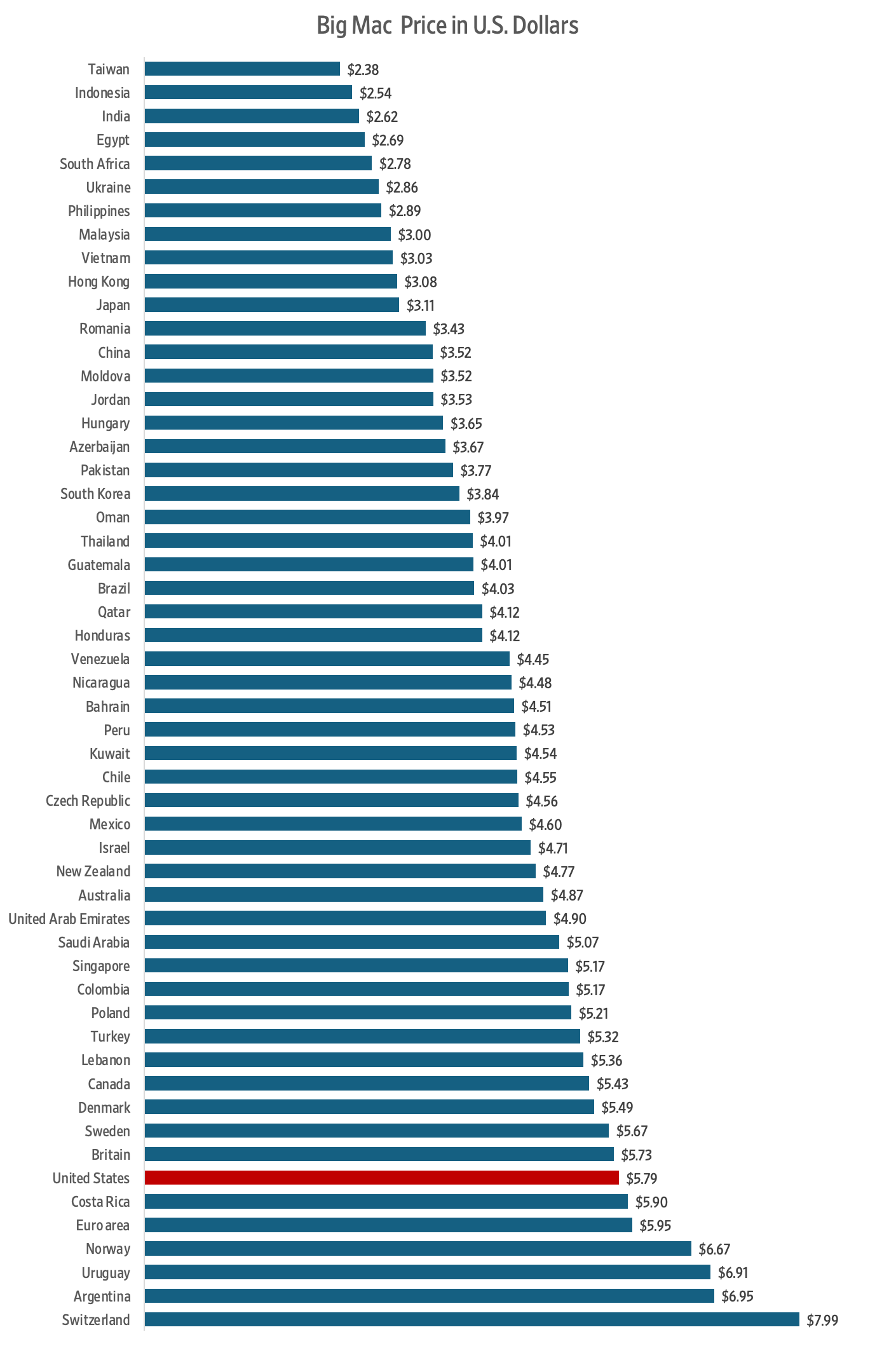
McDonald’s operates in over 100 countries worldwide. Since 1986, The Economist magazine has published the Big Mac Index, built on the theory of purchasing power parity (PPP)—the idea that exchange rates should equalize the price of an identical basket of goods across countries. The following shows the dollar price of a Big Mac in each country, sorted by price:
But we can go one step further.
Instead of comparing currencies, we can compare time.
We start with the nominal price of a Big Mac in each country, converted to U.S. dollars, and then compare it to average hourly earnings. Since average hourly earnings data are not available for all countries, GDP per capita divided by annual hours worked serves as a reasonable proxy for relative wages between countries.
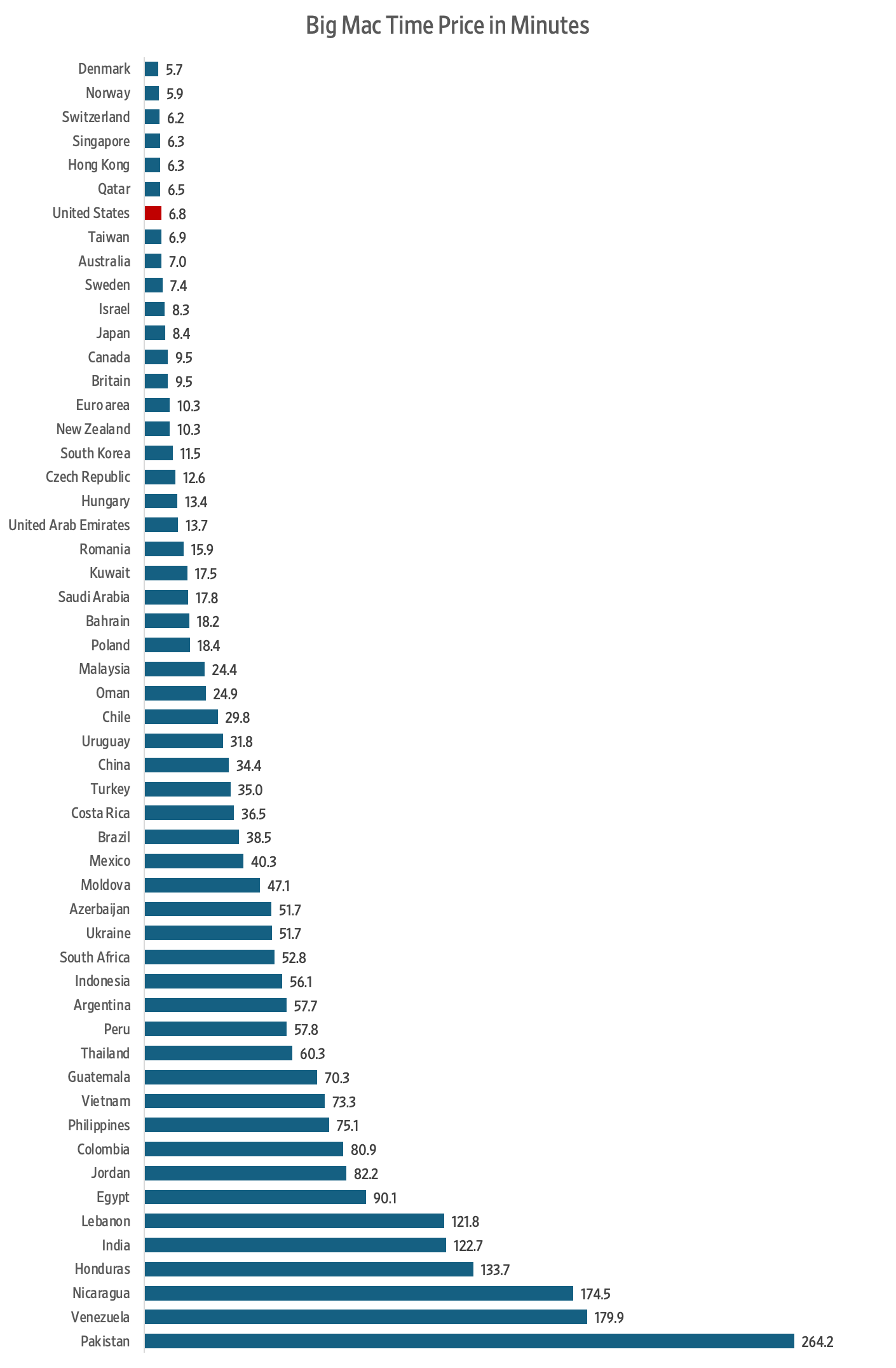
This transforms the question from “What does it cost?” to “How long do you have to work to get it?” A Big Mac can be more expensive in money but less expensive in time, depending on where you live.
A Big Mac in Taiwan costs only $2.38, compared to $7.99 in Switzerland, but after adjusting for hourly earnings, the time prices are very similar. In Pakistan, a Big Mac costs $3.77, but hourly earnings are $0.86, putting the time price at 4.4 hours. In Denmark, the price is $5.49, but hourly earnings are $57.60, so the time price is under six minutes. For the time it takes a worker in Pakistan to earn enough to buy one Big Mac, workers in Denmark can buy more than 46.
The Big Mac doesn’t just measure currencies; it measures the spread of knowledge.
What looks like inequality in dollars is often a difference in productivity, learning, and institutional capacity. The real divide is not between rich countries and poor countries—it is between places where knowledge compounds and places where it is constrained.
When a sandwich falls from four hours of work to four minutes, something profound has happened—not to the burger, but to the growth and sharing of knowledge.
The story of abundance is not written in dollars. It is written in time.
Find more of Gale’s work at his Substack, Gale Winds.