fbpx
01 / 05
What Cosmetic Surgery Innovation Can Teach Us About Healthcare Costs

Blog Post | Cost of Services

What Cosmetic Surgery Innovation Can Teach Us About Healthcare Costs

The average time price of 19 procedures has fallen by 50 percent since 1998.

Summary: Hospital services costs have surged, raising questions about the effectiveness of regulation and government intervention in the healthcare industry. To investigate the potential impact of free markets on cost trends, we examined the time prices of common cosmetic surgery procedures, which are elective and typically not covered by insurance. Our analysis reveals a significant decline in the relative time prices of these procedures, indicating increased abundance driven by innovation and market competition.


The Bureau of Labor Statistics reports that since 1998, hospital services costs have increased 61 percent faster than average wages and far outpaced consumer price index inflation. This industry is highly regulated, and government restricts supply and subsidizes demand.

Would free markets help to reverse these cost trends? To answer this question, we looked at the time prices of 19 common cosmetic surgery procedures. These procedures are elective, and insurance companies typically don’t provide reimbursements. Cosmetic surgeons also have been relatively free to innovate, and cosmetic surgery centers are globally competitive.

The American Society of Plastic Surgeons annually publishes prices for a variety of procedures. We compared the nominal prices from 1998 to 2022 against the average hourly wage rates of unskilled and blue-collar workers. This gave us relative time prices over time.

The average time price fell by 50.3 percent over this 24-year period. For the time it took to earn the money to pay for one procedure in 1998, you could get over two procedures today. Procedure abundance has increased by over 100 percent. The time price of chemical peels and laser hair removal fell the fastest by 87.7 percent and 80.1 percent, respectively. However, two procedure costs increased: upper arm lifts increased by 6.7 percent and facelifts by 1.6 percent.
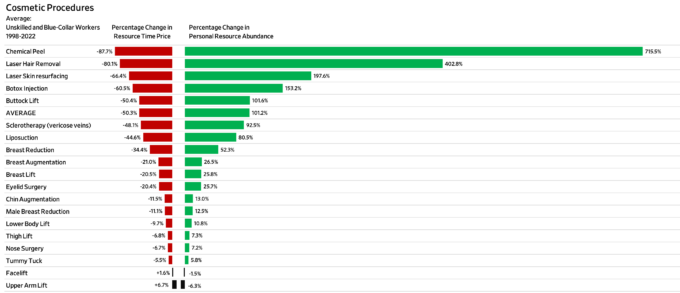
Bar chart displaying Nominal hourly wage rates from 1998 to 2022

The above analysis compares categories of wage earners over time, but what about individuals? We typically start as unskilled workers and then advance as we acquire more productive skills, knowledge, and experience. Categories remain constant while individuals are upwardly mobile. If we look at an unskilled worker who “upskilled” to a blue-collar worker, cosmetic surgery procedures have become dramatically more abundant.
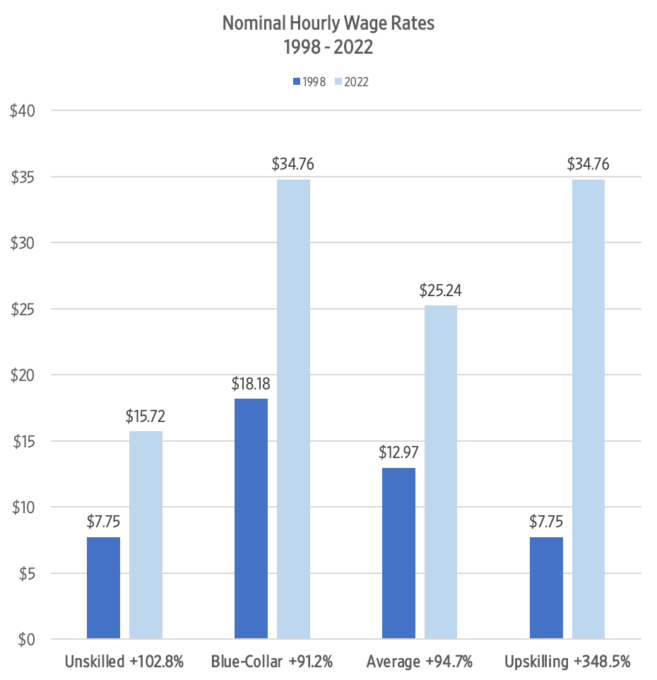
Graph showing nominal hourly wage rates for different groups of workers, with all groups showing increases from 1998 to 2022.

From 1998 to 2022, nominal unskilled hourly wages increased by 102.8 percent, while blue-collar hourly compensation increased by 91.2 percent. The average between these two categories is 94.7 percent. If you started out in 1998 as an unskilled worker and moved up to a blue-collar worker, your nominal hourly compensation increased by 348.5 percent.

Comparing an upskilling worker’s hourly compensation to the prices of cosmetic procedures indicates that the average time price fell by 78.4 percent. These workers could get 4.63 procedures in 2022 for the time price of one in 1998. Personal cosmetic surgery abundance increased by 363.5 percent for upskilling workers, growing at a 6.6 percent compound annual rate, doubling every 11 years or so.
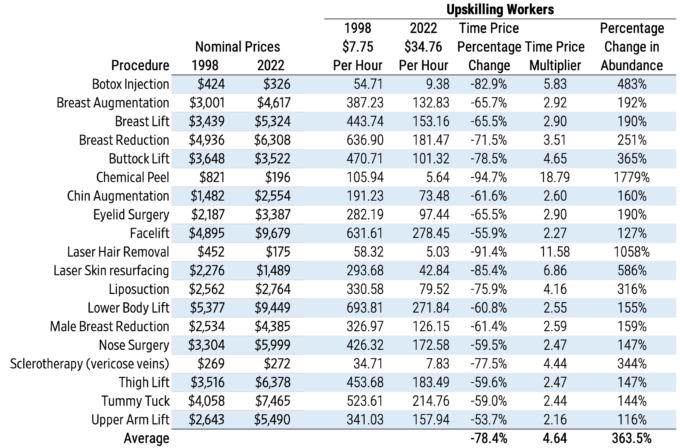

The figure shows the nominal and time price for various cosmetic procedures from 1998 to 2022.

This article was published at Gale Winds on 2/21/2024.

Blog Post | Cost of Living

Introducing the American Abundance Index

American living standards are best measured in time.

We are excited to share a new tool we’ve been building at Human Progress: The American Abundance Index—an interactive dashboard that tracks US living standards while adjusting for both inflation and rising incomes.

The idea is straightforward: how many hours do you need to work to afford the same basket of goods and services? Using Bureau of Labor Statistics data, the American Abundance Index converts price and wage growth into “time prices”—the amount of work time required to buy the Consumer Price Index (CPI) basket of goods and services—and “abundance,” which is the inverse: how much of that basket one hour of work can buy. When time prices fall, abundance rises, and each hour of work goes further. That’s the measure of affordability that actually matters.

Conceptually, this work builds off of Superabundance, a book by our editor, Marian Tupy, and his coauthor and Human Progress board member, Gale Pooley. Their core argument—that abundance is best measured in time—forms the foundation of the project. The index itself was built by our Quantitative Research Associate, Jackson Vann.

Users can select multiple worker categories, compare short- and long-run trends, and even see wage growth modeled to reflect real career progression rather than freezing workers in place. All the calculations are transparent and replicable, with the full dataset and code available on GitHub.


So what does the index actually say about American standards of living?

Over the past 12 months, inflation rose 2.68 percent while hourly earnings for the average private-sector worker grew 3.76 percent. As a result, the CPI basket became 1.05 percent more abundant. Since 2006, it has become nearly 14 percent more abundant—roughly equivalent to adding an hour of purchasing power to the average workday.

Blog Post | Cost of Living

Rethinking the Cost of Living with Mark Perry’s “Chart of the Century”

Always compare prices to hourly wages to understand the true change in living standards.

Summary: Comparing nominal price changes to changes in average hourly wages from 2000 to 2025, we can see that many goods with rising dollar prices have become more affordable in time prices.


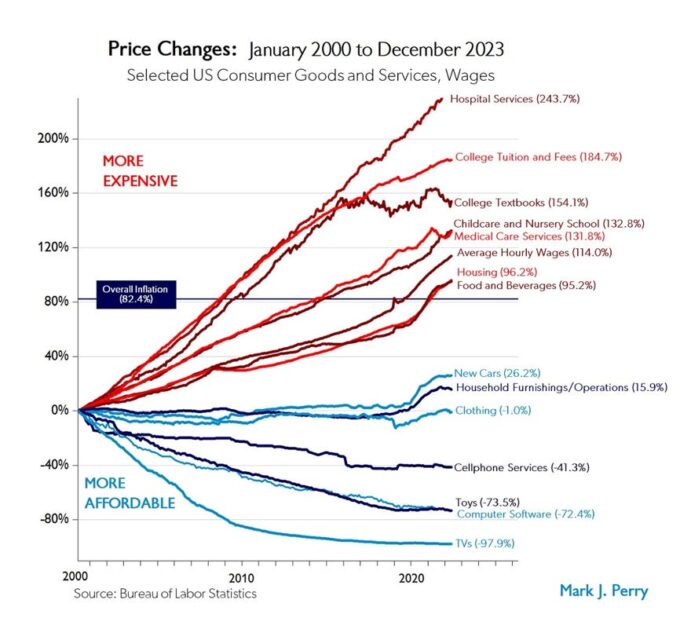
Professor Mark Perry from the American Enterprise Institute recently posted an updated version of his “Chart of the Century,” featuring price and wage data from the Bureau of Labor Statistics (BLS). The chart tracks 14 items over the 25-year period from January 2000 to December 2025. It also includes the overall inflation rate and changes in average hourly wages.

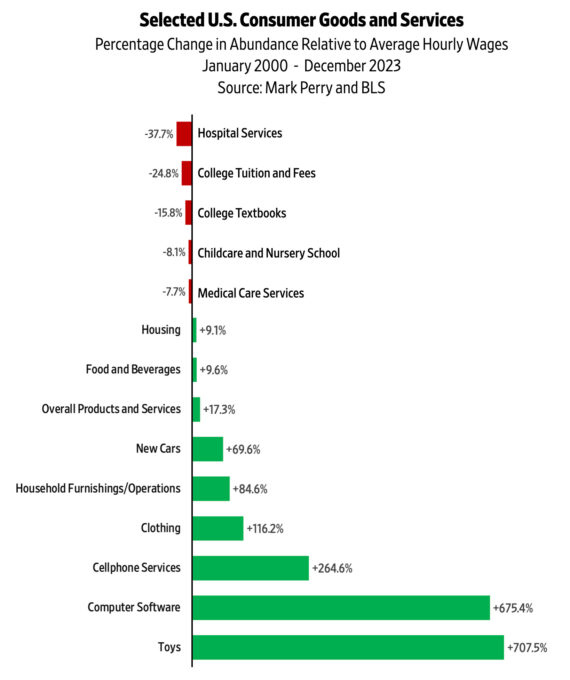
To examine the data from a different perspective, we calculated the change in the time prices of these 14 items relative to the change in the average hourly wage rate. We then calculated the abundance multiplier—a value indicating how many units you could buy today for the time it took to earn money to buy one unit in 2000. If there were no change, the abundance multiplier would equal one. A value below one indicates decreasing abundance, while a value above one reflects increasing abundance. We also calculated the percentage change in abundance for each item.

This analysis illustrates that things can become more expensive in dollar terms while simultaneously becoming more affordable in time prices. For instance, while the general Consumer Price Index (CPI) rose by 92.6 percent, average hourly wages increased by 131.1 percent. As such, time prices fell by 16.7 percent. For the time it took to earn enough money to purchase one CPI basket in January 2000, a consumer could purchase 1.2 baskets in December 2025—an abundance increase of 20 percent.

Notably, categories such as housing, food and beverages, new cars, household furnishings, and clothing all increased in money prices; however, after adjusting for rising wages, they all became more affordable in time-price terms. Although 10 of the 14 items rose in nominal prices over the 25-year period, only five had higher time prices when accounting for the 131.1 percent increase in hourly wages.

Find more of Gale’s work at his Substack, Gale Winds.

Blog Post | Science & Technology

How Robot Housekeepers Could Spark a New Baby Boom

The potential of technology to free humanity from the burden of household labor deserves more attention.

Summary: Early household robots like NEO may look unimpressive today, but they have great long-term potential. As birth rates fall and the burdens of parenting loom large, technologies that reduce everyday household labor could make family life far more manageable. Just as past innovations transformed domestic work and reshaped society, robotic housekeepers may one day help free time and ease parenthood.


The debut of the robot butler NEO has drawn widespread ridicule. Unable to perform many chores without a remote human operator, the machine has become a target of social media backlash. Videos circulating online show the robot struggling with basic tasks, such as closing a dishwasher.

But don’t underestimate the potential of robotic housekeepers just yet.

The technology is dawning at an opportune time. Consider the growing concerns about plummeting birth rates. Last year saw the lowest fertility rate ever recorded in the United States, below 1.6 children per woman.

Could robots help to reverse the trend by relieving the burden of household drudgery associated with child-rearing?

The question has broad implications because the United States’ low fertility is no anomaly. Global fertility decline is speeding up, doubling between the 2000s and 2010s and again this decade. This means the world’s population will almost certainly peak earlier than experts projected, and at a much lower level. Many countries are contemplating expensive taxpayer-funded efforts to spark a new baby boom, despite the poor track record of such policies.

There is much disagreement on what caused the 1950s baby boom, but one theory is that the rise of time-saving technologies played a key role. Between the 1920s and 1950s, domestic responsibilities were transformed as the number of households equipped with electric appliances, including refrigerators, stoves, vacuums and washing machines, rose dramatically. The new machines lessened the burden of household labor, freeing up time and making parenthood easier.

In the present era, technology is once again freeing up more time for many people, and not just by reducing commute times through remote or hybrid work. While reading about the latest breakthroughs, one might get the impression that machines are only learning to perform enjoyable and creative tasks, such as writing or drawing, rather than tending to the menial household chores that many would prefer to automate. One internet user expressed the sentiment this way: “I don’t want AI to do my art so I can do my laundry and dishes. I want AI to do my laundry and dishes so I can do my art.” Many would gladly welcome Rosey the robot maid into their homes.

The potential of technology to free humanity from the burden of household labor deserves more attention. Perhaps no group would benefit more than parents. The more children one has, the more laundry piles up and dishes fill the sink.

Various companies are racing to offer the public affordable robots to do housework. Robotic housekeepers might be here sooner than you think — even if NEO is seemingly not yet able to live up to its creator’s vision of a robot butler able to effortlessly empty the dishwasher, water house plants and do other chores. Tesla’s Optimus robot can fold laundry and take out the garbage, among other tasks. There are even robots that can wash dishes as fast as a human can.

If such technologies become widely available, everyday life will be far easier, and so will parenthood.

There are already robotic lawn mowers. In fact, a 2025 survey found that 13% of U.S. homes own a robotic lawn mower. And robot vacuums have become so common as to be unremarkable. In the United States, 15% of households now own a robotic vacuum, according to a YouGov poll. In the United Kingdom, one in 10 households owns one, while one in seven households reportedly plans to buy one within the next 12 months.

I remember when my family purchased a robot vacuum. We watched, mesmerized, as it zigzagged across the nursery carpet. Our toddler oohed and followed it around. Our awe reminded me of a touching account of a grandmother who had painstakingly scrubbed clothes by hand her whole life and then watched with wonder as her new laundry machine completed the task for her. One of the reasons I have more children than most is that I’m a techno-optimist, and I believe that my children will inherit a world with less toil and more joy. (My husband and I are expecting our fourth child.)

Of course, outsourcing all household chores to robots wouldn’t guarantee higher fertility. One lesson from the history of demographic forecasting is the need for humility.

After all, birth rates have dropped faster than demographers anticipated. But one thing is clear: Technological advancements have the potential to raise the standard of living, free up time and allow people to pursue their dreams. For many, this means having children.

This article was originally published at Deseret News on 11/29/2025.

Blog Post | Economic Freedom

What Richard Nixon’s Real Scandal Should Have Been

A decade of price-control misery

Summary: When President Nixon imposed wage and price controls in 1971, it created chaos. Gas shortages, rationing, and angry customers became daily realities, teaching one young gas station attendant how disastrous top-down economic planning can be. A decade later, when markets were finally freed, supply returned and abundance followed. The lesson endures: politicians create scarcity, but entrepreneurs and free markets create plenty.


Shortly after I turned 15, President Richard M. Nixon managed to make my life miserable. On Sunday August 15, 1971, against the advice of his economic counselors, and in total repudiation of his party’s campaign platform, he announced on national TV that he was suspending the gold standard, imposing a 10 percent tariff surcharge, and imposing wage and price controls.

At the time, I didn’t know a thing about macroeconomics. What I did know was how to make customers happy at my dad’s gas station: Fill their tanks fast, wash their windows, and send them off with a smile.

Nixon’s decision not only shook the foundations of global finance—it trickled all the way down to a teenager pumping gas on Main Street, teaching me firsthand how government policy can reach into everyday life. Nixon’s policies caused a decade of artificial shortages and almost destroyed my father’s business. As Robert Bleiberg, editor of Barron’s, noted at the time, “Price controls, as their advocates have claimed all along, do work like magic. They can make things disappear in the twinkling of an eye.” For me, Nixon’s policies meant no more happy customers, which translated to no more tips.

Like many gas station owners at the time, my dad decided to attempt rationing his limited allotment of fuel by restricting sales to only five gallons per customer. After waiting in line for sometimes more than an hour, most customers were furious to be told that they could only buy five gallons of gas. They took their anger out on their lowly attendant, not on the perpetrator of the calamity living in the White House.

The president, along with the politicians and corporate leaders who cheered for price controls, never had to face the fury of my customers. They could make sweeping decisions from behind their podiums and boardroom tables without ever paying the price for being wrong. As Thomas Sowell once put it, “It is hard to imagine a more stupid or more dangerous way of making decisions than by putting those decisions in the hands of people who pay no price for being wrong.”

Price controls tied the hands of domestic producers while leaving foreign suppliers, such as OPEC, untouched. The result was the opposite of what policymakers had intended. Instead of fueling independence, the policies throttled domestic supply and handed foreign oil giants the keys to America’s energy future.

In 1981, just eight days after taking office, President Ronald Reagan swept away the federal price and allocation controls on domestic oil and refined products. Overnight, my decade of gas-line misery came to an end. Prices did rise—but for the first time in years, people could fill their tanks without rationing, limits, or fear of empty pumps. I learned a key lesson: Politicians create scarcities, entrepreneurs create abundances.

When oil prices surged in the early 2000s, entrepreneurs and markets responded with a wave of innovation. Breakthroughs such as horizontal drilling and hydraulic fracturing unlocked vast new oil reserves, unleashing a surge of supply. America’s unique system of private ownership of subsurface mineral rights—rather than government control—supercharged this revolution by giving landowners a direct stake in production. The results were astonishing: The United States, whose oil industry was once thought to be in irreversible decline, has become a net exporter of petroleum products.

Since 1950 the average time price for a gallon of gasoline has been around six minutes for blue-collar workers. We’re actually around five minutes today. The United States has some of the lowest gasoline time prices on the planet.

Yes, we’ve had periods where the price has spiked, typically due to political turmoil, but time and again, innovation and markets have responded by creating greater abundance. Julian Simon predicted such would be the case, as long as politicians and bureaucrats don’t impose “solutions” that have counter-productive consequences.

Nixon resigned on August 8, 1974, to avoid impeachment for his crime of covering up the Watergate break-in. But to me, his darker crime wasn’t in a hotel—it was in every gas station in America. His Soviet-style controls left behind a nation of frustrated, unhappy customers and pump attendants who bore the real cost of his misguided policies.

Find more of Gale’s work at his Substack, Gale Winds.