fbpx
01 / 05
Update on the Five Metals from the Simon–Ehrlich Bet

Blog Post | Natural Resource Prices

Update on the Five Metals from the Simon–Ehrlich Bet

Since 1900, the average abundance of these five metals has increased 36.5 percent faster than the population.

Summary: The Simon–Ehrlich wager famously demonstrated that population growth does not lead to resource scarcity but instead drives innovation and abundance. Since 1900, the production of five metals featured in the bet has risen dramatically. This bolsters Julian Simon’s argument that human ingenuity and technological progress enable us to produce more resources at lower costs, ensuring greater abundance even as populations grow.


Hannah Richie at OurWorldinData.org recently published an insightful article on the five metals featured in the Simon–Ehrlich wager. In 1990, Paul Ehrlich lost the 10-year bet and had to write a check to Julian Simon for $576.07. Simon had let Ehrlich pick the five metals in 1980 when the bet started. The payment reflected the inflation-adjusted decline of 36 percent in the average price of the five metals over the decade. This was despite an extraordinary global population increase during the 1980s of 850 million people (19 percent)—the largest growth in human history. Yet, even with this surge, resource prices dropped, reinforcing Simon’s argument that human population growth, coupled with ingenuity and the freedom to innovate, drives resource abundance rather than scarcity.

Libertarian economist Julian Simon made a famous wager with the renowned doomsayer Paul Ehrlich in 1980. Simon challenged Ehrlich to choose five metals that he believed would increase in price over the next decade. After the bet concluded, Ehrlich, humbled by the outcome, handed Simon a check, having lost the wager.

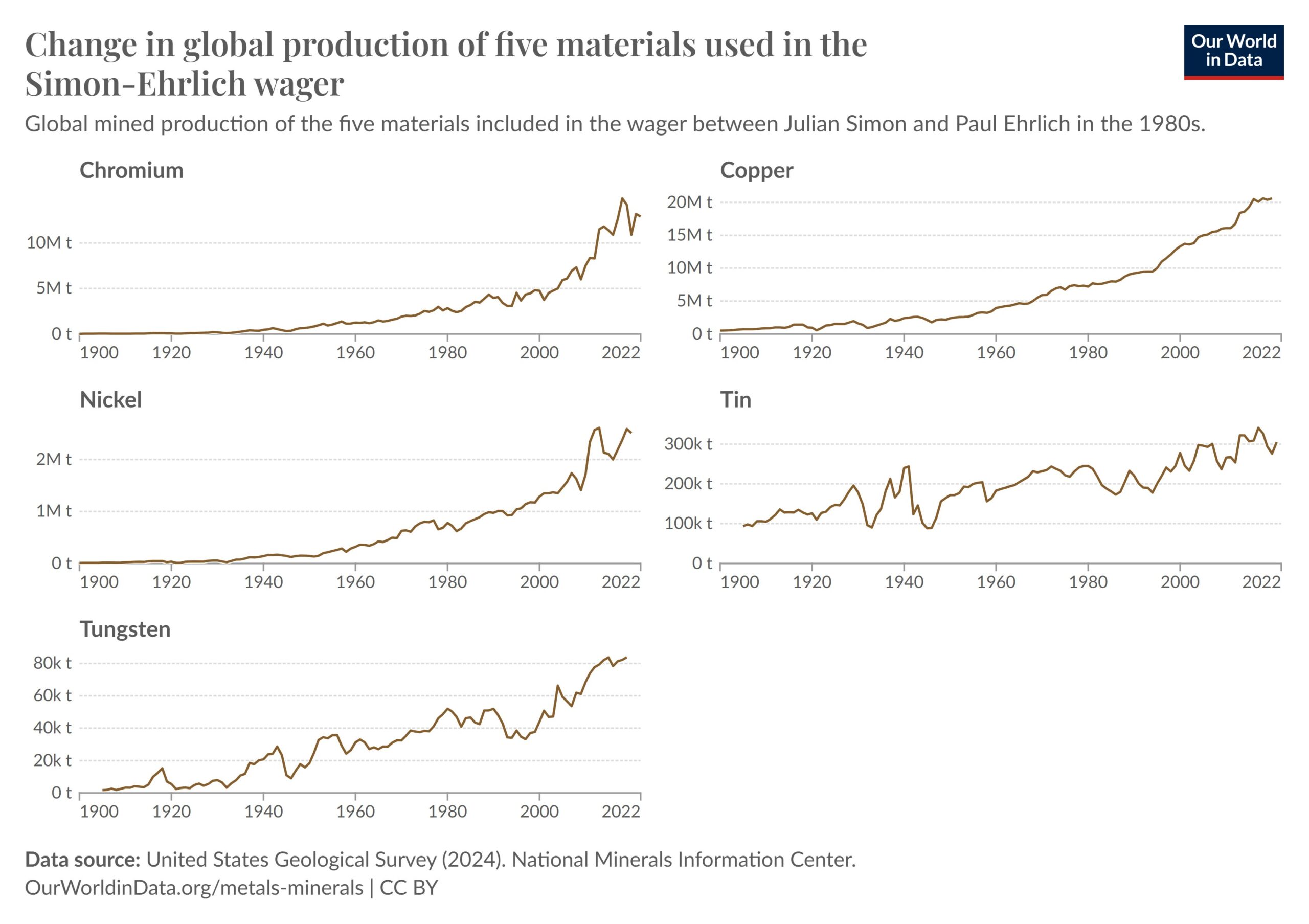
Richie highlights an important trend: The long-term abundance of these metals has increased significantly. Take a look at the staggering growth in their production since the early 1900s:

The five metals in the Simon-Ehrlich wager have actually become more abundant over time. The production of each of these metals has grown dramatically, defying Ehrlich's predictions of scarcity and rising prices.

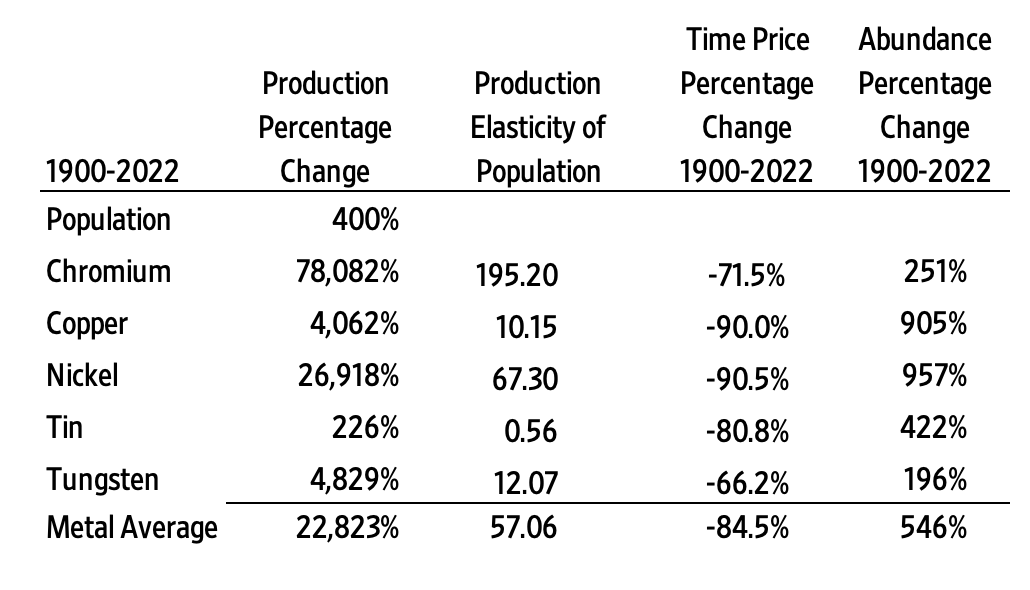
Between 1900 and 2000, the global population grew by 400 percent, from 1.6 billion to 8 billion. During the same period, the production of the five metals soared: Chromium increased by an astounding 78,082 percent, copper by 4,062 percent, nickel by 26,918 percent, tin by 226 percent, and tungsten by 4,829 percent. On average, production of these metals rose by 22,823 percent.

The relationship between population growth and resource production is captured by the production elasticity of the population. It is the ratio of the percentage change in production divided by the percentage change in population. On average, every 1 percent increase in population corresponded to a 57.06 percent increase in the production of these five metals.

In our book Superabundance, we compared the time prices of these five metals for blue-collar workers from 1900 to 2018 and have since updated the data to 2022.

The prices of the five metals have also decreased over time, meaning fewer labor hours are required for a worker to afford them. This reflects both rising wages and falling commodity prices, which are indicators of growing progress and abundance.

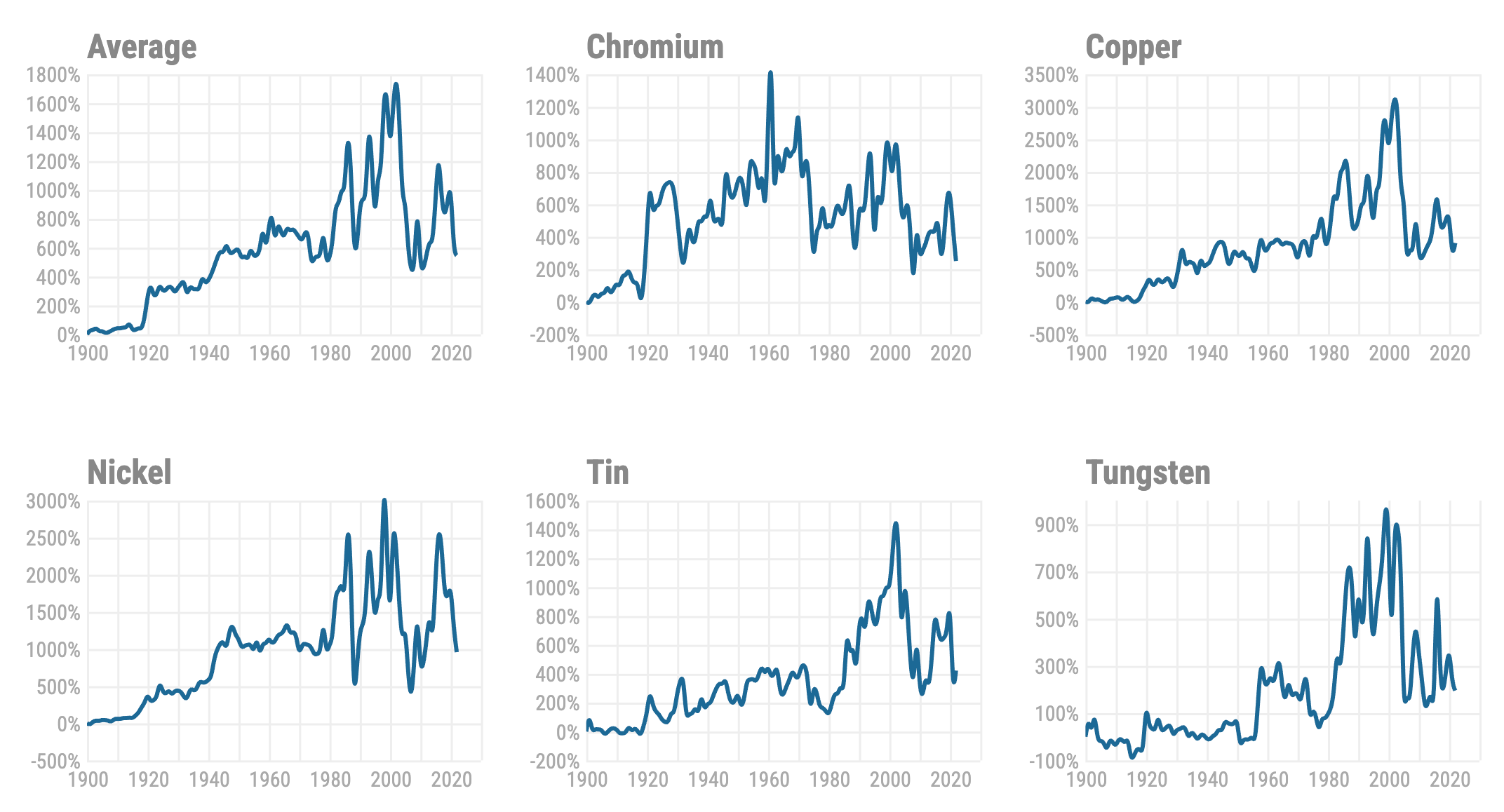
The charts below detail the growth in abundance for each resource since 1900. Please note that vertical scales differ across the charts. The charts generally show the effects of 9/11, the financial crisis of 2008, and COVID-19 lockdown policies.

Since 1900, the metals have become much more abundant, even as the global population has grown. This demonstrates that humanity is not a burden on the earth's material resources; rather, through innovation and production, people have been able to expand resource availability.

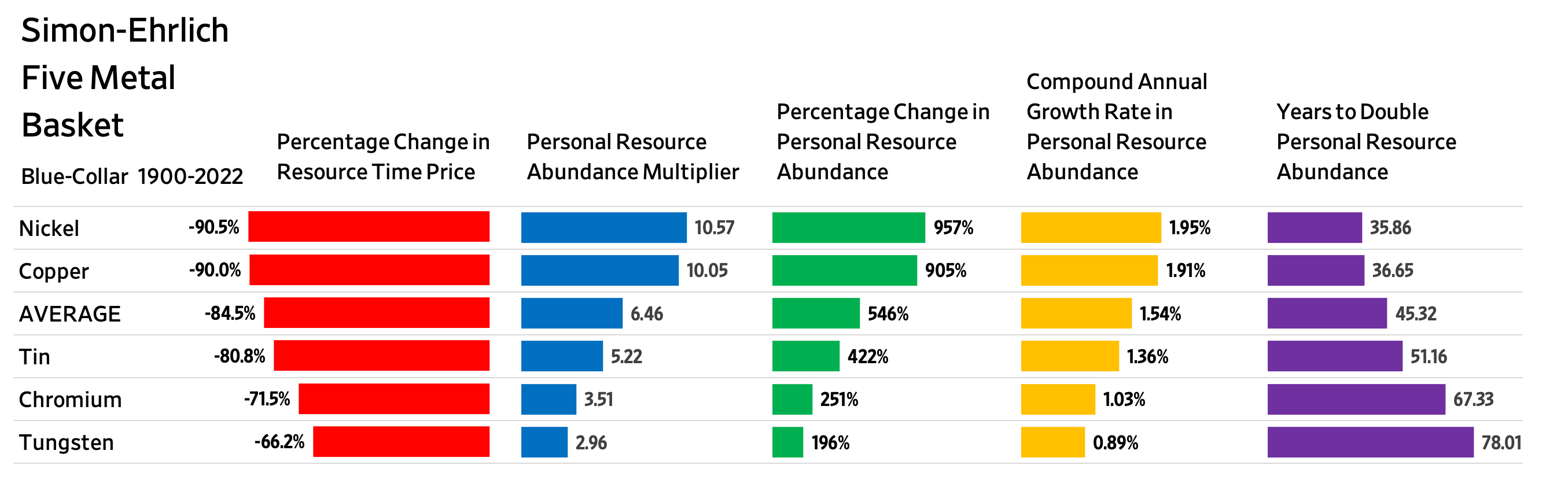
This table summarizes our findings.

Between 1900 and 2022, the production, time price, and abundance of each of the metals have all increased. The chart also highlights the production elasticity of population, showing how the growth in population has been accompanied by a corresponding increase in metal production.

From 1900 to 2022, the global population increased by 400 percent. Over the same period, the abundance of these five metals increased by an average of 546 percent, demonstrating that abundance has grown 36.5 percent faster than the population.

Some have suggested that Simon was just lucky. This is why looking at a much longer time period reveals underlying trends behind temporary fluctuations.

These data reinforce Simon’s prediction: The more people, the more we produce, and the lower the prices.

Tip of the hat: Max More

This article was published at Gale Winds on 1/14/2025.

Ministry of Power, Government of India | Energy Production

India Achieved Historic Milestone in Renewable Power Sector

“India’s power sector has achieved two historic milestones that show the nation’s steady progress toward a clean, secure, and self-reliant energy future.

As of 30 September 2025, the country’s total installed electricity capacity has crossed 500 GW, reaching 500.89 GW. This achievement reflects years of strong policy support, investments, and teamwork across the energy sector.”

From Ministry of Power, Government of India.

South China Morning Post | Energy Production

China Reaches Energy Milestone by “Breeding” Uranium from Thorium

“An experimental reactor developed in the Gobi Desert by the Chinese Academy of Sciences’ Shanghai Institute of Applied Physics has achieved thorium-to-uranium fuel conversion, paving the way for an almost endless supply of nuclear energy.

The achievement makes the 2 megawatt liquid-fuelled thorium-based molten salt reactor (TMSR) the only operating example of the technology in the world to have successfully loaded and used thorium fuel.

According to the academy, the experiment has provided initial proof of the technical feasibility of using thorium resources in molten salt reactor systems and represents a major leap forward for the technology.

It is the first time in the world that scientists have been able to acquire experimental data on thorium operations from inside a molten salt reactor, according to a report by Science and Technology Daily.”

From South China Morning Post.

Blog Post | Pollution

From Waste to Wealth: the Alchemy of Innovation

Environmental challenges can be transformed into economic opportunities.

Summary: Scientists and engineers are finding ways to turn pollution and waste into valuable resources. From recovering fertilizer from toxic lakes to creating biodegradable packaging from farm residues, innovation is transforming environmental problems into opportunities for growth. By reimagining waste as a resource, we can make the planet cleaner while fueling new industries and jobs.


Every summer, toxic algae blooms turn Lake Erie and other US lakes into a green soup, threatening drinking water for millions. Every year, American farmers burn millions of pounds of grain stalks after harvest. And every day, Americans throw away enough packing peanuts to fill an Olympic swimming pool. What if I told you that each of these waste streams could become valuable resources—and that the solutions are emerging from university laboratories right now?

We stand at a unique moment in history. For the first time, we possess the scientific tools to transform our most pressing environmental challenges into economic opportunities. The numbers tell a compelling story. According to the World Bank’s “What a Waste 2.0” report, global waste is projected to rise by 70 percent, from 2.01 billion tons today to 3.4 billion tons in 2050. Yet, the circular economy, or using waste productively to create wealth, could unlock $4.5 trillion in economic benefits by 2030. The question isn’t whether we can afford to innovate—it’s whether we can afford not to.

Three Breakthrough Innovations from North Dakota

The convergence of nanotechnology, materials science, and biotechnology has created unprecedented possibilities for environmental remediation. In a laboratory at North Dakota State University, my research team is developing three innovations that exemplify this waste-to-wealth transformation:

  1. Calcium peroxide nanoparticles that absorb phosphates from polluted lakes and convert them into sustainable fertilizer
  2. Flax-fiber composites that transform agricultural waste into biodegradable packaging materials
  3. Starch-based foam alternatives that replace petroleum-based packing peanuts with compostable materials

These aren’t pie-in-the-sky concepts. They’re practical solutions that could scale from our Fargo lab benches to global implementation within a decade. Here’s how each one works—and why they matter.

Turning Lake Poison into Farm Food

Over 500 “dead zones” now plague our planet’s bodies of water, with the number doubling every decade since the 1960s. These oxygen-depleted areas, caused primarily by phosphate runoff from agriculture, cost the United States $2.4 billion annually in economic losses. The 2014 Toledo water crisis, which left half a million people without access to drinking water for three days, was just a preview of what may come unless we act.

Here’s where nanotechnology can change the game. At our NDSU lab, we’re developing calcium peroxide nanoparticles—imagine particles 5,000-times smaller than the width of a human hair—that act as molecular sponges for phosphate pollution. When deployed in eutrophic (nutrient-rich) lakes, these nanoparticles serve a dual purpose that borders on alchemy: First, they absorb phosphates from the water with an efficiency 500-times greater than conventional materials; second, they slowly release oxygen over 30 days, breathing life back into suffocating bodies of water.

But here’s the truly exquisite part: Those absorbed phosphates don’t disappear. Our research team harvests them to create sustainable fertilizer. Consider the irony—the very phosphates that are killing our lakes came from fertilizer runoff, and now we’re capturing them to make new fertilizer. It’s the circular economy in its purest form.

The timing couldn’t be more perfect. The global phosphate fertilizer market, currently valued at $72 billion, is facing a sustainability crisis. Morocco controls 70 percent of the world’s phosphate rock reserves, and at current extraction rates, most of these reserves will be depleted within a century. By recovering phosphates from water pollution, we’re not just cleaning lakes, we’re securing agriculture’s future. Our preliminary calculations suggest that phosphate recovery from US agricultural runoff alone could replace 15 percent of imported phosphate fertilizer, saving farmers billions while restoring water quality.

From Farm Waste to Amazon Packages

The second innovation transforms an agricultural nuisance into packaging gold. North Dakota grows 90,000 acres of flax annually, primarily for the valuable oil in its seeds. But after harvest, millions of pounds of stalks are typically burned or buried, a waste of remarkably strong natural fibers that have been used for over 30,000 years for textiles, food, paper, and medicine.

At our NDSU lab, we’re extracting these fibers and mixing them with biodegradable polymer matrices to create packaging materials that rival petroleum-based plastics in performance while completely biodegrading in three to six months. The resulting composite materials achieve tensile strengths of 50–70 megapascals—stronger than many conventional plastics—using 35 percent less energy to produce.

The market is hungry for such solutions. The biodegradable packaging sector is experiencing rapid growth, projected to reach $922 billion by 2034. More important, consumers are voting with their wallets: 82 percent say they’ll pay premiums for sustainable packaging, and 39 percent have already switched brands for better environmental practices. Major corporations aren’t waiting. Dell already uses mushroom-based packaging grown on agricultural waste, while IKEA has committed millions of dollars to eliminate polystyrene entirely.

North Dakota sits on a gold mine of opportunity. The state’s two million acres of various crops produce enormous volumes of agricultural residue. By viewing these stalks, husks, and shells not as waste but as industrial feedstock, North Dakota could become a hub for sustainable packaging materials. A single processing facility could create 200 rural jobs while generating $50 million in annual revenue from materials currently worth nothing.

Replacing Satan’s Snowflakes

The third innovation addresses what some environmentalists refer to as “Satan’s snowflakes”—namely, those infuriating polystyrene packing peanuts that seem to multiply in your garage and never decompose. Americans generate enough polystyrene waste to circle the Earth in a chain of coffee cups every four months. This material persists for 500 to one million years, breaking into microplastics that contaminate our food chain.

In our NDSU lab, we’re developing starch-based foam alternatives using corn, wheat, and potatoes, all crops that North Dakota grows in abundance. These “bio-peanuts” dissolve completely in water, compost within 90 days, and require just 12 percent of the energy needed to produce traditional polystyrene. They even eliminate the static cling that makes unpacking electronics feel like wrestling an electric eel.

The economics are compelling. Companies such as electronics retailer Crutchfield report saving $70,000 to $120,000 annually in freight costs after switching to lighter, bio-based packing materials. With 11 states and 250 cities already banning polystyrene foam, and the European Union implementing strict regulations on single-use plastics, the market for alternatives isn’t only growing, it’s becoming mandatory.

Perhaps the most profound impact is psychological. Every online purchase delivered with biodegradable packing materials sends a message: Modern conveniences can be maintained without mortgaging the environment. While a small victory, such progress is building momentum for larger, more significant changes.

The Scaling Potential: From Lab to Global Impact

The opportunity is enormous: If just 10 percent of US agricultural waste were converted to packaging materials, it would replace 33 million tons of petroleum-based plastics annually. If our phosphate recovery technology were deployed in the 100 most-polluted lakes globally, it could recover enough phosphorus to fertilize five million acres of farmland while restoring recreational value worth $10 billion.

These aren’t distant possibilities—our NDSU innovations are progressing through the typical stages: proof of concept, pilot testing, demonstrations, and commercialization. We’re currently in pilot testing, with plans for field demonstrations next year. Industry partners have expressed strong interest, particularly from agricultural cooperatives seeking value-added opportunities for crop residues.

Innovation Beats Despair: Lessons from Environmental History

Some critics might ask, “Aren’t these solutions just Band-Aids on the gaping wound of industrial civilization?” Such a question, however, misses the profound lesson of environmental history. Every major pollution crisis we’ve faced, from London’s killer smog to acid rain and the ozone hole, seemed insurmountable until human ingenuity proved otherwise.

Consider the track record. Since 1970, the United States has reduced major air pollutants by 78 percent while increasing gross domestic product by 321 percent. The Montreal Protocol has eliminated 99 percent of ozone-depleting substances, saving approximately two million people from skin cancer each year. Acid rain, once predicted to cost $6 billion annually to address, was solved for less than $2 billion per year. These victories weren’t achieved by abandoning modern life but by making modernity cleaner and more efficient.

The same patterns are emerging in clean technology. Solar panel costs have plummeted 90 percent in the past decade. Renewable energy is often among the lowest-cost power sources, especially when comparing marginal generation costs. When accounting for storage or backup needs, however, total system costs can vary by region and grid mix. Battery prices have decreased by 97 percent over the past 30 years. Each follows Wright’s Law—costs decline predictably as production scales. Our NDSU waste-to-resource innovations will follow similar trajectories.

The investment community recognizes this potential. Clean technology attracted $1.8 trillion in investments globally in 2023, surpassing fossil fuel investments for the first time. The bioeconomy, currently valued at $4 trillion, is projected to reach $30 trillion by 2050. These aren’t charitable donations, but rather hard-nosed bets on profitable technologies that happen to benefit the planet.

From Lab Bench to Marketplace

Numerous university spin-offs have traveled the well-worn path from laboratory to marketplace. Companies such as Membrion (ceramic membranes developed at the University of Washington) and Integricote (nanocoatings developed at the University of Houston) demonstrate that academic innovations can achieve commercial success while addressing environmental challenges.

The Optimistic Imperative

The waste crises facing our generation are real and urgent—but so is our capacity to transform them into opportunities for prosperity. The toxic algae choking our lakes could become tomorrow’s sustainable fertilizer. The agricultural waste burning in our fields could become the packaging protecting tomorrow’s e-commerce deliveries. The petroleum-based foams polluting our oceans could be replaced by materials that harmlessly dissolve back into the earth.

This transformation, however, won’t happen automatically. It requires continued investment in research, supportive policies that incentivize innovation over incineration, and entrepreneurs willing to scale laboratory successes into industrial realities. The trajectory is clear: Waste is becoming wealth, pollution is becoming profit, and environmental restoration is becoming economic opportunity.

From my lab bench in Fargo, I see a future in which every environmental challenge sparks a thousand innovative solutions, every waste stream becomes a value stream, and the same human ingenuity that created these problems engineers their solutions. That’s human progress at its finest.

Blog Post | Energy Consumption

Light Has Burst Forth in Astonishing Abundance

Light abundance has increased by 100,435,912 percent since 1830.

Summary: In just two centuries, humanity has turned light from a rare luxury into one of the most abundant resources on Earth. What once demanded hours of labor now costs a fraction of a second’s work, thanks to relentless innovation and human creativity. From candles to LEDs, the story of light reflects a larger truth: when people are free to invent and exchange ideas, they transform scarcity into abundance and darkness into illumination.


Our book Superabundance (2022) was inspired in part by the work of Nobel Prize–winning economist William Nordhaus, who conducted an extensive analysis on the “time price” of light over the span of human history. He called time prices the true prices. Light can be measured in lumens. Comfortable reading light is around 1,000 lumens. Nordhaus reported that in 1830, earning sufficient money to buy the candles necessary for one hour of light at 1,000 lumens required around three hours of labor. A candle generates around 12 lumens; therefore, one would need 83 candles to generate 1,000 lumens.

Innovation replaced candles with kerosene lamps and then with incandescent lighting and then LED lighting. Today, for 75 cents, one can buy a Cree J Series 5050C E Class LED that generates 228 lumens per watt. By increasing the wattage to 4.4 watts one can, therefore, generate 1,000 lumens of light. Electricity prices are currently around 17 cents per 1,000 watt hours, commonly known as kilowatt hours or kWh. One watt hour costs 0.017 cents; thus, the 4.4 watts to power the Cree LED for one hour would cost a mere 0.0745 cents. The average worker earns $36.53 an hour, or slightly more than a penny per second. Working for around 0.0735 seconds, therefore, the average worker earns enough money to buy 1,000 lumens for one hour.

The light that cost 10,800 seconds in 1830 costs only 0.0735 seconds today. The time price has dropped by 99.99932 percent. For the time it took to earn the money to buy 1,000 lumens for one hour in 1830, workers today earn 146,980 hours of light today. That’s a 14,697,900 percent increase. Light abundance has been increasing around 6.3 percent annually on a compound basis, doubling every 12 years.

Calculating Changes in Global Light Resources

Over the last 195 years (1830-2025), the world’s population rose from 1.2 billion to 8.2 billion—a factor of 6.83, or a 583 percent increase. To measure how humanity’s resource base has changed, we calculate the size of the global resource “pie” by multiplying personal resource abundance by population. That reveals how much “total abundance” exists across humanity at a given moment.

As we already saw, during the 195-year period, personal light abundance rose by a factor of 146,980. Assuming for argument’s sake that everyone in the world enjoys American prices of LEDs and energy, combined with the 6.83-fold increase in population, the global light abundance factor would amount to 1,004,360. In other words, the global light pie has grown by 100,435,912 percent—from an index value of 1 in 1830 to 1,004,360 today.

Light abundance would have grown at a compound annual rate of roughly 7.3 percent for almost two centuries, doubling about every 9.8 years. What was once scarce, flickering, and expensive has become nearly boundless—flowing at the speed of electrons and photons across the planet.

Resource Elasticity of Population

In economics, elasticity compares the percentage change in one variable against the percentage change in another. Between 1830 and 2025, global light resource abundance increased by 100,435,912 percent. During same period, the world’s population increased by 583 percent. Dividing 100,435,912 percent by 583 percent gives us 172,176. Every 1 percent increase in population thus corresponds to a 172,176 percent increase in global light abundance.

Let There Be More Light

We have witnessed an exponential efflorescence of light—an illumination not merely of our cities but of the human spirit itself. More people with light has meant more minds, more ideas, and more ventures into the unknown. When free to imagine and innovate, humans transform scarcity into abundance—and ignorance into insight. Over the past two centuries, we have converted the darkness of want into the radiance of wealth, beginning with light itself. From the barbarous glow of whale oil to the humble candle, and from the flicker of gas and kerosene to the steady blaze of electricity and the brilliance of silicon, each technological leap has kindled new horizons of discovery. Every advance has multiplied the possibilities for the next. The ultimate source of growth is not material—it’s the human mind set free.

The next time you turn on a light switch, please take a moment to appreciate the great work of free and creative people toiling to bring us out of the darkness. Compared to the abundant light of today’s world, our ancestors really did live in the “dark ages.”

Find more of Gale’s work at his Substack, Gale Winds.