Summary: The bicycle, once a costly luxury, has become a symbol of how innovation transforms scarcity into abundance. What began as a marvel of mechanics in the 19th century is now affordable to nearly everyone, thanks to rising productivity and human ingenuity. Over time, free markets and technological progress have multiplied access to tools of freedom and mobility.
In 1885, John Kemp Starley invented the modern bicycle with two wheels of the same size and a rear wheel connected and driven by a chain. Interest in the new innovation exploded. By the 1890s, Europe and the United States were in the midst of a bike craze. A New York Times article from 1896 gushed that “the bicycle promises a splendid extension of personal power and freedom, scarcely inferior to what wings would give.” Long before their first flight in 1903, the Wright brothers were mastering gears, chains, and balance as talented bicycle mechanics and designers.
In 1910, you could buy a basic bicycle for $11.95 from the Sears, Roebuck, and Co. catalog. This sounds like a low price until you realize that entry-level, unskilled wages were $0.11 an hour. This means that it would have taken 108.6 hours to earn the money to buy one bicycle. Today, you can buy a basic bike at Walmart for $98, and entry-level limited food service workers wages are $18.75 per hour, indicating a time price of 5.2 hours. The time price has fallen 95.19 percent. For the time required to earn the money to buy one bicycle in 1910, you get 20.9 today. Personal bicycle abundance has increased 1,990 percent.
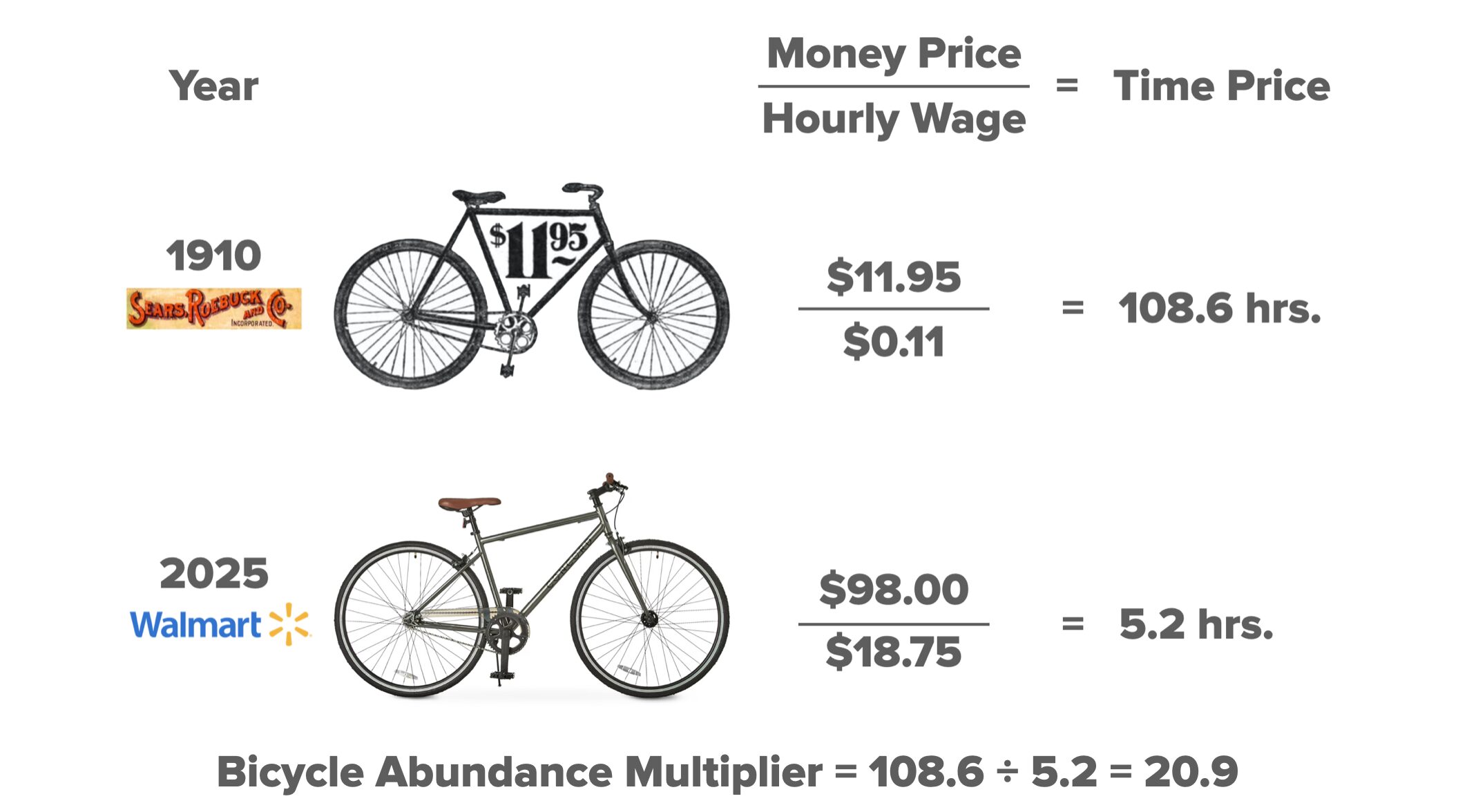

This astonishing increase in bicycle abundance occurred while the global population increased 369 percent, from 1.75 billion to 8.2 billion. Every 1 percent increase in population corresponded to a 5.4 percent increase in personal bicycle abundance. It’s as if all the new people brought their own bicycle as well as extra bicycles to share with everyone else.
When human beings are free to innovate, they turn scarcities into abundances.
Find more of Gale’s work at his Substack, Gale Winds.