Summary: Concerns that AI data centers are exhausting America’s land and water are largely overstated. Data centers occupy relatively little land compared with agriculture and other established uses, while their water consumption reflects temporary displacement rather than permanent loss. New cooling technologies and alternative water sources are also reducing local demand, suggesting that engineering—not scarcity—will shape AI’s environmental impact.
The American consumer advocate Erin Brockovich went on Real Time with Bill Maher Friday night to talk about what she has spent the year mapping: American towns that found out a data center was coming only after the bulldozers arrived. She has collected thousands of such reports from all fifty states. A big facility, she says, can consume millions of gallons of water a day. The audience was meant to conclude that artificial intelligence is swallowing the country’s water and land.
Start with the land, because that part is easy to settle. Cushman and Wakefield, the commercial real estate firm that tracks these deals, reports that the average parcel bought for a data center in 2024 ran to a couple hundred acres. Scale that up by the computing capacity the industry expects to have running by 2030, and by my reckoning every data center in America, plus all the ground around the buildings, comes to roughly the area of Rhode Island. The buildings themselves would fit inside a mid-sized city.
Now compare that with how we already use land. The federal government requires refiners to blend corn ethanol into gasoline and growing that corn takes an area about the size of New York State, for a fuel that a 2022 study in the Proceedings of the National Academy of Sciences found is probably dirtier than the gasoline it replaces. The Agriculture Department pays farmers to leave a Kentucky-sized area unplanted. Since 2000, American farmland has shrunk by an area larger than Colorado, and output went up anyway. None of this made the evening news.
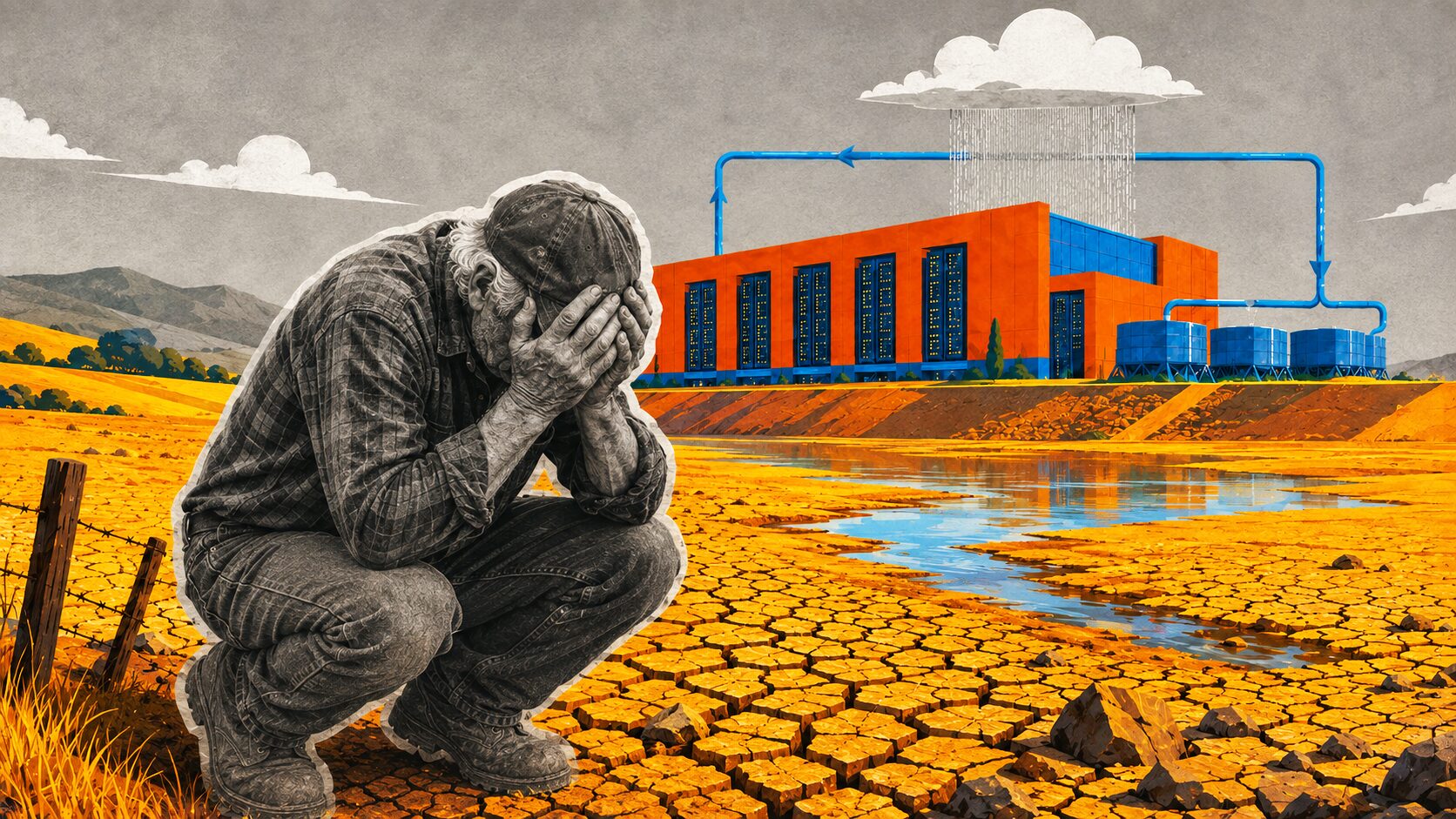
Water is the harder argument, and it is where the case goes wrong at the level of chemistry. A data center does not destroy water. Cooling moves heat but does not burn anything. Hydrogen and oxygen do not come apart in a cooling tower. The water molecules leave as vapor, and hydrologists have long put their average stay in the atmosphere at about nine days before they fall again as rain. The word often used, “consumption,” does not mean the water is gone. It means the water left the neighborhood. That is a genuine cost to a neighborhood. It is not a subtraction from the world’s supply, and no amount of AI will make it one.
The problem of local water displacement is one that engineers have been fixing for two years. The scary numbers come from old evaporative towers, but the newer Nvidia chips run at 113 degrees Fahrenheit. That is hotter than the air outside on most summer days. Heat moves from hot to cold on its own, so the liquid sheds its warmth into the open air through a radiator, like the one in a car. Those radiators need fans, and fans need power, so the better chips turn a water problem into an electricity problem. That is a good trade, because building power is something this country knows how to do.
Similarly, Microsoft has announced designs that circle the same fluid through a sealed loop past the chip and back. Google, Amazon, and Microsoft already run some sites on treated city wastewater rather than anything anyone would drink.
Brockovich anticipated this answer. In an essay published two days before the broadcast, she argued that a sealed loop does not remove the water use but only moves it to the power plant that supplies the electricity. She is right that this second, hidden figure is bigger than the water used at the site itself. But the two together still amount to less than one percent of all the water Americans consume. The figures behind it come from the Lawrence Berkeley National Laboratory, in a study Congress ordered and the Energy Department published. Its lead author, the staff scientist Arman Shehabi, supplies the numbers that both sides of this argument quote.
The comparison with national consumption is drawn by Robin Gaster of the Information Technology and Innovation Foundation, who reviewed the same evidence in July and drew two conclusions. The technology to bring on-site water use near zero already exists. And the upstream share depends on which power plants get built, which means it is not fixed either. A forecast of disaster must assume that nobody will ever build anything different.
For scale, the EPA’s WaterSense program reports that outdoor household water use runs to about nine billion gallons a day, most of it landscape irrigation: suburban sprinklers use more water in two days than all data centers in the country uses directly in a year.
The host pushed back against Brockovich’s more alarmist claims, but he soon went back to his old assumption that there are simply too many of us and that we are using too many resources. In an April 2019 monologue, Maher cheered the falling birth rate, called fewer humans the best gift we could give the planet, and named our numbers as the great unspoken cause of the climate crisis. Last Friday, he repeated those concerns. He was wrong to do so.
In 1980, the economist Julian Simon bet the biologist Paul Ehrlich, author of The Population Bomb, that a basket of metals would grow cheaper as the population grew. Ehrlich sent the check ten years later. The economist Gale Pooley and I are keeping the score. The Simon Abundance Index we published this April found that the Earth was 536 percent more resource-abundant in 2025 than in 1980, a period in which humanity added nearly four billion people. Every commodity we track is more plentiful per person than it was, because each additional person arrives with a mind as well as a mouth.
Maher has spent three decades treating every new demand on the earth as a bite out of a fixed inheritance. Data centers are only the latest one. The land is plentiful. The water is not leaving the planet, and the engineers cooling these AI machines are already several product cycles into solving the thing he is sure cannot be solved.