
Summary: A famous bet between Julian Simon and Paul Ehrlich illustrates two ways of thinking about resources and human ingenuity. Ehrlich thought of resources as a fixed pie, while Simon believed that human beings would find ways to make resources more abundant. As Simon predicted, thanks to markets and human ingenuity, the resource prices that Simon and Ehrlich bet on fell over a decade.
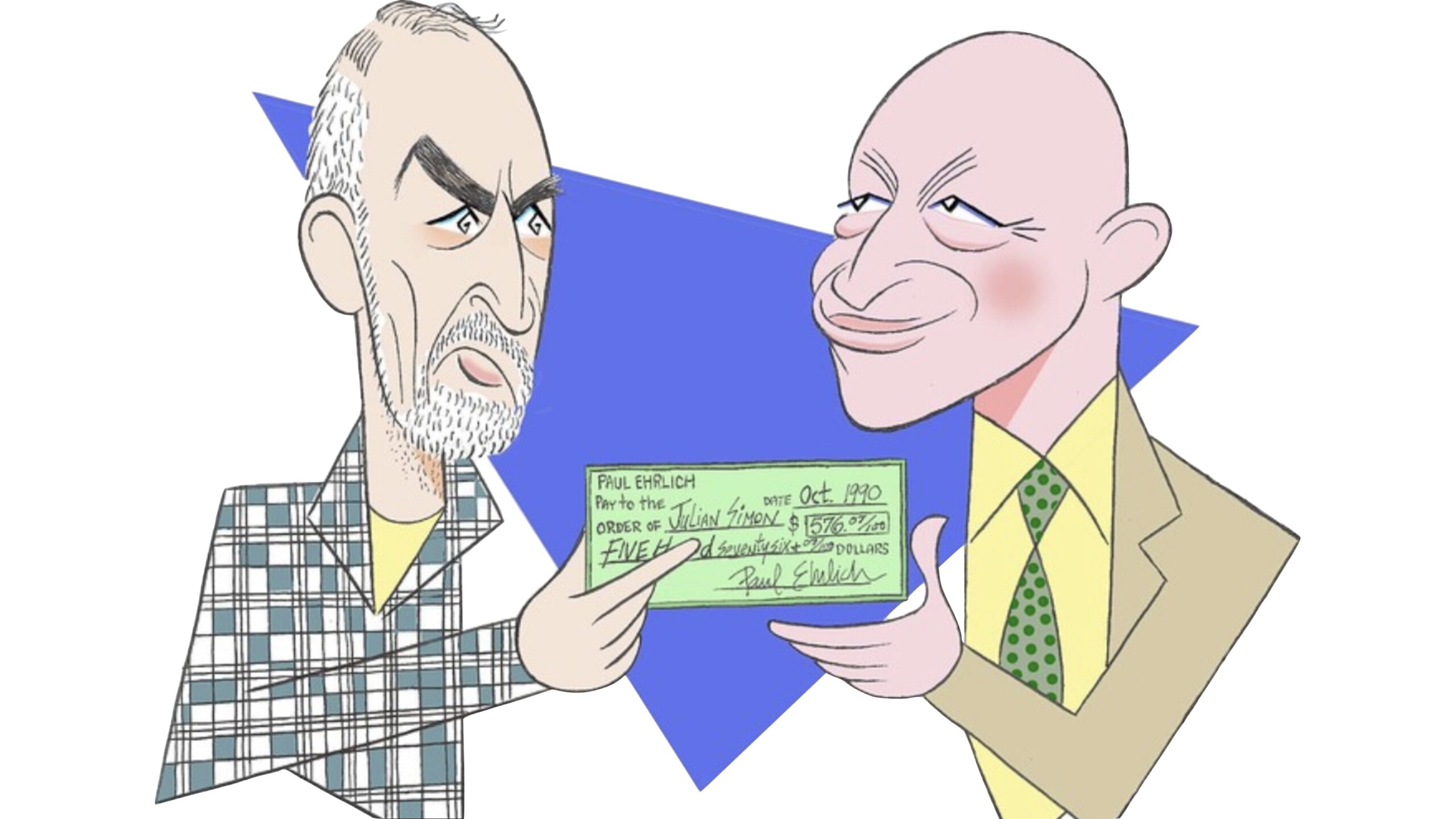
One of the most important checks ever written in economics was for $576.07.
It arrived in the mailbox of Julian Simon, the University of Maryland economist and Cato Institute senior fellow, on an October morning in 1990. The envelope was plain. There was no return address. Inside was a check from Paul Ehrlich. Ehrlich, who died last week, was the Stanford biologist and author of the bestselling 1968 book The Population Bomb.
That small check settled one of the great arguments of the modern age.
Ehrlich had spent years warning that population growth would outrun the Earth’s resources, bring rising scarcity, and push humanity toward disaster. Simon believed the opposite. He argued that more people did not simply mean more mouths to feed. It also meant more minds to think, invent, and solve problems.
The dispute became so bitter that Simon proposed a bet.
“Pick any raw material,” he told Ehrlich, “and choose any future date. I’ll bet the price will go down.”
Ehrlich accepted. He and two colleagues selected five metals: copper, chromium, nickel, tin, and tungsten. They priced a basket of those commodities on Sept. 29, 1980, and agreed to compare the inflation-adjusted price 10 years later. If the real price rose, Simon would pay Ehrlich. If it fell, Ehrlich would pay Simon.
Ehrlich was certain that population growth would make resources scarcer and therefore more expensive. Simon was certain that human beings would find ways to make resources more abundant.
By Sept. 29, 1990, the world’s population had increased by about 850 million people, a rise of 19 percent. If the doomsayers were right, that should have pushed prices sharply upward.
It did not.
Inflation over the decade was 57 percent. Yet the nominal price of the five-metal basket barely budged, rising from $1,000 to $1,004. In real terms, the basket’s price fell by about 36 percent. Ehrlich mailed Simon the difference: $576.07.
That check mattered because it exposed a mistake that still poisons public debate.
The mistake is to think that natural resources are fixed gifts of nature and that economic life is therefore a grim contest over a pile that can only shrink as population grows. That view sounds sober. It is, in fact, blind to the central truth of human progress.
Resources are not simply things lying in the ground. Resources are matter plus knowledge.
Oil was once a nuisance that seeped into farmland and polluted water. A barrel of oil in the Stone Age was worthless. A barrel of oil in an industrial civilization could heat homes, move trucks, power factories, and feed chemical industries.
Nature gives us atoms. Human beings give those atoms value.
That is why Simon understood something Ehrlich missed. The ultimate resource is not copper or farmland. It is the human mind. More precisely, it is the human mind set free to experiment, trade, specialize, and innovate.
Freedom matters here. People do not solve problems automatically. They solve them when they are allowed to respond to scarcity with invention and enterprise. High prices invite substitution. Competition rewards efficiency. Property rights encourage investment. Markets spread information no planner can gather. Free people learn to do more with less.
This is not a fairy tale in which every problem solves itself. Pollution is real. Bad policy is real. Governments can strangle innovation, distort prices, and lock societies into waste and stagnation. Progress, in other words, is not guaranteed.
But the lesson of the Simon-Ehrlich bet is that the burden of proof belongs to the prophets of permanent scarcity. Time and again, they have underestimated human creativity and overestimated the world’s physical limits.
That is as true today as it was in 1980.
We hear that energy is running out, that growth must stop, that the planet cannot support prosperity for billions, and that human wants must be cut down to fit a closed and exhausted world. This language changes with the decade, but the instinct behind it is old. It treats people as liabilities. It imagines the future as a rationing exercise.
Simon offered a better vision. Human beings are not just consumers of resources. They are producers of ideas. They are creators of substitutes, technologies, and entirely new forms of wealth. They do not merely divide a pie. They learn how to bake bigger pies from ingredients earlier generations did not know they had.
The real contest, then, is not between population and resources. It is between two ways of seeing humanity.
One view sees every additional person as another claimant on scarcity. The other sees every additional person as a possible problem-solver, inventor, entrepreneur, scientist, or worker whose efforts can make life better for everyone else.
The check for $576.07 settled the bet. But the larger wager remains open.
Don’t bet against human beings, especially when they are free.