Summary: Comparing nominal price changes to changes in average hourly wages from 2000 to 2025, we can see that many goods with rising dollar prices have become more affordable in time prices.
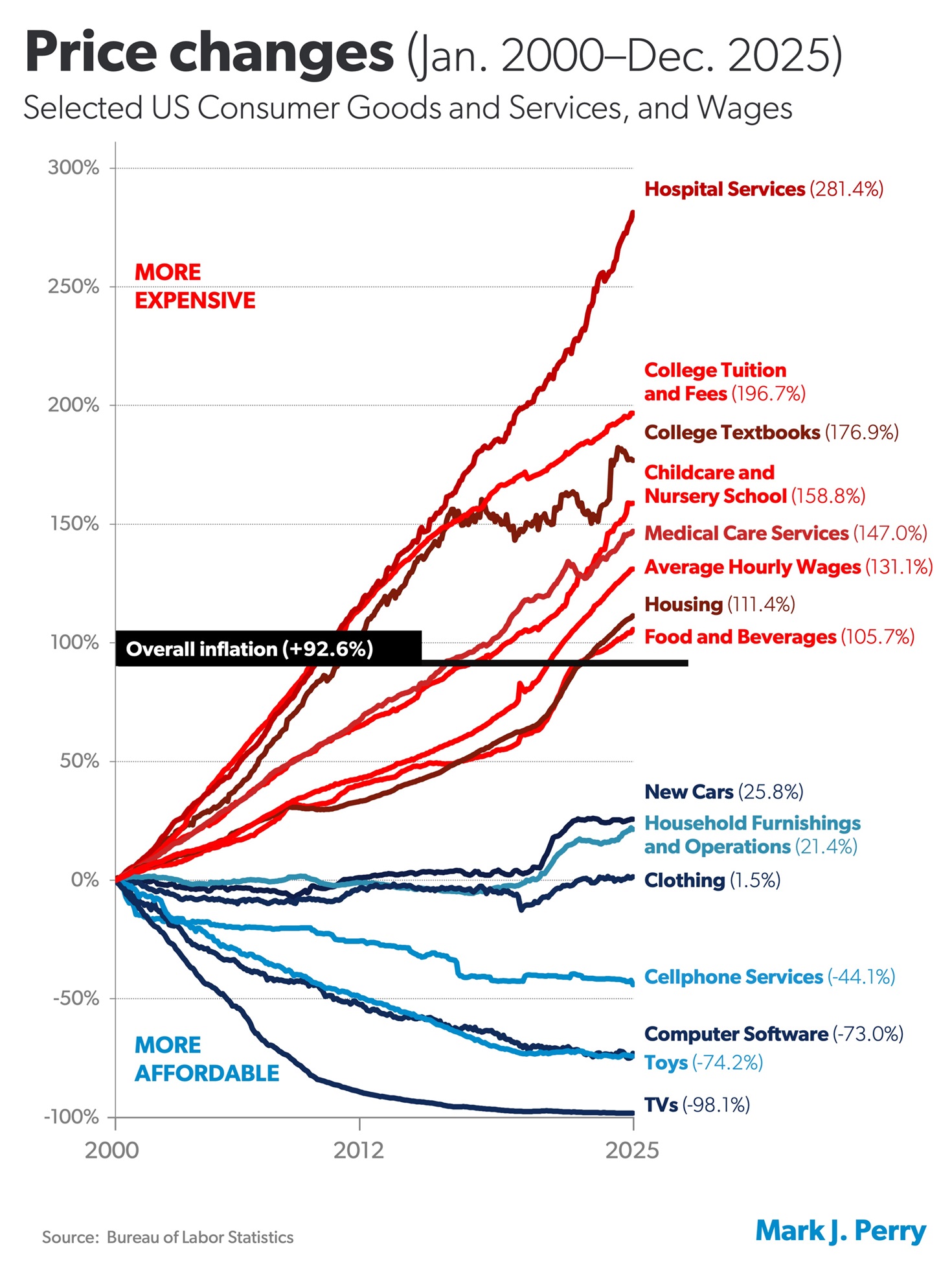
Professor Mark Perry from the American Enterprise Institute recently posted an updated version of his “Chart of the Century,” featuring price and wage data from the Bureau of Labor Statistics (BLS). The chart tracks 14 items over the 25-year period from January 2000 to December 2025. It also includes the overall inflation rate and changes in average hourly wages.
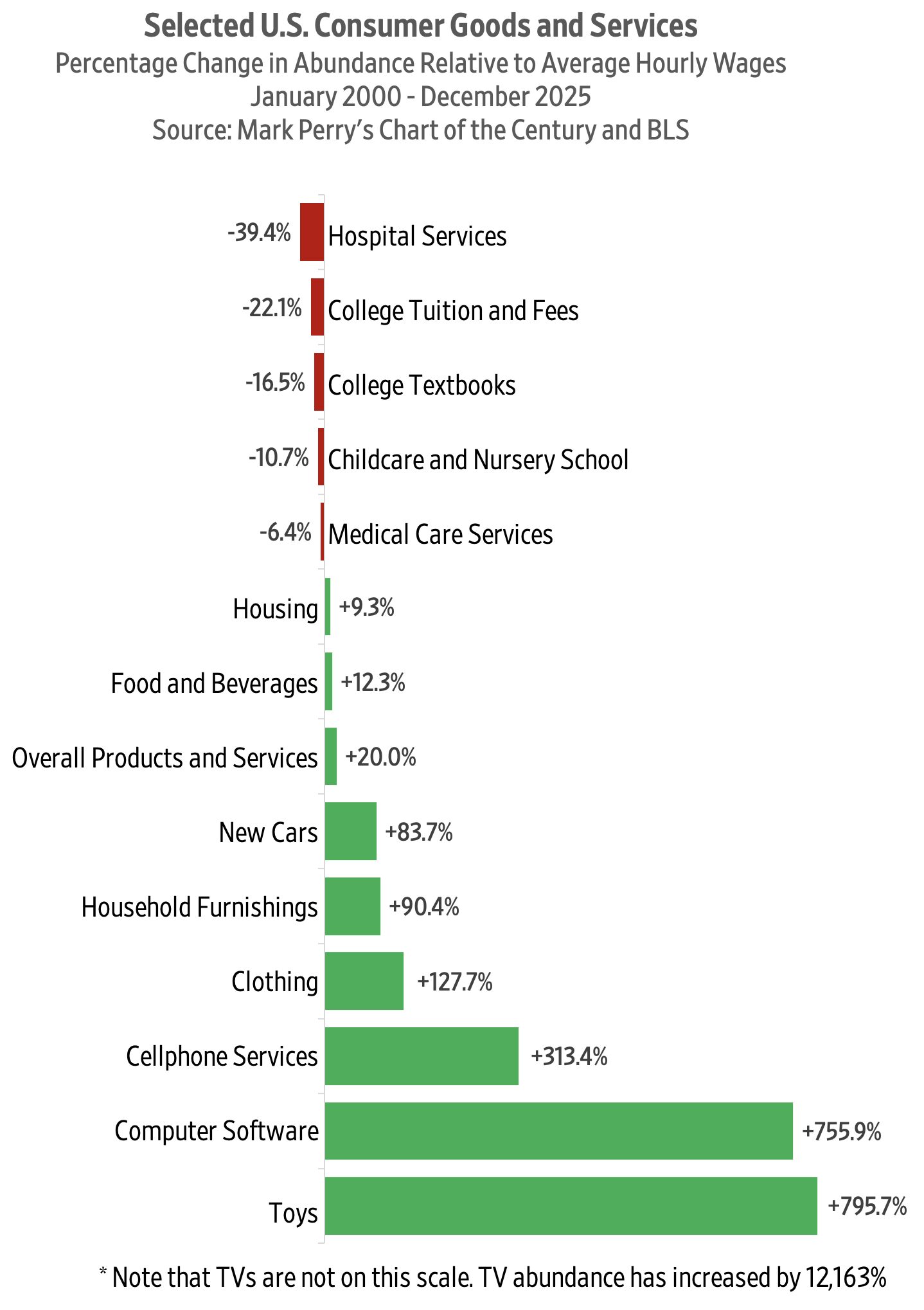
To examine the data from a different perspective, we calculated the change in the time prices of these 14 items relative to the change in the average hourly wage rate. We then calculated the abundance multiplier—a value indicating how many units you could buy today for the time it took to earn money to buy one unit in 2000. If there were no change, the abundance multiplier would equal one. A value below one indicates decreasing abundance, while a value above one reflects increasing abundance. We also calculated the percentage change in abundance for each item.
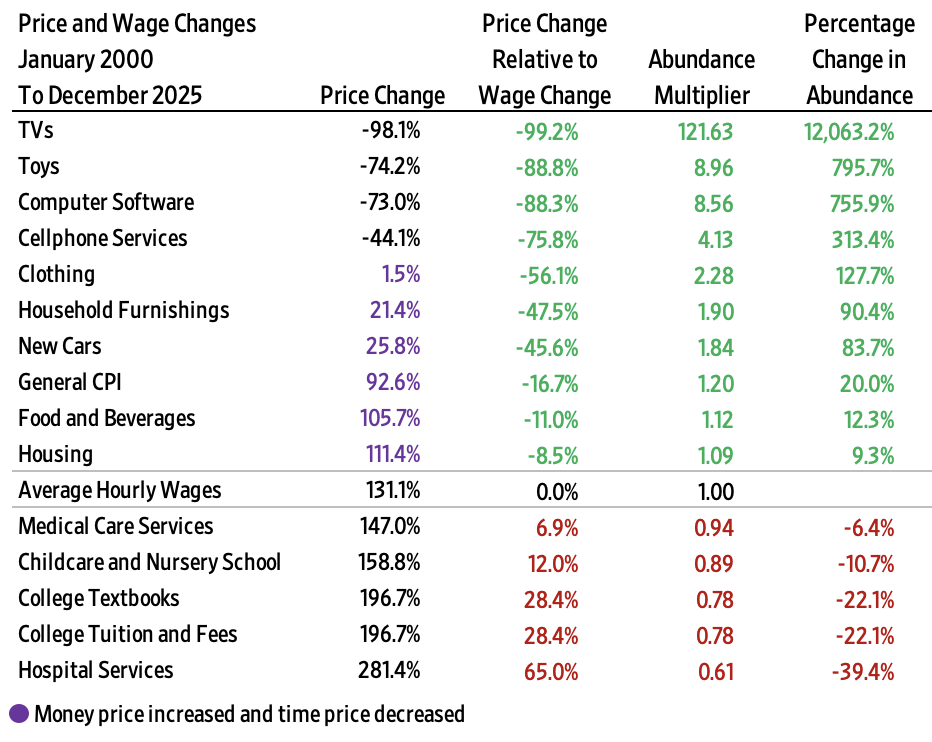
This analysis illustrates that things can become more expensive in dollar terms while simultaneously becoming more affordable in time prices. For instance, while the general Consumer Price Index (CPI) rose by 92.6 percent, average hourly wages increased by 131.1 percent. As such, time prices fell by 16.7 percent. For the time it took to earn enough money to purchase one CPI basket in January 2000, a consumer could purchase 1.2 baskets in December 2025—an abundance increase of 20 percent.
Notably, categories such as housing, food and beverages, new cars, household furnishings, and clothing all increased in money prices; however, after adjusting for rising wages, they all became more affordable in time-price terms. Although 10 of the 14 items rose in nominal prices over the 25-year period, only five had higher time prices when accounting for the 131.1 percent increase in hourly wages.
Find more of Gale’s work at his Substack, Gale Winds.