fbpx
01 / 05
No, We Won’t Run Out of Resources

Blog Post | Mineral Production

No, We Won’t Run Out of Resources

We’ve been adapting to resource scarcity for millennia. The idea that we would stop today, at the pinnacle of our development so far, is a peculiar one.

Summary: This article challenges the pessimistic view that human progress will soon come to a halt due to resource scarcity. It argues that humans are problem solvers who can adapt to changing circumstances and find new ways of using resources more efficiently. It illustrates this point with the example of germanium, a mineral that has been extracted from different sources over time depending on the demand and availability.


Pessimists often claim that human progress is about to come to a screeching halt. They say that the resources that make progress possible are about to run out, dooming us to a reversal in living standards. The Club of Rome, along with nearly every environmentalist, tells us that incessantly, usually pointing to a supposed mineral shortage that will end civilization. The pessimists insist that everything must be recycled and that we must have a completely circular economy. Alas, they fail to understand how the mineral industry actually works. On a deeper level, they fail to understand that humans have agency. We are not merely buffeted by the natural world but can solve problems ourselves.

Another group that fails to appreciate our problem-solving ability is the American Chemical Society (ACS). The Society has a list of “endangered elements,” which they think might run out in the near future. The idea that we could run out of hafnium is enough to make geologists guffaw – I actually tried this once, and that’s what happened: not just giggles but proper belly laughs. Germanium, another on that list of likely shortages, illustrates my point even better. The world doesn’t use much of it, perhaps 150 tons a year. Some of that is recycled. (There’s nothing wrong with recycling, but insisting that we must recycle is wrong.)

We first started using germanium for electronics before we switched to using silicon computer chips. Germanium is still the material of choice for getting a warm and fuzzy sound on a guitar pedal, but today, germanium is mostly used for night sights and long-distance fiber optics. That’s because adding a little germanium to glass allows it to carry light for longer distances. So, we like having germanium around, and we would miss it if we ran out.

Early germanium extraction methods used coal. There’s a little germanium in nearly all coal and more in certain other deposits. If you collect the vapor after burning coal, the germanium concentrates in the ash and can be collected. The chemical company Johnson Matthey used to have a plant in Cheshire, England, to the delight of fuzzy guitar pedal enthusiasts. Later, we realized that certain zinc ores could also provide germanium, and the world supply pivoted to a zinc mine in DR Congo. Then, we got wise to the harmful effects of coal dust floating around the countryside. Coal power plants installed electrostatic precipitators on their chimneys to collect the dust, and coal once again became the primary source of the world’s germanium.

It might seem lucky that today’s germanium supply is just a byproduct of producing electricity. But to think of it as luck is to get things the wrong way around. We are problem solvers, not just the recipients of happenstance. In the absence of that luck, we could build a factory to do it anyway. That’s how the world’s largest germanium producer, in China, works. They mine coal, burn it in a power station, and collect the germanium-infused dust. Rumor has it – and it might just be a rumor because it’s so cute – that the germanium content is so rich that they give the electricity away to the local town for free.

The point of my germanium example is to show that we are not dependent on the current methods of mineral extraction, nor do we need luck to avoid shortages. We are tool-making creatures. If we have a problem, we study the world around us and develop a way to solve it.

Like germanium, every item on the ACS list of “endangered elements” actually has a vast current supply. The current mineral extraction methods might have problems, but the total amount of resources that we can use is imponderable. And if our current methods come up a little short, we’ll find better methods of extraction.

Our adaptive abilities should be obvious, though they clearly are not. We’ve been adapting to resource scarcity for millennia, and the idea that we would stop today, at the pinnacle of our development so far, is a peculiar one.

Blog Post | Mineral Production

The Most Important Check in Economics

The Simon–Ehrlich wager and why predictions of resource scarcity keep getting it wrong.

Summary: A famous bet between Julian Simon and Paul Ehrlich illustrates two ways of thinking about resources and human ingenuity. Ehrlich thought of resources as a fixed pie, while Simon believed that human beings would find ways to make resources more abundant. As Simon predicted, thanks to markets and human ingenuity, the resource prices that Simon and Ehrlich bet on fell over a decade.


One of the most important checks ever written in economics was for $576.07.

It arrived in the mailbox of Julian Simon, the University of Maryland economist and Cato Institute senior fellow, on an October morning in 1990. The envelope was plain. There was no return address. Inside was a check from Paul Ehrlich. Ehrlich, who died last week, was the Stanford biologist and author of the bestselling 1968 book The Population Bomb.

That small check settled one of the great arguments of the modern age.

Ehrlich had spent years warning that population growth would outrun the Earth’s resources, bring rising scarcity, and push humanity toward disaster. Simon believed the opposite. He argued that more people did not simply mean more mouths to feed. It also meant more minds to think, invent, and solve problems.

The dispute became so bitter that Simon proposed a bet.

“Pick any raw material,” he told Ehrlich, “and choose any future date. I’ll bet the price will go down.”

Ehrlich accepted. He and two colleagues selected five metals: copper, chromium, nickel, tin, and tungsten. They priced a basket of those commodities on Sept. 29, 1980, and agreed to compare the inflation-adjusted price 10 years later. If the real price rose, Simon would pay Ehrlich. If it fell, Ehrlich would pay Simon.

Ehrlich was certain that population growth would make resources scarcer and therefore more expensive. Simon was certain that human beings would find ways to make resources more abundant.

By Sept. 29, 1990, the world’s population had increased by about 850 million people, a rise of 19 percent. If the doomsayers were right, that should have pushed prices sharply upward.

It did not.

Inflation over the decade was 57 percent. Yet the nominal price of the five-metal basket barely budged, rising from $1,000 to $1,004. In real terms, the basket’s price fell by about 36 percent. Ehrlich mailed Simon the difference: $576.07.

That check mattered because it exposed a mistake that still poisons public debate.

The mistake is to think that natural resources are fixed gifts of nature and that economic life is therefore a grim contest over a pile that can only shrink as population grows. That view sounds sober. It is, in fact, blind to the central truth of human progress.

Resources are not simply things lying in the ground. Resources are matter plus knowledge.

Oil was once a nuisance that seeped into farmland and polluted water. A barrel of oil in the Stone Age was worthless. A barrel of oil in an industrial civilization could heat homes, move trucks, power factories, and feed chemical industries.

Nature gives us atoms. Human beings give those atoms value.

That is why Simon understood something Ehrlich missed. The ultimate resource is not copper or farmland. It is the human mind. More precisely, it is the human mind set free to experiment, trade, specialize, and innovate.

Freedom matters here. People do not solve problems automatically. They solve them when they are allowed to respond to scarcity with invention and enterprise. High prices invite substitution. Competition rewards efficiency. Property rights encourage investment. Markets spread information no planner can gather. Free people learn to do more with less.

This is not a fairy tale in which every problem solves itself. Pollution is real. Bad policy is real. Governments can strangle innovation, distort prices, and lock societies into waste and stagnation. Progress, in other words, is not guaranteed.

But the lesson of the Simon-Ehrlich bet is that the burden of proof belongs to the prophets of permanent scarcity. Time and again, they have underestimated human creativity and overestimated the world’s physical limits.

That is as true today as it was in 1980.

We hear that energy is running out, that growth must stop, that the planet cannot support prosperity for billions, and that human wants must be cut down to fit a closed and exhausted world. This language changes with the decade, but the instinct behind it is old. It treats people as liabilities. It imagines the future as a rationing exercise.

Simon offered a better vision. Human beings are not just consumers of resources. They are producers of ideas. They are creators of substitutes, technologies, and entirely new forms of wealth. They do not merely divide a pie. They learn how to bake bigger pies from ingredients earlier generations did not know they had.

The real contest, then, is not between population and resources. It is between two ways of seeing humanity.

One view sees every additional person as another claimant on scarcity. The other sees every additional person as a possible problem-solver, inventor, entrepreneur, scientist, or worker whose efforts can make life better for everyone else.

The check for $576.07 settled the bet. But the larger wager remains open.

Don’t bet against human beings, especially when they are free.

Blog Post | Natural Resource Prices

America’s Commodity Appetite: Evidence of Dematerialization

America's economy has never ceased to crave materials, but it has grown better at extracting more value from less stuff.

Summary: A new study examines how the United States has shifted its material consumption patterns since 1900, showing a trend of “relative dematerialization” beginning around 1970. While certain commodities have grown in demand, many others have seen absolute declines due to technological advancements and efficiency improvements. Innovation and globalization have allowed the US economy to extract more value from fewer resources, raising questions about the long-term sustainability of this trend in an increasingly digital and energy-intensive world.


A new study by Iddo K. Wernick from the Rockefeller University’s Program for the Human Environment titled “Is America Dematerializing? Trends and Tradeoffs in Historic Demand for One Hundred Commodities in the United States” offers a remarkable portrait of how much the United States has changed in terms of material consumption since 1900.

The study examines the usage trends of 100 commodities—including iron ore, chickens, gallium, and titanium—and shows that a nation that started the 20th century with a seemingly bottomless appetite for raw materials pivoted dramatically around 1970. This pivot, which paradoxically coincided with the first Earth Day, marked a moment when the American economy began a decades-long march toward what Wernick calls “relative dematerialization.” In essence, “dematerialization” refers to the gradual uncoupling of resource use from economic growth.

In Superabundance: The Story of Population Growth, Innovation, and Human Flourishing on an Infinitely Bountiful Planet, Gale L. Pooley and I document a parallel phenomenon on the global stage, finding that resources become more abundant over time. Our key insight is that time prices—or the time required to earn the money to buy a specific good—have been falling for almost two centuries for almost all commodities. Although Wernick focuses on physical consumption patterns within the United States, his study corroborates a related idea: Increasing efficiencies allow Americans to produce or obtain more output from fewer inputs, which helps to keep price increases in check.

The Rockefeller paper breaks commodities into three groups based on their trends from 1970 to 2020. The first group consists of only eight commodities—including gallium, titanium, and chicken—for which demand grew faster than gross domestic product (GDP), showing that certain products vital to the modern economy (and the dinner table) can still outpace the broader economy. The use of the second group of 51 commodities, such as petroleum and nitrogen fertilizer, grew more slowly than overall GDP but increased in absolute terms. That relative decoupling translates to lower intensity of use: We consume more resources as our economy expands but less per dollar of economic output.

Finally, the use of the third group—41 commodities, including iron ore, cadmium, asbestos, and even water—experienced declines in both absolute consumption and intensity of use. According to Wernick, some of these, like asbestos, fell out of favor due to safety concerns, while others, like iron ore, lost ground because of new manufacturing technologies, such as electric arc furnaces, which made recycling more economical. Once indispensable commodities saw demand shrink, underlining the fact that most resources need not remain economically essential in the long run.

Wernick’s study also acknowledges the role of globalization in shifting the patterns of resource use: Certain energy-intensive or pollution-heavy production processes have migrated offshore, meaning the United States can appear more material-efficient while importing finished goods that embed resource usage from elsewhere. But that shift is neither absolute nor one way: The United States also exports large quantities of agricultural products, effectively shipping out “embodied” water, fertilizer, and cropland. These exchanges do not cancel each other out, but the global supply chain, which allows resources to flow to where they are most valued, benefits everyone.

Critics of this optimistic narrative often point to the “Jevons paradox,” whereby increased efficiency leads to cheaper commodities and triggers higher total consumption. The evolution of the American economy after 1970 certainly raises intriguing questions. Was relative dematerialization achieved at the cost of higher economic growth, which slowed around the first Earth Day? Is dematerialization a product of market-driven efficiencies or a result of government-imposed environmental laws and regulations?

Looking into the future, what will happen to American resource use as the United States becomes an information powerhouse? Although computing is electricity-intensive, it can create massive value with little use of physical commodities. And what if we are on the cusp of using incredibly dense fuels to generate that electricity, as the deals between tech companies and new nuclear companies might indicate?

The march of technological progress, combined with the deregulation and economic growth drives promised by the second Trump administration, may yet provide answers to those questions.

All told, Wernick’s findings confirm that, while the American economy has never ceased to crave materials—including metals, foods, and newly indispensable high-tech elements—it has grown better at extracting more value from less stuff. Our ingenuity is decoupling growth from sheer material input, though whether that trend can be sustained over the long run remains an open question.

Blog Post | Natural Resource Prices

Update on the Five Metals from the Simon–Ehrlich Bet

Since 1900, the average abundance of these five metals has increased 36.5 percent faster than the population.

Summary: The Simon–Ehrlich wager famously demonstrated that population growth does not lead to resource scarcity but instead drives innovation and abundance. Since 1900, the production of five metals featured in the bet has risen dramatically. This bolsters Julian Simon’s argument that human ingenuity and technological progress enable us to produce more resources at lower costs, ensuring greater abundance even as populations grow.


Hannah Richie at OurWorldinData.org recently published an insightful article on the five metals featured in the Simon–Ehrlich wager. In 1990, Paul Ehrlich lost the 10-year bet and had to write a check to Julian Simon for $576.07. Simon had let Ehrlich pick the five metals in 1980 when the bet started. The payment reflected the inflation-adjusted decline of 36 percent in the average price of the five metals over the decade. This was despite an extraordinary global population increase during the 1980s of 850 million people (19 percent)—the largest growth in human history. Yet, even with this surge, resource prices dropped, reinforcing Simon’s argument that human population growth, coupled with ingenuity and the freedom to innovate, drives resource abundance rather than scarcity.

Libertarian economist Julian Simon made a famous wager with the renowned doomsayer Paul Ehrlich in 1980. Simon challenged Ehrlich to choose five metals that he believed would increase in price over the next decade. After the bet concluded, Ehrlich, humbled by the outcome, handed Simon a check, having lost the wager.

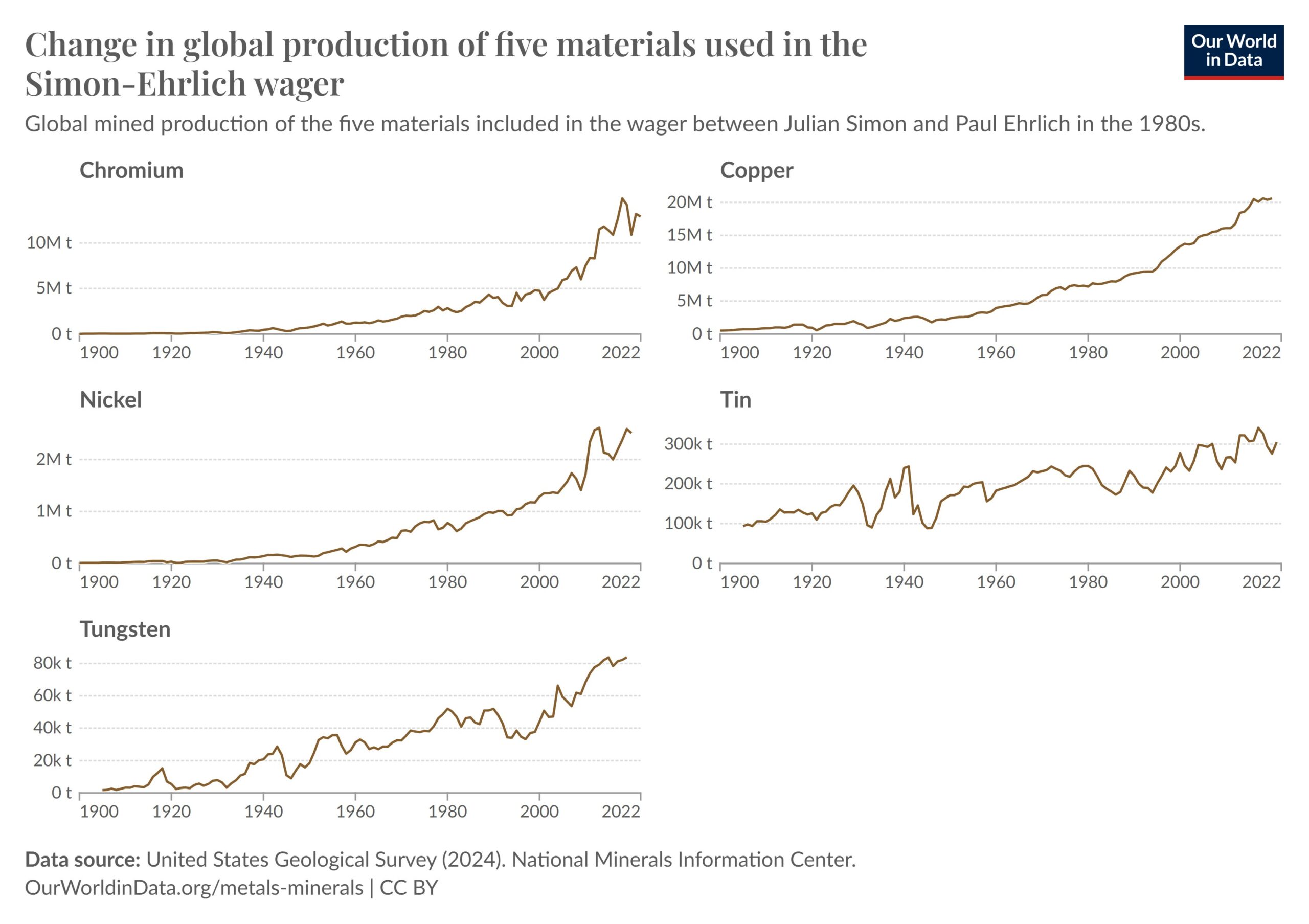
Richie highlights an important trend: The long-term abundance of these metals has increased significantly. Take a look at the staggering growth in their production since the early 1900s:

The five metals in the Simon-Ehrlich wager have actually become more abundant over time. The production of each of these metals has grown dramatically, defying Ehrlich's predictions of scarcity and rising prices.

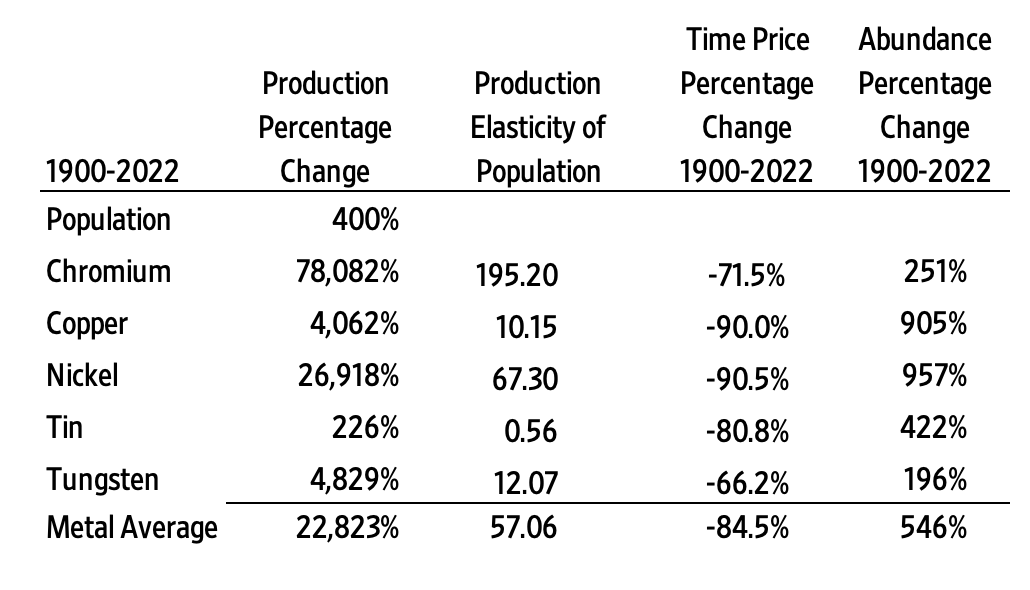
Between 1900 and 2000, the global population grew by 400 percent, from 1.6 billion to 8 billion. During the same period, the production of the five metals soared: Chromium increased by an astounding 78,082 percent, copper by 4,062 percent, nickel by 26,918 percent, tin by 226 percent, and tungsten by 4,829 percent. On average, production of these metals rose by 22,823 percent.

The relationship between population growth and resource production is captured by the production elasticity of the population. It is the ratio of the percentage change in production divided by the percentage change in population. On average, every 1 percent increase in population corresponded to a 57.06 percent increase in the production of these five metals.

In our book Superabundance, we compared the time prices of these five metals for blue-collar workers from 1900 to 2018 and have since updated the data to 2022.

The prices of the five metals have also decreased over time, meaning fewer labor hours are required for a worker to afford them. This reflects both rising wages and falling commodity prices, which are indicators of growing progress and abundance.

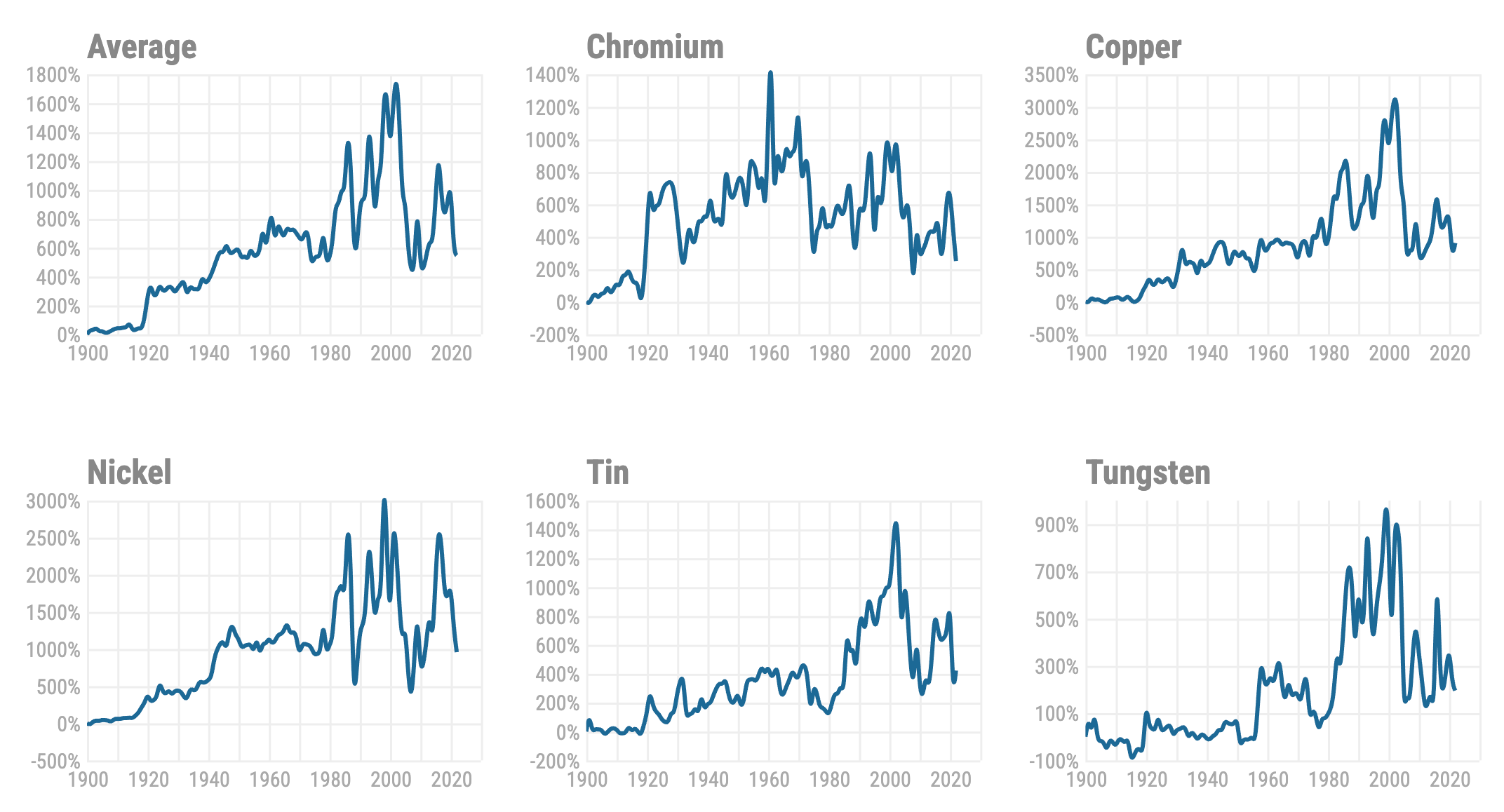
The charts below detail the growth in abundance for each resource since 1900. Please note that vertical scales differ across the charts. The charts generally show the effects of 9/11, the financial crisis of 2008, and COVID-19 lockdown policies.

Since 1900, the metals have become much more abundant, even as the global population has grown. This demonstrates that humanity is not a burden on the earth's material resources; rather, through innovation and production, people have been able to expand resource availability.

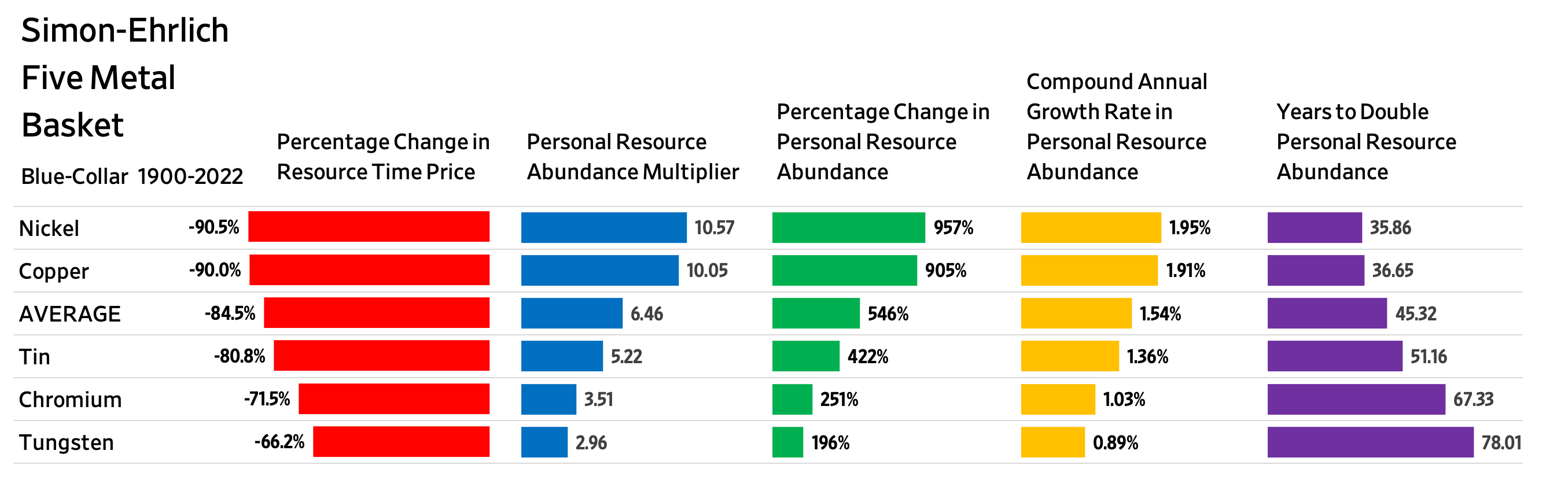
This table summarizes our findings.

Between 1900 and 2022, the production, time price, and abundance of each of the metals have all increased. The chart also highlights the production elasticity of population, showing how the growth in population has been accompanied by a corresponding increase in metal production.

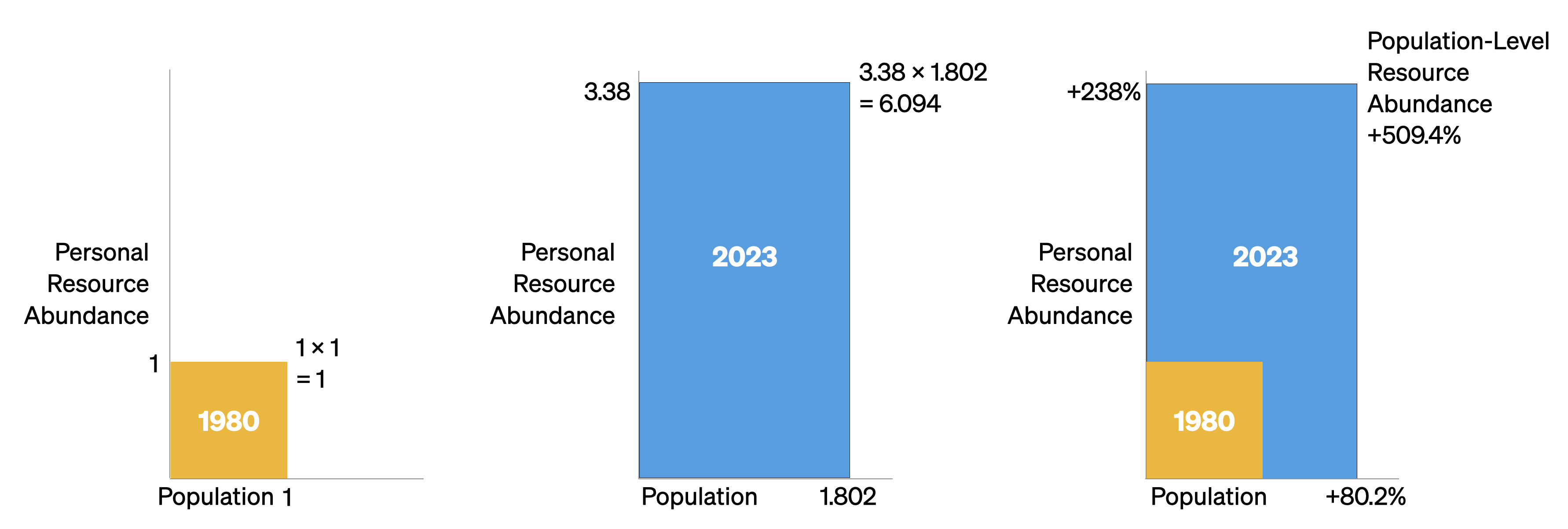
From 1900 to 2022, the global population increased by 400 percent. Over the same period, the abundance of these five metals increased by an average of 546 percent, demonstrating that abundance has grown 36.5 percent faster than the population.

Some have suggested that Simon was just lucky. This is why looking at a much longer time period reveals underlying trends behind temporary fluctuations.

These data reinforce Simon’s prediction: The more people, the more we produce, and the lower the prices.

Tip of the hat: Max More

This article was published at Gale Winds on 1/14/2025.