Today marks the 46th installment in a series of articles by HumanProgress.org titled Heroes of Progress. This bi-weekly column provides a short introduction to heroes who have made an extraordinary contribution to the well-being of humanity. You can find the 45th part of this series here.
This week, our heroes are Mary Astell and Mary Wollstonecraft–two 17th and 18th century English thinkers, who are widely considered to have been the earliest pioneers of feminist philosophy. The works of Astell and Wollstonecraft gained popularity in the 19th century and helped to provide the philosophical foundation for suffragette and women’s rights movements all over the world.
In the 17th and 18th centuries, Western European women were often poorly educated and had very little protection under the law. In a series of prominent works, Astell argued that women should have equal educational opportunities as men. Astell was also the first thinker to base her arguments for gender equality in philosophy, rather than historical evidence, as had previously been the norm.
Wollstonecraft took Astell’s call for equal education between the sexes a step further. The former argued that, since both men and women were endowed with the inalienable rights to life, liberty and the pursuit of happiness, women should also be granted the right to vote and allowed to pursue whatever career they wished.
Mary Astell was born on November 12, 1666, into an upper-middle-class family in Newcastle, England. Her father managed a local coal company, but despite her family’s wealth, Astell did not receive any formal education. Instead, she was taught at home by her clergyman uncle, Ralph Astell. Ralph was heavily involved in the philosophical school called Neoplatonism, which taught rationalist beliefs based on the works of the Greek philosophers, such as Plato, Aristotle and Pythagoras.
At the age of 12, Astell’s father died and left her without a dowry, which meant that her prospects for marrying someone of a similar social class became unlikely. A year later, her uncle Ralph died, leaving her without a teacher. Yet, throughout her teenage years Astell continued to teach herself many subjects and discovered that she had a particular aptitude for political philosophy.
In 1684, Astell’s mother died. That spurred Astell to move to Chelsea, a suburb of London. In Chelsea, Astell became quickly acquainted with a circle of literary and influential women. Astell’s new friends, along with William Sancoft, the former Archbishop of Canterbury who provided her with financial support, helped Astell to develop and publish her writings.
In 1694, Astell published her first book Serious Proposal to the Ladies for the Advancement of their True and Greatest Interest. Six years later, her second book titled Some Reflections upon Marriage was published. Both of these works were published anonymously. In them, Astell argued that women should receive an equal education to men. She averred that the existing intellectual disparity between men and women was not due to a natural inferiority, but due to the latter’s lack of educational opportunity. Astell also argued that women should be able to choose whom they marry or to refrain from marriage if they so desired.
Through these works, Astell became one of the first writers to advocate in favor of the idea that women were just as rational as men. By using Descartes’ theory of dualism (the idea that the mind and body are distinct and separable), Astell argued that both genders had an equal ability to reason irrespective of their physical differences. As such, women should be treated as equals. Astell famously wrote “If all men are born free, why are all women born slaves?”
Later in life, Astell left the public eye. In 1709, she became head of a charity school for girls. Astell designed the curriculum and it is thought that hers was the first school in England to have an all-women Board of Governors. After a mastectomy to remove a cancerous breast, Astell died in her Chelsea home on May 11, 1731.
Throughout her life Astell encouraged both genders to fight for women’s rights. After her death, Mary Wollstonecraft continued the advocacy for educational reform for women that Astell began.
Mary Wollstonecraft was born on April 27, 1759, in London, England. Like Astell, she was born into an upper-middle-class family that became significantly poorer over time. Wollstonecraft’s father, Edward John Wollstonecraft, was a violent man who frequently beat his wife in drunken rages. As a child, Mary would often intervene and try to prevent her father’s abuse. Over time Wollstonecraft’s father gradually squandered the family’s money, causing the family to move several times during her childhood.
Early in Wollstonecraft’s life, she befriended Jane Gardiner, née Arden. The pair would often read the then new “Enlightenment Era” books together. They also attended lectures by Arden’s father, John Arden, who was a scholar of natural philosophy and one of Wollstonecraft’s early teachers.
Unhappy with her home life, Wollstonecraft decided to move. Throughout the late 1770s and early 1780s, she worked in several different jobs across England and Ireland, including as a governess, needle-worker and teacher.
Wollstonecraft became frustrated with the limited career options open to women. In the late 1780s, she embarked on a career as an author, which was seen as a radical choice for a woman at the time. In 1787, Wollstonecraft wrote her first book titled Thoughts on the Education of Daughters. The book resembles an early version of a modern self-help book and offers advice on female education. It also included segments on morality, etiquette and basic child-rearing.
In 1788, Wollstonecraft was employed as translator for the publisher Joseph Johnson, who published several of her early works. Wollstonecraft had a great interest in the French Revolution. After the English philosopher Edmund Burke published a book titled Reflections on the Revolution in France, which challenged the principles of the French Revolution, Wollstonecraft decided to respond.
In 1790, Wollstonecraft published A Vindication of the Rights of Men, which criticized the despotism of France’s Ancien Régime, welcomed revolutionary reform, and argued that humanity’s natural rights must be protected by a government. In the book, Wollstonecraft also criticized the arbitrary nature of government power.
In 1792, Wollstonecraft published her best-known work titled A Vindication of the Rights of Woman. In the book, Wollstonecraft expanded on Astell’s work and argued that the education system trained women to be frivolous and incapable. Wollstonecraft noted that there are no mental differences between men and women. If women were given the same educational opportunities as men, she argued, the former would be capable of doing many professions and elevating themselves in society.
Unlike Astell, Wollstonecraft believed that the betterment of women should be sought through radical political change, with reforms required in both the educational and voting system. Wollstonecraft noted that, as men and women were intellectually similar, women should also be granted the right to vote. She wrote, “Women ought to have representatives, instead of being arbitrarily governed without having any direct share allowed them in the deliberations of government.”
Wollstonecraft also noted that “liberty is the mother of virtue.” Conversely, if women were kept “by their very constitution, slaves, and not allowed to breathe the sharp invigorating air of freedom, they must ever languish like exotics, and be reckoned beautiful flaws of nature.”
A Vindication of the Rights of Woman was hugely successful and helped bolster Wollstonecraft’s reputation as a writer. Later in 1792, Wollstonecraft went to Paris to observe the French Revolution. She arrived just a month before King Louis XVI was guillotined. Wollstonecraft stayed in France until 1795.
After the breakdown of a romantic relationship, Wollstonecraft was left heartbroken and twice attempted suicide. When she returned to England, Wollstonecraft became actively involved in a close-knit group of radical intellectuals, which included William Godwin, Thomas Paine, William Blake and William Wordsworth.
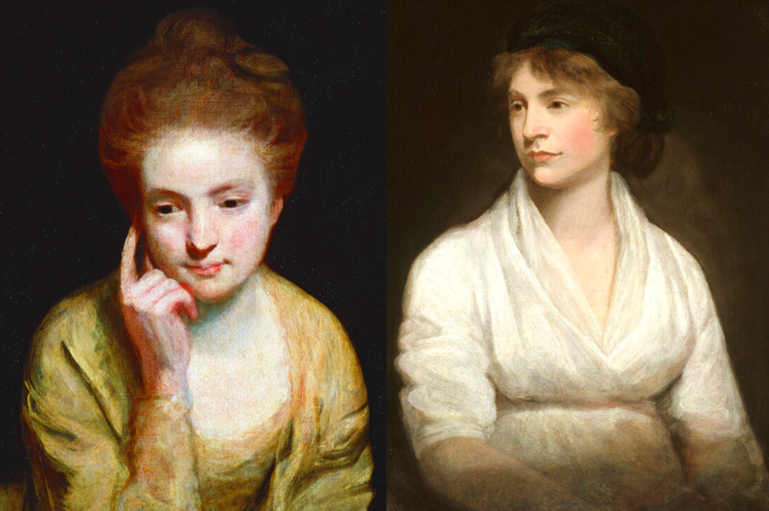
Mary Astell is depicted on the left side of the photograph above. Mary Wollstonecraft is on the right.
In 1797, Wollstonecraft married William Godwin and gave birth to Mary Wollstonecraft Shelley – who would go on to write Frankenstein. Just 11 days after she gave birth, Wollstonecraft died of septicemia on September 10, 1797.
Astell and Wollstonecraft’s writings were unsuccessful in bringing about immediate reforms when they were published. The works of the two thinkers, however, provided the intellectual foundation for the suffragette and feminist movements, which started in the late 19th century and continue around the world to this day. Although they were considered radicals during their time, without their ideas it is unlikely that women’s rights would be as extensive today as they are. For that reason, Mary Astell and Mary Wollstonecraft are rightfully our 46th Heroes of Progress.