fbpx
01 / 05
Heroes of Progress, Pt. 2: Fritz Haber and Carl Bosch

Blog Post | Food Production

Heroes of Progress, Pt. 2: Fritz Haber and Carl Bosch

Introducing the inventors of the "Haber-Bosch process," Fritz Haber and Carl Bosch.

Today marks the second installment of a new series of articles by HumanProgress.org titled, The Heroes of Progress. This bi-weekly column gives a short overview of unsung heroes, who have made an extraordinary contribution to the wellbeing of humanity. You can find the 1st part of this series here.

Our second Heroes of Progress installment features two German Nobel Prize-winning scientists, Fritz Haber and Carl Bosch. The two have created the “Haber-Bosch process,” which efficiently converts nitrogen from the air into ammonia (i.e., a compound of nitrogen and hydrogen). Ammonia is then used as a fertilizer to dramatically increase crop yields. The impact of Haber and Bosch’s work on global food production transformed the world forever.

Throughout the 19th century, farmers used guano (i.e., the accumulated excrement of seabirds and bats) as highly effective fertilizer due to its exceptionally high content of nitrogen, phosphate and potassium – nutrients that are essential for plant growth. But by the beginning of the 20th century, guano deposits started to run out, and the price of the fertilizer began to increase. If a solution to the depletion of guano hadn’t come soon, famine would have followed.

Enter, Fritz Haber. Born in 1868 in Breslau, Germany (now part of Poland), Haber began studying chemistry at the age of 18 at the University of Heidelberg. By 1894, Haber worked at the University of Karlsruhe, researching methods to synthesize nitrogen. Nitrogen is very common in the atmosphere, but the chemical element is difficult to extract from the air and turn into a liquid or solid form (a process known as “fixing” nitrogen).

After thousands of experiments over almost 15 years, Haber succeeded in producing ammonia on July 3rd, 1909. That proved that commercial production was possible. However, Haber’s breakthrough occurred in a small tube, 75 centimetres tall and 13 centimetres in diameter. At the start of the 20th century, large containers that could handle the pressures and temperatures required for industrial scale production of ammonia did not yet exist.

That is where Carl Bosch enters the story. Born in Cologne in 1874, Bosch studied metallurgy at the University of Charlottenburg in 1894, before transferring to the University of Leipzig to receive his doctorate in chemistry in 1898. Bosch met Haber in 1908 and after finding out about the latter’s breakthrough the following year, Bosch took on the challenge of developing suitable containers that could manage Haber’s process on the industrial level.

Within four years Bosch was producing ammonia in 8-meter-tall containers. The Haber-Bosch process was born. By 1913, Bosch had opened a factory that kick-started the fertilizer industry that we know today.

The discovery of the Haber-Bosch process meant that for the first time in human history it became possible to produce synthetic fertilizers that could be used on enough crops to sustain the Earth’s increasing population. It’s nearly impossible to say how many lives this breakthrough saved, but the expansion of the world’s population from 1.6 billion in 1900, to more than 7.3 billion today, “would not have been possible without the synthesis of ammonia,” claims the Czechian scientist Vaclav Smil.

After their revolutionary contribution to human progress, the two scientists worked to help Germany during World War I. Bosch focused on bomb making, while Haber became instrumental in developing chlorine gas. When Adolf Hitler came to power in 1933, Haber fled Germany to teach at Cambridge University, and he died shortly after in 1935. Meanwhile, in 1937, Bosch was appointed President of the Kaiser Wilhelm Institute – Germany’s highest scientific position. Being a staunch critic of Nazi policies, Bosch was soon removed from that position and died in 1940.

Today, more than 159 million tonnes of ammonia are produced annually, and while ammonia is also used for cleaning and as a refrigerant, 88 percent of ammonia is used for fertilizer. It is estimated that if average crop yields remained at their 1900 level, the crop harvest in the year 2000 would have required nearly four times more cultivated land than was actually cultivated. That equates to an area equal to almost half of all land on ice-free continents – rather than just the 15 percent that is needed today.

Without the combined efforts of Fritz Haber and Carl Bosch, the world’s population would be much smaller than it is today. The two have truly changed the world for the better. Their lasting contribution to the wellbeing of humanity means that they rightly deserve to be our second Heroes of Progress.

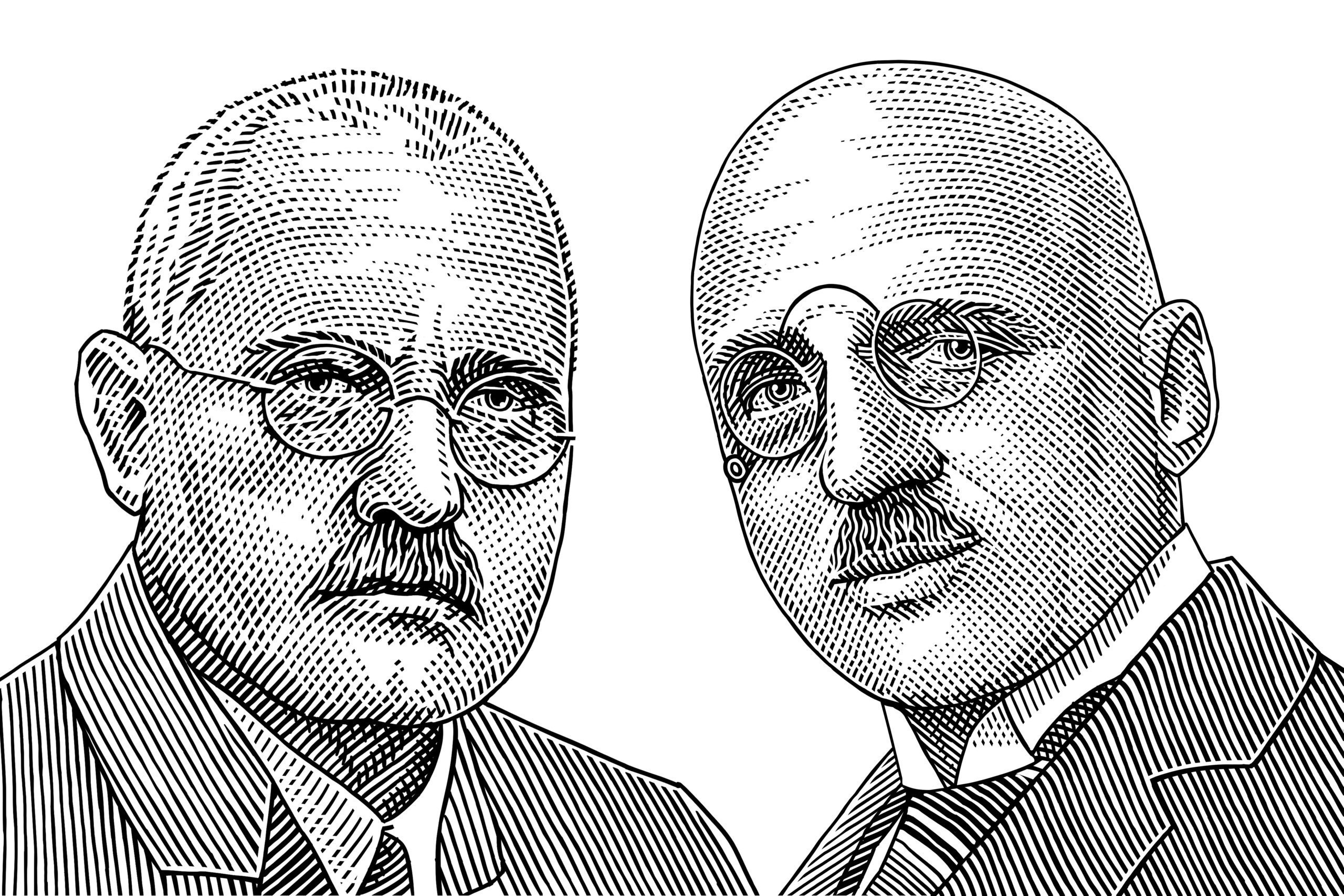
PS: Carl Bosch is on the left of our cover picture and Fritz Haber is on the right of our cover picture


Cornell SC Johnson College of Business | Food Consumption

GLP-1 Adoption Is Changing Consumer Food Demand

“We examine how consumers modify their food purchases after adopting appetite-suppressing GLP-1 receptor agonists, such as Ozempic and Wegovy. Using survey responses on medication adoption linked to transaction data from a representative U.S. household panel, we document the prevalence, motivations, and demographic patterns of GLP-1 adoption. Households with at least one GLP-1 user reduce grocery spending by 5.3% within six months of adoption, with higher-income households reducing spending by 8.2%. While most food categories see spending declines, the largest reductions are concentrated in calorie-dense, processed categories, including a 10.1% decline in savory snacks. In contrast, a small set of categories show directionally positive changes, with yogurt experiencing the only statistically significant increase. We also find an 8.0% decline in spending at fast-food chains, coffee shops, and limited-service restaurants. These food demand adjustments persist through the first year of medication use, though with some attenuation after six months.”

From Cornell SC Johnson College of Business.

Blog Post | Food Prices

McDonald’s Abundance Serves the World

The premier American brand has sold a trillion burgers.

Summary: With plausibly up to a trillion burgers sold worldwide, McDonald’s has become one of the most recognizable symbols of abundance and convenience. Its cheeseburger now takes far less work time to afford than in the past, reflecting broad gains in prosperity. McDonald’s has grown into a cultural touchstone, serving communities across the globe.


In 1948, McDonald’s offered nine items on its menu. This helped simplify operations and lower costs. McDonald’s stopped officially counting its hamburger sales after surpassing 100 billion burgers in 1994. However, based on recent estimates of roughly 75 burgers sold every second—or approximately 2.36 billion per year—the total number of burgers sold by McDonald’s is likely in the hundreds of billions, with some sources suggesting McDonald’s has already sold its trillionth burger.

My favorite McDonald’s item is the cheeseburger. It’s been my top choice since 1973, when McDonald’s first came to my hometown. This product will provide you with 300 calories, 15 grams of protein, 31 grams of carbohydrates, 13 grams of fat, and 720 milligrams of sodium. I think it’s delicious and a great food value.

In 1948, entry-level workers were earning around 66 cents an hour. A 19 cent cheeseburger would cost them around 17.4 minutes. Today they’re $1.99 and entry-level food service workers are earning $18.67 an hour, putting the time price at 6.4 minutes. The time price has dropped by 63 percent: You get 2.7 cheeseburgers today for the time price of one in 1948.

Today, with over 41,800 stores in 118 countries and global sales of $130 billion, chances are, wherever you go in the world you can find the Golden Arches calling you. Approximately 93 percent of the restaurants are owned and operated by independent franchisees, which has made many of them millionaires.

Chris Arnade has written extensively about how important McDonald’s is to American culture. He has a PhD in physics from Johns Hopkins University and worked for 20 years as a trader at an elite Wall Street bank before leaving in 2012 to become a photojournalist. His writings include many beautiful photographs that reveal the central role McDonald’s plays in many communities. Please take a few minutes to enjoy his work here.

Writing this has made me hungry. Time to add to that trillion burger count.

Find more of Gale’s work at his Substack, Gale Winds.

Blog Post | Labor & Employment

From Muscle to Mind: Earn More with Fewer Calories and Fewer Deaths

Office workers use 77.8 percent less energy and experience a 95.3 percent lower fatality rate than construction workers.

Summary: Work has changed dramatically over time, shifting significantly from physical to mental labor. Today, office jobs demand far less physical energy and carry far lower risks of injury or death compared to physically demanding trades. This transition shows how progress has allowed us to create more value with less strain on our bodies—and with far greater safety than workers of the past could have imagined.


Economist George Gilder points out that using blue-collar hourly wage rates to calculate time prices underestimates the gains we’re enjoying in an economy that’s no longer driven by muscle but by mind. Knowledge workers earn more in an hour, consume fewer calories, and risk far less death or injury than other workers. In other words, they do far more with far less. This is the true compounding of progress—and we can see it mapped on a single chart.

Calories Per Hour of Work

I asked several AI models about the number of calories per hour that different kinds of work require and this is what I got:

The energy demands of physical work versus knowledge work reveals a dramatic difference in caloric expenditure. Workers in physically demanding jobs burn significantly more calories than do their office counterparts:

High-energy physical work:

  • Construction tasks such as masonry or hanging sheetrock: 400–500 calories per hour (equivalent to running or high-intensity aerobics)
  • Heavy lifting and transport: 285–300 calories per hour for a 170-pound worker

Moderate physical work:

  • Manufacturing: 228 calories per hour (men), 180 calories per hour (women)

Office work:

  • Standing desk: 186 calories per hour for a 170-pound person
  • Sitting desk work: 100 calories per hour

As we transition from working with atoms to working with knowledge our bodies require a lot less energy to perform that work. Moving from construction work to sitting at a desk in an office requires 77.8 percent fewer calories per hour. Put another way, the calories needed to fuel one construction worker can power 4.5 office workers. The result is an economic system that creates more value with less resource consumption.

Fatal work injury rate

The Bureau of Labor Statistics reports on fatalities on the job:

Farming, fishing, and forestry are the most dangerous professions at 24.4 fatal injuries, with transportation and material moving at 13.6, and construction and extraction at 12.9. Office and administrative support are the least risky professions at 0.6. Farmers, fishermen, and loggers are more than 40 times likely than an office worker to be killed on the job. Moving from construction work to sitting at a desk in an office reduces the risk of a work fatality by 95.3 percent. Adjusted for population size, construction workers experience a work-related fatality rate more than 21 times higher than that of office workers.

And it was much worse in the past—something that we tend to forget when looking at present statistics. In 1900, deaths in the mining and oil extractions fields (lumped under mining) was estimated at 333 per 100,000 workers and remained that high through the 1920s. We can hardly comprehend just how good we’ve got it now.

Calorie-fatality index

If we combine these two factors into a calorie-fatality index and compare the construction and office industries, we note that office work is 99 percent lower than construction work on the index. Moving from blue-collar construction work to an office job indicates an overall improvement factor of 96.75 (or 9,575 percent) on the calorie-fatality index.

Find more of Gale’s work at his Substack, Gale Winds.

World Health Organization | Food Consumption

Breastfeeding in Indonesia on the Rise

“In Indonesia … The rate of exclusive breastfeeding among infants under six months has steadily increased, rising from 52% in 2017 to 66.4% in 2024. However, many infants are not exclusively breastfed for the full six months – the duration required to achieve the full health benefits.”

From World Health Organization.