Summary: The following is an adapted excerpt of The Grim Old Days, the latest book authored by HumanProgress.org Research Fellow Chelsea Follett. This section, taken from chapter 5, “Marriage,” details the harsh reality of matrimony in preindustrial Europe. With few potential partners, child brides and grooms, early deaths, frequent remarriage, and near-universal adultery among the nobility, marriage was usually far from the romantic commitment it is today.
Preindustrial marriage was not the fairy tale that many people imagine. Some assume that in the villages of yore, life was simpler, love and marriage came easily, and most of our ancestors lived happily ever after in contented, wedded bliss. In reality, limited partner choices, widely tolerated domestic abuse, and frequent early deaths meant marriage was fraught with challenges. In short, marriage wasn’t always happily ever after.
People in the past faced few options when it came to marriage. The number of potential partners in one’s tiny village was low—the few available choices might all be one’s cousins, increasing the risk of birth defects in any resulting children.
Peasants typically married within their own villages, which were so insular that local dialects often proved unintelligible to people living just a few miles away. Travel was rarer, and communities were more secluded than a modern person can easily envision. As William Manchester evocatively put it in his book A World Lit Only by Fire, in the Middle Ages, “Each hamlet was inbred, isolated, unaware of the world beyond the most familiar local landmark: a creek, or mill, or tall tree scarred by lightning.” By the 18th century, little had changed, and the majority of villagers married people living within 10 miles of themselves.
The tiny pool of possible marriage partners often produced matches that might raise eyebrows today, such as blood relatives and couples with large age gaps. As Kirstin Olsen wrote in the book Daily Life in 18th-Century England, “A husband 10 or 15 years older than his bride would arouse little comment,” for such relationships were common.
Given the highly limited pool of marriage partner choices, perhaps it is unsurprising that many people seemingly settled for spouses ill-suited to them. Olsen wrote that “much of the satirical literature of the 18th century…lampooned marriage as a hell or prison sentence for one or both partners. The most typical attitude toward marriage evinced in 18th-century literature and visual art is a sly, collegial misery.” The poem “Wedlock” by the Englishwoman Mehetabel Wesley Wright (1697–1750), herself pressured into a loveless marriage with a plumber, paints a typical picture:
Thou source of discord, pain and care,
Thou sure forerunner of despair,
Thou scorpion with a double face,
Thou lawful plague of human race,
Thou bane of freedom, ease and mirth,
…
That wretch, if such a wretch there be,
Who hopes for happiness from thee,
The Flemish poet and nun Anna Bijns (1493–1575) similarly advised other women to avoid marriage in her poem “Happy the Woman Without a Man.” She wrote that a newlywed wife becomes “sorry and sad within a single year” as her husband gets drunk, beats her, cheats on her, and “consider[s] her a slave, that’s all.”
Men were also often unhappy in marriage. In 1682, an anonymous writer urged men to avoid the institution:
Husband! Thou Dull unpittied Miscreant
Wedded to Noise, to Misery, and Want;
…
Marry’d! O Hell and Furies! Name it not,
…
But a Damn’d Wife, Inevitable Fate,
Destroys, Soul, Body, Credit, and Estates.
Disdain for one’s wife was common, and many men were dissatisfied with their wives’ appearance, lack of faithfulness, drinking habits, and temperaments. Emily Cockayne points out that “a curious little work of 1672 illustrated a misogynistic fantasy. It described a Dutch invention to help all unhappy husbands: a windmill to reform bad wives.” The illustration depicts ugly, frowning women entering the mill, led by their husbands, and beautiful, smiling women exiting the contraption. An accompanying description claims that the mill can transform “all sorts of women, as the old, decreped, wrinkled, blear-ey’d, long-nosed, blind, lame…[into] young, active, pleasant, handsome, wise, loving, vertuous and rich.”
Not Your Grandparents’ ‘Traditional’ Marriage
Those who imagine that the people of the past unfailingly adhered to stricter standards of sexual restraint and chastity might be alarmed at the frequency of shotgun marriages: in 18th century England, a third of all brides were already pregnant at their weddings. Similarly, about half of those regarded as married were actually married according to canon law (i.e., the ecclesiastical legal system). Many couples forwent a formal wedding and simply moved in together; they were treated as married under common law.
Although shotgun and informal marriages were frequent, marriages often ended in a less-than-ideal manner. Life in 17th-century Europe was so fraught with disease, war, and accidents that most marriages ended with a spouse’s early death, making remarriage and blended families far more common in the preindustrial past than today, despite what many might assume. Indeed, because life expectancy was low, couples who married in their mid- to late 20s typically had fewer than 20 years together before death ended their union. There often was no lengthy mourning period between a spouse’s death and remarriage. In England, up to one-third of widows remarried, and half of them did so within a year of their husbands’ passing.
The devastation wrought by the death of a spouse was worsened by sexist inheritance laws. Widows were often dependent on the sons who inherited their husbands’ property for support.
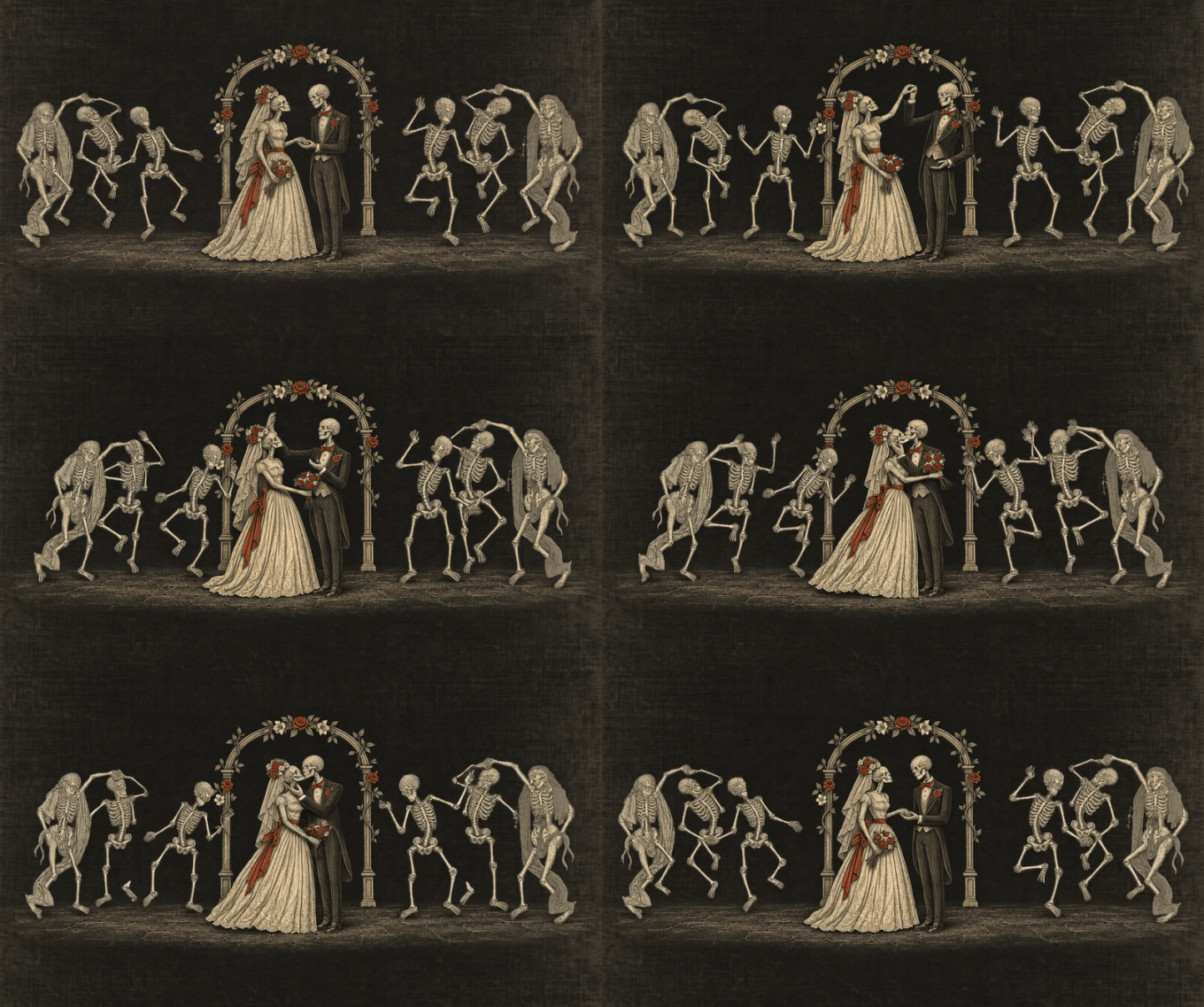
Even during wedding celebrations, death was never far from our ancestors’ minds. The rate of death in childbirth for medieval women was astronomical. Manchester writes: “On her wedding day, traditionally, [a bride’s] mother gave her a piece of fine cloth which could be made into a frock. Six or seven years later it would become her shroud.”
Still, people eked out what joy they could get from wedding celebrations. Among ordinary people, weddings were rude and raucous affairs. Olsen explains, “The guests kissed the bride, played practical jokes, sang obscene songs, and ate.” When the couple withdrew to their dwelling after the ceremony, they were offered little privacy, as “outside the revelers sang dirty songs and shouted insinuations about what was going on in the bedroom.” In Scotland, in a tradition called “the blackening,” revelers pelted the bride and groom with rotting food, manure, and mud in preparation for the hardships of marriage.
More troubling still, the bride, and the groom for that matter, might both be children. As Manchester writes: “Females could marry…when they reached their twelfth birthday. The age for males was fourteen. Even before she had reached her teens, a girl knew that unless she married before she was twenty-one, society would consider her useless, fit only for the nunnery, or, in England, the spinning wheel (a ‘spinster’).”
People born in ordinary households at least usually had some say in whom they married and when, whereas children in elite families were frequently betrothed from preposterously young ages. Patricians typically arranged betrothals for their children soon after age 7, and in some cases as early as 3.
Following these prepubescent betrothals, marriages could take place soon after the bride reached the age of puberty. Eleanor of Aquitaine (1122–1204) married Louis VII of France when she was 15, and he was 17. Lucrezia Borgia (1480–1519), a prominent Italian noblewoman, was married off to her first husband at just 13. The groom was 27. Another example is England’s King John (1166–1216), the monarch who issued the Magna Carta, who married Isabella of Angoulême when she was 12 years old. He was 33. In 1533, Charles V negotiated a marriage contract for his 11-year-old niece, Christina of Denmark, and a man four times her age, granting the groom the right to consummate the union immediately.
Our ancestors were not always faithful to their spouses, but the lower classes may have had a slightly cleaner record than the nobles. Among the nobility, adultery was nearly universal. In fact, Manchester claims: “Those wives in the noblesse d’épée who remained faithful to their husbands were mocked by the others. To abstain from…adultery was almost a breach of etiquette, like failing to curtsy before royalty.”
With so many difficulties accompanying marriage in the premodern age, it may seem a wonder that anyone married at all. Many people didn’t. Contrary to popular belief, in much of Europe, marriage was less common in the past than in modern times. Married people were only about a third of the population, compared with about 50 percent in Western Europe today. In northwestern Europe, being married was not common for most adults until well into the 17th century.
But remaining single in the preindustrial world brought its own challenges, as Olsen notes: “The life of a spinster could be a difficult one, with extended family using unattached female relatives as temporary live-in housekeepers when a wife died.” In other words, marriage was often the only way that women could avoid the fate of becoming unpaid live-in housekeepers to relatives. Economic necessity thus motivated many marriages. Marrying for love only began to emerge as an ideal in the 18th century and became more and more accepted during the 19th century.
A version of this article first appeared in Reason and is an adapted excerpt from The Grim Old Days.