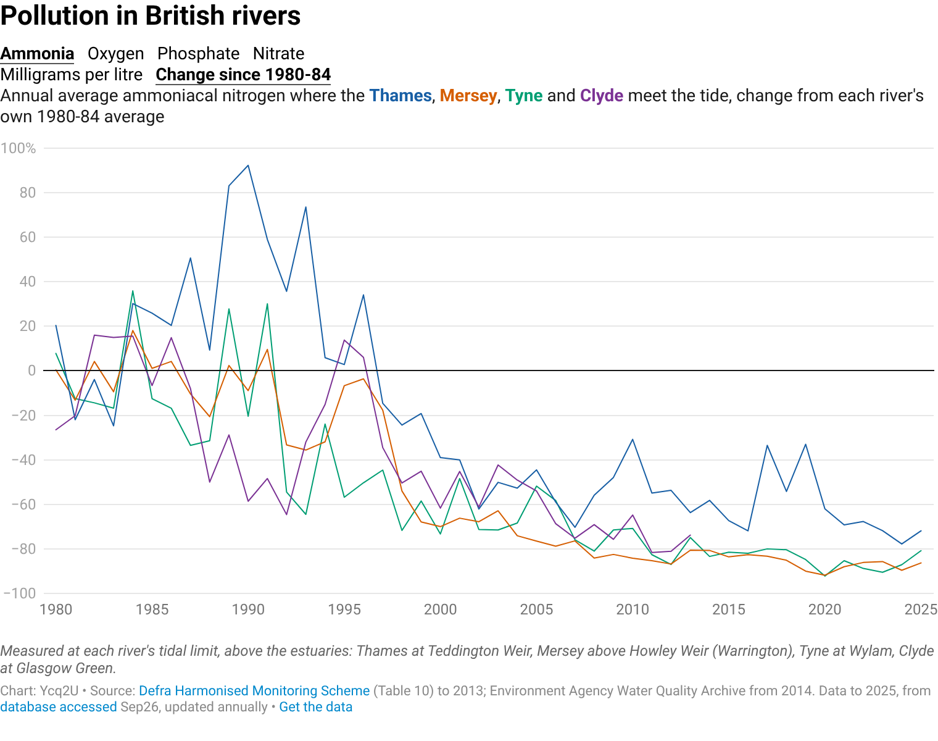
Summary: Many people believe Britain’s rivers are getting dirtier, and critics such as the economist Mariana Mazzucato blame profit-seeking water companies. Yet the big rivers were at their dirtiest under public ownership: in the 1950s, the Thames was declared biologically dead. Since the early 1980s, ammonia, the classic marker of sewage, has fallen by three-quarters or more in the Thames, Mersey and Tyne. The rivers seem dirtier because of a paradox of progress: England now monitors every storm overflow and publishes every spill, exposing pollution that went unrecorded for generations.
“Dirty old river,” begins Waterloo Sunset by the Kinks. When they released it, in 1967, the River Thames that runs through the British capital of London wasn’t just dirty: it had been declared biologically dead a decade earlier, along with chunks of most major rivers in the United Kingdom. Now the Clyde, the Mersey, the Humber and the Tyne are all alive again and teem with dozens of species of fish. As for the Thames, it is once again a home to some 125 species of fish, seahorses, and even sharks.
At this year’s Labour Party Conference, in Liverpool, politicians were swimming in parts of the Mersey once deemed too toxic even to dabble in. And when they got out, they started complaining about the deteriorating state of our rivers.
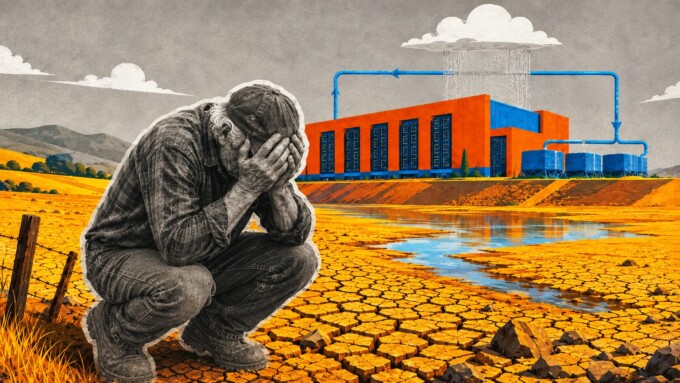
It was in a television set next to the Mersey that I debated Mariana Mazzucato, a University College London academic whose work on what she calls the “entrepreneurial state” is influential with the current government. Conversation turned to what she regarded as a sewage crisis. I said this was a misconception, a “paradox of progress.” Higher environmental standards mean greater transparency – and, with it, alarm when things go wrong. But overall, our rivers are cleaner than at any time in living memory. “You’re the only person in the UK who thinks that’s not an issue,” she replied. “The sewage going into our rivers and our seas is due to the lack of investment in infrastructure.” The model of private ownership, she argues, puts profits, shareholders and dividends first – hence the neglect, sewage and filth.
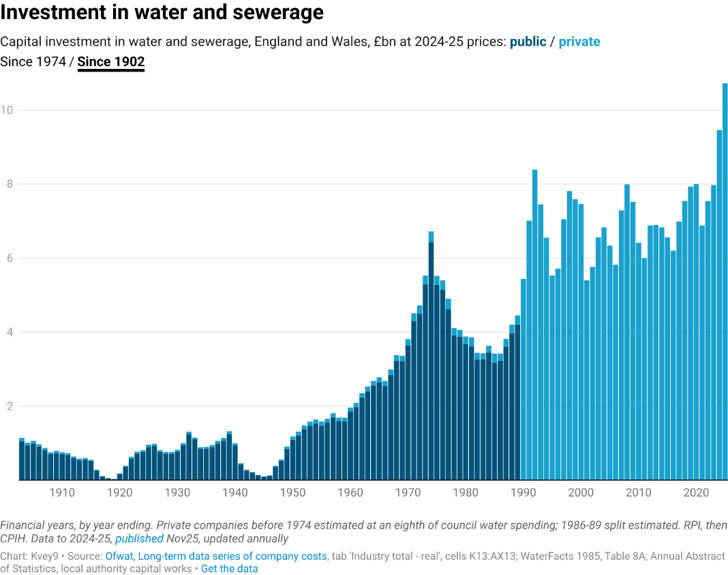
I see it differently. Water is largely privatized now, but when it was owned by government, our rivers were far dirtier and beaches far less fit to swim in. The state was negligent, not entrepreneurial or especially environmentally conscious. Privatization in 1989 was a mechanism to address the calamitous collapse in investment in water and sewage under government ownership, with capital spending that fell by almost half after budgetary tightening that started in 1973. Pipes were leaking almost twice as much water in the mid-1990s as they do now.
There have been many failures in regulation and corporate governance. Thames Water, in particular, has been a disaster. But the River Thames itself? Vastly cleaner than it was even ten years ago. The long story is that we are living in a golden era of environmental cleanup. And our rivers – in Britain, Europe and America – are going through an unprecedented rejuvenation due to a combination of capitalism, progress, innovation and (yes) investment in infrastructure.
But Prof. Mazzucato is right to say that almost no one talks about the improvement. Once, we treated filthy air and water with resignation: something we had no power to change. Now, we see it, quite rightly, as an outrage to be vanquished. This change is one of the main stories of our times. It’s a fascinating story. But it’s a long one, going back centuries – to the birth of London, Frankfurt, Paris, Dallas, Munich, Nanjing and many more.
A Brief History of Rivers – And Pollution
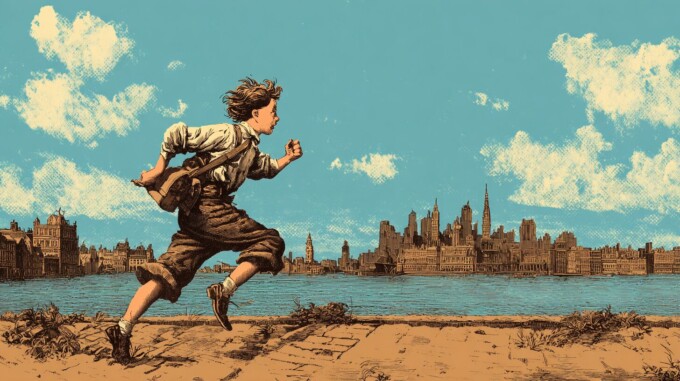
The Thames made London, just as the Seine did Paris, and the Main Frankfurt – the “ford of the Franks.” Oxford started as a ford for oxen. Bristol comes from the Old English Brycgstow or “place at the bridge.” Tianjin, China, home to 14 million people, means “Heavenly Ford,” after the spot where the future Yongle Emperor crossed the Hai. Settlements are made at decent crossing points, ferrymen settle, and things grow from there. Rivers were motorways before motorways were invented, convenient places for trade and, yes, handy places in which to empty a chamber pot. Not that this happened much: the usual thing to do was to empty the pot into a garden cesspit, which might in turn be emptied and used as manure for farms.
The rise of the flushing toilet in the 19th century took sewage straight to the river. Cue all kinds of problems (and disease) in a world that had not yet discovered germs and couldn’t quite work out where the cholera was coming from. The US cholera epidemics of 1832, 1849 and 1866 ran along rivers and wagon trails. When a dry summer left this sewage exposed on the banks of the Thames, it led to the Great Stink of 1858.
That was quite an event: a problem that had hitherto simply afflicted the poor hit the nostrils of the rich. Action followed. New sewers moved the waste downriver, but with varying efficacy, and population growth kept outpacing innovation. By the 1950s, sewage and industrial waste had made the Thames such a “dirty old river” that studies found fish had been extinguished. Further north, in 1951 and again in 1959, not a single salmon was reported caught on the Tyne.
Like the filthy air, the dirty water was seen as the price of city living. Back then, the reaction wasn’t today’s anger or outrage. It was resignation. The music of the time captures a moment. Waterloo Sunset was a love letter to the river Thames that followed The Standells’ Dirty Water (1966), a mock-ode to Boston Harbor and the Charles River. (“Well I love that dirty water / Oh, Boston, you’re my home”). The great Tom Lehrer pulled no punches with his 1965 satire, Pollution. “The breakfast garbage that you throw into the Bay,” he sang, “they drink at lunch in San Jose.” So much industrial gunk was being poured into Cleveland’s Cuyahoga River that it caught fire, not for the first time, in 1969. The blaze inspired Randy Newman’s 1972 song Burn On.
That was the time to talk about a sewage crisis, and about shocking underinvestment and neglect. At the time, water and sewage in Cleveland, London and Boston alike were run by public bodies: cities, counties or state agencies. Infrastructure is often sacrificed when governments hit budget problems, which is why privatization was seen as a longer-term cure. New companies could borrow and invest, with the repayments coming from customers’ bills. Far too much of that debt did indeed go to dividends. But when water firms were privatized in England and Wales, the investment flowed – and the great British River Cleanup began.
The Cleanup
The first Earth Day in 1970 launched a movement that pressed policymakers to start measuring pollution and cleaning our surroundings, and to convert economic progress into environmental progress. Laws set the targets, but consumer choice, innovation, and the market drove that progress: every day and in every way, we learned to tread more lightly on the planet. Pollutants in the air fell sharply. Deindustrialization helped, but consumers and voters started demanding, and getting, higher environmental standards.
In 1995, just 30 percent of England’s bathing waters were rated “good” or “excellent” for bathing. Now, it’s 87 percent: a stunning environmental clean-up at an historic speed. Levels of ammonia, the classic marker of sewage pollution, are down by three-quarters or more since the early 1980s in the Thames, Mersey and Tyne. Sewage is being treated much more effectively before it’s released into rivers. Capitalism, competition, and consumer demand for cleaner services are all having their effects.
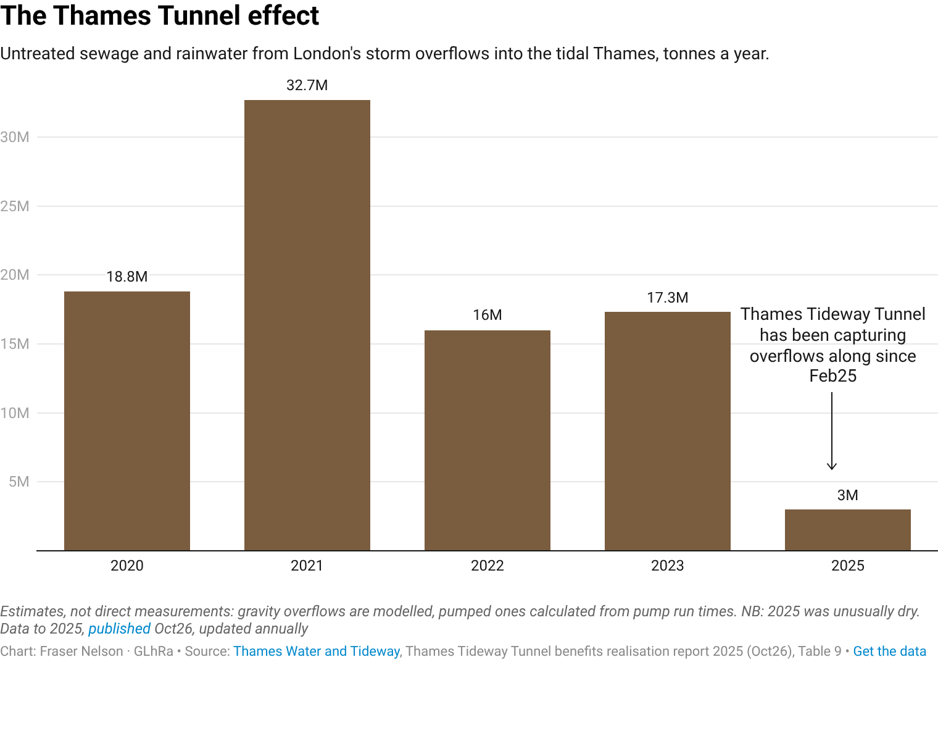
Nor does progress take a generation to show. Ten years ago, I bought a house near the Thames, which I cross on my way to work. But when I moved there, no one would think about swimming in it. The capital’s Victorian-era sewers are structurally sound but are regularly overwhelmed on rainy days. That leads to the notorious “stormwater” overflow where raw sewage ends up in rivers. Just five years ago, some 33 million tons of sewage-and-rainwater mixture was flushed into the Thames in a single year. My children row on the Thames. If anyone fell in, the school drill was to decontaminate them as if they’d been caught in Chornobyl.
And last year? Three million tons: still vile, but a 90 percent drop. That’s because the Thames Tideway super-sewer has finally opened: a privately funded (albeit government-guaranteed) feat of engineering. It cost £4.7 billion over nine years, funded by about £20-£25 a year on top of my annual water bill. It’s a once-in-a-century upgrade, exactly the kind of investment in infrastructure that critics claim isn’t happening. It has now captured more than 20 million tons of storm sewage – and the Thames is cleaner than at any time since Thomas Crapper started installing his new flushing toilets toward the end of the 19th century.
But that doesn’t feel like progress. In 2021, the UK Environmental Agency started to publish figures on stormwater – so people could see, for the first time, what has been happening for generations. The figures raised questions: Is the overflow disgusting? Absolutely. Fixable? Yes. The sewers, which were built for cities with far smaller populations, can be expanded. Similar super-sewers have been built in Paris, Washington D.C., Hong Kong and Singapore. Unlike in the UK, where the private sector footed the bill, the other cities, incidentally, used public money. Rivers get cleaner. That is the direction of advanced economies no matter who owns the water pipes. As we become richer, our standards rise. That’s progress.
Water Ownership and Pollution in Other Parts of the UK
The other sign of progress is that our tolerance drops. The singer Feargal Sharkey is now an environmental campaigner, highlighting the scourge of storm overflows in England. But when his musical career was at its height (with A Good Heart in 1985) the overflow wasn’t controversial. Short pipes carried much coastal sewage straight to sea every day, not just in storms. If he had campaigned then, he’d have had no traction: Isn’t that just everyday life? Wasn’t it just normal for sewage sludge to be pumped into the sea?
Sharkey now says the water industry in England is a regulatory failure where firms pollute, pass the cost to billpayers and almost never face punishment. He backs state ownership as the fix. But to see what that would look like, he can see closer to home. Water is still run by the government in Sharkey’s native Northern Ireland, as it is in Scotland. Neither seems in a great rush to mark its own environmental homework. In England, every storm overflow has been monitored since the end of 2023, and every spill must, by law, be published within an hour, with people like Sharkey quite rightly taking a keen interest in the results. Scotland only monitors about half of its overflows. Northern Ireland, one in five.
Sharkey is from Derry, where Alfred Street Florence, one of the city’s combined sewer overflows, was spilling into the River Foyle about three times a week last year. That’s 14 times as often as a typical overflow in England’s privately-owned system. So where is the anger? The UK’s worst offender is Welsh Water, a not-for-profit company with no shareholders which serves (or, rather, fails to serve) most of the principality. The people of Wales suffer five times as many sewage spills as England.
England’s private system now has a virtuous circle: transparency, public anger, campaigners, and politicians and companies that respond to the pressure. Private companies make this process better by being so easy to hate: all those profits, well-paid directors and dividends. Berlin admits its stormwater sewage still kills fish in the Spree. Munich doesn’t publish its figures at all. England is the only one counting every spill – and for that it’s being called the sewer of Europe. But that is, paradoxically, a sign of success. It’s necessary pain. Transparency leads to concern, which feeds pressure, which leads to investment.
Capital spending on the English private companies stands at about £700,000 per sewage overflow, vs £320,000 in not-for-profit Wales and £270,000 in state-run Scotland. On the Mersey, United Utilities spent some £200 million a decade ago extending its Liverpool treatment works at Wellington Dock, and it may build a super-sewer to protect Lake Windermere in Cumbria. There’s much to do – progress has rather stalled outside London.
I… Live by the River
Last summer, I went swimming at London’s first official River Thames bathing site just a short walk from my home. My daughter was learning to sail and, when she finished, messed around in the river with her friends. Just a decade ago, parents would have been horrified. Now we’re just mildly grossed out. There is so, so much more to do. That’s the beauty of environmental progress: it’s never enough. We riverside people now have water we can paddle-board on; even fish in. But for as long as there’s a chance of encountering sewage, don’t ask us to be happy – or thank anyone for the progress already made.
The UK government has been designating more stretches of beaches and rivers as official bathing waters: another sign of ambition and progress. That lowers the share of sites passing the test and seems to show that things are getting worse. As a company, Thames Water might be the worst imaginable advertisement for the market. It loaded itself with borrowing; the dividends and bonuses came long before new pipes and super-sewers. Ofwat, the regulator meant to stop that behavior, looked the other way during the good years. But Thames Water is no metaphor for every privatized utility. Most of all, its troubles cannot be made to obscure the overall story of environmental progress.
We are at the point where the environmental lights are finally being switched on. Switching them on is easier for a government when it’s not exposing its own failure. We will not like all that we see. That’s precisely the point: to release the power of scrutiny and pressure. With great results. When Dirty Water is played at Boston’s Fenway Park today, it’s a celebration of a Red Sox win – and a celebration of a river that now hosts public swims.
The cleaning and greening of the world, at an unprecedented pace, is an achievement almost as extraordinary as our ability to tell each other that the reverse is happening. Any country wanting to clean up its rivers a bit faster can look at the English model: transparency, investment, campaigners and rigorous debate. The anger is necessary and justified; it’s the engine of progress. But it should not hurt, sometimes, to look back and consider just how far we have come.