Today marks the twenty-first installment in a series of articles by HumanProgress.org called Centers of Progress. Where does progress happen? The story of civilization is in many ways the story of the city. It is the city that has helped to create and define the modern world. This bi-weekly column will give a short overview of urban centers that were the sites of pivotal advances in culture, economics, politics, technology, etc.
Our twenty-first Center of Progress is Bologna, home to the first university (as commonly recognized) and the oldest continuously operating university in the world today. The University of Bologna, traditionally said to be founded in the year 1088, was the earliest institution to award degrees and promote higher learning in the manner of a modern college or university.
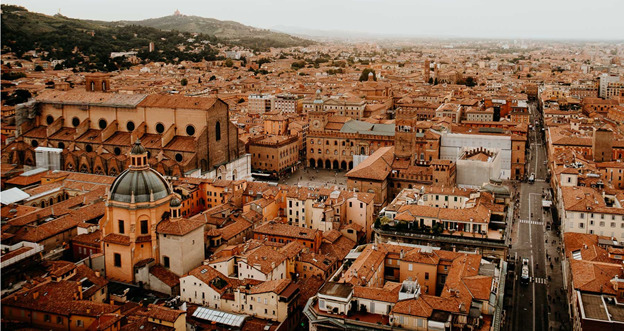
Today Bologna is the seventh-most populous city in Italy and home to over a million people. The city’s symbol is le Due Torri (the Two Towers), stone structures which may date to 1109 and 1119, respectively. (A scarcity of documentation from that time period means that the exact construction dates remain a bit of a mystery.) Despite sustaining damage from a bombing in 1944, Bologna’s historic city center has remained largely intact and, at 350 acres, is Europe’s second largest stretch of medieval architecture. The major historic squares are dominated not by statues of generals or political figures, but by tombs and memorials to medieval professors. While less popular with tourists than Florence, Venice, or Rome, Bologna has a burgeoning tourist industry. Other prominent local industries include energy, machinery, the refinement and packaging of local agricultural products, fashion, and automotives. The city is the headquarters of both Ducati, a motorcycle company, and Lamborghini, which produces luxury sports cars.
The city has three nicknames. La Rossa (the red) for its stunning medieval architecture, defined by red rooftops and lengthy UNESCO-protected red terracotta porticoes that make it possible to traverse much of the city while remaining in the shade. (Bologna also has a reputation for left-leaning politics, giving that nickname a double meaning.) La Dotta (the learned) for its long tradition of devotion to knowledge and for its many university students, as well as its status as the city that produced the first university. And La Grassa (the fat) as an acknowledgment of the city’s culinary innovations and reputation as one of Italy’s gastronomic capitals.
Bologna’s contributions to global food culture are significant. The city lends its name to Bolognese sauce, a meat-based pasta sauce popular in Italian cuisine that dates to at least the 18th century. Its variations are served in Italian restaurants around the world. But the city is perhaps most famous in the English-speaking world as the origin of the processed lunch meat known as Bologna sausage—with Bologna corrupted into the pronunciation baloney rather than ba-loan-ya—or simply called baloney. (Either spelling is acceptable for the food).
Baloney is a variation of Bologna’s mortadella sausage, which may have originated as long ago as the 14th century. Both mortadella and baloney are made of ground-up heat-cured pork. Italian immigrants to the United States popularized baloney in the early 20th century. An inexpensive product made from scraps of leftover pork, baloney has also come to mean “nonsense.” That is ironic given that, far from encouraging nonsense, the city of Bologna spearheaded humanity’s search for truth through higher education.
Bologna enjoys a prime location amid broad fertile lowlands next to the Reno River – to this day one of Italy’s leading agricultural regions. It is thus unsurprising that Bologna was first inhabited as early as the 9th century BC.
The city’s desirable location meant it was frequently conquered by outsiders. The original Etruscan city of Felsina (as Bologna was then called), fell to the Gauls by the 4th century BC. A Celtic people, they called the settlement Bona, meaning “fortress.” In 196 BC, Bona became a Roman outpost bearing the Latinized name Bononia, from which Bologna is derived. After the fall of the Roman Empire, Bologna was repeatedly sacked and variously occupied by invading Visigoths, Huns, Goths, and Lombards. The city was then conquered by the Franks, led by King Charlemagne, in the 8th century. Hungarians sacked the city in the 10th century.
By the 11th century, Bologna sought to escape feudal rule and become a free commune, with the motto Libertas (“freedom”). Exactly when Bologna made the transition is unknown, but the oldest surviving constitution of the city dates to 1123. However, the city did not remain independent for long, as various warring noblemen of the Italian medieval and Renaissance periods vied for control of the city.
While limited medieval records make dates uncertain and the precise order of events unclear, at some point during the 11th century Bologna became the center of a revived interest in higher education, particularly the study of law. Lay students from across Europe flocked to Bologna to study law under a renowned jurist known as Pepo, an expert on Justinian the Great’s compilations of Roman law.
Upon their arrival, foreign students were faced with discriminatory city laws. Bologna allowed collective punishment, the charging of any foreigner with the crimes and debts of their compatriots. The city could, in other words, seize a Frenchman’s property to pay another Frenchman’s debt, and punish a Hungarian for a crime committed by a different Hungarian. Because Italy was not yet a unified political entity, many groups who are today Italian, such as Sicilians, counted as foreign nationals and were also subject to collective punishment in Bologna.
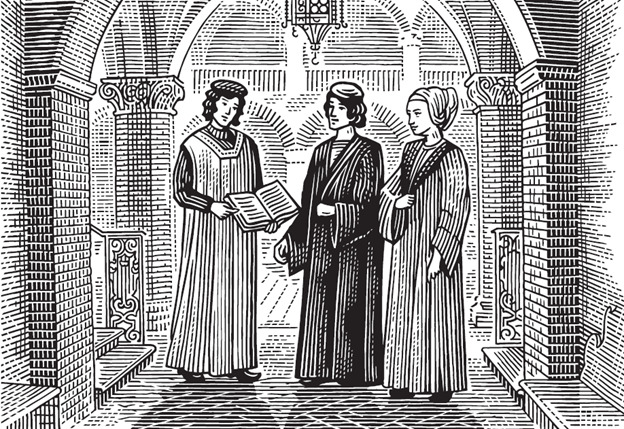
Bologna’s growing body of foreign students decided to try to change the laws concerning collective punishment that made living in the city perilous for non-natives. They formed a guild, a kind of mutual aid society, known as the universitates scholarium. The guild hired legal scholars to give organized instruction to the students, and the latter successfully petitioned the Holy Roman Emperor Frederick I (1122–1190) to aid their cause. Frederick I issued a charter officially recognizing the University of Bologna. Known as the authentica habita, the charter granted protection to Bologna’s foreign scholars from collective punishment and gave them the right of “freedom of movement and travel for the purposes of study.” The word universitas, which meant guild in late Latin, was coined to describe the organization and gave us the modern sense of the word university.
Like today’s universities, the University of Bologna developed separate departments for different fields of study, such as theology, law, medicine, and philosophy. And, like today’s universities, the University of Bologna set degree requirements and awarded bachelor’s, master’s, and doctoral degrees. By pioneering the university model of instruction, the University of Bologna helped humanity to make progress in many areas—but especially legal studies. Pepo is often said to be the first university’s first legal instructor.
Pepo was soon far surpassed by his student Irnerius (c. 1050–after 1125), who also went on to teach at the University of Bologna. He was originally a student of rhetoric and didactics. His wealthy patroness, one of Italy’s most powerful nobles at the time, Matilda of Tuscany (c. 1046–1115), convinced him to switch fields and study jurisprudence. Nicknamed lucerna juris (“lantern of the law”), Irnerius’s scholarship is credited with creating much of the Medieval Roman Law tradition. His glosses on the ancient Roman law code helped to move medieval law, which was sometimes disordered and contradictory, in the direction of becoming more systematic and rational like the ancient Roman legal system. Irnerius’s most famous students – Bulgaro, Martino, Ugo, and Jacopo – came to be called the Four Doctors of Bologna. Each allegedly had a different approach to legal philosophy.
By the end of the twelfth century, the University of Bologna had the uncontested title of Europe’s premier center for higher learning, particularly legal studies, drawing an ever-larger crowd of elite international students from across the continent. The Englishman Thomas Becket (c. 1120–1170), a famed Archbishop of Canterbury who sought to preserve the independence of the Church from the State, and who is now revered as a martyr-saint in both the Catholic and Anglican Church, studied law at the University of Bologna in his youth. The Florentines Dante Alighieri (c. 1265–1321) and Francesco Petrarca (1304–1374) also both studied at the University of Bologna. Other famous alumni include four former popes. Yet another renowned alumnus was the Dutchman Erasmus of Rotterdam (1469–1536), an early champion of religious toleration and peace, and arguably a hero of progress.
From the twelfth to the fifteenth century, the university had between three and five thousand students. Today, the university has over eighty-six thousand students.
The University of Bologna is also commonly said to be the first university to award a degree to a woman and allow one to teach at the university level. According to tradition, in 1237, a noblewoman named Bettisia Gozzadini (1209–1261) graduated after studying philosophy and law and began lecturing on jurisprudence in 1239.
Whether Gozzadini actually graduated from Bologna became a point of contention in the 1700s. The writer Alessandro Machiavelli (1693–1766) sought to provide evidence (possibly faked) of Gozzadini’s achievement in order to support the Bolognese Countess Maria Vittoria Delfini Dosi’s request to be granted a law degree. Despite Machiavelli’s efforts, the countess’s request was ultimately denied. Male scholars who opposed the idea of granting women degrees sought to dismiss Gozzadini as a popular legend. Scant records from the medieval period make the truth hard to discern.
That said, the University of Bologna employed the first female salaried university professor, the physicist Laura Bassi (1711–1778). She is credited with popularizing Newtonian mechanics in Italy. She was also the first woman to earn a doctoral degree in science and only the second woman to receive any doctoral degree. Bassi’s doctorate was also from the University of Bologna.
Bologna boasts many achievements in realms as diverse as architecture and gastronomy. But creating the world’s first university has been Bologna’s defining contribution to human progress. Universities have helped to promote scholarship, innovation, and higher learning ever since. By promoting the study of the law, in particular, Bologna helped humanity in its pursuit of an improved system of justice.
The translated university motto reads, “Saint Peter is everywhere the father of the law; Bologna is its mother.” The university’s full name is Alma Mater Studiorum Università di Bologna, or “the Nourishing Mother of Studies University of Bologna.” From that name, we get the term alma mater, popularly used by university graduates throughout the world to refer to whatever university they attended. But the mother of all universities is Bologna. For birthing the modern university system, medieval Bologna is rightly our twenty-first Center of Progress.