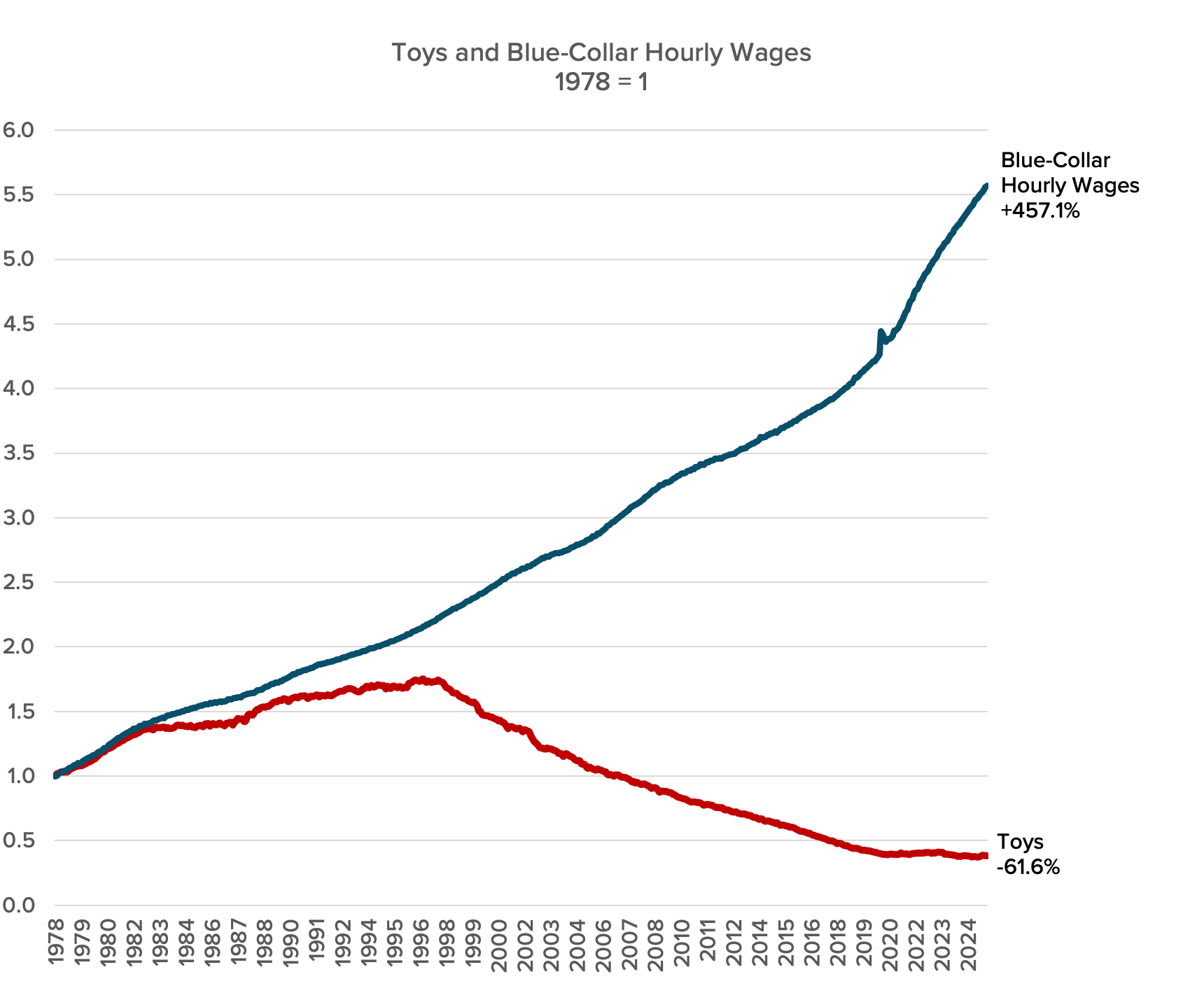
The US Bureau of Labor Statistics (BLS) started tracking the nominal prices of toys back in 1978. Prices peaked in 1997 and then began a steady decline. Since 1978, toy prices have decreased 61.6 percent. During this same period, blue-collar wages increased 457.1 percent from $5.66 per hour to $31.53 per hour.
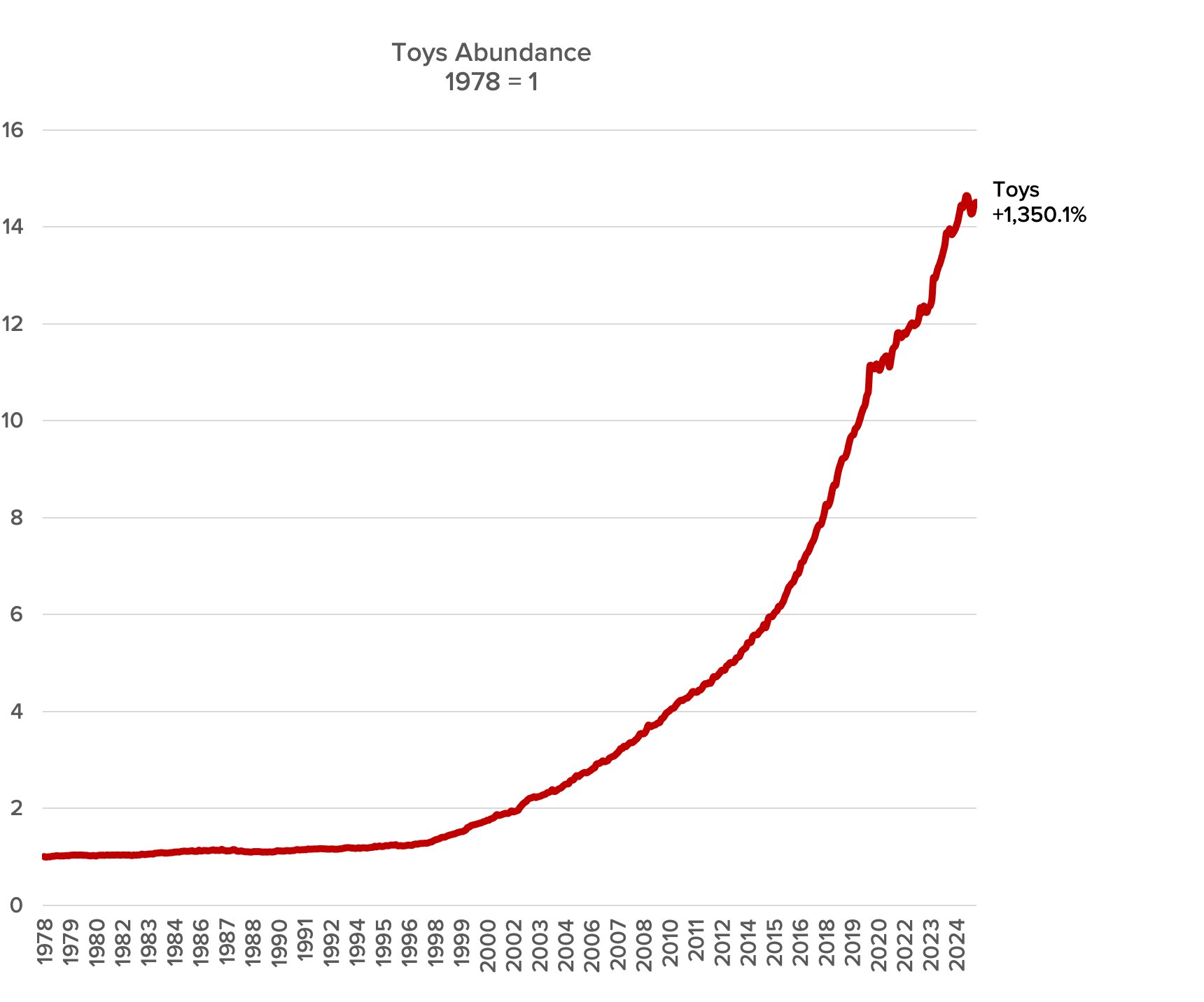
That indicates a 93.1 percent decrease in the time price of toys for blue-collar workers, who now get 14.5 toys for the time price of one back in 1978.
Upskilling Workers
Most people don’t begin their careers as blue-collar workers and remain there for 47 years. Consider entry-level workers, who earned $3.40 per hour in 1978. If, over the past four decades, these workers have upskilled and advanced to the average US private sector wage of $36.67 per hour, their nominal wage would have risen 978 percent. For these workers, the time price of toys fell by 96.4 percent, meaning they get 28 toys today for the time price of one in 1978. What used to take 10 hours of work to buy, now only takes 22 minutes. Innovation and free market competition have given us nine hours and 38 minutes of more time to enjoy the holidays.
Find more of Gale’s work at his Substack, Gale Winds.