
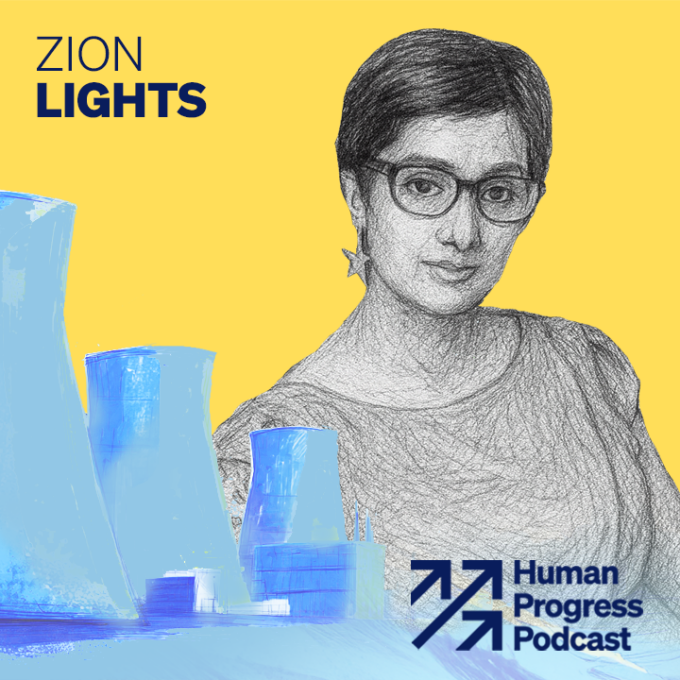
Chelsea Follett: Joining me today is Zion Lights, an award-winning science communicator who is known for her environmental advocacy work and her vision of a high-energy, low-carbon future. Zion has been called “Britain’s Greenest Mother,” by the Daily Telegraph and “An eco-pragmatist, happily heavy on science,” by the Guardian. Her latest book is titled ‘Energy is Life: Why Environmentalism Went Nuclear.’ And she also has a brilliant new op-ed promoting the book out on The Human Progress website. Zion, thank you for joining me. How are you?
Zion Lights: Good, thank you. Good to be back here.
Chelsea Follett: All right, so tell me, what inspired this book?
Zion Lights: The book is narrative nonfiction, so it’s quite unusual because, to be honest, there are a lot of good nuclear books out there, but they tend to focus on the technology. Now that’s good because we need those books as well. But what I find when I’m giving talks and interviews and things is usually I’m speaking to people that already agree with those points. So the people who tend to read the heavily scientific books already agree, you have a lot of common ground there, so you’re not really convincing them on anything. And for me, the comfortable space is being out there where the challenge is, is being out there trying to convince people to think differently or to just approach the subject differently, consider new ideas. So I’ve written it in a storytelling way, following my journey as an anti-nuclear activist for a long time and quite a prominent environmental activist, through to where I got to now, while also explaining things like waste and accidents, because people always ask about this, you simply cannot write a book about nuclear and not include them. But I’ve tried not to make it super technical because I think, actually, the people we need to reach out to, who need to read the book and consider different arguments and approaches, are not necessarily the sort of people who are reading the kind of dense technological books, which, as I say, there’s definitely room for them. But I wanted to write something that would have changed my mind. I know if I had read this book 15 years ago when I was out blocking roads, doing all those heavy protests, this is way before Extinction Rebellion, this book would have changed my mind 100%. I needed to hear these arguments. I needed to see this data, but not just look at plain data, but understand it in the context of what does that mean for humans and for the planet.
Chelsea Follett: We did an entire other podcast about your journey to get where you are today in terms of your policy beliefs. But for people who aren’t familiar with that whole journey, could you just quickly summarize your history as an activist in the environmental movement and how drastically your views have changed over time?
Zion Lights: Yeah. I’m what you might call a former radical environmentalist. And the reason I say that is because there’s a lot of people now who say, “I’m pro-environment and I’m pro-nuclear,” but they were not necessarily actively pro-environmental issues. And I was very active. I was active in all the major groups: Greenpeace, Friends of the Earth, taking part in protests, organizing protests, organizing petitions and open letters, lobbying. I was doing all of that from quite a young age, from teenage years, even before, to be honest, letter-writing and things before. And part and parcel of that is being anti-nuclear. So I went on anti-nuclear protests, I signed the anti-nuclear petitions. To me, weapons and energy were the same thing. That’s what I was taught in these groups. We don’t really learn about it at school, so there wasn’t any other information outside of what I was hearing in these groups. And so for a long time, I was a very active anti-nuclear activist. And over time, and this is a long story, I won’t get into it, but it’s all in the book, I changed my mind and actually felt so bad after I realized how good actually this technology is for the environment.
Zion Lights: I decided I need to make amends for my own sake, but also because I still believe in having clean air and having a better future for my children and things like that. And I thought, actually, I’ve done more harm than good. So I decided to completely pivot, which was not as uncommon now, but at that time, it was a really, a big moment for someone who, at that time, I was a spokesperson for Extinction Rebellion and I ran the newspaper. I founded and ran the newspaper, The Hourglass, that we used to distribute around the UK. And, yeah, I decided that… I’d already changed my mind some time before, but I decided that it was time to do it publicly because actually it was a message people needed to hear. And obviously, it was controversial and I got some people being upset with me about it, especially in those environmental groups. But actually, some people in those groups went, “Oh, wait, we agree. We didn’t think about it that way.” So that’s really good as well.
Zion Lights: So I changed my mind publicly to try and fix some of those wrongs and then kind of got propelled into just talking about nuclear all the time because suddenly I was… People wanted to speak about it, but they had all these technical questions. And I sometimes had to actually go away and read up on stuff because I didn’t know. And I’d say, “Well, they want me to talk about waste, but I’ve never seen waste.” So I had to go and visit Sizewell C, which is hours away from where I live. It’s right on the coast in the southeast of the country. Long train journey just to go and look at nuclear casks so I could say, “I’ve been there, I’ve seen them. I had a Geiger counter. I know they’re not overly radioactive. It’s all good.” But I think that’s really important because data and numbers can be very abstract, but the human story of, “I’ve been there and I hugged the cask and I’ve got the photo to prove it,” that kind of helped to push the conversation forward. And now I think we’re in a very different place and it’s moved along a lot since then, which I’m really happy about.
Chelsea Follett: Absolutely. So let’s dive into the book and the case for nuclear energy. You argue that, ‘Energy is life.’ That’s right in the title. What do you mean by that? And why do you think this framing has been lost in modern debates?
Zion Lights: It’s funny because when I was in Extinction Rebellion, one of the things that we pushed for was net zero goals. And this was influential everywhere, not just in Britain where the group was founded. All over the world, people were suddenly setting net zero goals, even countries with very little capacity actually to be able to do so. Everybody, I think, felt propelled, like pushed to do it. And I’m not saying that the reasons were wrong. Climate change is an issue, air pollution is an issue. But the problem came where, for some reason, net zero or decarbonization became synonymous with only renewables. And that was a huge, absolutely huge mistake. It should have just been clean… Not just clean energy, but what’s cleaner? Because you can have gas. Gas is cleaner than coal. So really, I would have said more this should be a phasing out coal initiative, but it’s not as catchy as net zero. Which obviously you can dive into, it doesn’t really even make sense. It’s not really possible to be net zero, but anyway, it’s catchy.
Zion Lights: It took off because it was catchy, and it captured a moment, I think, which now there’s been a lot of backlash to, people have thought about it a lot. But I think the reason why net zero was tied into, “Well, it can just be done with renewables,” is because it was about energy scarcity. That’s what it was about. How do we use less? And this is an old idea. This is from environmentalism from well before I was born, about living with less: less stuff, less consumerism, less energy. Definitely less energy. Even when I was growing up, I remember campaigns on TV about not leaving your lights on when you leave the room and not wasting your tap water and things like that. It was really drummed into us for a long time. And that came from the environmentalists who actually, I think, made a huge mistake because they’re focusing on these tiny little things that they just don’t add up to very much. And we know that because we can look at the state of where we’re at now and think, “Well, where’s the biggest savings been made?”
Zion Lights: Well, it’s been made when we’ve switched from coal to nuclear, or coal to gas, or gas to nuclear. We can see where those changes were made. It’s not from you or I remembering to turn the light off when we leave the room. Now, obviously we should. I’m not saying let’s be wasteful, but I’m just saying let’s be realistic. So what happened is the net zero got lumped in with, “We need to live with less,” and that means we’re bad because we’ve been living with too much, too much energy. And I’ve been asked this a lot as well. I’ve been asked this on various panels by people in the audience. They’ll say, “But isn’t there a danger of too much?” I think that’s really interesting. Why is there a danger of having too much? I’m not talking about just running your television. I’m talking about refrigeration and lighting after dark so that when you go out after dark, you have street lights. These are things we take for granted. And when I started to realize, it’s because people aren’t connecting. They’re asking that question and promoting scarcity because they’re not connecting their everyday life with energy. They have never had to live with scarcity.
Zion Lights: We haven’t. The only time we touched upon it was when we had the energy crisis because of what’s going on in Russia and Ukraine. And because of that, we suddenly had to think… We didn’t have to ration, but we had to think a bit more about using energy just because it got so expensive, because it was scarce, right? And for the first time, people started thinking, “Oh, this is something I need to consider. Maybe I shouldn’t run my washing machine as often.” But they didn’t like it because the fact is nobody actually likes living with scarcity. And when they actually had to do it, that’s a problem because I need to use my tumble dryer because it’s raining and my kids need their sports kit dried. How else am I gonna dry it? Sort of thing. Especially in Britain, it’s very wet a lot of the year round. In a way, it sounds obvious when you say, “Yeah, we’re heavily dependent on energy.” Right now, I’m on a laptop, I’m using a microphone that’s plugged in, I’m using a camera, I’m using lights. If it’s cold, I’ll put the heating on. If it’s hot, I… Well, most people might have AC. We don’t really have it over here. But we are so dependent on it, and it’s not… Even that word isn’t right, “dependent”. I’d say we’re almost interdependent, because it makes it sound like, oh, we could live without it, we’re just being spoiled. And that’s the problem that came with net zero. We’ve been spoiled and we’ve damaged the planet, we use too much energy, now we will suffer by having less. And that was wrong. I think actually what we should have been always aiming for was abundance and having more. So long as it’s clean, or as clean as possible, then there’s no problem. We could have always done that. The problem is that we didn’t make that shift, and then when we did, we went for ideology. The ideology of it needs to be wind and solar. And that’s failed. Where they’ve attempted that, like in Germany, and that’s failed. But also, I think it’s kind of failed people because the outcome of that is such expensive electricity. And now we’re at the point, at least in Europe, or a lot of Europe, where people just don’t care where it comes from, they just want cheap electricity.
Zion Lights: It’s just got to that point where even people who really care about the environment are saying, “It’s too expensive to run the heat,” or, “My nan’s freezing cold in her house ’cause she won’t put the heat on because it’s too cold.” That’s a sad way of thinking. Scarcity is actually a sad way of life. And there’s a reason that we moved away from that and we built radiators and we burned a lot of coal and we put in everything so that we wouldn’t have to deal with it anymore. But I often think also there’s more coming. What’s next? We are an energy-heavy species. That’s okay. But that probably means there’s more coming next, more technologies. Obviously you’ve got AI, but even more essential technologies might be coming. What happens if we have energy scarcity and we can’t afford them? That’s problematic to me. I know it upsets people to think of it this way because we’ve been almost trained to think about scarcity. Live with less, be less, you’re harmful, your existence on the planet’s harmful, you need to do less, you need to have less. And I think it’s just propaganda. And I’m sorry that actually I was part of groups that helped to push that because let’s be honest, it did not save anything. It has not solved anything. Even where you could say there’s cases where CFCs were damaging to the environment, the ozone layer, fine, we just replaced them with something else. We didn’t just stop using refrigeration because it had CFCs in them, we replaced them with something else. And that’s okay. Replace things with things that are better. That’s where nuclear comes in. It is one of the best technologies energy-wise. But we protested it because we didn’t want people to have more. That wasn’t my personal reason, but I’ve learned since then, actually, a lot of these people, even some of the environmentalists I’ve convinced, have said, “Well, the problem is if we have nuclear, then don’t we have just abundant energy and people just waste it?” So it still comes back to that reasoning. And I wrote the book to try and challenge a lot of those ideas. And it is quite challenging, but I haven’t seen them made anywhere else.I haven’t seen those arguments made anywhere else. So I’ve tried to put it as kind of imagine your life living somewhere without access to reliable electricity. What’s that life like? And do you really want to live that life? Because millions of people don’t.
Chelsea Follett: Historically, you claim that every major leap in human well-being seems tied to greater energy abundance. Tell me about that.
Zion Lights: Yeah, it’s true. If you think about people in cold climates, not particularly here, we have quite a mild climate here in Britain, but in colder climates, how many people died every winter just because they couldn’t stay warm? It really was survival of the fittest. If you could go and chop enough wood for your fire, then you might make it through the winter. But if you didn’t have a support network and you’re older or in any vulnerable community, or a child even, then you were unlucky and you wouldn’t survive. And I think that’s, obviously, I think that’s bad, and we don’t want that for anybody, which is also why cheap electricity is important. But you can link it to everything. And then in hot countries, you can link it to air conditioning. And I know that even in places like Singapore, you’ve had previous leaders say, “Well, actually, we could not have even had this level of development without air conditioning.” It saved so many people’s lives. And again, it’s hard for anyone to imagine when you don’t live in those extremes. I’ve only visited countries where it’s 40-degree heat, 40 degrees Celsius, and it’s too much for me.
Zion Lights: And I think, wow, yeah, it’s hard to live and work in those environments. And actually, you tend to get quite sluggish because you can’t do as much, and you have more diseases and all kinds of problems that come with that level of heat. But again, it was changed. Their entire society was changed because they got access to air conditioning, and they really appreciate it there. It’s embedded in the culture in the same way that central heating is here. There’s so many leaps, almost every leap when you look at it. Agricultural leaps, right? Mechanization. How did we go from really intense human labor to building machines in factories that required energy, and then going from that to electrifying? We’re already pushing for more electrification in lots of areas because, again, we recognize it’s usually more efficient. It’s almost always more efficient, and it’s healthier for you. So let’s just keep doing it. Yeah, there’s almost every kind of leap forward where we’ve improved things, it’s because we got that. Imagine if we didn’t have access to abundant electricity. Well, Singapore couldn’t have had that development because they couldn’t have had the AC. Lots of people would die every winter. I mean, we do have some cold-related deaths sometimes here in winter when it’s very cold, and there are some people who unfortunately can’t afford to put on the heating or they choose not to, and usually it’s elderly people. But it’s very low numbers. But if you look historically, it just used to be normal. There would just be people who didn’t make it through the winter, and in hotter countries, there would just be people who die of heatstroke and don’t make it through the summer. And it sounds absurd… It’s absurd, but I make the argument that nature is really unequal. Nature is mean. Nature goes after the weakest people. It goes after them. And I don’t mean weak as in the person’s weak themselves. I mean everybody gets old, everybody’s born a baby and becomes a child, all of those things.
Zion Lights: And you can look at healthcare as well. And I think there’s more coming in healthcare. Obviously, you’ve got things like medications that we have access to now that we couldn’t have had before because you have to store them at a certain temperature. Well, now we have refrigeration. We have all of the things obviously that you get access to in hospitals, which are all run on electricity. But even more, I think, is coming because they’re using more AI in some of these healthcare settings. They’re proving to be so good for human health that actually we’re gonna have more of that. But guess what that needs? That leap forward that we need now is from needing more energy. And I know a lot of people will think AI, they’ll think LLMs or AI art. I don’t like that, that’s what they’ll think. But I urge those people to go away and look at, and I did do another piece for Human Progress on this, some of the other applications that you don’t realize in healthcare, in diagnosis, in helping illiterate communities because you can use the voice recognition software. And again, that’s linked to healthcare as well. There’s so many applications that I don’t think anybody can look at that and say, “We don’t want to roll that out.” That’s amazing technology. But it requires a lot of energy, as we know.
Zion Lights: And so even that next leap is looking at that. And you can also look wider. You can look at science making leaps, like the Large Hadron Collider down on the France-Swiss border. It’s the biggest particle accelerator in the world. It’s trying to find out fundamental things about the universe. It uses a lot of energy. And during the energy crisis, they had to shut it down, because, in a way, countries were rationing on a large scale because France had to import more electricity to other countries. And you had scientists saying, “We don’t know if this will work if you leave it shut down long term. It’s not designed for that.” It was okay in the end, they managed to switch it back on. But I remember thinking that’s really sad. That should be headline news instead of just something I read in a scientific journal. Because that’s part of who we are. That kind of exploration is part of who we are. Why did we allow ourselves to pursue scarcity when we know that in order to push ourselves forward and for progress, we always need more, not less?
Chelsea Follett: You describe energy as a multiplier of human ingenuity. Can you give me some more concrete examples of how energy unlocks human potential?
Zion Lights: I tried to talk about this in human terms. When I visited my parents’ family in the Punjab in India, they live in a very poor rural area, although actually it’s not extreme poverty. It’s not the poorest of the poor. They have food. They’re rice farmers. They’re dependent… But here’s where the issues come in. Yes, they’re rice farmers, but they’re dependent on rain. If it doesn’t rain enough, if the monsoon rains aren’t sufficient, or if it doesn’t rain enough in the summer, then they don’t eat and they can’t sell that rice, so they don’t make any money, so they can’t buy other foods. It’s so hard to imagine having to live that kind of lifestyle where you can’t just go to the shop and buy some bread and rice and whatever you need. Well, we enabled that through development, which required burning a lot of fossil fuels. That’s how we got here. That’s our story. That is the human story. And there’s still countries, different places along the line. Some are still developing and some of us have already kind of got there.
Zion Lights: But you can go and have a look at how people are living now. And I think there’s a bit of a problem actually where Westerners will often go and they’ll see it as… I’ve had friends who’ve gone to India and they just go to the tourist sites and they said, “Oh, it’s so peaceful and I love how it’s not materialistic.” And they have the… I don’t know, it’s like a stereotyped kind of, “Oh, and they don’t care about the things we worry about, or they don’t have that stress of capitalism.” They don’t have the privilege. They don’t have the privilege because they are just trying to get through the day and make sure everybody’s fed and nobody dies of a preventable disease. Back, again, back to the village. If you get bitten by a snake or a dog, which is very common over there, there’s lots of wild dogs, governments try to eradicate them, it’s very difficult to do, they keep coming back, you’ll probably just die. If you’re in a village, you’ll probably just die because the nearest hospital will be hours away. From my parents’, from their village, it’s four hours, from my dad’s village. That’s by car, which nobody has in the village. They don’t have roads. There are roads in cities, but not in the rural areas. A lot of people have bikes. You think you can get to a hospital on a bicycle carrying a sick child when it takes four hours by car? It’s so hard to impress how integral it is to our everyday lives. We are energy-rich and we are really lucky. That doesn’t mean there aren’t other problems. That doesn’t mean that there aren’t nuances. I know that. But we can hold that idea in our head at the same time as looking at some of the things that need addressing and realize that the lifestyle that I’m describing, where they don’t have the access to, it’s not even just lighting and AC, AC would be important because it does get so hot there. But medication and healthcare, not just healthcare, but education as well. I remember my parents trying to pay for a teacher to live in the village, ’cause obviously my parents live over here. They’ve been here a long time.
Zion Lights: They’re very well off compared to anyone in India, apart from the few billionaires, if you like. And so they were like, “Well, that village would benefit from education. All our children have benefited from education. If we can improve the education, then they can solve some of the problems themselves.” We can hopefully do that. And they kind of had a building built. They paid for all of this, navigating it across overseas, thinking they were giving something back to a community that I think they always felt a bit guilty about leaving them behind in poverty. And they couldn’t find a teacher, even with a really good salary by their standards. They couldn’t find a teacher who’d be willing to live in a village where you might get bitten by a snake or a dog or any wild animals, there’s a lot of, there’s monkeys, there’s tigers, and you can’t get treatment for it. Like you can’t, “Yeah, there’s antivenom over here.” If you got bit by a snake, you’d just get antivenom and they’d know which one to use and you’d be fine. You’d be fine.
Zion Lights: But they don’t have those privileges that we have, which I don’t think should be privileges. I think they should be commonplace. It should be normal. It should be the norm that if you get something that’s preventable or treatable, you should be able to treat that. That is linked to energy because once they have the energy, they can have the development. It is gonna require burning a lot of fossil fuels unless someone goes over there and builds them a load of nuclear power plants. Someone’s gonna fund that? I don’t see it happening. Then it is going to be coal mostly, then gas, which is what happened here, happens in most countries, to then enable access to things like public transport to get to hospitals, to get to schools so that there’s more education. And then if you have a school, you could have people there who know how to administer antivenom. They may not be doctors, but it’s an interim measure. You’ll have all of those incremental things that we developed over time and you’ll have the infant mortality rate going down and you’ll have the maternal mortality rate going down and all the things that come with having access to energy to run things.
Zion Lights: And I haven’t even mentioned, it’s pitch black after dark. You get an amazing view of the stars, but you can’t go outside because there are wild creatures. I mean people do, and that’s how they get bitten. But I didn’t go. I didn’t because, to me, staying there for a few weeks was just absolutely out of my comfort zone. Big wake-up call and made me realize that actually it’s not about giving that… They don’t want handouts. It’s not about, give them lots of money, build that, build them a few buildings, give them a few solar panels. And there are lots of NGOs that do that. They go over and they set up solar panels and in 20 years they don’t work anymore. In some cases they’ve stopped working because it gets so hot there and they haven’t thought about that. That’s not enough. And that’s not gonna give them the development that we had. But it’s also, it’s intermittent and it’s unfair. They’re still living without reliable energy. Sometimes in the villages you would have people with some because they’d have a generator, but it’s unreliable, it’s occasional. It means everybody goes there and they charge the phone. They have all these wires kind of just hanging in the air that they’ve set up themselves and they’ll charge their phones and then they can use their phones. And that already is a huge equalizing opportunity for them because they have a phone, but the phone doesn’t work unless you can charge it.
Zion Lights: The phone requires energy, not just to make it, but to use it regularly for any purpose, for banking or for buying things online, or for looking things up like something serious has happened and I have no access to a doctor or anything like that, but maybe I can look it up. And that does save lives. It saves millions of lives. And I know even then people often look for perfect solutions to say, “Oh well, that’s not great.” You can’t say that when there’s no alternative. What you can say is, we need to make that better. But you’re not gonna make that better unless you build a really intensive energy program. And actually India’s tried doing this. In the ’70s they tried building a nuclear program, but it was too expensive for them at that time. The reason they were doing it was because they have abundant thorium and that would be game-changing for them if they could have thorium reactors, but it never really took off. And even now they’re still trying to build some power plants, but it’s just such a way off. It is gonna be coal for the foreseeable future for many places.
Zion Lights: Africa as well, although they’re also looking, there’s parts of Africa where they’re also looking at nuclear. A lot of these places don’t have the same stigma attached to the technology. That’s a very Western privileged thing. The people that grew up with abundant energy are the ones that then protest that same benefit and say, “Well, we have too much, we’ve had too much.” And I think some of that’s guilt. But instead of feeling guilty like, “I have too much, so I should have less,” that doesn’t help my family in India. That doesn’t help them. Just scrap that. You worrying about that and trying to get people to use less is actually, it’s detrimental to them because then you have things like the COPs happening where they always get pressured to sign agreements. “We want you to burn less,” when it’s just not possible for these countries to set net zero targets. But they have been pushed to do it, many of which I just, maybe another conversation, but don’t think it’s right. But that is an argument made by the people who have everything, really.
Chelsea Follett: You are very critical of telling the world’s poorest populations to use less energy. You describe that as a moral failure rather than just a policy disagreement. But how should policymakers weigh environmental concerns and climate concerns against immediate human needs, like cooking fuel, refrigeration for medicine, reliable electricity for schools and homes and hospitals? How do you weigh these things?
Zion Lights: I think that there are things, cooking fuels is a really good example of where we have better technology. And maybe you can’t, in this village you can’t have a gas cooker or an electric cooker because you’d have to be connected to all the pipes and the grid. Maybe you can’t have that. But at the moment you have the worst thing, which is millions of people using these little cookers which they put in wood or charcoal, which they collect, sometimes even bits of rubbish if they have nothing else. And they cook over that. Now imagine cooking over that every day, two, three times a day, maybe more if you’re cooking water, boiling water sometimes just for tea or whatever, they drink a lot of tea. Obviously more sanitary for you to drink boiled water when the water’s not necessarily clean. So there are better stoves that you can use in these areas. They use different fuels. They might use gas, and there have been some efforts to roll them out, but then there’s issues with getting fuel for them.
Zion Lights: Or sometimes it’s just a cultural issue. People don’t necessarily… They’re not necessarily taught how to use them, and they just don’t integrate it into the habit of everyday life. These are kind of solvable problems, which, again, if you have access to more technology, you can just look it up and watch a video online. That actually helps a lot. That can help with anything. Anyone knows that who uses YouTube to repair things that break around the house. It’s a similar principle, I think, but it still kind of ties into, well, what else do they need? They need more energy, they need more access, they need reliable access, regular access. But there are things like that where I think we’ve failed, actually. And I hate to be too negative about it, but this is something that we could have done years ago, ’cause this technology has been around for a long time. And honestly, I don’t really know why it hasn’t been done. I think there’s maybe just not been… There’s been more focus on climate than things like poverty. And it is true that there’s good news in the fact that, for example, more people have been lifted out of extreme poverty.
Zion Lights: But actually, when you look at how much more we could achieve, instead of only pushing for tighter environmental regulations, we should also look at tighter almost human regulations. What do humans need for really basic, better quality of life? And I’d say the stoves are one example. So many women and children, especially girls, ’cause they’re learning to cook over the fire, they get really sick from it, and they get a lot of respiratory issues. You can’t have a population that’s suffering with so many health issues excelling at what they do. And it’s sad because there’s so many people there.
Zion Lights: When you look at the poles and the wires and things that people are connecting to work out how to get electricity to their houses or connect their shops up, you just think, these are geniuses. How do they know this? They haven’t studied engineering. They can’t write, in a lot of cases. They could maybe speak four different languages, but they can’t read or write, but they’ve worked it out and it works. And that to me is, A, it’s amazing, but B, wow, what could they be doing if they had access to education? What could they be doing if they could watch YouTube tutorials on their phone? Because obviously, if you don’t have access to education, to a school, that’s the next best thing, you could just go online, but you’d still have to be literate for that, which is why the AI models, the models that are using speech recognition are really important, and there are people developing that. I was talking to someone about this the other day saying, why aren’t there more Einsteins? Why aren’t there more Picassos? And I said, what if they are? They’re just living in poverty. Right? If you’re thinking that you only get very few of these people, like they’re thinking the top kind of most talented geniuses, they might be living, trying not to get bitten by a snake, living in a village somewhere. You wouldn’t know. You wouldn’t know because they… How would you know? They don’t have the voice that we have, and we’re missing out on, not to just put it down to this, but we are missing out on human capital. When all of us thrive, we really thrive. You see that in cities when people work together and live together, they’re much more pushing forward with ideas and progress and development and creating new things. We see all that happen, but they already have those basic needs met, and there’s a lot of places that don’t.
Chelsea Follett: That’s a good overview of what gets overlooked when policy starts with targets instead of human outcomes. And yet many energy discussions, you point out, focus almost entirely on emissions targets. Why do you think people take that approach, and how can we improve upon that?
Zion Lights: It’s funny, because I did that for a long time. Now I talk about things like air pollution and other things, but we did completely focus in on that. And I think it goes back to the idea that we created climate change. For some people, that means apocalypse. Quite a few people, that means apocalypse. And we did that because of our lifestyles where we were burning fossil fuels. Therefore, this is their logic, therefore that is the sole problem and that’s what we need to solve. For me, it’s a bit different because, one of the reasons I want the planet to be healthy is because I care about people. I want my neighbor to be healthy. I want the people I know to be well-fed and not struggling. I don’t want to see that. I think that’s sad. I think we can do better than that, we should do better than that. And that’s why I start thinking more about people, which then leads me to think about, well, who are the worst off people? Poverty is one of the many issues. Lots of different issues, obviously, but it’s one of the issues where I think we could have moved forward a bit more than we have because you’ve got brilliant thinkers on this, people crunching out reports saying actually we can solve this like this, or we just need money to do that, or whatever. And it kind of just, I think, hasn’t happened because we’ve got so over-focused on the targets and specifically environmental targets, which actually haven’t always had the outcomes that we want. And the reason I’m critical is because I’m looking now at some of the campaigns that I was involved in and I think actually they were completely, they were wrong. And there were some good things like solving the ozone layer, but that didn’t come predominantly out of activism. It came out of world leaders looking at the data and sitting down and making changes and making an agreement to phase out CFCs because that was the problem. And it sounds simple now, obviously it wasn’t simple. You had to get all of these different countries to sign this treaty to make this decision to switch to other chemicals, which might be in some cases more expensive.
Zion Lights: But we’re capable of doing it, absolutely capable of solving these problems. But we don’t have a COP every year for, well, how do we ensure everybody has access to these basic things? It’s almost… And I think it’s almost because it’s something we all know, something we all believe, we all know it’s bad. So we kind of think, well, someone somewhere is working on that, that’s being fixed. And the climate thing wasn’t like that. It was the opposite message. We knew about this and no one did anything. That was the message. I’m not saying that that’s true. A lot has been done and been achieved. But I also had that message where I kind of said, “Well, we’re acting late.” We’d always say this, “It’s late. Why didn’t we do this sooner?” But my reasons were a bit different from traditional environmentalism, which was they were thinking, well, we’re destroying the planet and the animals, and we care about the extinction of the animals. They’re never thinking we care about the wellbeing of people. In a way, they were thinking, people were part of the problem because we created these problems by burning fossil fuels. And that’s where the scarcity argument comes from. Then we need to have less. And they put all their focus, and I think that was a big mistake, all the focus on that. Every major environmental group was really pushing on that specifically. And still many of them are. We need to live with less, and we need scarcity. And I think in a way, it’s almost like a religious thing, like a self-flagellation thing, because like I say, it might make you feel good about it, but is it really helping someone living in a climate where it’s becoming unlivable?
Zion Lights: What do they actually need? If we know that they actually need more air conditioning, for example, or better sea walls, why not when we send money there, which we do, why not put it into that instead of the things that we have been doing, which are more climate target-oriented or net zero-oriented? Because I think that’s been a bit of a… Yeah, I think that’s taken over. And I have spoken to people who do this work independently, and trying to alleviate poverty, and they have said to me privately, “The climate thing’s just taken over. It’s hard to get funded for anything ’cause all anyone cares about is climate.” And maybe I’m partly responsible because I spread that message. But I’m not saying it’s not an issue, I’m just saying it’s not the only issue. And there have always been other issues that have just been completely ignored. And I don’t think there’s a logical reason for it. I think it’s all about the feelings of, we did something bad, fossil fuels are bad, therefore we need to stop doing this. But it got mixed up in energy generally because obviously nuclear is also bad. That means we just have to live with less, we live with intermittent energy, and that solves everything, which obviously it doesn’t. But the amount of people that believe that is shocking to me. I mean world leaders included. You’ve just had the new German… Well, he’s not that new now, but the German Chancellor Merz saying, “We shouldn’t have phased out those power plants, but we can’t put them back online now.” But he’s come out and owned that and said that was a mistake. But hindsight’s a beautiful thing, isn’t it?
Chelsea Follett: I think that you are right to suggest that parts of the environmental movement have aimed at scarcity rather than abundance. Some critics do argue that abundance itself is the problem, limits are necessary. How do you respond to the idea that prosperity must mean restraint and degrowth? And where do you see this idea most clearly in current policy?
Zion Lights: We already live with abundance. You and I already live with abundance. And I’ll tell you why. If you go out and buy any appliance today, and you could buy a new appliance every day for the rest of the year, you’d be able to plug it in. It might be expensive, it might be hard to pay for. Fine, I agree. Maybe you’ll get a loan to cover it. Maybe you have a good job, I don’t know. But you will be able to use it if you want to. That’s abundance. We all live with that. We never get told, “You can’t plug that in. You can’t charge that today. You can’t have a hot shower. You can’t put the heating on. You can’t cook.” We might all have experienced it when there’s been either a power outage or maybe something’s broken at home or there’s a local grid issue. I’ve definitely had that just for a few hours. Just for a few hours, I can’t charge my phone. Just for a few hours, I can’t put the light on. And it’s shocking even then. I go to do something, I can’t do that. Oh, wait. Everything in my fridge is melting, I better sort that out. My freezer’s defrosting, I better sort that out. You start thinking differently because you’re just so used to the abundance. And so I think actually the anti-abundance stuff comes from people who are used to abundance and they don’t really know what it is not to have that. And I think it’s almost funny because it’s almost like the tragedy of security, of like you don’t have anything else to worry about. I’m not saying we don’t have worries, but it’s different when you’re genuinely raising children, for example, in a place where you know that you might not have the same number of children at the end of the day. But I think that’s almost why they picked something that they can’t relate to. And when I’ve spoken to some Degrowth people, including some like, one of the spokespeople in Extinction Rebellion, was heavily involved in it, and he’s very much like, go and live… I don’t know if he’s living there now, but he was going to go and live on this community with the people that founded Degrowth Theory sort of thing.
Zion Lights: Very invested in it. He’s one of the most well-off people I know, most privileged. He’s an academic professor, he’s got his country house, he’s got everything in place that actually, when you look at it on paper, like, wow, you have a perfect life. But obviously he didn’t feel like that, otherwise he wouldn’t be saying, “Well, I need to go and live on the land.” But it’s funny because I still thought then, it’s almost because he has everything so easy and everything that he wanted, and then because he’s still unhappy, he believes that that’s because of modern society. And that’s a very common argument. “It’s because of how we live, Zion. Mental health is bad because of how we live.” I’ve had people say that to me and I’ve said, “Well, do you think that people living in poverty have good mental health?” Like, where’s that assumption coming from? You just think that they’re just happy every day because they don’t have to do capitalism or whatever. They can’t go to a shop and buy whatever they want or have whatever they want to eat for dinner. There’s just a lack of choice there. I think there is a level of acceptance, and it often becomes religious acceptance, my experience looking in India. When I would question people and say, “What would you do if you could?” I remember when I visited there, my parents took me as a teenager, and I had a cousin… I have a cousin there who is so clever. She’s really, like she’s good at Math. She can’t read or write, but she can memorize stuff. She was so clever, and she was about my age. And I just was having this conversation with her in very broken… My Punjabi is not great, very broken mixture of Punjabi, a bit of Hindi, and whatever. And I said, “What would you do if you could leave? Like, what would you do?” And she said, “Well, I can’t leave. I’ve got to support my brother who’s disabled. I’ve got to help my mum cook.” All the chores, they’re doing… 90% of the day is chores in 40-degree heat. They’re trying to wash clothes with river water. This is how they live. This is how lots of people live. And I’d say, “Okay, but say someone could do that for you. Say that was done, that’s not an issue. What would you do? Could you go to the city?” Said, “I’d love to go to the city and get an education.” “Great. What would you do?” Well, I couldn’t even get her to imagine just what’s… And again, this academic and these Degrowth people would say, “Oh, they’re not selfish.” No, they don’t have choice. They don’t have a choice to think about what their own needs are, like a very basic human… Something to do with human dignity, they don’t have that. That’s not, “Oh, they’re so happy because they’re content.” They don’t think in terms of choice because poverty takes away your choice. You’ve never had it.
Zion Lights: For me, I can’t go back to that. I could live there, but I can’t go back to thinking like that where I don’t have a choice. I would still be thinking, “How can I improve this? How can I do that? Maybe I want something different for dinner today.” We can’t, you can’t go back. And my parents haven’t gone back. They always said, “When we retire, we’ll go back.” They retired a decade ago and they never moved back. You can’t. You can’t. It’s very difficult to go back into that mindset, and it’s kind of sad. And I remember saying to her, “You could be a doctor.” And this idea, the idea of it was just, “No, I could never.” I said, “You’re so clever. You could be a doctor. You could go and study, come back to the village, and you would be able to help all of these people.” “I don’t have money to do it. How would I get there? I don’t even know how to fill in the forms.” All of those things are true. There are so many barriers that you can’t even think of it as a possibility. And that made me sad because even, like on the hardest day, or I have a difficult day, things go wrong, we all have these days, I still think, “How can tomorrow be better? What could I do differently? What are my choices?” Endless, actually. Endless. An abundance of choices. And if I wanted to, I could go and live on the land, and embrace Degrowth Theory and just grow food and live in a community and live with access to still all the things that we have access to. If I get sick, I’m sure I’ll go to a hospital or someone will buy me treatment or whatever, but I’d be pretending and it would just be like cosplay, like LARPing. I always had an issue, even when I was deep in these groups, I always had an issue with this kind of living on the land idea because it’s like LARPing poverty but with the benefits of abundance, even if they’re in the background.
Zion Lights: If you get sick and you live in one of these communities, you will go and get treatment for it. You will not just bleed out. You might try different remedies, but some things can’t be shifted without antibiotics, right? Some things can’t be shifted without proper healthcare, and they will use it. Therefore, you are not living in a situation of degrowth if you still have access to those things. The people that live in the situation of degrowth where they have a really low carbon footprint, really low emissions, really low impact on the world, they also have a really small voice and very little agency, and I think that’s really important because agency is something that you have in abundance if you can go and live out your lifestyle as if there’s an apocalypse and therefore you embrace degrowth. Good for you. Abundance gave you that, an abundance of choice and opportunity. But there’s no arguing with people who believe that because I’ve tried. I have tried, and there’s no arguing. They really believe because there are discomforts in their current life, the solution must be the opposite. But what I’m saying is it’s not the opposite, it’s the same thing. You still have everything you want there. It might be an abundance of land, it might be an abundance of nature, but good for you. Not everybody has these things.
Chelsea Follett: You contrast this idea of degrowth or managed decline with your proposed human-centered approach, asking different questions about health, poverty, resilience, and opportunity. How would our energy policy look different if governments and policymakers used those metrics instead?
Zion Lights: And I think actually so this is a positive thing. I actually think we’re moving towards this already, because if you look at a lot of the most kind of built-up cities, they’re already doing really well. If you look at the statistics, they already consume less per person than if you live in the country. Not a lot of people realize this, but if you’re connected to a grid and you have public transport, or you can walk to places you need to walk to, you don’t always have to drive, or you can car share, all of those things that come with having lots of people in one place, actually they become really efficient, not just for human capital and connection, but in terms of carbon emissions. Actually you can live with less. It’s the better way to live. If I went and bought a house in the country and I have a wood burner, well, then I’m already contributing a lot more than my lifestyle in the city. I need to have a car because everything’s far away. If I need to get food, I have to go quite a long way. Even if you need to get post, you might need to. If you need to get any kind of medical treatment, you might need to, unless you’re in a village which has some of those amenities, which some of them do. But it’s still like you probably have to commute for work or you have to commute for things. I’m not saying that that’s a bad lifestyle. I’m just saying that if you look at it honestly, actually the people who live that kind of more idyllic idea of “we’re on the land, we’re closer to nature, it’s better for the environment”, it’s not better for the environment almost on any metric if you actually look at it. Yeah, you might say, “I’m getting my meat from a farmer down the road.” Fine. Certain things like that, you could maybe say that’s a little bit better. But equally, I get a veg box where I get vegetables that are grown in a farm here, and when they deliver it, they do a route where they deliver lots on one day. So it’s not like having to do it specifically for me. It’s part of a network of many of us doing it, so it doesn’t actually build up the emissions.
Zion Lights: These are all things that I started doing when I was hyper-focused on emissions and lowering my own. And some of them I still do just because they actually make more sense. It makes more sense. The veg is fresher. I like it. And it’s not more expensive, but it’s not more expensive for the farmer because lots of people are buying into it. Whereas if you’re in a more rural area, it is going to be. It’s still, it’s not a cheap lifestyle. And I think that’s where the mistake comes in, that we think we have to go back, like we’re doing it wrong and we have to go back. Actually, no, we’re making a lot of progress going forward and there are new technologies coming that are going to help improve that more. We’ve got a lot of development in SMRs going on, small modular reactors. Obviously, solar can work in small areas. People can have them on their houses. I know people who have them on the roof and then have an electric charging point for an EV, for an electric vehicle, and they say it’s so cheap and it doesn’t take from the grid and it completely powers their vehicle. Yeah, incremental changes. I know some people even are against EVs because they’re still cars, but incremental changes, that’s great. That just means less, you’re taking less from the grid. You’re not using fuel that other people are needing to pay for, so the price is lower, and you’re not creating localized pollution with a battered old car that’s running on diesel or whatever, although we’re phasing them out. But all of these things are kind of there for the taking. Actually, here at least, I’m seeing a lot of those changes anyway. People are getting heat pumps, people are doing more electrification, they’re getting electric stoves ’cause they realize gas isn’t the best always. If you can afford to, yeah, great, get one. They’re getting more electric vehicles. More connected cities means you don’t necessarily need…
Zion Lights: I don’t have a car. If I travel, I go by train anyway. Nobody goes into London in a car. There’s nowhere to park. It’s a nightmare. There’s a lot of traffic. I love going in by train, getting the Tube wherever I need to go, wherever it is in London. Actually, it’s a really easy lifestyle and it’s much easier than people I do know who live in the country down here. I’ve looked at it kind of like… ‘Cause it’s like a gorgeous thatched house. Those houses are so much upkeep. They’re falling apart because they’re just so old. And it’s an old technology, right? Thatch roofs, they have to be thatched every year. It’s hard to find people who can still do it, who have the skill. They have to pay for a lot of materials. Materials are not eco-friendly, and then it’s very difficult to do because you can only do it in dry weather and it often rains here even in summer. There’s no guarantee they’re going to have a stretch. Anyway, I’m just saying it’s again, it’s like a privileged, more expensive, more energy-intensive lifestyle in many ways.
Zion Lights: The reason why I keep going back to energy is because all the policy needs to do is make sure that our lives in the cities, you can’t do it so much in the country, really, but in the cities where most people are moving, just make sure they’re connected and that we have access to everything we need to. I live in what you’d call a 15-minute city. I know that’s taken on other connotations with people, but the idea that everything I need is within 15 minutes. There is a primary school, there is a secondary school, there are several supermarkets, there is a post office that I use regularly. I’m very lucky, although I say that, but I moved here specifically ’cause I wanted to be somewhere I could just easily get to these things on foot. And I do, and I can. And it is much easier and also definitely much better for the environment. I think the only things that I can’t change are I’m charging all of my things now. I’ve got things charging, I’ve got the lights on, I can’t really change that. And actually I did look into solar panels but my house doesn’t face the right way, doesn’t get the sun, so that’s not going to work either.
Zion Lights: Actually I need the grid and I would like the grid to be a clean, reliable grid and not importing gas from Russia or whatever. I would like it to be better than that. And therefore if it was homegrown energy, it would also be cheaper. Our electricity is very expensive. It’s not the most expensive in Europe, but it is up there. And that’s a shame because not everybody can afford that. And that’s sad to me when I hear parents on the school run complaining that, “Oh, no, how long’s this cold snap gonna last? Because having to have the heating on 24/7, my house is really drafty.” That’s sad to me. I don’t think that that should be things that people are worrying about. Those are really easily fixable problems.
Zion Lights: But it always comes down to energy, always does. And you could say there are things you can do to your house to make it less drafty, but if all your money is going on your electricity bills, you don’t have money to invest in that. That’s a secondary problem. The first problems are always going to be food, heat, if it’s cold, water, shelter, basic shelter. That’s it. Everything else is secondary. And I would like to see a world where we’re all living on that secondary layer. Maybe it’s too optimistic, maybe it’s too ambitious. I don’t know. I know people will say it’s so idealistic. But I kind of think, well, if we know how to solve all of it, we could do it tomorrow. We could do what France did tomorrow. In 10 years, build 58 reactors, decarbonize the grid. You’ve ticked the box of your climate goals, but most importantly, you’ve stopped importing fossil fuels from other countries, making the strain for them less so that they can afford more. You’ve made electricity cheap at home because these plants are going to run for at least 60 years.
Zion Lights: You’ve provided an entire community with training and good jobs and good finances. They don’t have to struggle because they have opportunities and they have mobility. Because if you have a program like that, you can go anywhere. In France, you can also go into space industry because they’re just better with the technology than we are. I would like to see that happen. I don’t think it’s even about making radical proposals. We already have the net zero goals anyway, so if you’re trying to do that, why not have this plan? And I have been told several times ’cause it’s too ambitious. But I think it’s less ambitious to do what France did than to try and do what Germany did, which is decarbonize with just wind and solar, which failed. Surely that is the least… For some reason that’s not seen as ambitious, but that’s the thing that we know doesn’t work. So sensible climate policy it does have to deal with the emissions bit. There’s nothing we can do about the fact that some emissions are baked in now and we will see climate impacts. There’s nothing we can do about that.
Zion Lights: But we can think further down the line, much further than our lifetimes. And it does tie into a lot of social issues because the cost of energy, the cost of electricity affects everybody. And especially right now, we’re really feeling it. And I know I’ve got friends in Germany who are really feeling it because it’s so expensive. And that really affects your quality of life and your ability to spend money on things you enjoy because you’re having to spend it on the very basics. So I think it ties into a lot of things as solutions. It’s not like a silver bullet, but it’s something that we could have done a long time ago. Not every country has that privilege, but a lot of countries in the West, almost all of them, could have done it. Same time that France did it. France didn’t really have anything special. They developed the expertise. They didn’t have to develop the technology. It was there. But they developed their own reactor, the EPR, and they just ran with it. And everyone else since then has been twiddling their thumbs. You could have solved that problem and then stopped looking at emissions and started looking at other issues that are also solvable.
Chelsea Follett: Why, I think you’ve covered why you see nuclear power as the solution to so many of these different interconnected issues. But why do you think there is so much skepticism toward nuclear power? And why is it so misunderstood by the public?
Zion Lights: So the reason that I was afraid of nuclear technology for quite a long time when I was younger was because it was conflated with weapons. And everyone in those groups, and they weren’t, I don’t think they were doing it nefariously. Some of them actually, they experienced the fear of there might be a nuclear war. Maybe you could say that’s coming back around. But some of them, they had stories of the Cold War, stuff that I didn’t live through. But the fear, the stories were very real to me. And they talk about leaflets being sent through the door about what to do if there’s a nuclear bomb. This is really scary stuff. And good. It should be scary. We should be scared of weapons. But just because it has the same name, and I know that sounds ridiculous, but this is how people think. Language matters. And just because it was the same, and they didn’t understand about the differences in the technologies, they conflated them. To them, it’s the same thing. So we don’t want countries to have civil nuclear and an energy program because they’ll have more weapons.
Zion Lights: We’re scared of weapons. We want all weapons to go away. Again, you can say it’s not logical, but there are still people who campaign against weapons today. And that, the stories became a thing of their own. We all believe the stories, even though I didn’t grow up with those, that wasn’t my personal experience. My friends’ fears became my fears, until I learned to start separating, and thinking about energy, and then separating civil technology and then realizing that there’s not as much crossover as they’ve made out. And actually, it’s very, very complicated. If you look into how the atomic bomb was developed, very complicated, very difficult. Not just something someone can just do in their back garden, which again is something that they would say to me is, if anyone has access to any nuclear technology, they’ll be able to do X, Y, and Z. And so they got this fear. And I think pop culture didn’t help, just because, again, it’s a really easy, scary story. There are other disasters that have happened in my lifetime and before my lifetime that we don’t tell the stories of. But they’re actually really scary and really horrible. But they’re real. And then there are things that we hear all the time. Like, there’s a new Chernobyl series, right? There’s a new one. They’re constantly pumping these out. Just the word is enough to scare people. Even though I haven’t been there and you haven’t been there and neither of us have lived through it, neither of us know anyone who actually lived there or lived through it or experienced anything to do with it, we all feel like we did because we saw it in the media. We saw it constantly in the news. We saw constant films about it or films that were post-apocalyptic but vaguely kind of, they might not even necessarily say it’s because of that. They would often, actually, a lot of these films, those disaster films, they start off in a post-nuclear apocalypse, but they don’t say what it was. So the viewer instantly thinks that could have been Chernobyl, whereas actually it’s probably more likely that it was a weapon because actually the devastation in some of those films… I grew up watching those films.
Zion Lights: The Road terrified me. You seen that one? And it begins with a post-apocalypse. People are literally eating each other. It’s… I saw that in the cinema and it really terrified me. It’s horrible. But I also realized, I’ve heard this story before. I’ve read about it. I read about it in this sci-fi book. I’ve constantly heard and read about it, and it’s become so real to me, just like any stereotype can. That story is so real to so many of us that actually it’s really difficult to actually look at what happened. So one story I was told by some of these activist organizations was, loads of people died because of the Fukushima Daiichi power plant meltdown. That’s what I was told. Now, actually, if you look into it, it’s very easy to look into. They died because of the tsunami and the earthquake. Yes, tens of thousands of people. Terrible. But not because of the meltdown. Not because of the meltdown. That’s really important because it wasn’t, oh, Chernobyl happened again. No, this was a tsunami. This was a natural disaster. But we don’t have so many films about that. Most people don’t… We don’t fear tsunamis. Like, yeah, fine, I live somewhere where there aren’t tsunamis, but I go to countries, I’ll visit a country where there’s a risk of a tsunami or an earthquake or other scary things. But I don’t fear it the way that I feared nuclear technology for so long. And so I can kind of see how what happened in Germany happened as well because they have even more… If you look into the books and the TV shows there, they have so many more than even I grew up with so many of these stories being told again and again from a different perspective. And now it’s a young girl suffering in this post-apocalypse. Oh no, they shouldn’t have built those nuclear power plants. It’s almost like brainwashed an entire population just because they associate the technology with such a bad feeling. I mean, I even got that from The Simpsons. This is a comedy. But who’s the most evil person in The Simpsons? Mr. Burns, the nuclear industry owner.
Zion Lights: He’s the most evil caricature of a person that I watched every day when I came home from school and I watched The Simpsons. And what’s a nuclear plant worker like? Homer Simpson. Irresponsible. Again, one of the worst caricatures of a person. He has some redeeming qualities, but in terms of work, he’s lazy, he makes mistakes. Even in the intro, I think there’s a fuel rod, but it’s got… Actually, it’s not a fuel rod, but I think it’s meant to depict a fuel rod, but it’s got green, goopy waste, which is what I thought waste looked like for a long time. It’s just flying around, this yellow barrel’s lying around. We all grew up with the same imagery. I don’t think a lot… All of that was deliberate. I don’t even think in that case it was deliberate, I just think it was picking up on a stereotype that works and making fun of it. But it only works because we all have that embedded fear already. And the environmentalists definitely used it and pushed it. But I think it is already there in pop culture just because if you’re trying to tell a scary story, that’s a really good place to start. But I would still argue there’s more scary things, but they haven’t had the culmination of activism and pop culture and media working together to create a really solid stereotype. I think that’s where it comes from.
Chelsea Follett: If listeners take away just one idea from your book and the accompanying op-ed and this conversation, what should it be about the relationship between energy, human dignity, and the future of progress?
Zion Lights: I would like people to stop thinking in terms of scarcity. And I still think that’s a bit of a controversial thing to say because we always think in terms of, we’ve always been told, “You’re wasteful. Are you wasting food? Are you wasting electricity? Do you need to buy that thing?” That is how many of us think, and that is a message that’s pushed all the time, at the same time as living in a society that’s constantly trying to sell you things that, yeah, maybe you don’t need. But I think we need to find some balance there with, if you need that to live a happy life, then fine. That’s all we’re here to do. That’s a really basic principle that I think we need to… We talk about there’s so many mental health issues and why are people struggling? Maybe some of it is… A lot of it, I think, is guilt. It’s guilt and not feeling able to just live your life the way you want to. And then the extreme becomes, well, we give that up. And I think we shouldn’t give up all the incredible things that we have developed to help all of us so that we all have access to very basic things like healthcare and education.
Zion Lights: And I know that there are issues in different countries and you could say some things could be improved. I’m not saying that we can’t have those discussions. We should have them, but have them from a frame of, “How do we get this to more people?” rather than, “These people have too much. These people have too much.” And I see this with even current arguments about wealth. “Oh, these people have too much.” But what about the people that don’t have enough? Can we talk about the people that don’t have enough? How do we get it so that everybody has enough so that there’s not such a disparity? I know it almost sounds like I’m talking about Socialism, but it’s a very basic thing. I think that we don’t need to think in terms of having less when the reason we got to where we are is because we kept pushing for more. That is the space in which human progress happens. How do I make this thing more efficient? How do I make a better technology? You’ve people fighting against new technologies all the time. We should be pushing for these new technologies.
Zion Lights: If we advance that technology, we make it more efficient or so that you can have a small modular reactor in your area instead of a large one, or you can have a phone that uses less materials than it currently does. Those are all good things. We should be, instead of saying, “Get off your phone. Stop.” This is what we do again. “Use it less. Get off your phone.” I don’t think that’s the solution. I think we need to think in terms of, we can still maintain this level, but if there are things that are out of balance, we just need to find that balance. I know it sounds kind of a bit vague, but I think we’ve lost that ability sometimes to look at the nuance around some of the solutions. The solutions are all there, but let’s look at them with nuance because sometimes when you think you’re putting more into something, you’re investing more in something, actually you’re getting a lot more out of it, and even environmentally you might be getting a lot more out of it.
Zion Lights: So, yeah, it’s really, I guess… The best word for it is abundance. I know that’s become a thing now, but I’ve been talking about it for many years, and it’s good that it’s becoming more common. But I would say even abundance is not going far enough because we already have abundance. We do. I have… Or I’m gonna admit it right now, I already have abundance. I do not wake up worrying that the lighting won’t work or that I can’t plug in an appliance. I switch on whatever I want, whenever I want. I’m not wasting it, but my fridge is always on. Hopefully your fridge is always on. We already have abundance. I want to see abundance for everybody, and I want to get rid of this old degrowth idea, which is a very Malthusian idea, that we can’t have it for everybody or the planet will die. No, the planet is better when we all thrive. 100% the planet is better when we all have access to everything. That’s what my message is at the very core of it.
Chelsea Follett: And it’s a very uplifting message. Thank you so much for speaking with me, Zion.
Zion Lights: Thank you. Thanks for having me.