01 / 05
World Getting Safer, No Daily Threat of Armageddon

Blog Post | Human Development

World Getting Safer, No Daily Threat of Armageddon

Wars are getting rarer and nuclear stockpiles are going down.

With the Russians occupying Crimea and eastern Ukraine, ISIS beheading innocents in Iraq and Syria, and Taliban resurgent in Afghanistan, it sure feels like the world is, to quote Donald Trump, “a mess.” Indeed, many politicians and military leaders have stated that the world has never been as dangerous as it is today.

As my Cato colleague Christopher Preble chronicled, “In February 2012 Gen. Martin Dempsey, the chairman of the Joint Chiefs of Staff, declared, ‘I can’t impress upon you [enough] that in my personal military judgment, formed over 38 years, we are living in the most dangerous time in my lifetime, right now.’ One year later, he upped the ante: ‘I will personally attest to the fact that [the world is] more dangerous than it has ever been.’ …Director of National Intelligence James Clapper testified in early 2014 that he had ‘not experienced a time when we’ve been beset by more crises and threats around the globe.’ …Sen. John McCain (R-AZ), born before World War II, explained in July 2014 that the world is ‘in greater turmoil than at any time in my lifetime.'”

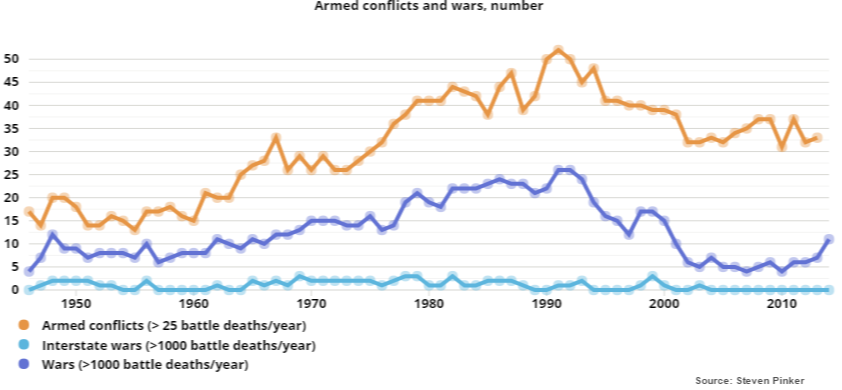
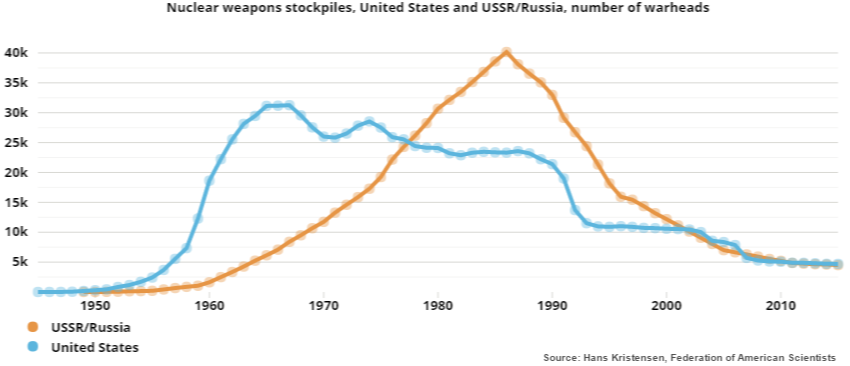
True enough, there are many troubles in the world and far too many lives are lost due to senseless violence. But, let’s keep matters in a proper perspective. Since the end of the Cold War, wars have become rarer. International conflicts are way down, though civil wars and armed conflicts have been on the uptick. Moreover humanity’s destructive potential–while still considerable–has been declining. Consider that in 1986, the Soviet Union had over 40,000 nuclear warheads, while the United States’ nuclear arsenal peaked in 1967 at over 31,000 warheads. Last year, both countries’ nuclear arsenal contained less than 5,000 warheads each.

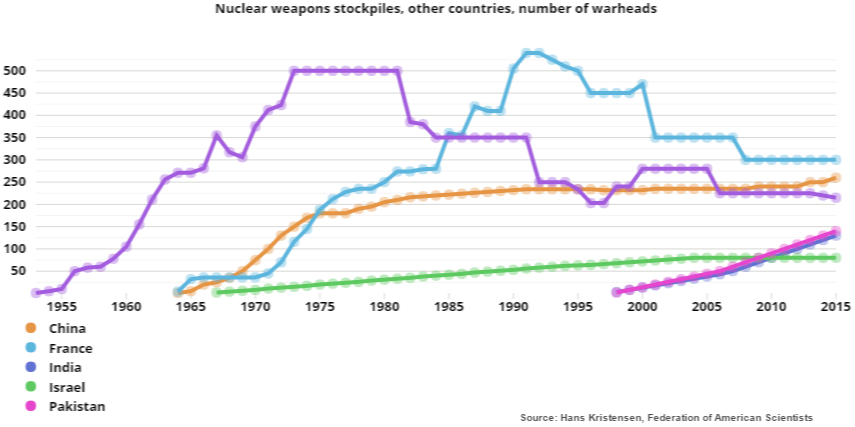
British, French and Israeli stockpiles are lower than they used to be, though Chinese, Pakistani and Indian stockpiles are increasing. And while today it is still possible for a terrorist group to detonate a dirty bomb in a Western metropolis, a world-ending nuclear Armageddon is no longer a daily threat.

Truth is that by yesteryear’s standards, Americans are safer. Even ISIS–that most brutal of terrorist organizations–does not pose a serious, let alone existential, threat to the United States. The fact that we do not feel safe may well be a result of the world becoming “smaller” due largely to the revolution in communication technology, rather than deterioration of America’s security.

The Economist | Terrorism

Al-Shabab Violence Falls Sharply in Mogadishu

“Mogadishu has been synonymous with violence ever since Somalia’s central state collapsed in the 1990s. Yet in recent years it has undergone a quiet transformation. Al-Shabab’s attacks in the city have fallen from 144 in the third quarter of 2022, when Hassan Sheikh Mohamud took office as president, to just five in the second quarter of this year. Data collected by the Armed Conflict Location and Event Data project (ACLED), a monitoring group, suggest the number of deaths in Mogadishu linked to al-Shabab is on track in 2026 to be the lowest since the group emerged in the mid-2000s.”

From The Economist.

Institute for Economics & Peace | Terrorism

Global Terrorism Falls to a Decade Low

“Key Findings of the Global Terrorism Index 2026 report:

  • Deaths from terrorism fell by 28 per cent to 5,582, and incidents decreased by 22 per cent to 2,944, marking the lowest figures since 2007
  • In contrast, Western terrorism fatalities rose sharply by 280 per cent to 57 in 2025, largely driven by antisemitism, Islamophobia and political terrorism
  • Iran risks becoming another breeding ground for terrorist militias if it becomes a failed State
  • Six of the ten countries most impacted by terrorism are in sub-Saharan Africa, maintaining its position as the epicentre
  • For the first time, Pakistan leads the Index as the country most impacted by terrorism, experiencing a sharp resurgence with 1,139 deaths and 1,045 incidents in2025, its highest level since 2013
  • Youth radicalisation fuelled lone-wolf attacks, with youth terrorism investigations rising threefold since 2021. Over the same period, 93 per cent of all fatal attacks in the West were lone-wolf attacks
  • Islamic State (IS) and its affiliates remained the deadliest terrorist organisation, responsible for just under 17 per cent of all attacks worldwide.”

From Institute for Economics & Peace.

Blog Post | Overall Mortality

Violence, Terrorism Trending Downward

The world is getting safer.

After the recent terror attacks in the United States and Western Europe, as well as Iraq and Afghanistan, it would be easy to conclude that the world is becoming more dangerous. The politicians and media have contributed to our growing sense of unease. Donald Trump claims that crime is rising, while Hillary Clinton speaks of a gun violence epidemic. Both, as Nick Gillespie shows, are inaccurate. In reality, many kinds of violence have become less common.

In the United States, the homicide rate fluctuated between 6.2 and 10.2 deaths per 100,000 people between 1967 and 1998. The rate dropped below 6 per 100,000 in 1999 and below 5 per 100,000 in 2010. The U.S. homicide rate for 2014, the most recent year for which data is available, was 4.5 per 100,000—the lowest since 1963. That means that the U.S. homicide rate is now at a 51-year low! Trump and Clinton’s speechwriters should take note.

HumanProgress contains data from the Global Terrorism Database for a period between 1970 and 2014. The data shows that terrorism killed more people in Western Europe in the 1970s and 1980s than in more recent decades. When estimates for 2015 and 2016* are added, a clear uptick in terrorism can be observed. That said, terrorism was clearly responsible for more deaths in Western Europe during the 1970s and 1980s. As horrible as the current terrorism uptick is, Western Europe has been through worse.

*Please note that the 2016 estimate does not include the most recent attacks.

Focusing on long-term trends rather than the media narrative and the pronouncements of our politicians is a far better way of assessing the true state of our security and crafting well-reasoned policy solutions.

This was first published in Reason.

Blog Post | Violence

America Is Relatively Safe and Tolerant

You are twice as likely to be struck by lightning in the US than be a victim of a mass shooting.

The recent killing of 49 innocent club goers in Orlando, Florida, has raised, once again, the issues of tolerance and violence in American society. Yet, even as we mourn the victims of hatred and violence, it is worthwhile to remind ourselves that, historically speaking, Americans live in very safe and tolerant times.

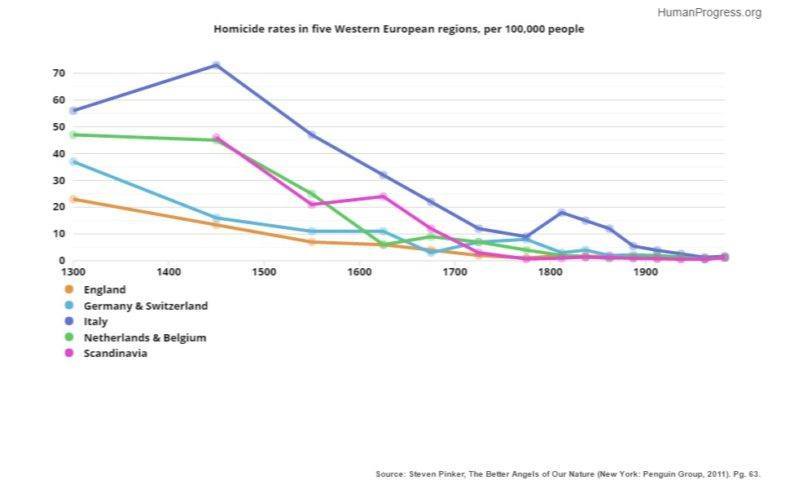
Let us start with public safety. As Harvard University psychologist Steven Pinker documented in his 2011 book The Better Angels of Our Nature, violence has been declining for centuries. In 1450, for example, Italian homicides averaged 73 per 100,000 people. England was relatively safe, with just over 13 homicides per 100,000 people.
Tupy US 1

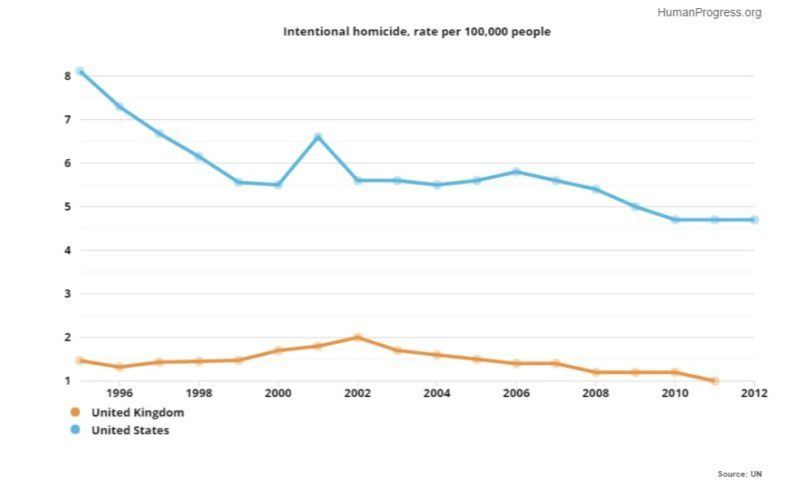
In 2011, in contrast, homicides in Great Britain and the United States averaged 1 and 4 per 100,000 people respectively.  While America’s overall homicide rate remains higher than that in Great Britain, there is enormous regional divergence. In 2015, for example, the homicide rate in New England’s Massachusetts was 1.61 per 100,000, but it was 11.67 in the Deep South’s Louisiana.
Tupy US 2

Overall, the homicide trend in America has been positive – mass shootings notwithstanding. Between June 18, 2015, when a suspected white supremacist killed 9 people in a historically black church in Charleston, South Carolina, and June 12, 2016, when a suspected Islamic extremist killed 49 people in a gay club in Orlando, Florida, 89 Americans died in mass shootings in the United States.

The population of the United States is approaching 324 million, which made the likelihood of dying in a mass shooting over the last 12 months 1 in 3.6 million. According to the National Weather Service, a U.S. government agency, the likelihood of being struck by lightning in 2014 was 1 in 1.2 million, by comparison. Such statistics are of no comfort to those who died and to their families, but they do put the evolution of violence in America in proper context.

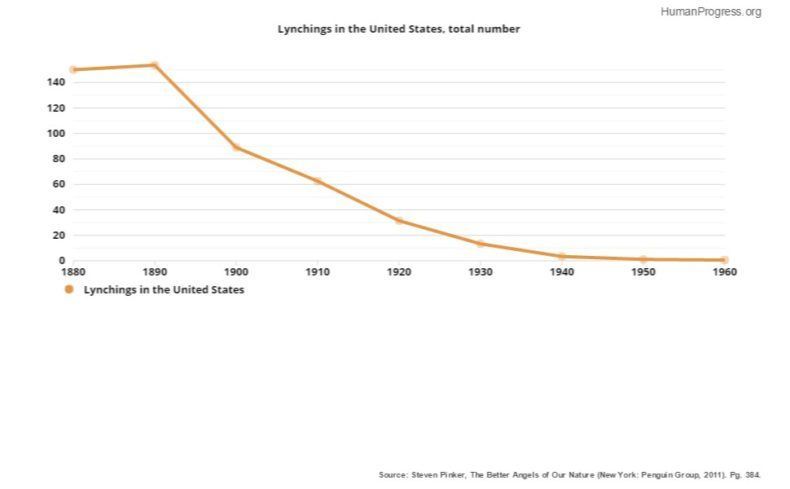
Similarly encouraging patterns can be observed in American attitudes toward minorities, including blacks and gays. For example, even after the Civil War ended the institution of slavery, the lynching of black Americans continued in the Jim Crow south. Lynching plummeted rapidly over the following decades and disappeared completely mid-way through the 20th century.
Tupy US 3

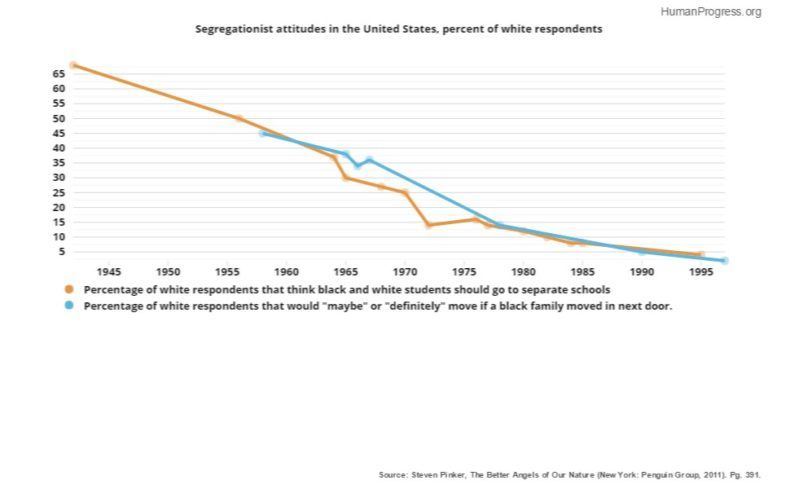
In 1942, 68 percent of white Americans thought that blacks and whites should go to separate schools. By 1995, only 4 percent of American whites thought that. In 1958, 45 percent of white Americans said that they would “maybe” or “definitely” move if a black family moved in next door. That number fell to just 2 percent in 1997. So rare were segregationist attitudes by the mid-1990s that the federal government discontinued collection of such statistics.
Tupy US 4

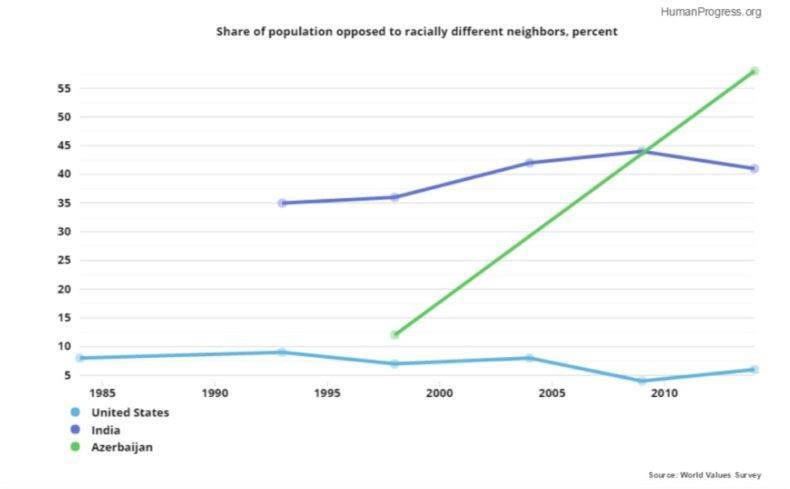
A higher level of segregationist attitudes in the United States was noted by the 2014 World Values Survey. The survey found that 6 percent of Americans were opposed to racially different neighbors. This number, however, includes not only whites opposed to black neighbors, but also blacks opposed to white neighbors, etc.

Overall, the survey ranked the United States 47th out of 60 countries surveyed. As such, the United States ranked better than the Netherlands, Germany, Estonia, Hong Kong, Taiwan, Japan, South Korea, Mexico, Ecuador and Peru.
Tupy US 5

On the opposite side of the spectrum was Azerbaijan, where 58 percent of the population was against racially different neighbors. Azerbaijan was followed by Libya with 55 percent, the Palestinian Authority with 44 percent, India with 41 percent, and Thailand with 40 percent.

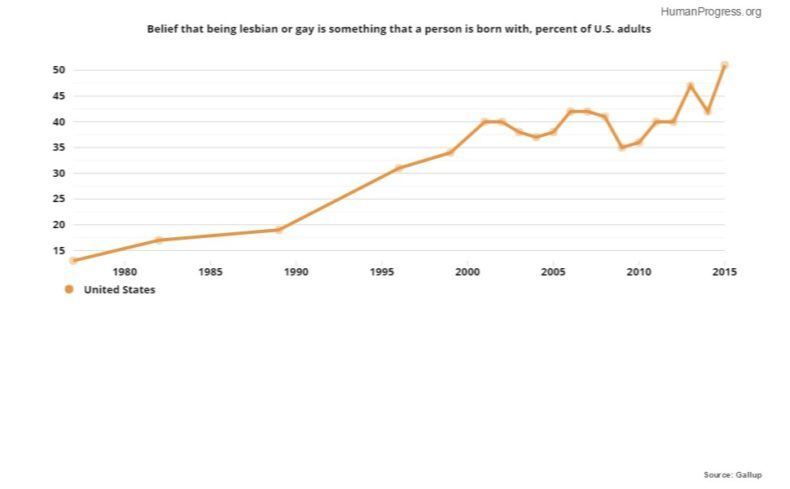
When it comes to homosexuality, trends are similarly encouraging. If anything, toleration toward gays and lesbians has been increasing at a dramatic pace. In 1977, only 13 percent of Americans believed that homosexuality was innate. By 2015, 51 percent Americans recognized the importance of genetics in determining a person’s sexual orientation.
Tupy US 6

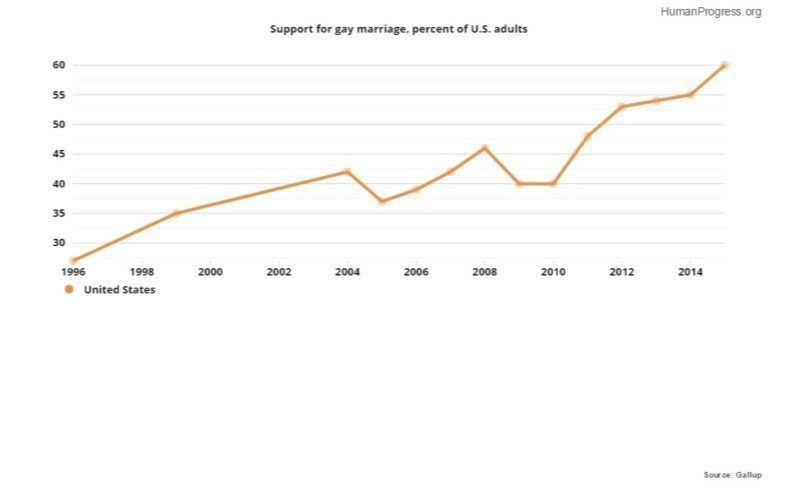
As late as 2002, only 38 percent of Americans believed that gay and lesbian relationships were morally acceptable. A mere 13 years later, 63 percent of Americans felt that way. Consider also that in 1996, only 27 percent of Americans supported gay marriage. By 2015, that number more than doubled with 60 percent of Americans supporting gay marriage.
Tupy US 7

Over the last year, we have heard much about the intrinsic racism and homophobia in American society. I disagree. By historical and by global standards, America is a remarkably tolerant and safe place, a few deranged or evil individuals, such as the shooters in Charleston and Orlando, notwithstanding.

Moving forward, it is important to recognize a few immutable realities. First, complete physical safety and emotional serenity are impossible in a free society. Second, deranged or evil individuals, who are determined to kill innocent people, cannot be stopped by new laws and regulations or by the evolution of social and cultural norms. Third, law enforcement, no matter how quick and brave, cannot prevent some, perhaps most, casualties. In extremis, all citizens must look to their own devices to protect themselves and their loved ones from the predation of those whom law and social norms have not or could not stop.

This article was first published in CapX.