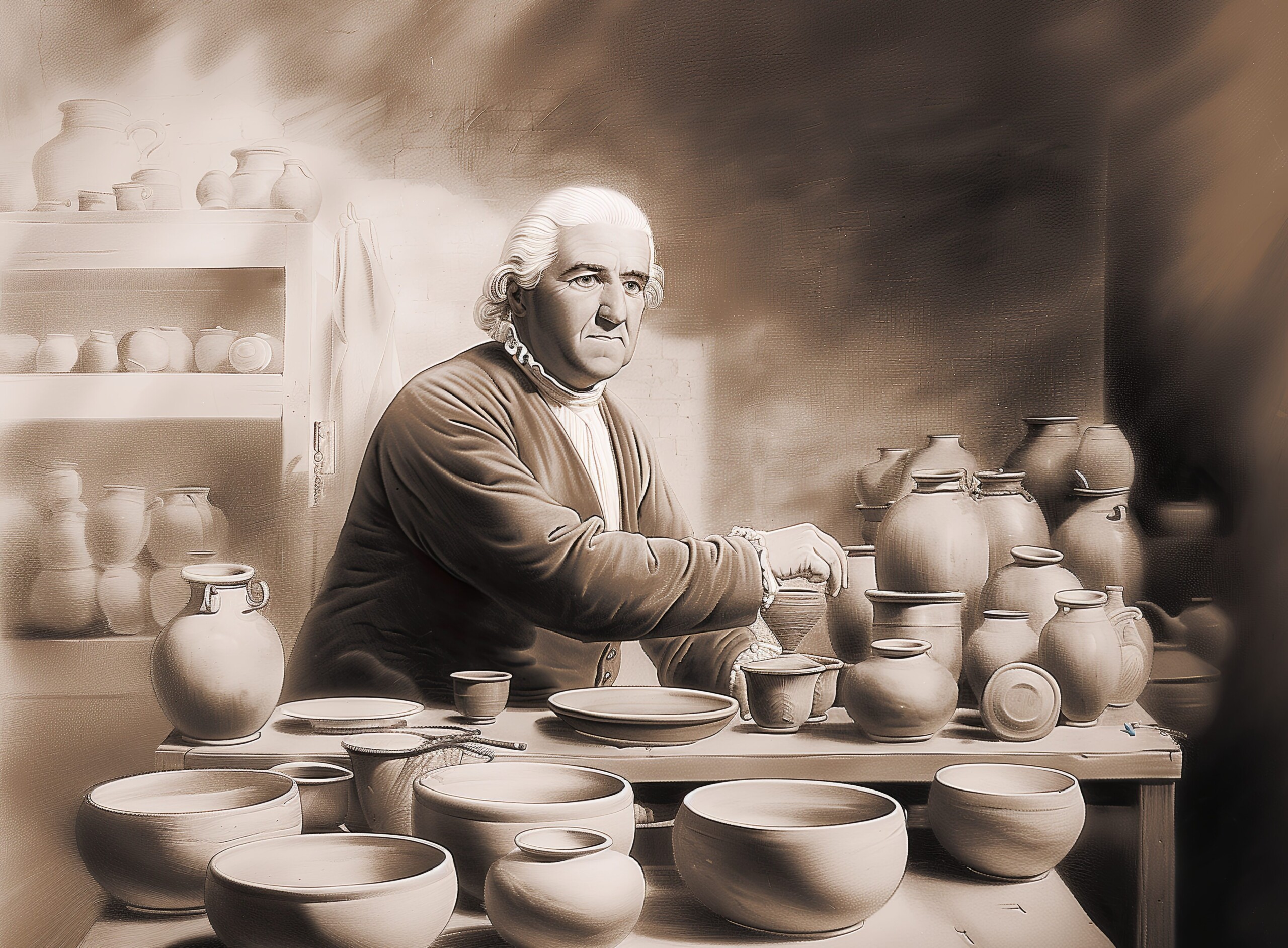
Summary: Josiah Wedgwood challenged the prevailing perspective on entrepreneurship, rising from humble beginnings to become an esteemed industrialists and advocates of Enlightenment ideals. Wedgwood’s story exemplifies the transformative power of entrepreneurship, philanthropy, and innovation, reshaping not only the economy but also societal perceptions of wealth and social responsibility.
This article was published at Libertarianism.org on 12/18/2023.
We use and encounter the word “entrepreneur” constantly in our daily lives. Entrepreneurs are an indispensable part of the modern economy, but for much of the Western world’s history, aristocratic elites looked down on merchants as crass money-makers. A long tradition stretching back to antiquity enforced the aristocratic view of property ownership and agriculture as the only honorable ways of making money. But in the 18th century, things started to change dramatically.
At the forefront of change was Josiah Wedgwood, a man born the child of a potter, who ended his life as an esteemed industrialist, a trendsetter for English society, and an advocate of Enlightenment ideals. He is also one of first examples of the entrepreneurial philanthropist in the modern sense, using his profits to build schools, homes, and improve the working conditions of his employees. Most famously, he was a staunch advocate for the abolition of slavery.
Wedgwood’s Upbringing
Josiah Wedgwood was born on the 12th of July 1730 in Burslem, Staffordshire. He was the eleventh child of Thomas and Mary Wedgwood. Wedgwood’s family, while not poor, was not particularly rich either.
Wedgwood’s father and his father’s father had both been potters. According to all conventional wisdom, Wedgwood would follow in his ancestors’ footsteps and earn a similarly modest living. Though there were many potters in his hometown of Staffordshire, potters only sold their wares locally. To sell to London was rare; to sell abroad was unheard of. Staffordshire was not the cosmopolitan center of the United Kingdom. By the end of Wedgwood’s life, this all radically changed.
From a young age, Wedgwood showed great promise as a potter, but at the age of nine he contracted smallpox, permanently weakening his knee, meaning he could not use the foot pedal on a potter’s wheel. But Wedgwood took this tragedy in stride despite his young age. While healing, he used his spare time to read, research, and most importantly, experiment. Instead of making the same pots his family had always crafted, he dedicated himself to innovating.
Combining Science and Faith
After his father’s death, Wedgwood’s mother took charge of educating her son imparting to him a deep appreciation for curiosity. Wedgwood came from a family of English dissenters, Protestants who broke off from the English state-supported Anglican church to start their own religious establishments. Specifically, Wedgwood and his family were Unitarian: they emphasized the importance of humans using reason to interpret scripture. Unlike many of their contemporaries, Unitarians did not see science and religion as conflicting ways of viewing the world but complementary. Because of this attitude, Unitarians were often found defending freedom of speech and conscience as indispensable rights for political and religious life.
Where Unitarians split most noticeably from the established Anglican church was their view of Original Sin. Growing up, Wedgwood was taught that the world could be made a better place through human effort. A modern observer views progress and making the world a better place as a common aspiration, however, few of our ancestors believed there was such a thing as consistent material or moral progress. It is easy to see why, given that belief system, most people were content to work the same job their father had using the same tools that had been used for hundreds if not thousands of years.
The Beginnings of a Business
At the age of 30, Wedgwood began his own business in Staffordshire at his Ivy House factory. Because of England’s vast colonial territories, tea and coffee were making their way to England in larger quantities. The emerging middle class began to frequent coffee and tea houses to converse with their peers, dramatically increasing the demand for pottery. Wedgwood observed an increased demand for pottery, but also an increased demand for beauty and style in everyday items.
In Wedgwood’s early days of business, elaborate designs were not popular; what was demanded was the pure simplicity of materials like porcelain. Porcelain, however, was in short supply and extremely fragile. To remedy this, Wedgwood began developing cream glaze that would give earthenware the appearance of porcelain with none of the downsides. After conducting over 5,000 painstaking tests, Wedgwood perfected what came to be known as creamware, something few of his competitors replicated.
Increasingly known for his high-quality products, Wedgwood was invited to participate in a competition with all the potteries of Staffordshire to provide a tea service or set for Queen Charlotte. Knowing this was a crucial opportunity, Wedgwood went all-in on creating a creamware set, even painstakingly using honey to help stick 22-karat gold to his pure white creamware. Wedgwood won the competition and was made the Queen’s potter. Wedgwood was light years ahead of his competition when it came to marketing and branding, and from this point onwards, all of the company’s paperwork and stationery boasted the royal association.
Wedgwood and the Consumer Experience
Wedgwood established showrooms in London to sell his wares. In the 18th century, most stores were cramped and dingy places. Wedgwood also pioneered a range of services we expect as standard today, including money-back guarantees, free delivery, illustrated catalogs, and even an early form of self-checkout. More than any of his contemporaries, Wedgwood focused on perfecting the retail experience. His showrooms were immediately popular, establishing his reputation throughout London, Bath, Liverpool, Dublin, and Westminster. Some showrooms were so popular they caused traffic jams with long-winding lines stretching through the street.
The Division of Labor and International Markets
The increasing demand led to Wedgwood being so successful he founded a new factory in 1769 named “Etruria” after the Etruscans of ancient Italy. Here Wedgwood dreamed of becoming “Vase Maker General to the Universe.” Despite being named after an ancient land, it was arguably at the time the most modern industrial space in the world. To minimize mistakes, Wedgwood broke down the process of making earthenware into a series of smaller tasks. Like the contemporaneous Adam Smith, Wedgwood observed that the division of labor dramatically increases productivity. As an employer, Wedgwood was an exemplar of humane business. Knowing the hot conditions of factories, he attempted to develop a form of air conditioning. He paid his employees well and provided cottages for his workers around Etruria.
With his modernizing practices, Wedgwood brought artistic perfection to an industrial scale. Though many of his popular products were initially purchased by the aristocracy, he eventually reduced the prices to appeal to an increasingly broader market. Wedgwood noticed that a high price was necessary to make the vases esteemed ornaments for palaces, but once aristocrats popularized his products, he would then reduce the price accordingly. Everyday people began to drink from mugs and decorate their homes with vases that for centuries had been exclusively owned by aristocrats.
Wedgwood had transformed Staffordshire from a town that nearly always sold their produce locally to a place that supplied goods for the whole nation. But Wedgwood saw the potential for further expansion abroad. Wedgwood began to ship to Europe but then rapidly expanded across the globe to places like Mexico, the United States, Turkey, and China. By the 1780s, Wedgwood was exporting most of his products abroad. Though during this period of his life business was booming, Wedgwood’s smallpox afflicted knee worsened, resulting in his leg being amputated without anesthetic and replaced with a wooden prosthetic. Seemingly unbothered, Wedgwood Christened the event “St. Amputation Day” and resumed work.
Business for a Good Cause
As Wedgwood shipped more goods abroad, he increasingly frequented London’s port, the largest slave-trading port in the world at the time. Wedgwood saw the whip-scarred bodies of enslaved people being shipped in from abroad. Wedgwood abhorred slavery, not only because it was immoral, but because for Wedgwood, it was not befitting of the national character and the esteem Britain ought to hold as a free nation. At its inception, in 1787 Wedgwood joined the Society for Effecting the Abolition of the Slave Trade.
He campaigned against slavery by using his craft to create mass-produced cameos of a black man in chains on his knees against a white background with an inscription beneath reading “Am I Not a Man and a Brother?” Wedgwood gave away these medallions free of charge to abolitionist groups, even sending medallions to Benjamin Franklin, then to the president of the Pennsylvania Abolition Society. Franklin praised his medallions, saying their effectiveness was equal to the best written works against slavery. Gentlemen had this image inlaid in their snuff boxes, and ladies wore it on bracelets and hairpins.
A friend of Wedgwood and fellow abolitionist wrote of Wedgwood’s medallions, “the taste for wearing them became general, and thus fashion, which usually confines itself to worthless things, was seen for once in the honorable office of promoting the cause of justice, humanity and freedom.” Wedgwood saw how fashion could be a vehicle for political change. His medallions perfectly captured the message of the abolitionist cause, two hundred years before the advent of the t-shirt, today’s preferred method of displaying one’s political affections.
Wedgwood was not only a master craftsman, an industrialist, and an activist: he was also a scientist. In 1765, he joined the Lunar Society of Birmingham, a group of industrialists, scientists, and philosophers who met during the full moon because the light made the journey at night easier. Members included people such as Joseph Priestly and Matthew Bolton. In 1783, Wedgwood was elected to The Royal Society of London for Improving Natural Knowledge by inventing the pyrometer, a device used to measure the high temperatures of kilns while firing pottery.
Death and Legacy
After a life dedicated to his work and the betterment of the world, Wedgwood passed away on the 3rd of January 1795 at the age of 64. The name Wedgwood became synonymous with excellence in pottery, and remains so today.
Throughout Western history, aristocrats, nobles, and other elites often peddled a narrative that prosperity was achieved through familial ties of property ownership and military prowess. People like Josiah Wedgwood challenged this narrative by showing a new path for the Enlightened industrialist and philanthropist. Instead of making his fortune from familial connections and war, Wedgwood showed the peaceful path to wealth by simply fulfilling consumers’ desires. His marketing practices were light years ahead of his time, and his penchant for building a distinct brand through advertising and high-quality goods was an unprecedentedly modern strategy at a time when the wealthy still wore powdered wigs.
Wedgwood used his wealth to benefit the world by treating his workers with dignity while advocating for humane causes like the abolition of slavery. Stories like Wedgwood’s counter the anti-capitalist narrative of the corrupting tendencies of private enterprise, showing how business can be humane, cosmopolitan, and most importantly, for Wedgwood, beautiful.