fbpx
01 / 05
The Typical US Worker Out-Earned Inflation by $1,400 a Year

NBC News | Personal Income

The Typical US Worker Out-Earned Inflation by $1,400 a Year

“While higher costs for everything from milk to medicines have preoccupied U.S. consumers in the pandemic era, earnings have also risen enough, on average, to push up households’ purchasing power a bit. And blue-collar workers have been the biggest beneficiaries.

An analysis published in July by economists at the Treasury Department found that the median worker can afford the same representative basket of goods and services as they did in 2019 — plus have an additional $1,400 a year.”

From NBC News.

Blog Post | Cost of Living

Introducing the American Abundance Index

American living standards are best measured in time.

We are excited to share a new tool we’ve been building at Human Progress: The American Abundance Index—an interactive dashboard that tracks US living standards while adjusting for both inflation and rising incomes.

The idea is straightforward: how many hours do you need to work to afford the same basket of goods and services? Using Bureau of Labor Statistics data, the American Abundance Index converts price and wage growth into “time prices”—the amount of work time required to buy the Consumer Price Index (CPI) basket of goods and services—and “abundance,” which is the inverse: how much of that basket one hour of work can buy. When time prices fall, abundance rises, and each hour of work goes further. That’s the measure of affordability that actually matters.

Conceptually, this work builds off of Superabundance, a book by our editor, Marian Tupy, and his coauthor and Human Progress board member, Gale Pooley. Their core argument—that abundance is best measured in time—forms the foundation of the project. The index itself was built by our Quantitative Research Associate, Jackson Vann.

Users can select multiple worker categories, compare short- and long-run trends, and even see wage growth modeled to reflect real career progression rather than freezing workers in place. All the calculations are transparent and replicable, with the full dataset and code available on GitHub.


So what does the index actually say about American standards of living?

Over the past 12 months, inflation rose 2.68 percent while hourly earnings for the average private-sector worker grew 3.76 percent. As a result, the CPI basket became 1.05 percent more abundant. Since 2006, it has become nearly 14 percent more abundant—roughly equivalent to adding an hour of purchasing power to the average workday.

Blog Post | Cost of Material Goods

Why Your Groceries Are Cheaper than Kevin McCallister’s

Since 1990, grocery abundance has increased by 43.2 percent and pizza abundance by 285 percent for blue-collar workers. If you were upskilling, it was 186 percent for groceries and 610 percent for pizzas.

Summary: A famous grocery run in Home Alone appears to illustrate how much nominal prices have risen since the film came out in 1990. But a look at sticker prices alone misses the bigger picture. When costs are measured against what people earn, everyday food looks far more affordable than it once did. Thanks to rising nominal wages and ongoing innovation, modern households enjoy far greater abundance, even when nominal prices appear higher at first glance.


In the 1990 movie Home Alone, eight-year-old Kevin McCallister went grocery shopping. He bought a half gallon of milk, a half gallon of orange juice, a TV dinner, bread, frozen mac and cheese, laundry detergent, cling wrap, toilet paper, a pack of army men, and dryer sheets. His bill came to $19.83.

Professor Christopher Clarke at Washington State University does an annual price analysis of Kevin McCallister’s shopping basket and estimates that today’s price for those items would be around 114.5 percent higher ($42.54) than was the case in 1990. But, as my readers know quite well, things can become more expensive and more affordable at the same time. How is that possible? It’s possible because wages typically increase faster than prices. In the past 35 years, blue-collar hourly wages have increased by 207.7 percent, from $10.32 per hour in 1990 to $31.76 today.

Kevin’s basket in 1990, in time prices, would have cost 1.92 hours compared to 1.34 hours today. The time price of Kevin’s basket has fallen by 30.2 percent. For the time it took to earn the money to buy the basket of goods in 1990, you get 1.432 baskets today. Grocery abundance has increased by 43.2 percent.

If you got your first job in 1990 as an entry-level worker and have been upskilling for the past 35 years and are now an average worker, your hourly wage rate increased 511.3 percent: from $6.03 an hour in 1990 to $36.86 an hour today. Your grocery basket time price fell by 65 percent, giving you 2.86 baskets today. Your grocery abundance has increased by 186 percent.

In the movie, the McCallister family also orders 10 pizzas, and the bill comes to $122.50 (plus tip). That would put the time price for 1990s blue-collar workers at 11.87 hours, or about one hour and 11 minutes per pizza.

Professor Clarke did a price check on how much 10 classic cheese and pepperoni pizzas cost at a Little Caesars pizzeria near the McCallister’s home today—it comes to only $98.09 (plus tip). The nominal price has actually shrunk! That would put today’s time price at 3.08 hours for the 10 pizzas, or about 18.5 minutes per pizza. The time price has fallen by 74 percent. That means that for the time it took to earn the money to buy one pizza in 1990 you get 3.85 pizzas today. Pizza abundance has increased by 285 percent. If you are an upskilled worker, your pizza time price fell by 85.9 percent, giving you 7.1 pizzas today for the time price of 1 in 1990, thus increasing your abundance by 610 percent.

Hopefully you didn’t forget to count the kids before taking off on Christmas vacation this year! And remember, life can become more abundant every day if people are free to innovate.

Find more of Gale’s work at his Substack, Gale Winds.

Blog Post | Trade

The Rising Tide: How Trade Lifts All Boats

Free exchange turns scarcity into abundance for rich and poor alike.

Summary: Trade has been a driving force behind economic growth, poverty reduction, and rising living standards across the globe. Far from harming the poor, open markets have helped lift billions out of extreme poverty while improving health, education, and life expectancy. History and modern evidence alike show that free exchange expands the economic “pie” for everyone, making prosperity the norm rather than the exception.


In his book The Rational Optimist, the British science writer Matt Ridley argued that economic progress began when people began to trade. “By exchanging,” he explained, “human beings discovered ‘the division of labour,’ the specialisation of efforts and talents for mutual gain… The more human beings diversified as consumers and specialised as producers, and the more they then exchanged, the better off they have been, are and will be.” For Ridley, “exchange is to cultural evolution as sex is to biological evolution.”

The Scottish father of economics, Adam Smith, recognized the economic potential of trade when he noted that “the liberal system of free exportation and free importation” is “not only the best palliative of a dearth, but [also] the most effectual preventative of a famine.”

While economists disagree on several policy issues, trade is generally not one of them. For example, survey data suggest that 95 percent of economists agree that tariffs tend to reduce economic welfare. Another 90 percent do not think the United States should restrict outsourcing.

You’d never know that by listening to today’s political debates. While protectionism is nothing new, the recent rise in anti-trade policies is an unfortunate setback for the United States and for the world.

Far from a rigged game that exploits those at the bottom, the globalization of the market system has brought global extreme poverty to its lowest levels in human history (Figure 1). That is why the Turkish-American Nobel Prize–winning economist Daron Acemoglu and his coauthors have described the creation of the market system as “one of the greatest achievements of humankind.”

Figure 1. Share of global population living in extreme poverty, including and excluding China.

Sources: World Bank Poverty and Inequality Platform 2024; Our World in Data 2024.

Note: Extreme poverty is defined as living below the International Poverty Line of $2.15 per day. These data are adjusted for inflation and for differences in living costs between countries. These data are expressed in international dollars at 2017 prices. The data relates to income measured after taxes and benefits, or to consumption per capita.

Furthermore, despite claims to the contrary, the United States’ participation in the global economy has significantly benefited American consumers and workers. Real incomes have not stagnated over the past few decades. They’ve risen, including for those at the bottom of the income distribution (Figure 2).

Figure 2. Real median personal income in the United States

Source: Federal Reserve Economic Data (FRED), St. Louis Fed

Note: Shaded areas indicate US recessions.

Nor has international trade hollowed out American manufacturing. While employment in the sector has declined as a result of automation and productivity gains, manufacturing output—especially output per worker—has increased.

As Michael Strain from the American Enterprise Institute observes, “America is upwardly mobile, particularly for those nearer the bottom of the income distribution. Incomes aren’t stagnant. Workers do enjoy the fruits of their labor. The argument that life hasn’t improved for typical households in decades borders on the absurd. The game is not rigged. The American Dream is not dead (Figure 3).”

Figure 3. Average real wage at percentiles of the wage distribution

Source: Michael Strain, The American Dream Is Not Dead, p. 47.

In a 2020 article, I reviewed the scholarship linking trade to economic growth and poverty reduction. Overall, the empirical literature shows that trade reduces poverty predominantly through economic growth. Critics sometimes claim that growth leaves those at the bottom behind. It may improve the average, they say, but only because of large income boosts at the top.

That talking point is simply untrue. Economic freedom, including openness to trade, and growth have been shown to improve incomes across the board. A rising tide truly does lift all boats, not just the yachts of the wealthy. Growth positively touches every tier of the economic ladder. A bigger economic pie means better living standards for everyone involved, making economic growth propoor.

The Indian economist Arvind Panagariya has documented trade’s role in the economic success of Hong Kong, Singapore, Taiwan, South Korea, India, China, and other countries throughout Asia, Africa, and Latin America. Across more than 200 jurisdictions and five decades of data, he found a causal relation between trade and per capita income: the countries that experienced intensive growth always maintained a high and/or expanding trade-to-GDP ratio.

In a new review of the literature, Dartmouth’s Douglas Irwin found the same thing. The empirical research on trade liberalization has been “remarkably consistent” in its conclusion that open trade fosters growth in productivity and, therefore, standards of living (Tables 1 and 2). Tariffs, on the other hand, hold growth, productivity and standards of living back. Previous literature reviews have come to similar conclusions. That is why economists from all sides of the political spectrum come together on trade.

Table 1. Selected studies of trade reform and economic growth.

Source: Irwin, “Does Trade Reform Promote Economic Growth?” p. 162.

Despite the populist rhetoric about helping the American workers and consumers, those same workers and consumers end up eating the cost of tariffs in the form of higher prices. The negative effects of protectionism also have a disproportional impact on the poor, who tend to gain the most from trade.

And keep in mind that living standards aren’t just about income. Open market economies have higher adult literacy rates, longer life expectancies, lower infant mortality rates, better environmental stewardship, and greater life satisfaction than closed economies do. As Nobel Prize–winning American economist Robert Lucas wrote, “The consequences for human welfare involved in questions [about economic growth] are simply staggering. Once one starts to think about them, it is hard to think about anything else.”

Table 2. Selected studies of trade reform and industry productivity

Source: Irwin, “Does Trade Reform Promote Economic Growth?” p. 168.

Note: TFP = total factor productivity.

Income inequality is a major criticism of an open economy, but, interestingly enough, most studies find no relation between greater economic freedom and income inequality (though the findings are somewhat mixed). It’s worth noting that concerns over income inequality are often concerns over inequality within already rich countries. When it comes to inequality, in other words, it tends to be the global rich arguing with the super global rich (and much of that concern is overblown).

But look at the bigger picture. Overall, globalization has led to both a decline in global poverty and global inequality (Figure 4).

Figure 4. Global income inequality: Gini index, 1820–2020

Note: Global inequality, as measured by the global Gini coefficient, rose from about 0.6 in 1820 to about 0.7 in 1910 and then stabilized around 0.7 between 1910 and 2020. It is still too early to say whether the decline in the global Gini coefficient observed since 2000 will continue.

Income is measured per capita after pension and unemployment insurance transfers and before income and wealth taxes.

According to the 2024 “Economic Freedom of the World” report, the share of income earned by the poorest 10 percent in the most economically free countries is about the same as that of the poorest 10 percent in the least economically free countries. In other words, the income distribution—the slicing of the economic pie—looks the same across countries, no matter the level of economic freedom.

Figure 5. Economic freedom and income share of lowest 10 percent

But the amount of income earned by the poorest 10 percent in the most economically free countries is eighttimes that of the poorest 10 percent and slightly more than the average person in the least economically free countries (Figures 5 and 6). The poor’s portion of the economic pie may be the same across countries, but free countries have bigger pies.

Figure 6. Economic freedom and income share of lowest 10 percent

We did not redistribute our way into riches or plunder our way into prosperity. Instead, the historical shifts both institutionally and culturally in favor of a trade economy led to a radical upsurge in material well-being that the American economist Deirdre McCloskey has aptly labeled “The Great Enrichment”:

In the two centuries after 1800 the trade-tested goods and services available to the average person in Sweden or Taiwan rose by a factor of 30 or 100. Not 100 percent, understand—a mere doubling—but in its highest estimate a factor of 100, nearly 10,000 percent, and at least a factor of 30, or 2,900 percent. The Great Enrichment of the past two centuries has dwarfed any of the previous and temporary enrichments.

It’s not that we suddenly figured out how to slice up the economic pie just right. We made the pie 2,900 to 10,000 percent bigger through commercial exchange. When the pie is bigger, there’s more pie to go around. And we’re all richer for it.

Blog Post | Food Prices

Thanksgiving Dinner Will Be 8.8 Percent Cheaper This Year

Be thankful for the increase in human knowledge that transforms atoms into valuable resources.

Summary: There has been a remarkable decrease in the “time price” of a Thanksgiving dinner over the past 38 years, despite nominal cost increases. Thanks to rising wages and innovation, the time required for a blue-collar worker to afford the meal dropped significantly, making food much more abundant. Population growth and human knowledge drive resource abundance, allowing for greater prosperity and efficiency in providing for more people.


Since 1986, the American Farm Bureau Federation (AFBF) has conducted an annual price survey of food items that make up in a typical Thanksgiving Day dinner. The items on this shopping list are intended to feed a group of 10 people, with plenty of leftovers remaining. The list includes a turkey, a pumpkin pie mix, milk, a vegetable tray, bread rolls, pie shells, green peas, fresh cranberries, whipping cream, cubed stuffing, sweet potatoes, and several miscellaneous ingredients.

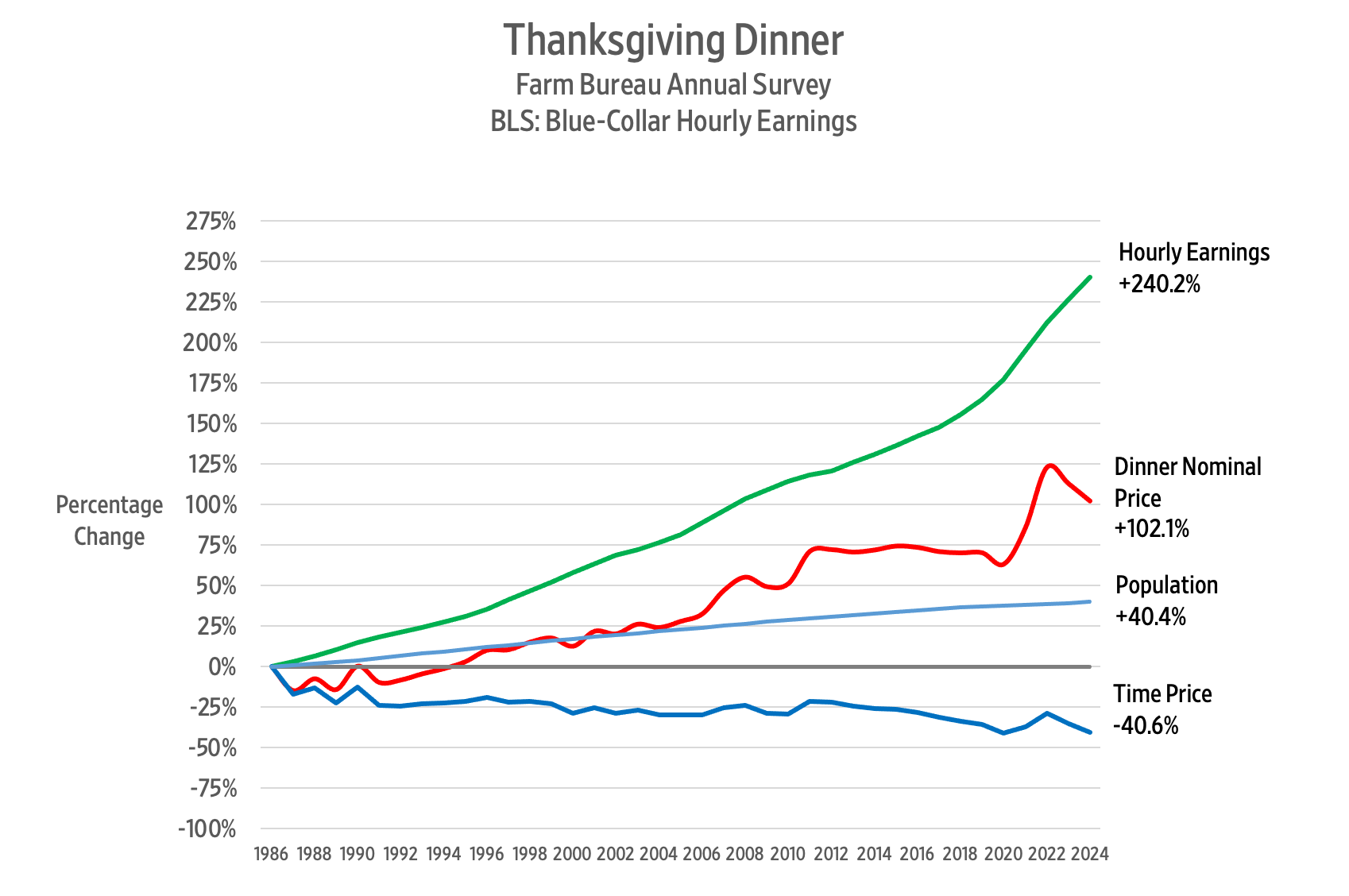
So, what has happened to the price of a Thanksgiving Day dinner over the past 38 years? The AFBF reports that in nominal terms, the cost rose from $28.74 in 1986 to $58.08 in 2024. That’s an increase of 102.1 percent.

Since we buy things with money but pay for them with time, we should analyze the cost of a Thanksgiving Day dinner using time prices. To calculate the time price, we divide the nominal price of the meal by the nominal wage rate. That gives us the number of work hours required to earn enough money to feed those 10 guests.

According to the Bureau of Labor Statistics, the blue-collar hourly wage rate increased by 240.2 percent – from $8.96 per hour in October 1986 to $30.48 in October 2024.

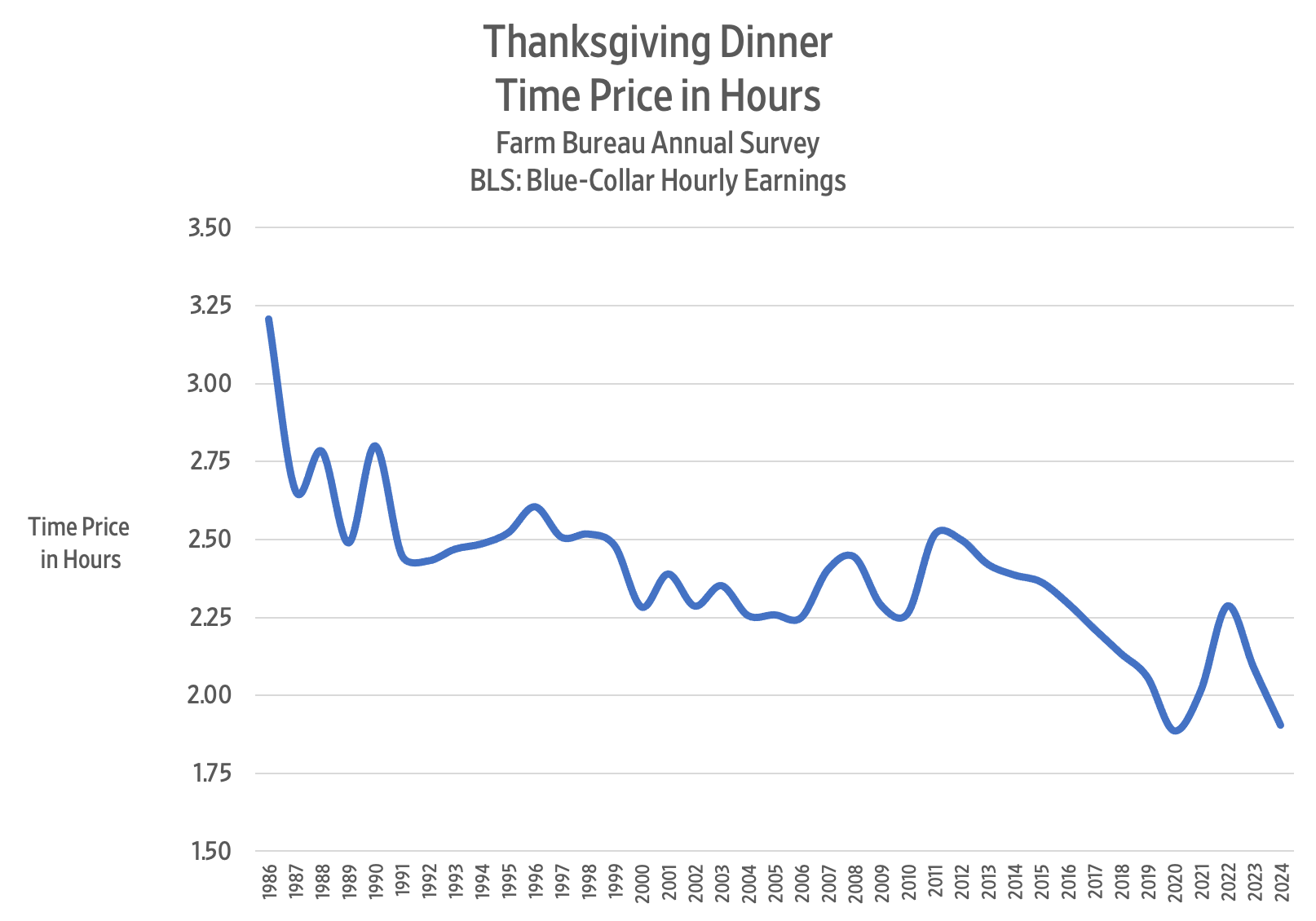
Remember that when wages increase faster than prices, time prices decrease. Consequently, we can say that between 1986 and 2024 the time price of the Thanksgiving dinner for a blue-collar worker declined from 3.2 hours to 1.9 hours, or 40.6 percent.

That means that blue-collar workers can buy 1.68 Thanksgiving Day dinners in 2024 for the same number of hours it took to buy one dinner in 1986. We can also say that Thanksgiving dinner became 68 percent more abundant.

Here is a chart showing the time price trend for the Thanksgiving dinner over the past 38 years:

The figure shows that the time price of a Thanksgiving dinner for a blue collar worker has gone down since 1986.
The figure shows that the time price of a Thanksgiving meal has decreased, while population, the nominal price of the meal, and hourly earnings have all increased.

The lowest time price for the Thanksgiving dinner was 1.87 hours in 2020, but then COVID-19 policies struck, and the time price jumped to 2.29 hours in 2022.

In 2023, the time price of the Thanksgiving dinner came to 2.09 hours. This year, it came to 1.91 hours – a decline of 8.8 percent. For the time it took to buy Thanksgiving dinner last year, we get 9.6 percent more food this year.

Between 1986 and 2024, the US population rose from 240 million to 337 million – a 40.4 percent increase. Over the same period, the Thanksgiving dinner time price decreased by 40.6 percent. Each one percentage point increase in population corresponded to a one percentage point decrease in the time price.

To get a sense of the relationship between food prices and population growth, imagine providing a Thanksgiving Day dinner for everyone in the United States. If the whole of the United States had consisted of blue-collar workers in 1986, the total Thanksgiving dinner time price would have been 77 million hours. By 2024, the time price fell to 64.2 million hours – a decline of 12.8 million hours or 16.6 percent.

Given that the population of the United States increased by 40.4 percent between 1986 and 2024, we can confidently say that more people truly make resources much more abundant.

An earlier version of this article was published at Gale Winds on 11/21/2024.