Listen to the podcast or read the full transcript here.
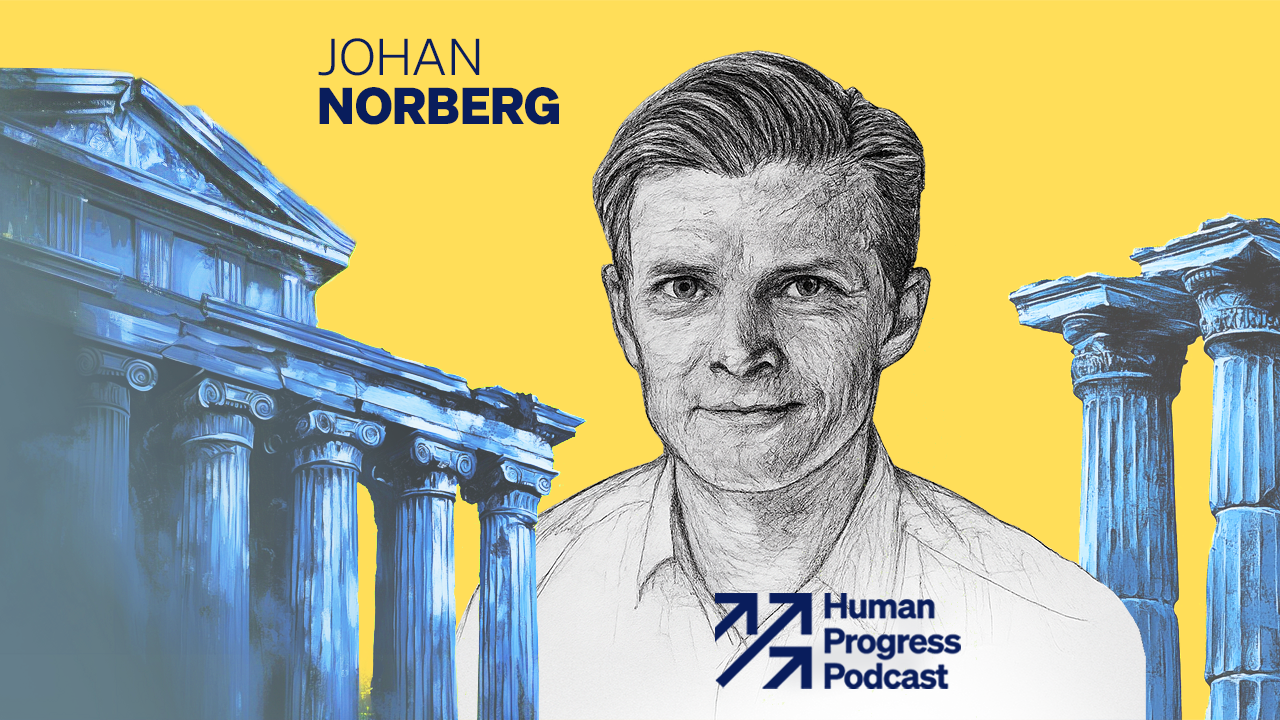
Joining me today is Johan Norberg, a historian, commentator, and my colleague here at the Cato Institute. His books include The Capitalist Manifesto, Progress: Ten Reasons to Look Forward to the Future, and Open: The Story of Human Progress. His latest book is Peak Human.
Johan, tell me about what inspired you to write Peak Human?
One reason is that we live in a golden age right now, and I would like it to keep going for a bit longer. I think it’s useful to look to history for clues about how you build and maintain thriving, dynamic civilizations.
What do you mean by the term golden age?
I’m glad you asked. I’m not thinking about mighty empires and territorial expansion. I’m thinking about decent, dynamic, and innovative civilizations that grow and prosper. I’m looking at periods where you saw a great many innovations in different spheres of human experience: cultural creativity, scientific curiosity, technological innovation, and economic growth.
You have this great line in the introduction where you say, “If we discard all the achievements of those who came before us because they weren’t sufficiently enlightened and decent, and they weren’t, we will eventually lose the capacity to discern what is enlightened and decent.”
What did you mean by that?
It’s incredibly easy to dismiss everything that wasn’t up to our modern moral standards, but if we do that, we lose the ability to understand progress. Some of these past civilizations, imperfect as they were, were incredibly important stepping stones on the way to the Enlightenment, to individual rights, and to prosperity.
Let’s walk through the different golden ages you focus on, starting with ancient Athens.
In the 4th century BC, Athens was just one among thousands of different Greek city-states. That was a great thing for them, because they could compare what they were doing with others and learn. And the Athenians, partly because of their bad soil, were a trading civilization that ventured outward to find useful things, which created a spirit of curiosity and innovation. They even created this ancient form of democracy that, while it excluded women and slaves, gave a lot of power to the average man.
Along with all these things—democracy, openness, and trade—they began to experiment with new ideas in everything from architecture to theater to philosophy. I would argue that this was the first civilization where we actually see people saying that it’s a good thing to criticize your forefathers and come up with something original. And if you start doing that, you’ll come up with lots of exciting ideas.
What lessons can we learn from Athens?
One obvious lesson, which appears in all of these golden ages, is that without one strong man in charge, you open up the whole system to experimentation; ideas can come from anywhere in the network. You basically crowdsource your ideas and, while you’ll get more bad ideas, you’ll also get more great ideas that people can build upon.
I think that’s an important lesson for us. When we think of how to move on and find something better, do we create a great big plan telling people what to do, or do we simply allow more people to join in the game?
What brought the Athenian golden age to an end?
The very long Peloponnesian War against Sparta started to erode that sense of openness and curiosity. Thucydides, the great Greek historian, talked about how people on all sides became tribalists, constantly thinking about how to search for scapegoats and traitors rather than new trading partners. Obviously, the strongest example is when Socrates was sentenced to death for his teachings. That’s something that happens by the end of most of these golden ages; once they sour on intellectual openness, they try to impose some sort of orthodoxy and force people to think and behave in the same way.
Let’s move on to Abbasid-era Baghdad and the Islamic golden age.
One thousand years ago, the greatest thinkers in Europe got their best ideas from Arabs, who had far superior science and technology. Algebra, algorithm, arithmetic, average—all those terms come from this melting pot of an empire that was built from northern Africa all the way to Afghanistan. It was a huge free trade area with the same set of laws and the same language, but it was also very open to different peoples and religions. In Baghdad, they invited thinkers from other cultures and from other religions to talk about their ideas, and constantly translated their texts in order to benefit from them. They considered themselves the successors to the Greek philosophical tradition.
It is often said that the end of the Abbasid Caliphate was when the Mongols invaded in the 1250s. However, by the time of the Mongol invasion, the Caliphate had already been in decline for over 200 years. It started losing its way internally because of a fear of religious difference. Not fear of Christians or Jews, but fear of different traditions within Islam. The Abbasids built state-funded schools where teachers simply repeated Sunni dogma. The intellectuals who used to have various, diverse benefactors got government jobs on the condition that they left their critical judgment outside. That began to undermine the dynamic, open-minded intellectual tradition of the Arab world. You can actually see how texts on science and on technology begin to decline in the areas that got these state-run Madrasas.
Tell me about Song Dynasty China. It’s been said that they came very close to initiating an industrial revolution.
Karl Marx talked about how, in the 19th century, there were three major innovations that ushered in bourgeois society in Europe: Gunpowder, the compass, and printing. But the Chinese had those 1000 years earlier. They were the most innovative and wealthiest society on the planet.
How did they become so wealthy? Well, you have to focus on the Song Dynasty. From the 10th century to the 13th century, China had a relatively strong rule of law and free market. Farmers had property rights rather than being feudal peasants. They were very innovative; they borrowed new crops from other parts of the world, created new irrigation systems, and even came up with paper money. So much food was produced during the Song Dynasty that the Chinese population doubled. That led to urbanization and the rise of an early manufacturing economy. They produced so much iron and steel that Europe couldn’t compete for several hundred years. They also experimented with new textile machines in order to automate the manufacturing of textiles. It’s possible that if they had continued that path, they might have come up with some of the innovations that gave us the Industrial Revolution.
Unfortunately, this golden age was cut short. There was a period of war against Mongol invaders, then civil strife, and in the 14th century, the Ming Dynasty took power. They very self-consciously styled themselves as the dynasty that would restore stability in a top-down uniform way, and they wanted to halt economic change. They grounded their amazing armada and restricted international trade. They were almost role-playing a nostalgic idea of Chinese culture, and even forced people to dress like they did 400 years previously. People were bound to their local village and to their professions. All this created stability at the cost of hundreds of years of stagnation. In the end, the greatest civilization on the planet became a relatively poor civilization that was ultimately humiliated by Western colonial powers.
Moving on to Renaissance Italy, which was also an incredible era of human flourishing.
After the long Middle Ages, the Italian city-states began to pick up scientific, technological, and business ideas from trade with the Arab civilization. The Pope didn’t like all this trading with the infidels, but the Italians said that trade should be free all the way to the gates of hell, which I think is a very powerful free trade slogan. This combination of new ideas and new technologies, combined with these fiercely competitive city-states, led to a lot of experimentation and social mobility. And when you have social mobility, people want to show their status, and they did that by funding art. There was an intimate connection between this new capitalist wealth and a spectacular cultural flourishing.
How did it end?
It sounds like I’m repeating the Abbasid story, but it was religious fragmentation. Both the Pope and the Protestants began to think that they had the one true religion, and that the only way to create a harmonious, unified society was to ensure we all thought in the same way. This “competitive fanaticism,” as Stephen Davies calls it, started in the early 16th century and created widespread fear and anxiety. The popes, who used to be very tolerant of the Renaissance humanists and their secular ideas, began to think, “We have lost our way. We have to return to something pure, something strong.” So, they began to purge the dissenters like Galileo Galilei. Over a very short period, you move from a very tolerant, dynamic, and open Italian civilization to a battle over fanaticism, and no matter who wins, they start to purge their societies of this tolerance.
That’s a great segue into the next society you feature: the Dutch Republic.
The Dutch Republic was the great European exception. They were crazy: they thought that people should be allowed to believe different things. So even though there was a Calvinist majority, other Protestants were accepted, as well as Catholics and Jews. So, in the 16th and 17th centuries, the Dutch Republic collected refugees and dissenters from all over Europe, and books that were purged and burnt in other places could be published in Amsterdam. Everyone from John Locke to Descartes moved to Amsterdam to develop their ideas.
Everybody else thought that Dutch society would break down in utter collapse. Instead, the opposite happened. The other great European states broke down thanks to civil strife and religious war, and the only place left standing was the Dutch Republic. And it wasn’t just that they had relative peace and stability; they also managed to build the richest civilization on the planet because of their relative openness, free markets, and rule of law.
The success of the Dutch Republic was an incredibly important lesson for Europeans in the 17th century, and I think it was one of the reasons that classical liberalism began to take off. As our dear colleague Deirdre McCloskey points out, for the first time in Europe, there was a sense that it was not bad to be a merchant or producer. Previous European civilizations did a lot of trade and production, but they frowned upon it. They thought that production and trade should be left to slaves and foreigners because a real gentleman should just own land passively and make war. This begins to change in the Dutch Republic.
What led to the downfall of the Dutch Republic?
That’s a very sad story. One of the great recurring themes in history is that fear and anxiety often create some sort of societal fight or flight instinct. When you think that everything is breaking down, you want to hide from the world behind walls or a strong leader. This is what happened in the Dutch Republic in the late 17th century.
Admittedly, they faced difficult prospects. They were being invaded repeatedly by their neighbors, and in 1672, they were invaded by England and France at the same time. It was an existential moment where almost everything broke down. Unfortunately, the panicked reaction amongst the Dutch people, and especially some of the more radical Calvinists, led to this idea that, again, we have to return to some pure orthodoxy in order to protect what we’ve got. They began to purge their universities of independent thinkers, and they started to hand power to a strong man, the Stadtholder William of Orange, whom they wanted to assume total power. In 1672, rioters lynched their previous prime minister, Johan de Witt, and even ate parts of him. The fact that even the sensible Dutch can go that far in times of trouble speaks volumes about human nature when we’re anxious.
Let’s move to the Anglosphere, the last Golden Age featured in your book.
This is a long story: we’ve got the Enlightenment, the Scottish Enlightenment, the Industrial Revolution, and the foundations of liberal democracy. But it all starts with a Dutch invasion in 1688. This is the nice ending to the Dutch Republic story: when they feared being surrounded once again in the 1680s by France and England, the Dutch decided to do one last Hail Mary and invade England. However, it’s not a standard foreign invasion; they were invited by the English Parliament; the Whig party wanted the Dutch to protect them against the Stuart monarchs. The Dutch succeeded with this invasion, and many of their ideas were passed on to the English. Ideas about limiting the power of the royalty, property rights, free trade, and free speech.
The rest is history. We get more experimentation, new ideas, science, and technology, and that leads to the Industrial Revolution. It’s not just a British story, of course; it’s a pan-European development, but it is turbocharged in Britain in the late 18th and early 19th centuries. Then we get it in America as well, and that changes the whole world. The Dutch ideas that had been transplanted into a bigger British body politic were now transplanted into the American one. And after the Second World War, America decided to be the protector and guarantor of a relatively liberal world order, which is based, I would argue, on Dutch ideas.
With this world order, which makes the world relatively safe for liberal democracies, we see for the first time a truly global golden age. Weird peripheries like Sweden or East Asian nations can suddenly get access to the frontier knowledge and technology. We suddenly move from a world where 8 out of 10 people live in extreme poverty to one where less than one out of 10 people live in extreme poverty. Despite all the problems today, we live in history’s greatest golden age.
How do we ensure that our current golden age doesn’t end?
The first thing is to learn from our mistakes. First, don’t take progress for granted. We take wealth and freedom for granted because we happen to have been brought up in an extraordinarily prosperous world. But that wasn’t the rule throughout history; it has to be fought for. We have to fight for our institutions if we want to continue enjoying their results.
The second lesson is that we have to learn how to count to ten when we’re anxious. As Thucydides, the ancient Greek historian, put it, there are two different mindsets: the Athenian mindset of going out into the world to learn or acquire something new, and the mindset of staying at home to protect what you’ve got. If you do that, you tend to lose what you’ve got because it’s not there. Knowledge, technology, and ultimately wealth are not like piles of gold that just lie around; they have to be constantly regenerated. If we become like Spartans and try to protect what we’ve got by ending openness, trade, migration, and the rule of law, we will lose what we’ve got, as we’ve seen throughout history.
You also have a prediction in your conclusion that future golden ages might be more diluted than in the past.
What sets this time apart from all the others is that we have more golden age eggs in different baskets.
Historically, when Rome or Baghdad collapsed, you could really talk about the end of civilization. You lost knowledge that was only rediscovered thousands of years later. Today, we live in a global civilization, not just when it comes to our values or ideas, but in terms of access to the latest knowledge about science and technology. Even if we failed and stopped producing stuff, others would pick up the torch, and in a way, that’s a relief. We won’t see the complete end of civilization this time around unless we do something really bad.
This also means that I have a hard time thinking that some part of the world could just speed ahead of everybody else, because we can imitate ideas so much faster than we could in the past. The only question is, what do you do as an individual, as a business, as a city, or as a nation? Are you open to those ideas? Are you constantly comparing notes and benchmarking, or do you shut your mind off to all that stuff? That will decide whether or not you help create a golden age, not where you happen to be placed geographically.