Summary: A. Roger Ekirch’s book offers a vivid and unsettling portrait of life after dark before the modern era. In a world lit dimly by candles and haunted by both real and imagined dangers, the setting sun marked the beginning of fear, vulnerability, and isolation. From rampant crime to ghostly superstitions, nocturnal life was fraught with hardship, mystery, and menace that shaped how generations lived.
Read part one of the book review.
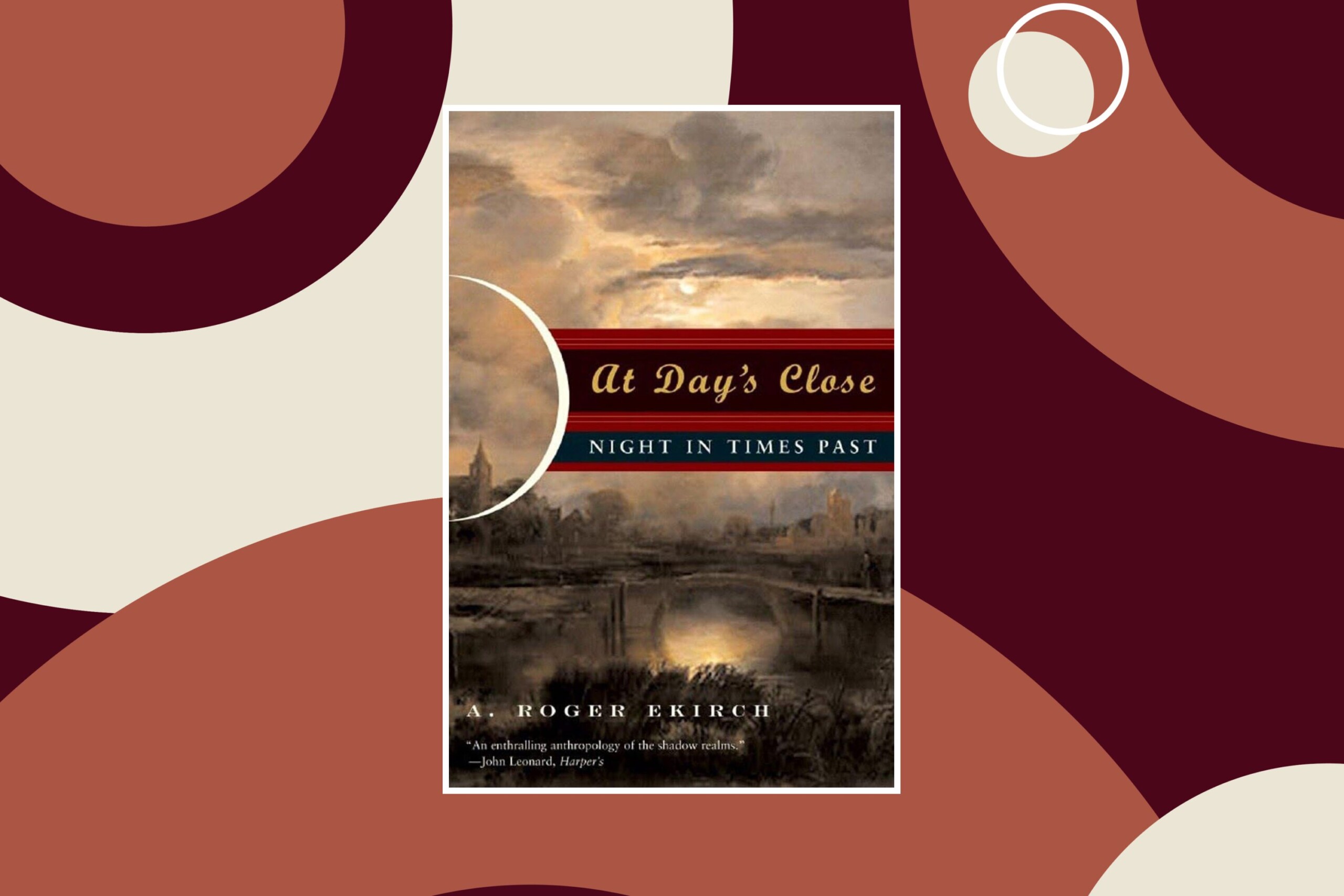
The historian A. Roger Ekirch’s book At Day’s Close: Night in Times Past provides a fascinating window into our ancestors’ world. The book provides insight into everything from the nocturnal dangers they faced, such as the threats of crime and fire, to their deeply uncomfortable sleeping arrangements. For excerpts from the book on that last subject, click here.
Nighttime in the past was far darker than today. Lighting was of poor quality and prohibitively expensive. “Preindustrial families were constrained by concerns for both safety and frugality.” Indeed, “even the best-read people remained sparing with candlelight. In his diary for 1743, the Reverend Edward Holyoke, then president of Harvard, noted that on May 22 and 23 his household made 78 pounds of candles. Less than six months later, the diary records in its line-a-day style, ‘Candles all gone.’”
Use of candles during the day was widely considered so extravagantly wasteful that it was avoided even by the wealthy. In 1712, the rich Virginia planter William Byrd II recorded finding an enslaved woman on his plantation named Prue “with a candle by daylight” for which he barbarically “gave her a salute with [his] foot” (in other words, kicked her). Jonathan Swift advised servants to never light candles “until half an hour after it be dark” to avoid facing wrath.
Most people, of course, had no servants (free or enslaved) and even fewer candles to spare. “At all hours of the evening, families often had to navigate their homes in the dark, carefully feeling their way” and relying on familiarity with the house. “Individuals long committed to memory the internal topography of their dwellings, including the exact number of steps in every flight of stairs.” The wood stair railing of a plantation in colonial Maryland features a distinctive notch to alert candle-less climbers of an abrupt turn.
“All would be horror without candles,” noted a 16th-century writer. Yet “light from a single electric bulb is one hundred times stronger than was light from a candle or oil lamp.” Although they were the best form of artificial lighting our ancestors knew, candles created only small and flickering areas of light. Rather than completely filling a room as artificial light does today with the flick of a light switch, candle light merely “cast a faint presence in the blackness,” not reaching the ceiling or the end of a room and leaving most of one’s surroundings still drenched in darkness. Even objects within the reach of the pitifully small pool of light could appear distorted. A French saying mocking the poor quality of candle illumination stated, “By candle-light a goat is lady-like.
“Prices fluctuated over time, but never did wax . . . candles become widely accessible. . . . Tallow candles, by contrast, offered a less expensive alternative. The mainstay of many families, their shaft consisted of animal fat, preferably rendered from mutton that was sometimes mixed with beef callow. (Hog fat, which emitted a thick black smoke, did not burn nearly as well, though early Americans were known to employ bear and deer fat.)” Vermin found such candles delectable. “Tallow candles required careful storage so that they would neither melt nor fall prey to hungry rodents.” Unpleasantly, candles “made from tallow gave off a rancid smell from impurities in the fat. . . . Wicks not only flickered, but also spat, smoked and smelled. . . . Still, despite such drawbacks, even aristocratic households depended upon them for rudimentary needs,” as wax candles were so expensive.
“Only toward the eighteenth century did cities and towns take half-steps to render public spaces accessible at night.” The average person remained indoors after sunset. “For most persons, the customary name for nightfall was ‘shutting-in,’ a time to bar doors and bolt shutters.”
Centuries later, little had changed. “Across the preindustrial countryside, fortified cities and towns announced the advance of darkness by ringing bells, beating or blowing horns from atop watchtowers, ramparts, and church steeples.” As rural peasants retreated into their homes, “townspeople hurried home before massive wooden gates, reinforced by heavy beams, shut for the evening and guards hoisted drawbridges wherever moats and trenches formed natural perimeters.” The writer Jean-Jacques Rousseau wrote of his panic as he rushed toward Geneva’s barred gates: “About half a league from the city, I hear the retreat sounding; I hurry up; I hear the drum being beaten, so I run at full speed: I get there all out of breath, and perspiring; my heart is beating; from far away. I see the soldiers from their lookouts; I run, I scream with a choked voice. It was too late.” When the Swiss writer Thomas Platter (1499–1582) found himself locked outside Munich’s city gate, he was reduced to seeking overnight shelter at a “leper-house.” In one French town, when a guard rang the bell signaling the gates were closing a half-hour too early, “Such was the mad crush of panicked crowds as they neared the gate that more than one hundred persons perished, most trampled in the stampede, others pushed from the drawbridge, including a coach and six horses. For his rapacity, the guardsman was broken upon the wheel. . . . Just to approach ramparts without warning at night constituted a crime.”
The time of shutting-in varied with the length of the day. “In winter, when darkness came on quickly, they could shut as early as four o’clock.” Laws even banned leaving one’s home at night. “In 1068, William the Conqueror (ca. 1028–1087) allegedly set a national curfew in England of eight o’clock.” Streets were blockaded to further discourage venturing outside after nightfall. “Lending weight to curfews, massive iron chains, fastened by heavy padlocks, blocked thoroughfares in cities from Copenhagen to Parma . . . Nuremberg alone maintained more than four hundred. In Moscow, instead of chains, logs were laid across lanes to discourage nightwalkers. Paris officials in 1405 set all of the city’s farriers to forging chains to cordon off not just streets but also the Seine.” In the early 1600s, one writer noted of the French town of Saint-malo: “In the dusk of the evening a bell is rung to warn all that are without the walls to retire into the town: then ye gates are shut, and eight or ten couple of hungry mastiffs turn’d out to range about town all night. . . . Courts everywhere exacted stiffer punishments for nighttime offences” than daytime ones. For example: “For thefts committed after the curfew bell, towns in Sweden decreed the death penalty.”
Toward the end of the Middle Ages, 9 p.m. or 10 p.m. became the standard “hour for withdrawing indoors” in much of Europe.
After nightfall, “for the most part, streets remained dark.” Even where early attempts at street lighting were made, they were seldom adequate. “As late as 1775 a visitor to Paris noted, ‘This town is large, stinking, & ill lighted.’ . . . Lamps in Dublin, as late as 1783, were spaced one hundred yards apart just enough, complained a visitor, to show the ‘danger of falling into a cellar.’”
Sunsets were seldom considered beautiful. “Rarely did preindustrial folk pause to ponder the beauty of day’s departure.” Instead, most surviving descriptions of sundown were characterized by anxiety. “Begins the night, and warns us home repair,” wrote one Stuart poet.
Most ordinary people feared nighttime. “We lie in the shadow of death at night, our dangers are so great,” noted one English author in 1670. Shakespeare’s Lucrece calls nighttime a “black stage for tragedies and murders” and “vast sin-concealing chaos.” “According to Roman poet Juvenal, pedestrians prowling the streets of early Rome after sunset risked life and limb” because the darkness hid so many threats. Centuries later, similar warnings are recorded: “Except in extreme necessity, take care not to go out at night,” advised the Italian writer Sabba da Castiglione (c. 1480–1554).
Many cultures widely believed that demons, ghosts, evil spirits, and other supernatural threats would emerge after sundown, hiding in the all-encompassing darkness. “Evil spirits love not the smell of lamps,” noted Plato. “In African cultures like the Yoruba and Ibo peoples of Nigeria and the Ewe of Dahomey and Togoland, spirits assumed the form of witches at night, sowing misfortune and death in their wake.” The most feared time of night was often the “dead of night,” between midnight and the crowing of roosters (roughly 3 a.m.), which the Ancient Romans called intempesta, “without time.” The crowing was thought to scare away nocturnal demons.
Hence, “in the centuries preceding the Industrial Revolution, evening appeared fraught with menace. Darkness in the early modern world summoned the worst elements in man, nature, and the cosmos. Murderers and thieves, terrible calamities, and satanic spirits lurked everywhere.”
The night was filled with terrors both real and imagined. Fear of the night was ancient. In Greek mythology, Nyx, the personification of night and daughter of Chaos, counted among her children Disease, Strife, and Doom.
The Talmud, an ancient religious text, warns, “Never greet a stranger in the night, for he may be a demon.” After all, darkness hid “vital aspects of identity in the preindustrial world.” At night, “friends were taken for foes, and shadows for phantoms.” Ghostly nighttime encounters were widely reported throughout the preindustrial age, as widely held superstitions combined with a dearth of proper lighting to create traumatic experiences in the minds of many of our ancestors. “There was not a village in England without a ghost in it, the churchyards were all haunted, every large common had a circle of fairies belonging to it, and there was scarce a shepherd to be met with who had not seen a spirit,” an 18th-century writer in the Spectator claimed. “The late eighteenth-century folklorist Francis Grose estimated that the typical churchyard contained nearly as many ghosts at night as the village had parishioners.” Fear of such folkloric creatures was near-universal. Most ordinary people felt genuine, acute distress regarding the pantheon of evil spirits they feared lurked in the night:
Especially in rural areas, residents were painfully familiar with the wickedness of local spirits, known in England by such names as the “Barguest of York,” “Long Margery,” and “Jinny Green-Teeth.” Among the most common tormenters were fairies. In England, their so-called king was Robin Good-fellow, a trickster. . . . “The honest people,” if we may believe a visitor to Wales, “are terrified about these little fellows,” and in Ireland Thomas Campbell reported in 1777, “The fairy mythology is swallowed with the wide throat of credulity.” . . . Dobbies, who dwelt near towers and bridges, reportedly attacked on horseback. An extremely malicious order of fairies, the duergars, haunted parts of Northumberland in northern England, while a band in Scotland, the kelpies, bedeviled rivers and ferries. Elsewhere, the people of nearly every European culture believed in a similar race of small beings notorious for nocturnal malevolence.
In the minds of our ancestors, every shadow might hide trolls, elves, sprites, goblins, imps, foliots, and more. A favorite prank of young men was to affix “candles onto the backs of animals to give the appearance of ghosts.” The impenetrable darkness of the night before humanity harnessed electricity gave rise to imagined horrors beyond modern comprehension.
Other denizens of the nocturnal world included banshees in Ireland whose dismal cries warned of impending death; the ar cannerez, French washwomen known to drown passersby who refused to assist them; and vampires in Hungary, Silesia, and other parts of Eastern Europe who sucked their victims’ blood. . . As late as 1755, authorities in a small town in Moravia exhumed the bodies of suspected vampires in order to pierce their hearts and sever their heads before setting the corpses ablaze. During the sixteenth and seventeenth centuries, reports of werewolves pervaded much of Central Europe and sections of France along the Swiss border, notably the Jura and the Franche-Comté. The surgeon Johann Dietz witnessed a crowd of villagers in the northern German town of Itzehoe chase a werewolf with spears and stakes. Even Paris suffered sporadic attacks. In 1683, a werewolf on the Notre-Dame-de-Grâce road supposedly savaged a party that included several priests.
And that is not all that the darkness ostensibly hid. “Known as boggles, boggarts, and wafts, ghosts reportedly resumed their mortal likenesses at night.” It was popularly believed that those who died by suicide were doomed to wander the night for all eternity as ghosts, and such ghosts were sometimes thought to assume the form of animals such as dogs.
Ghosts afflicted numerous communities, often repeatedly, like the Bagbury ghost in Shropshire or Wiltshire’s Wilton dog. Apparitions grew so common in the Durham village of Blackburn, complained Bishop Francis Pilkington in 1564, that none in authority dared to dispute their authenticity. Common abodes included crossroads fouled by daily traffic, which were also a customary burial site for suicides. After the self-inflicted death in 1726 of an Exeter weaver, his apparition appeared to many at a crossroads. “‘Tis certain,” reported a newspaper, “that a young woman of his neighbourhood was so scared and affrighted by his pretended shadow” that she died within two days. Sometimes no spot seemed safe. Even the urbane. [English writer Samuel] Pepys feared that his London home might be haunted. The 18th-century folklorist John Brand recalled hearing many stories as a boy of a nightly specter in the form of a fierce mastiff that roamed the streets of Newcastle-upon-Tyne.
Material problems sometimes exacerbated such anxieties. Amid an episode of widespread starvation in Poland, one observer in 1737 opined, “This calamity has sunk the spirits of the people so low, that at [Kamieniec], they imagine they see spectres and apparitions of the dead, in the streets at night, who kill all persons they touch or speak to.”
Such superstitions inspired a feeling of terror that was all too real and could result in actual deaths. Sometimes our forebears literally died of fright, experiencing cardiac arrest from the sheer shock of glimpsing sights in the darkness that they interpreted to be fairies or other such entities. And ordinary people accused of being witches or werewolves could face execution. “In Cumberland, of fifty-five deaths arising from causes other than ‘old age’ reported in the parish register of Lamplugh during a five-year period from 1658 to 1662, as many as seven persons had been ‘bewitched.’ Four more were ‘frighted to death by fairies,’ one was ‘led into a horse pond by a will of the wisp,’ and three ‘old women’ were ‘drownd’ [sic] after being convicted of witchcraft.” (Note that fairies were considered dangerous, not adorable; an 18th-century rebel group of agrarian peasants in Ireland even adopted the moniker of fairies “to intimidate their adversaries”).
Many deaths attributed to legendary beings hiding in the darkness were caused by the darkness itself. Lethal nighttime accidents were common because of the poor state of lighting. “On most streets before the late 1600s, the light from households and pedestrians’ lanterns afforded the sole sources of artificial illumination. Thus the Thames and the Seine claimed numerous lives, owing to falls from wharves and bridges, as did canals like the Leidsegracht in Amsterdam and Venice’s Grand Canal.” Canals, unguarded ditches, ponds, and open pits of varying kinds were far more commonplace in the past, as concern for safety was considerably lower than in the present. “Many people fell into wells, often left unguarded with no wall or railing. If deep enough, it made little difference whether dry”—the fall was sufficient to cause death. Straying from a familiar route could prove lethal. “In Aberdeenshire, a fifteen-year-old girl died in 1739 after straying from her customary path through a churchyard and tumbling into a newly dug grave.
“Even the brightest torch illuminated but a small radius, permitting one, on a dark night, to see little more than what lay just ahead.” Wind could blow out a torch or lantern in an instant. William Shakespeare described the frequent horror of “night wand’rers” upon seeing their “light blown out in some mistrustful wood” in his poem Venus and Adonis (1593). Traveling when the moon was bright could be the difference between life and death; by the 1660s, one in every three English families bought almanacs forecasting the lunar phases, and in colonial America, such almanacs “represented the most popular publication after the Bible.” In parts of England, the evening star (the planet Venus) was known as the Shepherd’s Lamp for its role in helping the poor navigate the night. An overcast sky could, of course, deprive a traveler of any celestial light from the stars or moon. Spaniards called such occasions noché ciéga, blind nights.
Making nocturnal navigation even harder, ordinary people in the past were rarely fully sober. This lack of sobriety, when combined with darkness, could lead to confusion and accidents. “A New England newspaper in 1736 printed a list of more than two hundred synonyms for drunkenness. Included were ‘knows not the way home’ and ‘He sees two moons’ to describe people winding their way in the late evening.” In some cases, intoxication contributed to hallucinations of the supernatural and to deadly accidents. In Derby in England, one preindustrial “inebriated laborer snored so loudly after falling by the side of a road that he was mistaken for a mad dog and shot.” Similarly tragic episodes abounded. “On a winter night in 1725, a drunken man stumbled into a London well, only to die from his injuries after a neighbor ignored his cries for help, fearing instead a demon.”
When natural phenomena illuminated the night unexpectedly, our forebears often reacted with distress. Examples of such sources of illumination included comets, aurora borealis, and swamp gas lights (caused by the oxidation of decaying matter in marshlands releasing photons). Many people took swamp gas lights to be a supernatural occurrence, termed will-o’-the-wisps.
All unusual nocturnal lights inspired terror and wonder in the people of the past, who often understood the lights as supernatural signs or portents. A comet in 1719 “struck all that saw it into great terror,” according to an English vicar, who noted that “many” people “fell to [the] ground” and “swooned” in fear. “All my family were up and in tears . . . the heavens flashing in perpetual flames,” wrote George Booth of Chester in 1727, when the aurora borealis, usually only visible farther north, made a rare appearance in England’s night sky and caused panic. One colonist in Connecticut “reportedly sacrificed his wife,” killing her in the hope that a human sacrifice might appease the heavens, upon seeing an unexpected light overhead (likely a comet). Occasionally, unexpected natural light sources could prove helpful. “Only the flash from a sudden bolt of lightning, one ‘very dark’ August night in 1693, kept the merchant Samuel Jeake from tumbling over a pile of wood in the middle of the road near his Sussex home.” More often, unanticipated lights in the darkness led to tragedy. “‘Pixy led’ was a term reserved in western England . . . for nocturnal misadventures attributed to will-o’-the-wisps.” Many deaths by drowning resulted from our forebears’ rash reactions to the sight of such “pixies” (in actuality, swamp gas).
Other nocturnal dangers were all too human, although they might pretend otherwise. “In Dijon during the fifteenth century, it was common for burglars to impersonate the devil, to the terror of both households and their neighbors. Sheep-stealers in England frightened villagers by masquerading as ghosts.” In 1660, the German legal scholar Jacobus Andreas Crusius claimed, “Experience shows that very often famous thieves are also wizards.” Many criminals indeed attempted to perform magic through grotesque superstitious rituals. “Some murderers hoped to escape capture by consuming a meal from atop their victim’s corpse. In 1574, a man was executed for slaying a miller one night and forcing his wife, whom he first assaulted, to join him in eating fried eggs from the body.” And that was not all.
The most notorious charm, the “thief’s candle,” found ready acceptance in most parts of Europe. The candle was fashioned from either an amputated finger or the fat of a human corpse, leading to the frequent mutilation of executed criminals. Favored, too, were fingers severed from the remains of stillborn infants. . . . To enhance the candle’s potency, the hands of dead criminals, known as Hands of Glory, were sometimes employed as candlesticks. Not unknown were savage attacks on pregnant women whose wombs were cut open to extract their young: In 1574, Nicklauss Stiller of Aydtsfeld was convicted of this on three occasions, for which he was “torn thrice with red-hot tongs” and executed upon the wheel (In Germany, a thief’s candle was called a Diebeherze.). . . . Before entering a home in 1586 a German vagabond ignited the entire hand of a dead infant, believing that the unburned fingers signified the number of persons still awake. Even in the late eighteenth century, four men were charged in Castlelyons, Ireland, with unearthing the recently interred corpse of a woman and removing her fat for a thief’s candle.
Many households also turned to attempts at magic to defend against thieves and monsters, using “amulets, ranging from horse skulls to jugs known as ‘witch-bottles,’ which typically held an assortment of magical items. Contents salvaged from excavated jugs have included pins, nails, human hair, and dried urine.” Some hung wolves’ heads over doors. “To keep demons from descending chimneys, suspending the heart of a bullock or pig over the hearth, preferably stuck with pins and thorns, was a ritual precaution in western England. . . . In Somerset, the shriveled hearts of more than fifty pigs were discovered in a single fireplace.”
Fear of not only evil spirits but of such flesh-and-blood criminals lurking in the darkness kept most people indoors. In 1718, London’s City Marshal noted, “It is the general complaint of the taverns, the coffeehouses, the shopkeepers and others, that their customers are afraid when it is dark to come to their houses and shops for fear that their hats and wigs should be snitched from their heads or their swords taken from their sides, or that they may be blinded, knocked down, cut or stabbed. . . . As late as the mid-eighteenth century, a Londoner complained of the ‘armies of Hell’ that ‘ravage our streets’ and ‘keep possession of the town every night.’” Almost anyone who ventured outside did so armed. “As soon as night falls, you cannot go out without a buckler and a coat of mail,” opined a visitor to Valencia in 1603.
On a night in Venice, a young English lady suddenly heard a scream followed by a “curse, a splash and a gurgle,” as a body was dumped from a gondola into the Grand Canal. “Such midnight assassinations,” her escort explained, “are not uncommon here.” First light in Denmark revealed corpses floating in rivers and canals from the night before, just as bloated bodies littered the Tagus and the Seine. Parisian officials strung nets across the water to retrieve corpses. . . . In Moscow, so numerous were street murders that authorities dragged corpses each morning to the Zemskii Dvor [Zemsky Court] for families to claim. In London . . . Samuel Johnson warned in 1739, “Prepare for death, if here at night you roam, and sign your will before you sup from home.”
“On moonless nights in many Italian cities, young men called ‘Bravos’ prowled as paid assassins.” In some cases, affluent and highborn youths roamed the night looking for a fight: ”Some cities saw the rise of nocturnal gangs composed of blades with servants and retainers in tow.” Most ruffians and thieves hiding in the darkness were common people out to commit robbery, not bored young noblemen hoping to enter a swordfight. “During the late sixteenth century, pedestrians in Vienna or Madrid rarely felt safe after dark. Foot-pads [thieves] rendered Paris streets menacing, a visitor discovered in 1620; one hundred years later, a resident wrote that ‘seldom not a night passes but some body is found murdered.’”
In London in 1712, a gang called the Mohocks terrorized the population: “Besides knifing pedestrians in the face, they stood women on their heads, ‘misusing them in a barbarous manner.’” The poet Jonathan Swift so feared that gang that he made a point of coming home early. “They shan’t cut mine [face],” he reasoned.
A lack of proper lighting afforded criminals ample cover to commit crimes. In 1681, the British dramatist John Crowne observed that night is “The time when cities are set on fire; / When robberies and murders are committed.”
Indeed, nocturnal crime was so common that a dictionary in 1585 defined thieves as felons “that sleepeth by day” so that they “may steale by night.” Surviving records suggest most preindustrial crimes occurred at night. “In the eighteenth century, nearly three-quarters of thefts in rural Somerset occurred after dark, as did 60 percent in the Libournais region of France.” “Of Italian peasants, a poem, ‘De Natura Rusticorum,’ railed: “At night they make their way, as the owls, / and they steal as robbers.”
Even indoors, nocturnal thefts were so common as to be unremarkable. In 1666, Samuel Pepys awoke “much frighted” by the noise of a theft, but upon realizing the thief was merely robbing a neighbor and not Pepys’s own home, he went back to sleep feeling relieved. Urban areas were not the only sites of crime. Bands of thieves roamed the countryside. “Bands of a half-dozen or more members were typical, as were violent break-ins. . . . Wooden doors were smashed open with battering rams and shutters bashed apart by staves. Gaping holes were cut through walls of wattle and daub. Nine thieves in 1674 stormed into the Yorkshire home of Samuel Sunderland. After binding every member of the household, they escaped with £2500.” Criminal gangs were more common in some areas than others. “French gangs, known as chauffeurs, grew notorious for torturing families with fire.” Criminals either carried no lights or “dark lanterns,” which emit light from only one side. (Merely possessing such a lantern constituted a crime in Rome and could lead to imprisonment).
In preindustrial societies, violence left few realms of daily life unscathed. Wives, children and servants were flogged, bears baited, cats massacred, and dogs hanged like thieves. Swordsmen dueled, peasants brawled, and witches burned. . . . Short tempers and long draughts made for a fiery mix, especially when stoked by the monotony and despair of unremitting poverty. The incidence of murder during the early modem era was anywhere from five to ten times higher than the rate of homicide in England today. Even recent murder rates in the United States fall dramatically below those for European communities during the sixteenth century. While no social rank was spared, the lower orders bore the brunt of the brutality.
The thieves of the past were not picky and would even pry “lead from the roofs of dwellings.” After all:
Economic necessity begot most nocturnal license. With subsistence a never-ending struggle, impoverished households naturally turned to poaching, smuggling, or scavenging food and fuel. The common people are thieves and beggars,” wrote Tobias Smollett, “and I believe this is always the case with people who are extremely indigent and miserable.”
“The working poor also took precautions, for even the most mundane items—food, clothing, and household goods—attracted thieves.” Each household, however humble, barricaded itself as night fell. “Doors, shutters, and windows were closed tight and latched.” Throughout most of history, locks were feeble and easily picked. “Not until the introduction of the ‘tumbler’ lock in the eighteenth century would keyholes better withstand the prowess of experienced thieves. In the meantime, families resorted to double locks on exterior doors, bolstered from within by padlocks and iron bars. . . . Also common, naturally, for those who could afford the expense, was the practical use of candlelight to ward off thieves. . . . In the Auvergne of France, so alarmed by crime were peasants in the mid-1700s that an official reported, ‘These men keep watch with a lamp burning all night, afraid of the approach of thieves.’”
While darkness caused lethal accidents, offered cover for crimes, and terrified our ancestors with the fear that the night might hide supernatural threats, fire could also kill. Understandable fear of fire motivated brutal punishments for arsonists and would-be arsonists. “A mob in 1680, upon learning that a woman had threatened to burn the town of Wakefield, carried her off to a dung heap, where she lay all night after first being whipped. A worse fate befell a Danish boatman and his wife, upon trying to set the town of Randers ablaze. After being dragged through every street and repeatedly ‘pinched’ with ‘glowing tongs,’ they were burned alive.” A 24-year-old University of Paris student was burned alive for arson in 1557. In Denmark, beheading was the usual punishment for arson. After a Stockholm bellringer failed to sound the alarm when a fire flared in 1504, he “was ordered to be broken on the rack, until pleas for mercy resulted instead in his beheading.”
Candles, hearth flames, and poorly cleaned or designed chimneys all posed constant fire hazards. “Some homes lacked chimneys altogether, to the consternation of anxious neighbors. Complaining that John Taylor, both a brewer and a baker, had twice nearly set his Wiltshire community ablaze from not having a chimney, petitioners in 1624 pleaded that his license be revoked. Of their absence in an Irish village, John Dunton observed, ‘When the fire is lighted, the smoke will come through the thatch, so that you would think the cabin were on fire.’”
Most ordinary homes among the impoverished masses were infested with vermin, and rats and candles proved a highly combustible combination. Flickering candles “made tempting targets for hungry rats and mice. Samuel Sewall of Boston attributed a fire within his closet to a mouse’s taste for tallow.” The Old Farmer’s Almanack advised placing candles “in such a situation as to be out of the way of rats.”
“Despite the introduction of fire engines in cities by the mid-seventeenth century, most firefighting tools were primitive,” the fire engines being mere tubs of water transported by runners on long poles or wheels. Rather than assisting in fighting the flames, neighbors often robbed burning homes. “Fireside thefts were endemic.” In England, “So routine was this form of larceny that Parliament legislated in 1707 against ‘ill-disposed persons’ found ‘stealing and pilfering from the inhabitants’ of burning homes.” “There was much thieving at the fire,” noted the Pennsylvania Gazette of a 1730 Philadelphia blaze.
“Often, barely a year passed before some town or city in England experienced disaster. From 1500 to 1800, at least 421 fires in provincial towns consumed ten or more houses apiece with as many as 46 fires during that period destroying one hundred or more houses each.” England was hardly unique in this regard. Across the preindustrial world, fires raged:
Fires spread terror from Amsterdam to Moscow, where an early morning blaze in 1737 took several thousand lives. Few cities escaped at least one massive disaster. . . . Toulouse was all but consumed in 1463, as was Bourges in 1487, and practically a quarter of Troyes in 1534. The better part of Rennes was destroyed in 1720 during a conflagration that raged for seven days. . . . Boston lost 150 buildings in 1679 after a smaller blaze just three years before. Major fires again broke out in Boston in 1711 and in 1760 when flames devoured nearly 400 homes and commercial buildings. . . . While New York and Philadelphia each suffered minor calamities, a fire gutted much of Charleston in 1740.
Rural areas were not necessarily safer from the threat of fires. The Danish writer Ludvig Holberg (1684–1754) observed, “Villages were laid out with the houses so close together that, when one house burned down, the entire village had to follow suit.” After all, rural construction materials were highly flammable. “Once ignited, a thatch roof, made from reeds or straw, was nearly impossible to save.”