
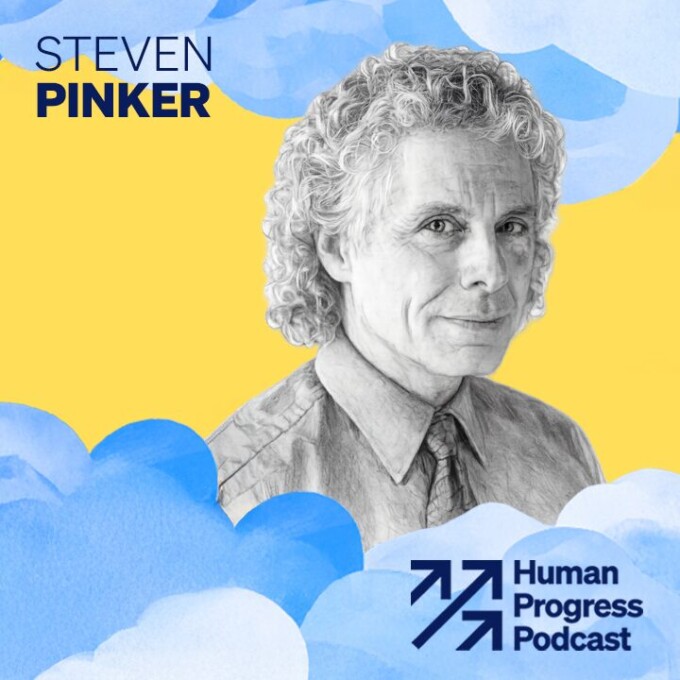
Marian Tupy: Hello and welcome to the next episode of humanprogress.org. Today, I’m very pleased to have with me Steven Pinker, a world-renowned Harvard University psychologist and author of best-selling books including The Blank Slate, The Better Angels of Our Nature, Enlightenment Now, and of course, most recently, When Everyone Knows What Everyone Knows. Highly recommend all of them. Steven appeared on this podcast back in 2020, and today I hope to continue the conversation with him about the promise and criticisms of human progress. Welcome, Steve.
Steven Pinker: Thank you. Thank you, Marian. Pleasure to be here.
Marian Tupy: Let’s start at a sort of very high level and look at how Americans think about the country and where we are, psychologically speaking. Gallup shows that 80% of Americans are either satisfied or very satisfied with their lives, but only 20% are satisfied with the way that America is going. Now, obviously, this is a bit of a discrepancy. So what does a psychologist have to say about that?
Steven Pinker: It’s a fascinating phenomenon. Pollsters have known about this for decades. They call it the optimism gap. Just about any question you ask, “What is the quality of education in this country?” “It’s terrible.” “What’s the quality of your child’s school?” “Well, not bad.” “How safe is the country?” “Oh, you can’t walk anywhere. You get mugged, you get attacked, there are terrorists.” “How safe is your neighborhood?” “Oh, I feel perfectly fine.” And question after question, your economic prospects, people do feel better about their own lives than the country. So what’s going on? I think part of it is, of course, that none of us can experience the entire country. We get it from the media, and the media have a number of negativity biases. There’s an actual negativity bias that editors feel they’re much more responsible if they emphasize negative stories than positive ones. I’ve heard one editor say, “Well, in journalism, we think that negative news is journalism, positive news is advertising.” And I think it was Stewart Brand who once said, more generally, not just in the news media, that a pessimist sounds like he’s trying to help you, an optimist sounds like he’s trying to sell you something.
Steven Pinker: So there is, in terms… People think there’s greater gravitas to negative than positive news. That’s one. Because humans in general have a negativity bias. Negative emotions are more psychologically potent than positive emotions. There are more negative emotions than positive emotions. Then that’s gonna be reflected in the market for news. You can just see that in our market for fiction. A lot of popular entertainment is crime movies, mafia movies, war movies, murder mysteries. It’s just more, a lot more interesting, engaging often than positive stories because conflict is inherently interesting. But also just the nature of news selects for negative events because it reports what’s new and what is discrete enough to be a story. So if something happens, chances are it’s more likely to be bad than good because there’s just many more ways for things to go wrong than for things to go right. And so something can go south in a hurry. There can be a terrorist attack, there can be a natural disaster, a building can collapse, a police shooting. Positive things tend to be either things that don’t happen, like a region of the world that is not at war, but that’s not news.
Steven Pinker: So for example, for my generation, the idea that there would be no war in Southeast Asia for 40 years, that would be unthinkably utopian because we grew up with the Vietnam War. But you don’t have a headline saying, “Another year has passed, there’s still no war in Vietnam.” Or there are developments that increase by a few percentage points a year, like the decline in extreme poverty, the rise in literacy, many of the things that you’ve written about. It’s just never a Thursday in October in which it suddenly happens and it’s a headline. So our picture of the country as a whole, the world as a whole, is, I think, distorted both deliberately and accidentally by just the very nature of news.
Marian Tupy: So recently on a podcast with Tyler Cowen, we talked about a concept that he coined, but I also wondered about, which is negativity contagion epidemic, essentially. So on the one hand, yes, if it bleeds, it leads. The media has to sell certain stories. But there is the human component. We have evolved to look for bad news, and that makes us feel much more pessimistic about the whole world. So does that mean that rational optimists are bound to lose? Because we are always only going to reach tens of thousands or hundreds of thousands of people, whereas the negative news is going to reach hundreds of millions of people.
Steven Pinker: Yeah. Well, I wouldn’t put it as pessimistically as we’re bound to lose, but we face constant headwinds. It’s an uphill battle. But the reason that we’re not bound to lose is that there are a lot of variations across countries and across times in national optimism or pessimism. There’s a lot of paradoxes here, that the degree of optimism in a country does not seem very closely related to the conditions of life in that country. So the world’s most, I think, most pessimistic country is France, which is a pretty nice place to live. The world’s most optimistic countries are, I think, Nigeria and China. Now, of course, China is better than it used to be, but it’s still not a particularly wealthy country across the entire population.
Marian Tupy: And you are quite right that even if you look at the Gallup poll, which goes back to 1979, between 1979 and 2025, whilst the life satisfaction is steady at 80, the dissatisfaction with the United States tends to oscillate between like 60% and 20%. So there is hope there.
Steven Pinker: Interesting. Yes. Let me mention one other thing going back to why there is this optimism gap, and so as not to reassure our listeners that you and I are Pollyannas and Panglosses and oblivious to the real problems, is that since there really are problems in the world, to put it mildly, and there are periods in history where things get worse as well as get better, depending on what measure you’re looking at, and some things have gotten worse in the last 10 or 20 years, but one has to have a quantitative, statistical, probabilistic view of the world to acknowledge the reality that some things can get worse while still being better than they were historically, that some things can get worse while other things are getting better. That kind of quantitative, nuanced view, so that you don’t conclude from something that genuinely has gotten worse that everything has gotten worse or that we’re in a worse situation now than we ever have been. So that’s one other component that is not cognitively natural, but that kind of statistical literacy or quantitative, multi-factor appreciation, which ought to be the first thing that schools try to teach. That’s what being an educated person consists of. I think we haven’t done enough of it in the educational system and in the media ecosystem where journalists and commentators should just remind people that things can be better without being perfect. I’m not telling you anything you don’t know because I’m sure you get this all the time.
Marian Tupy: Well, to quote Steven Pinker, “Human progress doesn’t mean that everything is getting better for everyone, everywhere at all times. That would be a miracle,” right?
Steven Pinker: Yeah. That wouldn’t be progress. That would be a miracle.
Marian Tupy: But speaking…
Steven Pinker: Sorry, one more ting, and this is a quote, one of my favorite quotes from one of the great rational optimists, David Deutsch: “Problems are inevitable. Problems are solvable. Solutions create new problems that have to be solved in their turn.”
Marian Tupy: Would you want to modify it? I wonder what David Deutsch would think about it. To modify it in a way that usually what happens is that we have a big problem, we solve it, creating a usually smaller problem, solving it leading to another problem. I like to use the example of hunger, that we used to have famines. We solved it through higher food production, leading to obesity. Now we’ve come up with Ozempic, which takes care of obesity, but maybe reducing our muscle mass, and then we’ll have to find a solution to that and so on. But each step of the way is a smaller problem. Now, I don’t think there is some sort of a hard rule for that, but it seems to work out like that on average.
Steven Pinker: Yeah, I think it’s a very good way of putting it. I would also add, and I think that’s very much consistent with Deutsch’s three laws, if you will. One asterisk is Thomas Sowell likes to say there are no solutions, there are only trade-offs, which is another way of putting it, with the asterisk to that at the same time that there are always trade-offs, the curve can be bent so that you still get… Even if you’re trading things off, you’re still in a better situation than you were. Trade-offs themselves can be modified so that you have to pay fewer costs for the same benefits or more benefits for the same cost.
Marian Tupy: I think that’s a very important asterisk on the Sowell argument because I never bought it fully, thinking that at some point you can have solutions to the problem like the problem of hunger, then obesity, then muscle loss, et cetera, until eventually the trade-off becomes almost imperceptible. But that’s just… Now you mentioned something about basic literacy and so forth. Recently I’ve been reading about freshmen entering university without basic ability to read and count and so forth. People reading fewer books and so forth. Are we actually getting dumber? Is education maybe the one example where one could make an argument that situation is worse than it was 40 or 50 years ago? Or is that buying into the negativity contagion?
Steven Pinker: Yeah, I think… I don’t know about 40 or 50 years ago, but certainly 20, 25 years ago. And it’s not the only example. The world’s democracy score has gone down in the last couple of decades. War deaths are worse now than they were 20 years ago, although still better than they were in the ’60s, ’70s, ’80s, and most of the ’90s. But yeah, so educational scores have gone down. The Flynn effect, by which IQ scores rose for about three points a year for almost a century, has now gone in the other direction. Now, it doesn’t mean that we’re back to the level that we were 100 years ago, but it does mean that there is a bit of a droop. And there may be a combination of factors there. It may be that there are pathologies in our educational system, that the drive for equity and especially for equity across all racial groups has led to bringing down the top rather than raising the bottom. That is, there are fewer accelerated and advanced courses. Standards for reading and methods of teaching reading have not followed the optimal methods. Maybe our schools of education have been training teachers to use the wrong methods in reading.
Steven Pinker: Plus changes in the culture where reading is, like an appreciation of progress, reading and literacy are one of the things that are good but cognitively unnatural. That is, they go against our evolved nature. We didn’t evolve with print. It was a recent invention. Reading is… For many of us, it’s become so second nature that we just assume that it’s the most natural way of getting information. But what we’ve seen, especially in the last 10 years, when video has become so cheap because of the cloud computing revolution and the broadband revolution, that a lot of people, unlike us, much prefer to listen and watch than to read. You just see this. When I go to Google and I ask a basic question about how to unstick my printer or how to solve a problem, I get like five videos and I just want to get like a paragraph that would solve it. I don’t want to see Seth saying, “Hi, welcome to my show. If you like it, subscribe and give it a like,” to just help me solve the problem. But clearly there’s something unusual about me because people are going for the video. And the massive availability of video, of TikTok, of YouTube, means that people may not be either… Are getting the practice, putting the effort into literacy, which we have reason to believe was one of the drivers of the Flynn effect and of cognitive sophistication in general.
Steven Pinker: My understanding is the decline of scores in reading and math are most severe at the low end, that the smart students have not declined much, but the weaker students have. So it is a problem, and I think it’s a problem that ought to be addressed. We may not be able to get large numbers of students to read entire books, although we should aim for that, at least at the higher end. There also may be… I’ll throw out one other factor and that is that knowledge has increased exponentially, thanks to the availability of information on the web from Wikipedia and other sources. But just there’s… I have found, just as a curious person, that I can get lost in reading about things that just… The history of the potato chip or the transatlantic travel or planets. There’s just a flood of information out there and it’s all really interesting. And it may be that with knowledge increasing exponentially, the optimal length of a work of text may no longer be a book. And I say this with some embarrassment because that’s kind of what I do. I write books, sometimes very long books. But for some kinds of information, it may be that a book really shows diminishing returns.
Marian Tupy: Forgive me, I want to move on to some other criticisms of human progress, but I do want to suggest one idea and that is to what extent do you think it may be that just ignorance is more visible than it used to be? Perhaps the share of the population that was interested, that was curious and that was interested in transatlantic sailing or planets in 18th century France was always a tiny sliver of the population equivalent to the Steven Pinkers of this world today. But nobody cared about what the 90% of Frenchmen who were peasants were reading or not reading or what they believed in. And maybe that sliver of population has been constant across ages. But now ignorance is more in your face because people walk around with microphones and are asking ordinary people, “Can you name the three branches of government?” and they can’t, et cetera.
Steven Pinker: That’s interesting. And of course it is one of the, it’s part of the paradox of democracy that what the person in the street who votes thinks and how they think is a major problem or a major issue at least. But yeah, that could be also, yeah, that’s a good point. And the democratization of media, where it used to be that there was Time magazine and the New York Times and CBS and NBC and the BBC, and you heard from, because of just the massively limited bandwidth, there were gatekeepers and you would hear from a more elite segment of the population. Now with comment sections on websites, with blogs, with social media, we unfortunately know more about what the average person on the street thinks and it’s not a pretty sight. But it may… In fact, there’s reason to think that, you’re right, that there was always a huge undercurrent of belief in conspiracy theories and the paranormal and crazy stuff, but they just… No one asked them and they weren’t interviewed by the BBC. So that’s part of it. Although as you yourself mentioned at the beginning, there are some data showing a decline in literacy. So it isn’t just reporting. There is a real effect there too.
Marian Tupy: Let’s now look at other criticisms of human progress. You and I had an article recently in Free Press pushing back against this view held by some parts of the right that life in America but around the world has basically become meaningless, that we are suffering from a crisis of meaning. Have you ever seen any hard evidence suggesting that people’s lives are more meaningless in rich countries versus poor countries or that lives are less meaningful today than they used to be 100 or 200 years ago? Because I haven’t.
Steven Pinker: No, I haven’t either. That is, we don’t have survey data on “How meaningful do you think life is?” Now, there are snapshots of meaning and happiness in the present which suggest that they are partially but not perfectly correlated. So in general, people who are happier say their lives are more meaningful. But there are people who say that some sources of meaning are not the same as sources of happiness and vice versa. This is research by Roy Baumeister. So just to give a couple of examples, if you’re dedicating your life to some cause, there are setbacks, there are frustrations, that makes you less happy, but you say your life is more meaningful compared to just a life of pleasure and leisure. Time spent with friends is more pleasurable, time spent with family is more meaningful. So there are ways that they’re not perfectly correlated, but they are partially correlated. So the fact that over, as best we can tell, over the course of history, if you look at the whole range of countries, there’s more increase in happiness than decrease. Countries that are very affluent, like the United States, where we may be kind of close to the ceiling and there has not been an increase in happiness, maybe even a slight decline.
Steven Pinker: But overall, across the world, there’s reason to believe that happiness has increased for obvious reasons, that people are living longer, they’re less poor, they’re better educated and so on. So that would suggest but not prove that there has not been a decline in meaningfulness. It’s still possible, but just anecdotally, there have been complaints that life is meaningless as far back as you go. Ecclesiastes, “Vanity of vanities, all is vanity.” Henry David Thoreau in 1854, “The mass of men lead lives of quiet desperation.” Now, how a guy living in a cabin on a pond could know this is unclear, but that was the perception. T.S. Eliot, “We are the hollow men, we are the stuffed men,” 1920s. Starting in the ’50s, there was a great fear of alienation. That was the big issue. And part of the counterculture was how suburban middle-class life was meaningless and empty and plastic and artificial. The Pursuit of Loneliness, 1970 bestseller by Philip Slater. Jimmy Carter’s malaise speech in the late 1970s. So it’s a constant complaint. So the fact that people say it doesn’t necessarily mean it’s true. And one would think that if your wife or you don’t die in childbirth, if your children don’t die in the first few years of life, that’s pretty meaningful, I would think, which doesn’t prove that there hasn’t been an increase in meaninglessness, but there is a reason to be skeptical of it.
Steven Pinker: And the thing is that there’s a sense in which it’s always tempting to think that life is meaningless because though we like to think that there is a plan to the universe, a purpose, and we get disillusioned when we find there isn’t one, the laws of nature don’t tell any story with a goal or an ending. That’s the greatest discovery of the scientific revolution, that the laws of physics just do their thing and they don’t look ahead. Now, this doesn’t mean that human life is meaningless because we have goals like health, education, knowledge, happiness, peace, safety. We humans have goals which we can pursue. And as you and I have pointed out, we’ve made progress toward those goals.
Steven Pinker: But if you’re looking for life as a whole to have a pleasing story arc, you’re gonna be disappointed. You’re gonna be tempted to think that life is meaningless. Also, there are things that are built into the evolutionary process that guarantee that a lot of life is gonna appear meaningless. We die, we get older, we weaken. Our relationships, even our closest relationships like family and romantic relationships, mix elements of conflict of interest with overlap of interest, so there’s never a perfect relationship. There’s the law of entropy. Things fall apart, things decay. So the universe is indifferent. And if you think that what gives life meaning is that the universe tells a story, you’re gonna be disappointed. Now, I think the answer to that is that we ought to look at human purposes. And there are plenty of them, like not dying young, like not getting shot, like knowing more, like experiencing art, experiencing culture, experiencing friendship, seeing the world. But one has to reorient and I think realize that those are the goals of life and not expect that the universe tells a story that is satisfying.
Marian Tupy: I guess one thing that worries me is how quickly people are willing to accept an assertion of crisis of meaning without long-running data or the relevant comparisons and so forth. And so what seems to happen is that very often people look for proxies of meaning such as, for example, anxiety and suicides. And so I just wanna very briefly talk about those two. So there seems to be some evidence that there are higher anxiety rates in rich countries rather than poor. So from that you could deduce that human progress actually leads to higher anxiety. But as we have seen with other research, such as, for example, research into autism, definitions can change. They can expand to a level where things that you previously never ascribed to anxiety will be ascribed to anxiety today. Trauma used to mean being bombed by the Germans in the trenches of the First World War. Today it may be that you are breaking up with your boyfriend or your girlfriend. Do you have any sense as to how reliable the data on anxiety and trauma is?
Steven Pinker: Yeah, my sense is that there’s a mix of both. There’s certainly a kind of diagnostic category creep because what used to be a life event is now a psychological diagnosis. And I’ve seen this in my own students, that there’s an eagerness to diagnose oneself, sometimes with bogus diagnoses like autism for introversion. And there’s certainly been concept creep for trauma, even though of course there really is trauma. But there’s a funny kind of bizarre cachet to having a pathology. I think there probably has, on top of that, been, as best I can tell, there has been some increase in anxiety. Jean Twenge, a psychologist, has looked retrospectively at surveys. Now again, survey data are biased by reporting biases, but maybe even since the late ’50s, there seems to be an increase in anxiety. Now, some of that may be that when there’s more responsibility, just when you become an adult, there are more things that you take responsibility for that add to your anxiety burden. So when I think back, now, this may be a stereotype, but I think back to my parents in the 1950s, there were a lot of things that they just never thought about. Exercise.
Steven Pinker: Are they getting enough exercise? That just wasn’t a thing. Are they exposing themselves to skin cancer risk by going out in the sun? Have they not forgotten to put on enough sunblock and wear protective sunblock clothing? The state of the climate, of inequality. People didn’t even think about these. Now, of course, they had their other anxieties, like nuclear war, but we’re aware of more, we take on more… There’s a sense in which we’re more adult, and so some of the anxiety might be real. There may also be, especially in the last 10 or 20 years, Jean Twenge and Jon Haidt have been trying to make the case that social media, especially through smartphones, in particular in younger people, have led to a genuine rise in anxiety, which is, there’s some controversy there over cause and effect. Maybe more anxious kids, more depressed kids turn to social media. But there seems to be at least some evidence that suggests there may be some causation there. Now, I want to turn to suicide, which is, I think, a separate…
Marian Tupy: Yeah. Actually, before you do that, let me offer to our listeners what I consider to be the strongest argument in favor of rational optimism, and then please blow it out of the water. Because the argument would go something like this: the clearest sign of unhappiness, dissatisfaction, is when you kill yourself. And here in the United States, we actually did have an increase in suicides, but suicides are dropping in most, if not all, of the other rich countries. So my argument would be you cannot ascribe dissatisfaction with life leading to suicide to whatever accumulation of wealth or too much information or whatever else it is that defines human progress. It seems like a quintessentially American pathology rather than a pathology of all countries that are prosperous. What’s wrong with this argument?
Steven Pinker: No, that’s really interesting. So when I wrote Enlightenment Now, which was my manifesto of rational optimism, or at least of human progress, so I have a section on suicide. And one might think, just as in my work, the data that I report on violence, I usually concentrate on homicide rather than on crime rates as reported to the police, simply because homicide is the most objective measure of violence because a dead body is hard to argue away, people record homicides pretty accurately, and so it’s the best indicator of violence. So by extension, one might think, as you introduced the topic, that suicide would be the best indicator of unhappiness. It’s the ultimate indicator. You’re so miserable that you want to cease consciousness altogether. But partly to my surprise, that doesn’t seem to be right, that suicide and unhappiness are not that well correlated. There are puzzles, such as that some of the highest suicide rates are in countries like South Korea, which is actually a pretty pleasant society, and a lot of poor and violent countries have relatively low rates of suicide. Or at least as best we can tell, because I should add something we both know, that there is some ambiguity in how officials record deaths that might be due to suicide.
Steven Pinker: When there’s a stigma against suicide, they’re often classified as accidents. So there is some uncertainty about the accuracy of the data. But as best we can tell, there’s not an excellent correlation between suicide and unhappiness. There’s even what some researchers call the suicide-unhappiness paradox, that countries that are happier can sometimes have higher suicide rates, partly for the same reason that sometimes suicide rates increase around holidays like Christmas. If you look around you and everyone is happy and you’re not, then you really think you’re a loser, and there can be a lot of despair by social comparison. And suicide rates are also driven by things like contagion, if there’s a recent suicide reported in the press, how easy it is to commit suicide. I quote the rather macabre poem by Dorothy Parker: “Guns aren’t lawful, nooses give, gas smells awful, you might as well live.” That is, how easy it is to commit suicide has a huge effect on suicide rates. Suicide went way down in Britain when they changed the composition of cooking gas from coal gas to methane, which is not toxic, and it was harder to commit suicide, fewer people committed suicide.
Steven Pinker: Or in developing world countries, access to pesticides, a common method of suicide, has a big effect on actual rates. And in the United States, availability of guns seems to be one of the drivers. So anyway, that’s just… There’s a lot, I think, a lot of puzzles in suicide rates. But generally globally, I think it’s important to point out, as you do, that as best we can tell, suicide rates are actually going way down globally, and especially in poorer countries. But you’re right also in many rich countries. The United States is something of an anomaly. Since the 1990s, when the Global Burden of Disease project began to collect data, the Institute for Global Health Research, so suicide’s gone down by about 40%. And a lot of that is due to urbanization, that when, say, a woman is put into an arranged marriage, leaves her village for the village of her husband and her husband’s father, is dominated by her mother-in-law, has no friends, no way of escaping, that leads to a lot of suicides. In a more modern urban culture where you kind of have more freedom to do what you want, there’s less desperation. And so globally, modernization, urbanization has led to suicide rates going way down.
Steven Pinker: So as you put it, yes, the United States and particular sectors in the United States give us something of a misleading picture of what’s happening worldwide. Even in the United States, suicide rates went down until the mid to late ’90s. That was actually kind of a low point, and they’ve been rising since then. But it’s not as if they’ve been inexorably rising over the last, say, century.
Marian Tupy: Right. So those are very good caveats, and thanks for introducing that nuance. How comfortable would you be with the following statement: that if suicides around the world are decreasing, and I looked at OECD data because those are the richest countries in the world, and they’ve been declining, shouldn’t that give us at least a pause between saying that modernity and progress is making people miserable?
Steven Pinker: Absolutely, yes. The answer is yes. Yes.
Marian Tupy: One thing that you and I discussed in our Free Press article was the criticism that meaninglessness in the West is driven in part by a decrease in religiosity. And indeed, you do have some public figures and intellectuals in the United States arguing in favor of essentially a theocratic arrangement in the United States. Now, a defender of religion and somebody concerned about the decline of religion will see how serious it is of an issue over the long run because it seems to fluctuate. But a defender of religion might say that religion is essentially a cognitive or cultural technology for producing responsibility, happiness, restraint, and gratitude. So if you remove religion, you may as well be making these things worse. You may be making people more irresponsible, more unhappy, less restrained, and less grateful. What do you think about that particular counterargument to what we have written about?
Steven Pinker: Yeah, so I think there is a need for community institutions and organizations that bring people together, that discuss purpose and meaning and ethics and morality, that are a locus for collective action. The problem is that if you bundle that with theology, with miracles, with scripture, with invisible agents, it just isn’t gonna be convincing to people anymore. The problem isn’t that religion was taken away from people. People left religion. It just was not meeting their needs for meaning and purpose. And in every developed country, there’s been a move away from organized religion. That isn’t because… But the churches are still around. These are… The people who left religion often had a religious education. No one’s stopping them from going to church. They just don’t find that that is enough to give them meaning and purpose. Partly because the institutions themselves have not been sources of morality or meaning. The Roman Catholic Church with its sex abuse scandals, evangelical Protestantism in the United States with its embrace of far-right politics, the homophobia in organized religions, the subordinate role to women, especially in the more conservative religions like Orthodox Judaism, these are just turn-offs. Not just kids, but people in general just don’t find them sources of meaning.
Steven Pinker: The stories of miracles just aren’t gonna cut it anymore. And people give as their reason for leaving organized religion, they just don’t find the stories compelling anymore. Now, I would concede that institutions that bring people together, that have them reflect on the meaning of life, that have them do charitable work, I think that there’s a greater need for them, whether they be reformed, liberalized religions that divest themselves from the miracles, from the scripture, from the prejudices, or other organizations like humanist organizations, fraternal organizations like Shriners, the Lions, the Kiwanis, the Rotary that bring people together and that often do very good work such as eliminating diseases in the developing world, or a brand new kind of organization that we haven’t seen yet. I can see the need for that. But the thing about religions is, I like to quote Yogi Berra, who said, “If people don’t want to come out to the ballpark, no one’s gonna stop them.” So if the churches have been there, people are leaving them for a reason. And so it’s not that the cause can’t be that people have been clamoring for religion and someone’s been keeping them away. Religion just doesn’t do it for them, at least the religions that we have now.
Marian Tupy: So you quoted from Yogi Berra. I’m gonna quote G. K. Chesterton, who is supposed to have said that when men stop believing in God, they don’t believe in nothing, they believe in anything. A 2021 national survey found that young Americans are more likely to believe in witchcraft, luck, black magic, spell casting, for example. What do you make of somebody who would argue that at least Christianity kept black magic and spell casting and witchcraft at bay? And by losing the sort of established traditional religions, you have simply opened doors, not you personally, but the rise of atheism has opened doors for black magic.
Steven Pinker: A few things. During the witch hunts of the 16th century, that was a pretty Christian movement. I mean, “Thou shalt not suffer a witch to live,” that’s in the Christian Bible. So a few things. I think Chesterton was actually wrong about the correlation, that in general, people who are more religious are also more open to astrology, ESP, paranormal, crystal healing, and other kinds of New Age woo-woo. So I don’t think it’s true as a general correlation. It is interesting, the data that you cite on openness to paranormal beliefs. So I’ve never reported this, but I tried to look at trends over time in belief in devils, ESP, precognition, curses, all kinds of paranormal things. As best I can tell, it’s been pretty flat since the 1970s. Astrology has gone a bit down, although I think that the reason astrology has probably gone down is that people read newspapers less, and newspapers used to have horoscopes, so it just seems less a part of the establishment culture. But there is, going back to the data that you cite, there is an age effect. Younger people are more open to paranormal phenomena than older people. And in general, just sort of zooming out a bit, just a sort of a meta-observation, something that you and I are both aware of.
Steven Pinker: Any change over time can be a cohort effect, that is, as one generation replaces another, that generation has beliefs that they carry with them as they age; a period effect, namely the zeitgeist, the spirit of the times where everyone changes; or a life cycle event, that is, as people get older, they change their beliefs. And as the demographic composition of the population changes, say with a baby boom or a baby bust, there are relatively more old people versus young people. So those are three different ways in which societies can change, and quantitatively, it’s not always easy to tell them apart. But as best I can tell, the paranormal phenomena that you just cited is largely an age effect. Younger people are more open to woo-woo and magic than older people. So I think those data are correct, but it doesn’t necessarily mean that societies have become more open to the paranormal. As best I can tell, it’s kind of flat, but if you poll younger people, there’s gonna be a higher belief.
Marian Tupy: One way or another, there is a sizable chunk of the population that is attracted to the concept of… To some form of supernatural, to something transcendental. And critics would say that this is what they call the God-shaped hole in human heart, that basically what irreligious people are offering is a meaningless, cold universe without a purpose, whereas what people really need in order to make sense of their lives and in order to be happy is a belief in some form of transcendence. What do you think of that particular argument?
Steven Pinker: Yeah, so one thing is, I think it’s literally wrong in the sense that people’s craving for transcendence, meaning, and purpose isn’t shaped like a God. In fact, that argument is sometimes used to explain the rise of wokeness, that because of the decline of religion, the pursuit of equity, the search for racists, the idea that differences between groups are a moral emergency where you have to find the oppressors and punish them. There’s no God in any of that. It’s not shaped like a God. That is, it isn’t that people are invoking something like Zeus or Thor or some substitute deity. They are looking for some higher purpose, but it’s not God-shaped. So that just mischaracterizes it altogether. Granted, there is, for many people do search for some kind of transcendence, but kids like to believe in Santa Claus. It doesn’t mean that that has to be indulged in that form. The universe is cold, and I think we’re best off acknowledging that. That does not follow that life is meaningless, because the fact that the universe doesn’t care about you doesn’t mean that other humans don’t care about you or that we don’t have to care about other humans.
Steven Pinker: That is, there is a purpose, there is a meaning, that is to make people as well off as possible, to increase flourishing, to increase knowledge and life and health and freedom and safety. These are really, really meaningful. At least I think they are. I don’t see anything wrong with them. I don’t think that that should leave you empty. And the fact that we live in a cold universe, that is the laws of physics, the laws of biology, the behavior of viruses and bacteria and parasites and fungi, they don’t care about you. I’m sorry, they don’t care about you. And the sooner you realize that, the more you’ll be able to attend to the things that really do matter, such as our institutions, our moral norms, our policies, our technology, our medicine, our educational knowledge-making institutions. These are really, really meaningful. And I think part of growing up, and of course Kant’s definition of the enlightenment was man’s escape from his self-imposed childhood. So there are some hard lessons, like the universe itself is a cold place, but humanity has great capacity for compassion, for empathy, for knowledge, for improvement. And I think you and I, we don’t have an algorithm for getting the mass of humanity to realize that, but we do what we can in making the argument. And the more that we orient concerted human effort to the things that really do matter, I think the better off we will be.
Marian Tupy: Another criticism of people who bemoan the decline of religiosity would go something like this: without religion, what is the basis for your morality? Where does morality come from if not from man being created in the image of God?
Steven Pinker: Yes. Well, man created in the image of God doesn’t give you a whole lot of morality. If you look at the Old Testament, God is commanding the Israelites to rape, massacre, mutilate their enemies. There are religious prescriptions against mixing linen and cotton, against lighting a fire on Saturday, all kinds of crazy stuff that has really nothing to do with morality as we could argue for it. Conversely, I think the obvious source of morality is in some kind of impartiality, some kind of Golden Rule, categorical imperative. Just as the way we teach kids to be moral is we say, “How would you like that if someone did that to you?” This is the basis of morality is both conceptual or logical. Namely, I can’t say there’s anything special about me just because I’m me and you’re not and hope for you to take me seriously. As long as I depend on you for anything, as long as I’m not the galactic overlord, ruler of the universe, and my fate depends on other people, I’ve got to agree to some sort of social contract that treats us as equivalent. And we also know there’s so many more ways of hurting people than helping people.
Steven Pinker: If we all refrain from hurting people and agree to helping people, there’s so many opportunities for extending a big benefit to others at a cost to ourselves that we’re all better off if we are generous, non-violent, non-exploitative. It’s a better way for us all to live. And that’s why the same kind of core of morality can be seen in so many different formulations, like versions of the Golden Rule, which you can see have independently been discovered by many cultures, and the more sophisticated versions like the John Rawls veil of ignorance: choose a society where if you didn’t know your position, you would agree to it a priori. The social contract, the categorical imperative, or as the quote from Spinoza that I used as the epigraph for Enlightenment Now: “Those who are guided by reason want nothing for themselves that they do not want for all of humanity.” They’re all versions of the same thing. A supernatural deity has no role in it.
Marian Tupy: The most common counterargument I hear to that point of view goes something like this: it is very well for an intelligent professor who reads a lot of books to derive moral principles from reciprocity and from reason and self-interest. But ordinary people don’t think like that. What’s wrong with just picking off the shelf an oven-ready set of moral norms that are presented by modern Christianity, which is to say a set of moral norms that has been, shall we say, made more humane over time? So to the extent that people think about churchgoers today as being mostly peaceful and tolerant and wanting to help each other, it’s there on the shelf, just pick it up. You don’t have to do much thinking for which you might not have time in the first place.
Steven Pinker: Well, I think that that could be a means to an end, but one has to keep in mind what the end is, which is not religious morality but humanistic morality, morality we can justify. Because as we know, an awful lot of religions give an off-the-shelf morality such as kill anyone who insults the prophet Muhammad or execute blasphemers or gay people or thou shalt not suffer a witch to live. There’s all kinds of really immoral stuff that goes along with these off-the-shelf moralities from religion, that is. To the extent that religions are guided by humanistic, enlightenment, universalist principles, and many religions have been, some of the liberal Protestant denominations and Reform Judaism and so on, and the legacy God stuff is, you can keep that as part of the symbolism, some of the ritual. The same way that there are pretty humane constitutional monarchies like Canada, which have the king there as a kind of symbolic figurehead but doesn’t really wield much power. I think there’s nothing wrong with that. And I occasionally go to religious services and I mumble the mumbo jumbo about God that I don’t believe in as just part of the ritual if the institution has moved in a humanistic direction. So I think that’s, I certainly would not oppose that. Maybe that would be a good thing. Maybe we could have liberalized religions that under the influence of secular morality have ditched all of the authoritarian and violent parts. That could be a viable option for many people.
Marian Tupy: A somewhat different criticism of human progress has to do with status competition, essentially the idea that no matter how absolutely things get better in life, ultimately, as you once again put it in your book, men don’t contend with the dead but with the living. I believe it’s a quote from Hobbes, correct?
Steven Pinker: Yes. Yes.
Marian Tupy: So are our efforts, which remind people, well, certainly Human Progress’s efforts, which remind people how bad things used to be, bound to fail because people care about relative rather than absolute improvements in life?
Steven Pinker: Yes. Interesting. I love that Hobbes quote because he introduces it by saying there’s a natural reverence for antiquity because men contend with the living, not with the dead. That is, status competition among intellectuals and moralists, that is, with other intellectuals and moralists, will tend to revere earlier eras and bemoan the present era because complaining about the present is another way of complaining about your contemporaries, your rivals. So going back to our original conversation at the outset of this conversation, why is there often a negativity bias? Partly, it’s status competition among elites. That is, when intellectuals, professors, and cultural critics denounce current society, what they’re really doing is they’re denouncing fellow elites. They’re denouncing the politicians, the technologists, the religious elites, elevating their own elite, often the cultural critics and literary intellectuals. But that’s an aside on the status competition among elites. But about ordinary people, we do certainly compare ourselves to others, and your Cato colleague John Mueller and our mutual friend once said so. Yes, in a sense, things never get better. That is, people do tend to pocket the progress that they have achieved and just assume that it’s the natural state of affairs.
Steven Pinker: Of course you turn on a tap and you get hot and cold clean water, you flick a lever and waste disappears, you flick a switch and you’ve got light. Isn’t that the way things always are? And you forget that these are amazing accomplishments. Or you vaccinate kids and they don’t come down with measles or polio. So we do tend… And we concentrate on both the problems that remain and, as you point out, our relative status. There is that. And so there is a sense in which there won’t be a utopia. People will always, some people, a lot of people, everyone, at some points in their lives will compare themselves to others and not be as happy as maybe objectively they ought to be. Still, it’s worth working toward progress because even if you take things for granted, even if you’re kind of a spoiled first world brat, it’s still better that you live to 80 instead of 55. It’s still better that your kids live and don’t die. It’s still better that you can travel to see Europe or South America than if you’re confined to your village. So I think we can say life can get better even when we’re spoiled and we don’t appreciate it.
Marian Tupy: So in other words, don’t complain about human progress, complain about human nature. Take it up with Darwin and evolution essentially.
Steven Pinker: At least to some extent. I like the… And this can occur at any level. Just going back to your point about status competition. One of my colleagues once, we were gossiping about a scientist that we both knew, and he said, “So-and-so,” I won’t name the person, “has only been happy for 10 minutes in his life. That’s when he got a Nobel Prize. Then he realized other people have them too.” So this feature of human nature can occur no matter what the objective level of success is. And that is something that wise people have to realize. We should realize it in ourselves because, of course, I’m not immune. I sort of think, “How come he’s on the bestseller list and I’m not?” and “How come he gets this prize?” We’re all vulnerable to it. And a wise person steps back, thinks, “Hey, so many things in life can go wrong. Be grateful for things that have gone right, try to extend them to others.” But realize that some degree of the human condition, as you put it, human nature and just the state of being human, means there will be frustrations, there will be conflicts, there will be tragedies, there will be friction even with our loved ones.
Steven Pinker: These are things that we ought to recognize as part of the human condition at the same time as we bend the trade-offs so that there are as few dangerous, maladaptive, destructive elements as possible.
Marian Tupy: As you are speaking, I took this off the wall. It’s a quote that I keep from a psychologist called Richard Layard. I don’t know much about him, but he did say, I’m not sure if you will be able to read it, “One secret of happiness is to ignore comparisons with people who are more successful than you are. Always compare downwards, not upwards.” How do we go about explaining to people that it’s okay to understand that there is always going to be somebody who is taller than you are, handsomer than you are, more intelligent than you are, faster than you are? Is this something that people used to understand and understand less of today? Have we taken a wrong turn maybe in the ’80s and ’90s when we started telling kids that they could be anything they wanted to be? Is this simply a matter of miseducation or am I barking up the wrong tree completely?
Steven Pinker: No, that’s really interesting. And there are some features of a whole culture and some changes in culture over time that are very grassroots, bottom-up, viral, that can be influenced by education, by the message that we give children for sure, and each other. But there are some changes where no one’s in charge. And it’s kind of like issues that we, especially at the Cato Institute, are familiar with in economies, that there is a higher level of organization that wasn’t planned and dictated from central planners or philosopher kings, that millions of people interacting with each other give rise to drifts and changes that are not so easy to control. And that kind of appreciation of life’s lessons, I think we shouldn’t abdicate our responsibility for what we teach kids, but a lot of it may just be in the millions of messages that we send one another. That combination of media, of institutions like religions and educational institutions and government messaging and many other things that just aren’t easy for any of us to direct or control from the top down. We can try to nudge them, everyone do their part. But you’re right that this is a kind of a wisdom appreciation that we’d be better off having, but that it’s not easy to engineer.
Marian Tupy: Well, if it’s Zeitgeist, I certainly hope that Zeitgeist doesn’t get so negative that we adopt and implement policies that prevent human progress from happening simply because of this negativity, emotional contagion that is going on around us. And hopefully this podcast will help some people to get a perspective that even though a lot of people are still complaining, life is still objectively better than it was before. So I want to thank you very much for taking the time. It was a pleasure to see you and to talk to you again after what, six years? And best of luck.
Steven Pinker: Thank you so much, Marian. It was a real pleasure to talk with you and we will stay in touch.
Marian Tupy: Thank you.