
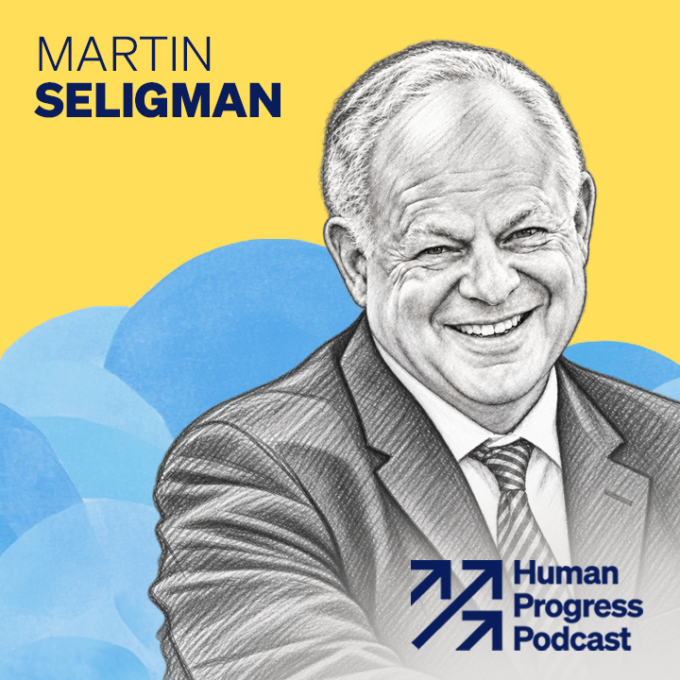
Adam Omary: A virtual warm welcome to Cato. I’m Adam Omary, a research fellow at Cato’s HumanProgress.org. I’m honored to be joined by Dr. Martin Seligman, director of the Positive Psychology Center at the University of Pennsylvania. Dr. Seligman is widely credited with founding the modern positive psychology movement and has been called by my graduate advisor, Steven Pinker, “perhaps the world’s greatest living psychologist.” He’s the author of many books, including, most recently, Agency: The Psychological History of Human Progress, which we’ll be speaking about today. Dr. Seligman, thank you for being with us.
Martin Seligman: I’m delighted to be here, Omar. Thank you.
Adam Omary: I’m also joined by my colleague, Johan Norberg, senior fellow in the Center for Global Liberty and Prosperity at Cato and a historian of human progress. Thank you for being with us, Johan.
Johan Norberg: Thank you. As an old Martin Seligman fan, I’m also delighted to be here tonight.
Adam Omary: Being a psychologist myself, I plan to discuss agency with Dr. Seligman from the psychological perspective, and Johan will discuss human progress from the historical perspective. We’re going to speak for about 40 minutes total, followed by 20 minutes of audience Q&A. For our audience, please go to the Cato Agency event webpage to submit your questions. Before we start our panel, Dr. Seligman, I’d love to hear an overview of the book from you.
Martin Seligman: I’m trying to found a new field, Adam, the field that Isaac Asimov called psychohistory. And it has two aims: the attempt to show that psychological states profoundly influence historical events, and then to use what we know about history to try to predict the future. And the state I deal with here, psychologically specifically, is agency. And agency for me has three components. The first is efficacy, the belief that you can accomplish your goal. Optimism, the belief that you can do this into the distant future. And imagination, the range of goals that you can possibly achieve. And the historical hypothesis is that when civilizations believe in human agency, that’s when progress and innovation occur. And when they’re absent, that’s when stagnation and even regression occurs. So in the course of the book, I start with hunter-gatherers and what we know about their agency through the Greco-Roman period, in which we see Bronze Age belief that the gods do it, which in the Golden Age becomes overriding belief that it’s humans that accomplish things. And then that declines actually up through Augustine in the fourth century, who renounces human agency. Then I look at the Middle Ages and the glacial growth of agency, then the Renaissance, the Reformation, in which agency is greatly reduced by Luther and Calvin, and then the Arminian Protestant revolt against Luther and Calvin, and finally modern views of human agency.
Martin Seligman: And the book culminates with what I do full-time now, Adam, and that’s AI. And the question of, is AI going to destroy us, which I do not believe, or is it the most technologically important aid to human agency, certainly of my lifetime? And that’s what I believe. So that’s the book.
Adam Omary: I’m excited to get to AI, and I want to begin with conceptions of progress. As you describe in Agency, and as we outline with data on humanprogress.org, by so many measures, we’re living in the most extraordinary time of human history. We’re wealthier and freer. Lifespan is longer than ever. Disease rates and mortality are going down. And yet, despite these extraordinary improvements in human living conditions, so many people seem pessimistic about the future. Why is that?
Martin Seligman: Well, first, the facts of the matter are that people are pessimistic in spite of overwhelming statistics in quality of life, personal freedom, technology, purchasing power, health, and the like. And your question is, how could that be? How could people be denying human progress? And I think there are at least two answers. One is ideological, and that is it’s become very beneficial politically to argue that we’re in one crisis after another, and that only I, the political candidate, can solve that crisis. And so I think the belief in perpetual crisis, in spite of the fact that what we have is a fairly steady growth in progress, and even in peace for the most part. And the other is journalism and what’s conveyed to people. So a hundred years ago, if you were a farmer in Nebraska, you might find out a month later that the Titanic went down. Right now, if you just watch CNN all day long, you’re just going to hear about one horrible thing after another. If it bleeds, it leads. And I think this gets people to think that it’s really bleeding that’s going on and not progress. So I think the combination of political ideology and journalism are two of the factors that lead people to believe that progress is a myth.
Johan Norberg: I congratulate you and thank you for this book, which I happen to think is incredibly important, opening up a new field, really, of studying human agency throughout history. It’s also great fun to read, so I recommend it to everyone. Look, I think you’ve very well documented the rise and fall in the belief of human agency throughout history and how that correlates with human progress as well. My question to you is this: when we look at some of these eras of lots of belief in human agency and human progress, there are some of the usual suspects of progress history. We’ve got ancient Athens, Renaissance Italy, the Dutch Republic, Britain after the Glorious Revolution, and the American Experiment. And they also have other common denominators, one of them being that they are compared to other contemporary civilizations relatively free and open, with relatively limited governments and free markets. So I wonder, how do you sort out cause and effect here? I have yet to find one example of a very despotic, regimented society with high levels of agency. Could it be that is agency really the independent variable, or might it be that agency is what we observe when people are more or less liberated, so that they are free to experiment and also have the incentives to create, adapt, and change?
Johan Norberg: How do you sort that out?
Martin Seligman: Great question. It’s a chicken and egg question for me. And so first I want to speculate on what the relationship of freedom is to agency. Freedom is a fact about the world, and agency is a belief about oneself. So freedom means that outcomes are really contingent on what you do, and no one is stopping you from doing it. Agency, on the other hand, is the belief that that is so, and that varies a great deal with ideology and with age. And when you believe in agency, the first variable is efficacy, the belief that you can do it, you try hard. The second variable is optimism, which means you persist. And the third variable is imagination, which means you innovate. Now, when we live in a relatively free world, technology advances, science advances, literature gets better, quality of life gets better, more progress occurs, and that impacts agency itself. That is, this makes you believe you can do it more, and if you believe you can do it more, that produces more freedom in the world. So for me, the relationship is reciprocal causation, in which agency increases freedom, freedom increases agency, and so on. And do you have a case in mind in which the two variables are driven apart?
Martin Seligman: One in which there’s high freedom but low agency, or another in which there’s low freedom and high agency? Do we have any historical examples that dissociate the two?
Johan Norberg: I’d be hard pressed to find one, possibly in societies after an institutional collapse, where there’s still a high degree of freedom, and yet there is a series of shocks, perhaps at the end of the Roman Empire, where we’d find a terrible decline of belief in human agency, while still in certain regions there are still some freedom. But I’d be hard pressed to find an example.
Martin Seligman: Here’s a possible historical example. So I was fortunate enough to be able to do one of my chapters with a group of Chinese scholars from Beijing and Hong Kong, and what we looked at was Chinese history from 1700 BCE to about 300 CE, and we found out something rather different from Western history. So when I do Western history, essentially I find this reciprocally causal relationship between individual agency and progress, and that coheres with increases in freedom by and large. China is different. So China, we quantify individual agency and collective agency, I can do it versus we can do it. And in Chinese history, it looks like the balance between the two. When there’s a good balance between we can do it and I can do it, that’s when you get progress in China. Whereas when you get massive collective agency overwhelming individual agency, that’s when you get collapse. So the Chinese example doesn’t really dissociate the two, but tells us something about the importance of we agency.
Johan Norberg: Right. Can I ask you a related question when we’re trying to sort out causes and effect in history? You show that trade plays a supporting role in many of your historical episodes, and especially how it creates more prosperity, and that changes your worldview as well and your belief in agency. But I wonder if trade might even be a main character, preceding and even causing many of the changes that you write about. Because why is it that we often see an explosion in the belief in human agency in certain areas? And I think that it’s been well documented throughout history that exposure to others and other ways of doing things itself increases agency because suddenly you discover that your society’s way is not the only possible one. And also trading with others forces you to look into other kinds of minds, constantly defying the elements, taking risks, and meeting strangers and trying to find out what kind of goods and services they want from us in exchange for something else. Could this be why we start to develop a theory of mind and begin to see these clusters of agency?
Martin Seligman: I took my kids recently to one of those Washington museums, which talks about Columbus and the Caribbeans and the huge epidemic that swept through the Caribbean because the natives of North and South America did not have immune systems that were capable of coping with these new viruses and bacteria that Columbus and Cortés brought. Crossroads really matter a great deal. So crossroads, where there’s an intersection, trade, an intersection of diverse people, galvanize theory of mind, galvanize behavior. So it just doesn’t—if you rely on, if you live at a crossroads and you rely on what your tribe tells you, what the gods whisper in your ear, you’re not going to be able to survive invaders and trade. And the people that survive at a crossroads are people with theory of mind, with an agility mentally and physically to survive diversity. Their immune system, unlike that of the Caribbeans, is better. So again, what comes first here is difficult to say, but trade at crossroads has been enormously important in progress and in the belief in agency.
Adam Omary: Agency motivates this sort of trade cooperation, risk-taking of the adaptive sort, but risk-taking isn’t all good. And one could argue that high agency people probably make even more mistakes than the average person simply by virtue of trying more things. While we’re trying to encourage agency in society, could progress depend on achieving the right balance between those highly agentic risk-takers and cautious skeptics who force them to be more conservative, more pragmatic, rather than everyone being more boldly optimistic?
Martin Seligman: Well, I think that’s so, but also natural selection does it as well, and that if you take a lot of risks, you’re cannon fodder as well, and you get eliminated. Your ideas get eliminated by natural selection, and you also, by being a risk taker, can be physically eliminated. So I think there are both psychological and Darwinian factors at work here on shaping agency.
Adam Omary: And they’re orthogonal. You’re saying one can be a risk taker without necessarily having high agency, and conversely, one can be very sensitive to threat but also have high agency.
Martin Seligman: Yes, I think that’s so, and I’m just also thinking about the kind of science I’m involved in, in psychology, and actually what I don’t like about the history of psychology per se, and that’s the difference between discovery and verification. And so my life in psychology has been about discovering things that weren’t there before. But almost all of academic psychology is about verification and replication, and these are two very different scientific and, if you will, commercial strategies. The difference between innovating something genuinely new and then refining and improving on it. And these are different minds. And I guess the kind of psychology and science that I like and endorse is the science of invention and discovery. And I think refinement and verification is child’s play.
Adam Omary: Speaking of psychological discovery, Dr. Seligman, you’re famous for your work on learned helplessness, which is essentially the opposite of agency. Again, paradoxically, despite living in the freest and most prosperous time in history, we see a lot of this learned helplessness, especially among young people and especially on social media. Do you worry that culture, even though there’s benefit to identifying structural barriers to, say, achieving the type of flourishing that people would want, even though there’s inequality in the world, that it can inadvertently reduce our sense of agency to focus on these sorts of inequalities or barriers, when in reality what we need to do is focus more on the mindset that can help us continue, continue progress?
Martin Seligman: Victimology really gets in the way of agency. So learned helplessness was the belief that nothing I do matters. And quite a lot of ideology about why suffering occurs in the world, why inequality occurs in the world, very easily leads to the belief that you’re a victim of a malign environment, a malign system. And while we have a lot of compassion for victims, and indeed I spent a lot of my life working with severe psychopathology and victims, the belief that you’re a victim is itself a form of learned helplessness in which you don’t try, you don’t initiate, you’re not optimistic about the future. So one of the barriers here that leads us away from recognizing progress is the convenient explanation that when things go wrong and when we suffer, it’s not because of our character or our decisions or what we do, it’s because we’re victims.
Adam Omary: You just mentioned natural selection and also the cultural selection of ideas. It seems strange, borderline impossible, that people could even have learned helplessness. Could it be what social psychologist Rob Henderson calls a luxury belief? In other words, only in a society that is prosperous enough for one to get away with learned helplessness can we see that type of mindset evolve?
Martin Seligman: No, I wouldn’t go that far. So learned helplessness is not only quite real in the laboratory and in real life, but over the last 25 years, my colleague Steve Maier, who died last month, was able to trace out the brain circuitry for learned helplessness. And to simplify it, there is a structure in the rodent brain and the human brain called the dorsal raphe nucleus. And when it fires, that’s when you see passivity and giving up. And it seems to be the default response to bad events in mammals. And what overcomes it is a forebrain circuitry in which we learn hope and mastery. And when we learn hope and mastery, that triggers a set of circuits in the forebrain which inhibit, which turn off the dorsal raphe nucleus. That’s a way of saying that helplessness is a very real phenomenon. It’s a non-mammalian reaction to bad events, and it’s a mammalian reaction which, if it’s not inhibited by hope, leads to profound passivity, cognitive deficits, poor health, and premature death. So helplessness is for real.
Johan Norberg: Excuse me, just a brief follow-up. Why is that? What’s your explanation for this default setting? What’s the evolutionary benefit of giving up?
Martin Seligman: Well, if you’re a reptile or a bird and not a mammal, and a snake, a predator jumps on top of you, you don’t have a lot of coping mechanisms, and you don’t have a lot of cognitive mechanisms to deal with it. And by conserving energy, by curling into a ball and giving up, you conserve energy. The immune system changes appropriately, and you have to hope, as a species, that when you come out of it, the predator hasn’t yet eaten you. So it’s because non-mammalian species don’t have a cognitive and behavioral repertoire of mastery and agency that we’ve inherited underneath our frontal cortex a set of biological mechanisms that incline us to give up. And it requires a belief in agency, a belief in hope, an experience of mastery and coping to turn off the reptilian giving up. That seems to be the default consequence of adversity.
Johan Norberg: Wow. Yeah. There’s another evolutionary reason why we were in the mess we’re in. And you have a wonderful concept for our negativity bias. You write that we inherited a bad weather brain, so that those of us who, of our ancestors who were anxiously looking towards the horizon for bad weather or predators probably survived and passed their stressed-out genes to us. And that makes a lot of sense. That’s the reason why we pay more attention to bad news and risks. And I have two questions about this. First of all, there’s another interesting thing that you write about. Yes, we pay more attention to bad—what’s bad—than what’s good. And when anything is shocking, we think that we instantly need to pay attention to that. On the other hand, you also document, and you’ve done a lot of research on this, that political candidates who are more hopeful and optimistic about the future usually win out. Why is it that we want bad news but hopeful politicians?
Martin Seligman: Another good question. Let’s look at the data and see if we can make sense of it. So first, there is a negativity bias, and indeed it comes out of our ancestors in the Ice Ages, in which if they believed it was a beautiful day in Stockholm today, it’s going to be beautiful tomorrow, they got crushed by the ice. So you inherited the ancestors’ brains that said it may look beautiful in Stockholm, but the ice is coming. So we’re naturally pessimists. Pessimism comes naturally, and for those people who think that optimism is kind of a footless, thoughtless matter, it’s the pessimism that’s natural and thoughtless. Now, why are we attracted to optimism? Well, first, we are attracted to optimism empirically. And so if I do an experiment in which I give you a speech to deliver on the telephone, either in highly depressive cadence or in very chirpy cadence, and I just wait for how long it takes for people to hang up on you, we hang up on depressed people. Misery loves company, but company does not like misery. And there’s a contagion both of pessimism and optimism. So it seems to be a fact that we’re attracted to optimistic people. I’m not sure I can say more deeply why, but politically, this seems to be the case, at least in American elections.
Martin Seligman: So we’ve looked at the last 120 years of elections, and for the most part, the more optimistic candidate wins. We looked deeply at that in the Trump-Harris election, and with a great surprise. You might think that Trump is the more pessimistic candidate. Well, he’s the darker candidate. He cites four times as many bad events as Harris. But we decided to look at how he explains those bad events versus Harris. And it turns out, and we tracked this through the campaign, at the nomination acceptance speech and the first debate, Trump and Harris are equally pessimistic, and Trump cites more bad events. But through October, and right through October 31st, Trump gets more and more optimistic. And by the end, he’s massively more optimistic than Harris. And we put this in a sealed envelope, which is our prediction about the election, and we sent it to our reporter friends. And it, I think we’re the only pundits, I wouldn’t say we’re pundits, who predicted a Trump victory. So we vote. We like optimists, and we vote for them, and we want to be led by optimists. And even when we’re doing what we usually do in politics, looking for the least bad of two choices, the least bad is what’s attractive to us.
Martin Seligman: So I believe that optimism is an attractive notion interpersonally and politically.
Adam Omary: From politicians to scientists, innovators, you understandably focus your discussion on agency, on career high achievers. How do you distinguish agency from ambition? What does high agency look like in an individual who chooses to live a quiet life centered on family?
Martin Seligman: Good question. Let’s see how ambition differs. I’ve never been asked this, so I’m winging it, from the three components of agency. So the first component is you believe that your actions will produce the results. Well, to be ambitious, you’d have to have that if you’re going to be successfully ambitious. To be agentic, you have to believe that you can succeed at your goals into the far future. And again, to be ambitious, not only the desire for fame and fortune, but you actually have to believe that your actions will work in the future. And thirdly, to be agentic, you have to entertain a large range of possible goals that you can choose from. And again, being ambitious, merely desiring fame and fortune by no means guarantees imagination. So I guess I’d say that’s the difference. Ambition is shallow. It’s the driving force that you want fame and fortune, whereas agency is how you achieve these things.
Johan Norberg: One thing I’ve been wondering about, and something that keeps me awake at night, is the problem that you write about: pessimism and despair seem to be self-fulfilling. If you think that there’s nothing to be gained, there’s no chance, then it undermines trying. So, and this obviously is of incredible importance to us who are trying to explain the very real existence of human progress, the fact that when people are free to experiment and innovate and exchange, good things happen. And if people don’t believe that, if they don’t realize what’s been going on in the world, the fact that objective indicators of living standards are improving, there is a risk that that will undermine this very, very real progress. So, can you talk to us about the importance of understanding past progress for agency and for human flourishing? Basically, can you tell us why Cato’s Human Progress work is so important?
Martin Seligman: It’s crucial not to be helpless, to believe in human progress. So I’m in a constant struggle with my English department and my history department at the University of Pennsylvania, both of whom are pervaded by the belief that human progress is a myth. And the cost of not believing in human progress is not trying. The cost of alarmist pessimism, for example, about the climate is going to lead to catastrophe, leads to not trying to do something about the climate. So how do we teach history to young people in a way that shows them the enormous amount of human progress? And for me, this has to do with good education. So when my English professor friends tell me there’s been no human progress, I say, well, 200 years ago, 44% of your children would have died before the age of five. Now less than 1% of your children die before the age of five. Progress is a myth. And so I think Cato and people like Steven Pinker, and my favorite is Our World in Data, are the sources that, educationally and in unbiased ways, as far as I can read it, tell us there’s human progress. We have to teach history differently. Human history is not just the history of awful events and victims and suffering.
Martin Seligman: It’s the history of the rise from illiteracy, poverty, death, to literacy, wealth, long lives, and a huge increase in human well-being, measured by any objective measure of human well-being I know. And the measure that defies it is measures of depression and pessimism today. And that’s the way of naming, Johan, the problem about misteaching the history of the world.
Johan Norberg: Yeah. Indeed. You mention explicitly Isaac Asimov’s Foundation series, great series of science fiction novels, and Hari Seldon’s psychohistory. To me, this is psychohistory. This is a pioneering study in that. But Seldon is also using history to predict the future and to think about, so how do we act now based on all this knowledge that we’ve acquired? Well, if you were in Hari Seldon’s shoes, do you have any advice here at the Cato Institute? Of course, we’re constantly debating ideas, institutions, policies that might encourage agency and human flourishing. If you had to design institutions not merely to maximize agency and flourishing today, but to preserve it for centuries, what would you build into it?
Martin Seligman: Yeah, I’m afraid I can’t answer that well. I could give you the general formulation. What I think history teaches us is that progress depends, at least partly, on the belief that I can do it, the belief that I can do it into the future, and on imagination. So we need institutions, the teaching of history, the structure of politics, that maximize citizens’ beliefs that they can accomplish their goals by their own actions, that maximize people’s belief in the future, in the far future, and that maximize people’s ability to contemplate a range of goals that they might achieve. How to instantiate this in institutions, in politics, in academia is beyond me, but I can say for sure we’re not doing it now.
Johan Norberg: You’ve given us some very good ideas on how to think about it.
Adam Omary: Dr. Seligman, you began this conversation pointing towards AI, artificial intelligence, as the next major step of human progress. I’m already seeing many audience questions in the chat about AI. As a reminder to our virtual audience, you can go to the Cato Agency Event webpage to submit your questions now, which I’ll be reading for the remainder of this event. So artificial intelligence increasingly allows us to delegate decisions and tasks that once required our own knowledge and effort. When does that delegation expand our freedom, and when does it weaken our confidence or ability to act for ourselves?
Martin Seligman: Yeah, I am delighted to address that question. I deal with AI, Claude and ChatGPT, roughly six hours a day. In fact, I’m so excited by them, I feel like I’m 21 again. Let me tell you two enormous ways in which they’ve increased my agency. The doom sayers have had the floor about AI, and my job as a positive psychologist is to try to think through not the worst scenarios, but the best. So let me give you two examples from my life in which AI hugely expands my own agency. AI has produced more love in my life, contrary to those who say it’s dehumanizing. I have two four-year-old grandsons, Denny and Max. I’m 80 years older than they are, and I noticed, starting at around age two, I was becoming invisible to them. They walk faster than I can run. I can’t throw a football around with them. So I went to Claude and to Chat, and I said, “Help me write stories in which Max and Denny are the guardians of the world and the heroes.” And now I’m on volume six, chapter 24, Max and Denny tour the solar system. Well, the consequence of that is I’m visible to them. I have more love in my life.
Martin Seligman: That’s number one. Number two, and much more important, AI has increased my own creativity, and I believe that AI is creative in the sense of two. And let me just give you one crucial example of a discovery that I made with Claude that no human being and I could have made. This is the paradox of the Axial Age. So across the globe, 1000 BCE, Greece, Israel, Persia, India, China are backwaters: villages, illiteracy, minimal technology, etc. Five hundred years later, all of those cultures are thriving by all of our indices of progress. What happened in those 500 years across the globe? Well, I had a hypothesis, and that was that they invented new words. They conceived for the first time in human history of words about human agency, as opposed to divine agency. Well, interesting hypothesis. I knew no human being could test it. That is, there still is a small field of ancient philology, but there’s no human being who knows ancient Sanskrit, ancient Persian, ancient Chinese, ancient Hebrew, and ancient Greek, but Claude and ChatGPT do. So I gave them a hypothesis. We worked for a day together, and sure enough, the words don’t exist or barely exist in the five cultures in 1000 BCE, but by 500 BCE, they’ve invented the words.
Martin Seligman: And so, for example, in Hebrew, the word teshuva is invented. It’s not in the Torah. It’s later on. Teshuva means repentance. It means you can actually do things to change your life. It’s an agentic human resource that didn’t exist in the Torah. And once you have new words, you get new things occurring because of the new words. Take sexual harassment, for example. People were harassed forever sexually in the office, but there was no word for it until about 1970. Once there was a word for it, it opened up lawsuits, mandatory training, and ways of counteracting it. So when we have new words, we invent new things. And that’s an example in which AI makes a discovery in the sense of two going back and forth between a human, me, and AI. Could not have been made by human beings.
Adam Omary: There are many audience questions about how do we expand and promote agency, and also to tie it back to the AI discussion, there is some concern about if we are having agents think for us, if they’re doing writing instead of us, particularly for young students who are just beginning to learn to think and write, do you think of agency like a muscle? Certainly it can be grown, but is it also use it or lose it?
Martin Seligman: The one doomsayer worry, and by the way, the doomsayer stuff is all hypothetical. So the more love in my life and discovery of the mystery of the Axial Age are real. They’re not hypothetical. The one hypothetical I agree with is what they call de-skilling. It’s more properly called unskilling. So let’s take writing. So I’ve been writing for 70 years, and that means hundreds of thousands of times I’ve had to make choices between perhaps and maybe in the sentence. And so at age 84, I’ve got the skill of writing, and I’m delighted to have Claude, who writes better than I do, help me along and edit, because it’s not de-skilling me. I know how to write. But if starting at age six, I have the writing and these thousands of perhaps-maybe decisions made by the machines, I’m never going to learn how to write. So that’s the one doomsayer worry that I agree with. But again, I want to point to the fact that the doomsayers are all talking about hypotheticals, and AI in my life is a real enhancer.
Adam Omary: Another audience question: How do different philosophical ideas, such as religious versus secular worldviews, individual versus collectivist ethics, drive cultural adoption or rejection of agency?
Martin Seligman: Yeah, let me give two examples. I’ll give you the obvious Marxist one, and that is to the extent that we believe that history unfolds as a result of historical forces that are beyond our control, that’s a recipe for passivity. And it suggests that that’s an ideology that leads to a victimology, passivity, lack of progress. In religion, I spent a lot of the book documenting different religious views, and let’s take early Catholicism and early Christianity before Augustine. So early Christianity after Jesus, up to about 300 A.D., is very optimistic. You can become holy, and in fact, your encounter with God after you die is about, did you do the things that would make you acceptable for salvation? Under that kind of belief, you get agentic action. Augustine comes along in 383 and says, Hold it, that’s Pelagianism. Pelagius believes that you can contribute to your own grace, that you can cooperate with God to bring good things about and to avoid temptation. Augustine says that’s nonsense. Any time you do something good, it’s only by the grace of God, and that’s the opening gate for the stagnation of the Middle Ages. And once again, we have it after the Renaissance. And contrary to what you’ve been taught about the Reformation, Lutheran—Catholicism is becoming highly agentic.
Martin Seligman: Erasmus argues that we’re like toddlers. When we fall down, God lifts us up, but we have to have motive power of our own to be so lifted. Luther says that’s nonsense, and in his retort to Erasmus on the bondage of the will, he tells us about predestination, about the lack of human will, and Calvin even goes further with utter depravity. And what you get in early Reformation until the Restoration is a downswing in progress. When the Restoration occurs and Arminian Protestantism, which believes you have to assent to grace, that’s when progress gets resuscitated. So, long-winded way of saying what you believe ideologically and what kind of religious faith you have modulates your achievement, your agency, and most importantly, the achievement of entire cultures.
Adam Omary: Another audience question. Why is it so hard for people to change their minds?
Martin Seligman: Oh boy. I have to say it’s a fact to begin with. So I once gave a course on brainwashing and religious conversion, and I was interested in changing of minds. And it turns out, when you stare at that literature, brainwashing and religious conversion don’t change people’s minds. If you’re in the environment, if you’re in a Chinese or North Korean prison and you’re given brainwashing, for as long as you’re in prison, you will believe more than Mao, the words in communism and collectivism. But as soon as you get back to Canada, you no longer believe those things. With religious conversion, what Wesley and other people found out is you could convert people, but you had to keep cadre around to keep it going. So the fact of the matter is that people very rarely change their minds, and they conform to society and to what’s around them. And when they do radically change their minds, we don’t know why and how. So this is a great question. It’s the main question of psychotherapy, and in many ways it’s a question of how political views radically change. The answer is we don’t know.
Adam Omary: There are several questions, perhaps from our younger audience, noting that younger generations are failing to reach milestones like home ownership and family formation at the same rate as their parents. Does this pose any challenges to agency? We hear a lot, especially in the media, on social media from young people, this sense that there are barriers to achieving the American dream, that unaffordability is on the rise and other threats to their agency. So the issue is framed, at least.
Martin Seligman: Yes, and I refer to superabundance in this context, that there are some things which are superabundant now. The price of the great bet between Ehrlich and Julian Simon, all of those commodities have gotten cheaper and better. I’m convinced that health, foodstuffs, longevity, purchasing power are all greater now than they’ve ever been in the past. Those should enhance agency, but there are some things that are not superabundant that, to my mind, don’t follow the Tupy and Pooley findings, and home ownership is one of them. And so we have increasing barriers to fulfillment, like not having home ownership, but we’ve got other opportunities that counteract that, like living longer, being healthier, having more purchasing power. So it just doesn’t do to say, well, you know, I can’t afford a house and therefore I’m miserable and I’m going to give up, in the face of the fact that I’m going to live longer, healthier, and more productively through life.
Adam Omary: This book, Superabundance, that Dr. Seligman just referenced is from Cato’s very own Marian Tupy, who runs HumanProgress.org, as well as Gale Pooley, a collaborator of ours. Definitely recommend, and certainly connects to the psychological history of human progress and the economic reality of human progress today. Perhaps a final question, question on immigration. Thomas Sowell writes that individuals who immigrate from their homelands display a spirit of entrepreneurship that those who don’t immigrate lack. Will current populist animosity to immigration critically impoverish American innovation and economic growth?
Martin Seligman: It’s a sensible possibility that the people who emigrate, if they have the freedom to do so, will be the most agentic people, the risk takers and the like. So one danger in the restriction of immigration is that we will lose the people at the cutting edge of the societies they want to leave because those societies are not abundant and free. So lack of immigration should worry us.
Adam Omary: Johan, any final rapid-fire questions?
Johan Norberg: Well, in that case, one personal question, if I may. You’ve looked here in an incredibly novel way at how agency is important to people finding… new ways of finding meaning in their lives and creating productivity in the economy. And yet, I often hear you talking about how the profession you’ve chosen, the life’s project you’ve chosen, has been a calling rather than a choice. Is that another way of framing the choice, or is this an exception?
Martin Seligman: I don’t know the answer to that, but I, as I’ve gotten older, I’ve realized two things about my own trajectory. One is that the big changes in my life occurred by epiphany, by remarkable experiences which changed my trajectory, even dreams and the like. And the second, Johan, is that I no longer prepare for events like this one. I feel the words will be put in my mouth, and indeed that happens more and more as I age. So I’m not willing to say I’m a product of choice and agency. There’s more in the universe than human choice.
Adam Omary: Dr. Seligman, thank you so much for your masterwork, Agency: The Psychological History of Human Progress, and thank you for taking time to join us today virtually at Cato, and thank you to our virtual audience.