
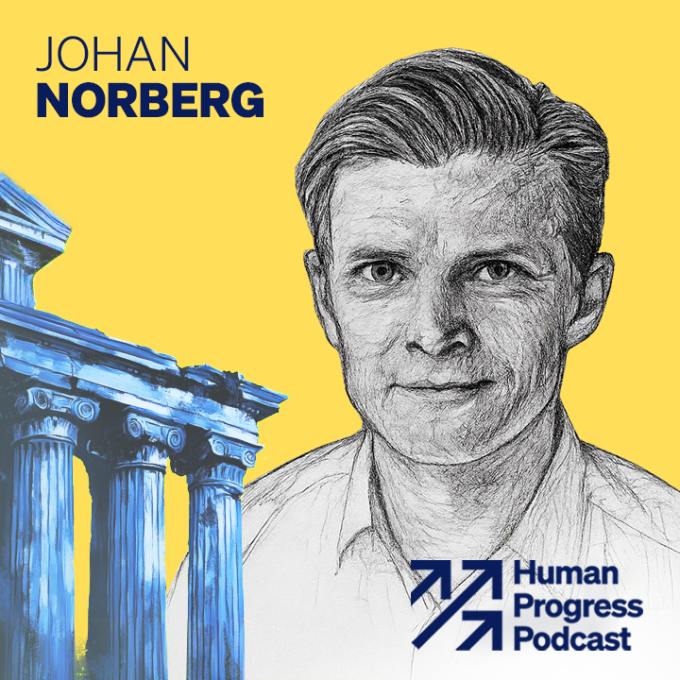
Chelsea Follett: Joining me today is Johan Norberg, a historian, lecturer, and commentator, and also my colleague here at the Cato Institute, where he’s a senior fellow, and his books have been translated into 40 languages. Those books include The Capitalist Manifesto, the International Bestseller Progress and Open, which was an economist book of the year. He regularly writes for publications such as The Wall Street Journal, Reason, and The Huffington Post, and his latest book is Peak Human. Johan, how are you?
Johan Norberg: Good, thank you. Thanks for having me on the show.
Chelsea Follett: So tell me about what inspired you to write Peak Human? What gave you the idea for this book?
Johan Norberg: Yeah, why do I write about golden ages and history? Well, one reason is that I happen to think that we live in a golden age right now, and I very much would like it to keep going for a bit longer. And then I think it’s useful to look to history for some clues as to how you build thriving dynamic civilizations, but also learn from some of the lessons and why they started to decline and eventually fall.
Chelsea Follett: So what do you mean by the term golden age? I think it’s used in different ways, perhaps.
Johan Norberg: Yeah, it is. I’m glad you asked. So I’m not thinking about sort of mighty empires and territorial expansion, subjecting other peoples or anything like that. I’m thinking about how you create relatively decent, dynamic, innovative civilizations that continue to grow and prosper. So I’m looking at periods where you saw a great many different innovations in different spheres of human experience. So cultural creativity, scientific curiosity, technological innovation, economic growth, things like that. And I should of course mention that it doesn’t mean that life was golden for everyone throughout most of history, it’s been pretty bad as you so well know. As Mary Beard, the classicist expert on Romes often points out when people tell her that they would’ve wanted to live in Roman times, they often assume that they would’ve been the emperor or a senator, just roughly one of a few hundred people rather than the millions who lived much worse circumstances, and especially of course, if you were a slave back then. But that didn’t set these civilizations that I looked at, apart from their contemporaries because they all had oppression and relative poverty. What set these apart was that they managed to lift themselves up from that for a period of time and to give more opportunities, more freedoms, and better living standards for most people.
Chelsea Follett: I think that’s a really important point. You have this great line in the introduction where you say, “if we discard all the achievements of those who came before us because they weren’t sufficiently enlightened and decent and they weren’t, we will eventually lose the capacity to discern what is enlightened and decent.” What did you mean by that?
Johan Norberg: Yeah, I mean by that, that it’s so incredibly easy to take a particular point in time and the particular ideas and morality that we now inhibit, and they are much better than they used to be, no doubt about that. There is a risk that we will just use that to judge everything that wasn’t perfect, wasn’t up to our standards in the same way. And in that case, if all cats are gray, we suddenly, I think, lose the ability to understand how you make progress, how you move from worse places to better places. And how many of the great ideas and institutions that we live with now, how they evolved over time and that some of these places, imperfect as they were, were incredibly important stepping stones on the way to the enlightenment, to individual rights, and to prosperity.
Chelsea Follett: Tell me a bit about the title. In some ways you were very fortunate with the timing because my understanding is that you came up with the title Peak Human, that we can learn from the Rise and Fall of Golden Ages. Prior to during his… The beginning of his presidency, president Trump saying he wanted to start an American golden age, that kind of put that term out into the public discussion. Although it’s of course a bipartisan goal, everyone would like to live in a golden age. How did you come up with this title? And Peak Human also is an interesting choice.
Johan Norberg: Yeah, no, it’s interesting how everybody suddenly talks about golden ages, and it’s not because I have it in my title. I seem to remember that Xi Jinping the Chinese dictator also talks about the Golden Age his about to create this. Probably there’s something going on in the world and the culture right now. But also then specifically I think it’s important to distinguish what some people think of as golden ages, which they seem to associate with great power and great leaders which is not very often the way to create decent golden ages, which are more about empowering more people and be open to surprises and to trade, to migration and so on. And that relates to the title Peak Human as well. I didn’t pick that title my agent did, so Andrew Gordon all credit to him.
Johan Norberg: But I think it captured something important, that this is what we can be, that it’s important to, when you look at history, you become slightly cynical and depressed because we’ve done so many awful things, but also we’ve managed, and our ancestors have managed to create relative progress and astonishing achievements in difficult times. So I think that’s the peak, but after a peak, it goes downwards. So it’s both about the rise and decline, and it captures both in that title.
Chelsea Follett: So you’ve spoken a bit about your definition of a golden age, but history is very vast. How did you narrow it down to the seven societies that you examined? What were your selection criteria?
Johan Norberg: Oh, gosh, yeah, that was tough. So I asked the smartest people I know, and I read the best historians and the economic historians who when they have defined what are really great periods in human history. And then there’s this… And I read your book about great cities in history as well. And then I come up with sort of a long list of sort of these are the ones that capture what I’m looking for, places that make tremendous progress and to manage, to create better living standards than the alternatives. And then I narrowed it down to the ones that seemed really quite impressive. So to the extent that it was difficult to bypass them, but I could have included so many more if this had been a longer book.
Chelsea Follett: So let’s walk through those different golden ages that you do focus on and the lessons that we can hopefully learn from them. Starting with ancients Athens, tell me about Athens.
Johan Norberg: Yeah, what an amazing place to be. So in the 5th, 4th century BC they were just one of 1000 or perhaps 2000 different Greek city states, and that was a great thing. So they could compare what they were doing to others and learn something from them. And more of a trading civilization than the other Greek city states, partly ’cause of their bad soil. So they had to go out there and find something new and useful everywhere. And I think that really gave them the sense that curiosity and innovation, that’s what we are about. And they even created this kind of ancient form of democracy, excluding, of course, women and slaves. But compared to that’s not what the other city states noticed because women and slaves were excluded everywhere. They thought that what made Athens strange was that it gave so much power to the average man. And somewhere between all these things, democracy, openness, trade, they began to experiment with new ideas in everything from architecture to drama and poetry to intellectual innovation. I would argue that this is the first civilization where we actually see people saying that it’s a good thing to be an intellectual innovator and to criticize the forefathers and the prophets and to come up with something original. And if you start doing that, you’ll come up with lots of exciting ideas.
Chelsea Follett: Right. And the birth of a philosophy. What lessons can we today learn from Athens? I think some people might say, well, this is interesting, but it’s so long ago. How can we actually apply these lessons today?
Johan Norberg: Well, one thing that’s an obvious lesson, and we’ll come back to that in all of these golden ages I think, is that without having one strong man in charge, you open up the whole system, the whole region to experiments and ideas that can come from anywhere in the network. So you basically crowdsource more ideas and then you’ll get more bad ideas, but you’ll also get some great ideas that people will build upon. And I think that’s an important lesson for us when we think of how we move on and find something better. Do we do that by having a big, great plan telling people telling businesses what to do, or do we do it by allowing more people to join in the game?
Chelsea Follett: And in terms of the cautionary tale of Athens, can we learn any lessons from the ultimate ends of their golden age? What brought their golden age to an end?
Johan Norberg: Well, it rarely happens in one day. It’s often a longer term thing going on. I would argue that the whole very long Peloponnesian war against Sparta with all their allies in different places, started to ruin some of that sense of openness and curiosity. Thucydides the great Greek historian talked about how suddenly people on all sides became tribalists and constantly thinking about how to search for scapegoats and traitors rather than new companions, partners and trading partners. And that, I think, started a long-term decline. Obviously the strongest example of that is the, when Socrates was sentenced to death for his teachings or rather for being a scapegoat for their suffering. And that’s something that happens in by the end of most of these golden ages, a death to Socrates moment. When you sour on your tradition of intellectual openness, and instead you try to impose some sort of orthodoxy and force people to think and behave in the same way, that’s always a worrying sign.
Chelsea Follett: So it’s a twofold lesson overextension and in war on the one hand, draining resources and so on. And on the other hand, also limiting free inquiry, freedom of expression and punishing intellectual dissidence. Let’s speak to the Roman Republic, which is the next society that you examine. Tell me about the Roman Republic.
Johan Norberg: Yeah, the Roman Republic was of course, and that must be said, an incredibly brutal place, a very militaristic state, but so were most of their neighbors at the time as well. What set Rome apart from them was that they were more successful, not necessarily because they fought harder or better, but because they constantly picked up new ideas while out there conquering. In some strange way from the beginning of the Roman Republic even in their mythology, they talk about this, what sets them apart from others was that Romulus the mythological founder of the city, he basically invited everyone to come to Rome to populate the place and come and bring their ideas and their cultures to this place. So it was founded on an idea of openness. And it has often been… All cultures pick up ideas from others, but it’s more difficult if you associate yourself with very strong and particular traditions.
Johan Norberg: It’s more easy if you build a tradition that’s based on innovation and on constantly imitating others. And that’s what the Romans did. They picked up everything from their gods to their legal system, from the Greeks and from the Etruscans and from people they made war against, not because they were nice, decent, do good liberals or anything like that, they did it in order to beat people up in a better way, but they understood that openness could be a weapon. Even a literal weapon. Sort of their swords were Spanish swords, even called Spanish swords, and they picked up their ways of building ships from their enemies in Carthage and so on. And that’s how they prospered in a way, like the Borg in Star Trek, if you watched that. Not a decent role model, of course, but just like the Borg, they were brutal, but they did it by constantly absorbing new ideas and technologies rather than sticking to their own script.
Chelsea Follett: Right. Just like the Borg simulated different ideas.
Johan Norberg: And resistance was futile.
Chelsea Follett: Yes, it was. And as you point out, it was very brutal in Rome. It was very hierarchical, there were slaves, many people were enslaved. But it was also very diverse. What lessons do you think we can learn from that? Because it is such a complicated society.
Johan Norberg: It is a complicated society, and in many ways a brutal society, but a diverse pluralistic society that realized that they benefited from being open to other peoples. And this is something that Claudius the emperor talked about. What sets us apart from previous civilizations is that we can conquer and integrate a people during the same day. A little bit of an idealization, but he had a point that they often left populations that they had conquered in place, even the elites in place, they could keep their own traditions and ideas as long as they just sort of became a part of the racket and help to give them troops if they needed them. And this meant that talented people from the provinces, they could make a career in the Roman system, in the senate, in the military, some even became emperors eventually. So there was an idea about how migration made them stronger and how meritocracy made Rome stronger constantly.
Chelsea Follett: So they had all of this diversity, they were integrating all of these different ideas, and ultimately this led to, what you term “a golden age,” in many different accomplishments to the point where today it’s said that the average man allegedly thinks about Rome, ancient Rome multiple times a day, clearly left its mark on the world. What do you see as some of the chief accomplishments of Rome that resulted from this incredible capacity to absorb knowledge and technology from different areas of the world?
Johan Norberg: Yeah. What did the Romans ever do for us as Life of Brian, has it. I actually spoke to Gaios Flavios who started this meme about how men think about the Roman Empire all the time. He is a Roman reenactor who pointed out that people think of Rome according to their own background and their own education. So engineers are often obsessed with how they were building concrete, the aqueducts and things like that. Lawyers think about Roman law and how they had a version of rule of law and the concepts of individual rights, including property rights. Doctors, of course, think about Latin medical terms and scientists think about scientific progress during this era. I think what the Romans really added generally was lots of wealth, partly because they were a big trading civilization.
Johan Norberg: They became one since they integrated so many… Conquered and integrated so much land and the Mediterranean, that they became a huge trading power and could benefit from ideas, goods, and services from everywhere. But the one greatest achievement associated with that, I’d say which they added to what Greek had already done, was technological innovation. They were quite clever in coming up with new smart materials, combinations, building methods, and they did that by picking up bits and pieces of know-how and of material from all over this great empire.
Chelsea Follett: So let’s move on to Abbasid Dynasty era, Baghdad and the Islamic golden age. I think many people in the West at least are aware of ancient Athens and ancient Rome and their contributions, but perhaps the history of Baghdad is less known, so please walk us through it.
Johan Norberg: Yeah, no, that’s right. That wasn’t always the case. 1000 years ago, the greatest thinkers in Europe talked about how they got their best ideas from Arabs and from generally citizens in the caliphate because they were so far superior when it came to science and technology, we don’t have to go further than the letter A, to observe our intellectual debt to the Arab world. We’ve got Arabic numerals we’ve got algebra, we’ve got algorithm, arithmetic, average all those things comes from this melting pot of ideas in this empire that was built from northern Africa all the way stretching to Afghanistan, then integrating it into a huge free trade area that was integrated with the same set of laws and the same language, Arab language and Islamic law, but was very open at this time to different peoples and different religions, and they… Not just as citizens, as merchants, but also as intellectual.
Johan Norberg: So in Baghdad, they invited thinkers from other cultures and from other religions to talk about their ideas, constantly translating their texts in order to benefit from them. They consider themselves like the real inheritance of the Greek intellectual, philosophical tradition. Aristotle was their guy, whereas they thought that the Bezant in East Roman empire had lost its way in the 9th, 10th century AD. Because they didn’t read books, they burned books. Whereas here, we’re open to these different traditions, and that’s the reason why they also managed to make much more progress in science and technology.
Chelsea Follett: So they were relatively very open, very tolerance. I think some of the lessons we can learn from that are obvious, but again, now looking to the end of their golden age in the fall of their golden age, is there anything that we can perhaps learn from their story and how it ended?
Johan Norberg: Yeah. I think this is incredibly important because often it said that the end of the Abbasid Caliphate was when the Mongols invaded in the 1250s. And of course, that’s a very vivid sort of end of a civilization, but by then, it had already been in decline for some 200 years or more than that. So it started not with foreign invaders, but it started with losing its way internally. And what began to change, and this is something we see in many civilization, is a fear of religious difference. Not fear of Christians or Jews or anything like that, but fear of different traditions within Islam. So we saw fragmentation of the empire, different interpretation, not just Sunni and Shia Islam, but different versions within it. So some rulers became afraid of that, but they also realized we can exploit these differences to sort of rally our people and then attain more power.
Johan Norberg: And what really started the end of this open era was actually state led education because the Abbasids realized that a way to instill a form of orthodoxy was to build state Madrasas, where we hire lots of teachers to not do what we used to do in the caliphate, being open-minded, reading between the lines and combining traditions and benefiting from them, but by repeating the one true Sunni version against the other Muslims. So for the first time, these intellectuals who used to be on the market, they had different benefactors, and sometimes the students paid them. Sometimes they had businesses on the side. For the first time they got a, like a government job, but on the condition that they left their critical judgment outside, because now they were only supposed to talk about what was right and what was wrong. And that began to undermine this whole dynamic, open-minded intellectual tradition in the Arab world. You can actually see how texts on science and on technology begins to decline in the areas at that time that they got these defacto state run Madrasas.
Chelsea Follett: That’s fascinating. The enforced uniformity of thoughts. Tell me about Song Dynasty China. It’s been said that they came very close to initiating an industrial revolution even, but they didn’t quite make it. Tell me about that.
Johan Norberg: Yeah. China has been a great civilization for such a long time. Karl Marx talked about how… In the 19th century, how there were three major innovations that ushered in the bourgeois society in Europe. Gunpowder, the compass and printing. But of course, the Chinese had that 1000 years earlier, and they were the most innovative society, the wealthiest society on the planet. And how did they become that? Well, then you have to focus on the Song Dynasty. From the 10th century onwards, 11th, 12th, 13th century. They ran China, and they were the focal point where we see so many great developments of technologies, of business models of wealth. Because they created relative to Chinese history before, but also relative to contemporaries, a relative rule of law and a very free market based on farmers having property rights rather than being feudal peasants.
Johan Norberg: And that made them very competitive and innovative. They borrowed new crops from other parts of the world, they learned new irrigation systems, they started to trade in strange way. They came up with paper money in order to be able to exchange in a better way with others. This resulted in massive wealth, so much food was produced that the Chinese population doubled. It also led to urbanization and urban village businesses, a very commercial society that started to manufacture stuff. And to the extent and in such an experimental way that some economic historians have talked about how they almost ushered in an industrial revolution some 400 years before the the British did, because they produced so much iron and steel that Europe couldn’t compete with for several 100 years. They also experimented with new textile machines in order to automate the manufacturing of textiles and of clothes with water power and muscle power. Something that if they had continued that path, it’s almost trial and error, they could have come up with some of the things that gave us an industrial revolution. So it was an impressive period. And some of the things that Europeans saw when they traveled to China probably inspired them to come up with similar inventions back in Europe.
Chelsea Follett: So it was an era of incredible achievements. What lessons can we take from Song Dynasty China? Both how they achieved so much and their ultimate downfall?
Johan Norberg: Well, I think that one thing you should learn is to always keep an eye on the eccentrics and the rebels out there, because this didn’t really come from a sort of top down plan from the Emperor’s Court, it happened because farmers began to experiment, it happened because city dwellers began to test new things. They were supposed to be very regimented, they lived in very regulated cities where they weren’t even allowed to mingle between the classes, between the professions. They were supposed to live in their own world in dwellings after dark, and only the sound of the drums told them that now it’s okay to go out to the market and do your stuff and then go back home. But people began to break down the walls because traders wanted to do business, because people wanted to be out and go to religious ceremonies.
Johan Norberg: And some just wanted to make new friends and partners in other places. And once that started happening, the Chinese said that, the Chinese authorities began to say, okay, let’s allow some freedom over there. And that created prosperity, so they gave them even more freedom. In a way this is what Deng Xiaoping started to do when he came up with this very Song era like slogan in the late 1970s about reform and opening up. He didn’t start the sort of road to Chinese prosperity again after 500 years of stagnation. But what he did was that he noticed that there were experiments going on out in the farms. They de facto privatized. The informal village businesses did great stuff, so why shouldn’t we allow more people to do these things? And let’s open up export processing zones to do these things.
Chelsea Follett: Tell me about the downfall of the Song Dynasty’s Golden Age.
Johan Norberg: Yeah. We talked about how they were close to an industrial revolution, and I would argue some sort of almost Renaissance ideas about individualism and curiosity, but that was not to be, that was cut short. And this was because they ended up unfortunately in a period of war first against Mongol invaders, then civil strife, a period of turbulence and chaos that could have resulted in a comeback, ’cause they hadn’t really lost the ideas, much of the technology was still there, many of the trade routes were there, they still had a world leading armada, they could have continued. But that was not to be because the next dynasty that took power in the 14th century was the Ming Dynasty. And they very self-consciously style themselves as the dynasty that would restore stability. Now we’ve had a period of chaos and of uncertainty.
Johan Norberg: We will restore stability top down in a uniform way from the court. So what they first started doing then was to destroy some of the mechanical engineering that they had, some of the international trade, because that upsets pattern all the time, doesn’t it? So they actually grounded their amazing armada, let it rot in harbor, burned the maps so that no one would get new crazy ideas about traveling abroad even putting the death penalty on international trade and to really restore what they thought of as some sort of mythological golden age before the Song Dynasty, they began to force people to dress like they did 400 years previously. And so they had some sort of almost role playing nostalgic idea of Chinese culture. And that surely created stability because people were then bound to their local village to their professions, to their clothes, people couldn’t experiment anymore. So that stability led to stagnation. It led to hundreds of years of stagnation, which in the end led to the greatest civilization on the planet becoming a very poor civilization that was, had none of the scientific, technological, or economic capacity of the rest of the world. So in the end, they could be humiliated by colonial powers who could just move in because by then they were superior.
Chelsea Follett: Moving on to Renaissance Italy, also an incredible era of human flourishing. Tell me about what they achieved, how they achieved it, and then we’ll again, move on to possible lessons about the end of that era.
Johan Norberg: Yeah, no, it’s a great period in time and Europeans are happy that after the long middle ages, some of them quite dark, Europe was back. And that was partly due to inspiration from other places like trade with the Muslim world, that’s what the Italian city states did. They continued to trade throughout the Mediterranean so they could pick up the scientific technological ideas, but also ideas about business. Many of the foundation of modern financial capitalism in Europe was very much borrowed from the Arab civilization. The Pope didn’t like them trading all the time with the infidels, but the Italians said that trade should be free all the way to the gates of hell, which I think is a very powerful free trade slogan should be repeated today. And they learned from the Chinese civilization, from India where Marco Polo’s tales about a much wealthier civilization over there. So that set minds racing. Shouldn’t we have some of that as well?
Johan Norberg: The magnetic compass, the printing press, gunpowder unfortunately, the paper stuff like that. And this combination of new ideas and new technologies combined with these fiercely competitive city states got them experimenting in new ways. And then that created social mobility, and when you have social mobility, you have to show your status in a new way. So you do that by funding a fresco for your local church and funding some of Leonardo’s or Mitchell Angelos works. You have this intimate connection between this new capitalist wealth with this spectacular cultural flourishing.
Chelsea Follett: And how did it end as well? What was the ending there?
Johan Norberg: Well, now it sounds like I’m repeating myself from the Abbasid story, but religious fragmentation was the greatest threat to, or so they thought many of these rulers and so did the churches. Both the Pope and the Protestants began to think that they had the one true way, and that the only way to create a harmonious unified society was if we all thought in the same way and therefore, we have to kill all the others. We have to burn the heretics, and we have to make war on each other. And unfortunately, this, Stephen Davies calls it “Competitive fanaticism,” that starts in the early 16th century. Creates fear, anxiety, and all those popes who used to be very tolerant to, and even sponsoring many of the Renaissance humanists and their very secular ideas, they began to think, “Oh, we have lost our way,” because now we have others coming up with other ideas. We have to return to something pure, something strong, the one true way. So they begin to purge the dissenters and begin to hunt down the people like Galileo Galilei and Bruno and others who think about things in another way. So in a very short period of time, you move from a very tolerant dynamic, open Italian civilization to a reformation, counter reformation battle over fanaticism. And no matter who wins, they start to purge their societies of this tolerance.
Chelsea Follett: And this great segue into the next society you feature actually the Dutch Republic, because out of these terrible wars of religion, eventually people did develop the ideal of religious tolerance. Right? And the Dutch Republic in some ways exemplified this early on. Tell me about the Dutch Republic.
Johan Norberg: Yeah, the Dutch Republic was the great European exception because they were crazy, they thought that people were allowed to believe in different ways. So even though there was probably most of the time a Calvinist majority, even other Protestants were accepted, even Catholics, even Jews. So they got refugees and dissenters from all places, and all books that were purged and burnt in other places could be published in Amsterdam in the 16th and 17th century. And it also meant that people move there, refugees from other places, from the religious wars and from Despots. So everyone from John Locke moved there from England in order to develop his ideas in peace to people like Descartes Catholic Frenchman moves to this Calvinist place in order to develop his ideas. And this was of course, crazy or so everybody else thought. One English observer, traveler said, “It’s nuts because in one family, they have seven different faiths. This society will break down in utter collapse.”
Johan Norberg: But of course, the opposite happened. The other great European states broke down in civil strife from religious war. During this time. England did, France did, Spain did, Germany certainly did during this 30 years war. And the only place left standing was the Dutch Republic, because if it’s acceptable to have different faiths without having to kill one another, well then it’s easier to live in harmony, and that’s at last the lesson that many Europeans picked up from the Dutch example. And obviously more than that. It wasn’t just that they had relative peace compared to others. They also managed to build the richest civilization on the planet because of their openness, their free markets, their relative rule of law, they kickstarted the enlightenment, they got this extraordinary cultural golden era with Rembrandt, Vermeer, Frans Hals, and others.
Johan Norberg: So for some strange reason or so, every other European thought, this weird place, this north European northwestern periphery that doesn’t have anything. They didn’t have strong university traditions, they didn’t have a powerful army, they didn’t even have much land on which to stand. They had to take it from the ocean and battle against the ocean constantly. They managed to become the richest civilization in history. That was an incredibly important lesson for Europeans in the 17th century. And I think that’s one of the reasons why classical liberalism began to take off. It wasn’t just the great ideas of thinkers, but it was also the example of the Dutch republic.
Chelsea Follett: Right. And many of them might still be fanatic, fanatical or very radical in their beliefs in the sense that they had great conviction. But what was different was that they allowed people to have difference beliefs, they did not try to enforce their own beliefs through violence. And as you say, what we received from them, though, the very beginning of that great uplift out of poverty, the great enrichment as our colleague Deirdre McCloskey calls it arguably began in the Dutch Republic. So tell me about that transformation information of living standards. What did the Dutch Republic create through this incredible openness and tolerance?
Johan Norberg: Yeah, this is an incredibly important point. Both the intellectual change and the ensuing wealth. Because as our dear colleague McCloskey points out for the first time we get in Europe, this sense of a… That is not bad to try to make money, it’s not bad to be a merchant or to produce stuff. Because all these other great European civilization that I write about, the Greeks, the Romans, obviously, they did a lot of trade and lots of production, but they kind of didn’t like it, they frowned upon it, and they thought that this is something better left to the slaves and to the foreigners because a gentleman should own just sort of own land passively and make war, because that’s the sort of the decent moral thing to do. But okay, it’s acceptable to do it. And if you don’t have that intellectual atmosphere where you can receive some respectability if you are engaged in wealth production, it might be difficult to do it on a large scale, long term sustainably.
Johan Norberg: But this begins to change in the Dutch Republic, partly because that tradition had always been there, I think partly because of their tradition of not having much of feudalism, battling against nature and the ocean, which created more of work ethic and trust in your fellow man and more of traditional property rights, things like that made it a more bourgeoisie society originally. But then of course, as they got more freedoms, as they fought for their independence against the Spanish with more free trade, secure property rights, low taxes, they became incredibly wealthy without having much to begin with. And then that’s proof of concept. And then it started to take off, and the rest of the world found it extraordinary that this strange place that doesn’t produce much of, for example agricultural products, has more of it than any other place due to commerce and trade.
Chelsea Follett: It’s an incredible story. But again, what led to the downfall of the Dutch Republic? Can you tell us about how this all came crashing down eventually?
Johan Norberg: Yeah, that’s a very sad story. One of the great recurring themes in history is that fear, fear and anxiety often leads to some sort of societal fight or flight instinct. When you think that everything is breaking down, you don’t know what will happen next, you kind of want to retreat hide from the world behind walls or dug barriers, and give your power to a strong man who promises to protect you, and this is to protect you. And this is what happened in the Dutch Republic in the late 17th century. And admittedly they faced difficult prospects. They were being invaded repeatedly by their neighbors who didn’t like their tolerance and wanted their wealth. And in 1672, they were invaded by England and France at the same time. It was an existential moment where almost everything broke down.
Johan Norberg: Unfortunately then the panicked reaction amongst people, and especially some of the more radical Calvinists, led to this idea that, again, like some of the Renaissance Italians and the Abbasids, we have to return to some pure orthodoxy in order to protect what we’ve got. So perhaps we shouldn’t have all these tolerance. They began to purge their universities from independent thinkers, from enlightenment thinkers, and they started to give hand power to a strong man, the Stadtholder William of Orange, whom they wanted to assume total power, and they rioted against local, provincial and city guilds who had power originally. And in 1672, the utmost example that fear is a dangerous drug, is that rioters even attacked and killed their defacto previous Prime minister, Johan de Witt, who was one of the originator of the real golden age, attacked, lynched him and eat parts of him. So if even the sensible Dutch can go that far in times of trouble and of panic, then it speaks volumes about what’s in human nature when we’re anxious.
Chelsea Follett: It gives meaning to eat the rich, doesn’t it?
[laughter]
Johan Norberg: Exactly does. Too soon.
Chelsea Follett: Absolutely. So let’s move to the Anglosphere, the last Golden Age featured in your book.
Johan Norberg: Yeah. And obviously this is a long story. We got the Enlightenment is going on there, Scottish Enlightenment and English tea houses, we get the industrial revolution, we get the foundations of liberal democracy, and then moving on, being transplanted into a bigger body politic as the English colonists in North America take those more liberal libertarian ideas and bring them over there. But it actually all starts with a Dutch invasion in 1688. So this is the great nice ending to the Dutch Republic story that they had some power and some creativity left in them. So when they feared to being surrounded once again in the 1680s by France and England, the Dutch society, all the different cities, and William of Orange decides to do one last Hail Mary and try to attempt to invade England.
Johan Norberg: It’s not just a foreign invasion, they’re also invited partly by the English Parliament. At this time. The Whig party wants them to come there and protect them against the Stuart Monarchs, and they’re afraid of their despotism and their Catholicism. And they succeed with this huge invasion, incredibly risky civilization. Had it failed, would’ve been the end of the Dutch, of course. But partly by accident, it also means that many of these Dutch ideas were then passed on to the English and then to the British after the Union with the Scots. So ideas about limits to the power of the Royals ideas about property rights, about free trade, about free speech, subtly, those ideas are acceptable in Britain. And that’s an important part of the story of why the industrial revolution and the great enrichment took place there.
Chelsea Follett: No, absolutely. That’s one of the key questions of economics, right? Why did the Industrial Revolution begin when and where it did? Tell me more about the Anglosphere and bring it to the present day.
Johan Norberg: Yeah. I mean the rest is history, because what happens next is that when you have that foundation of a certain rule of law in a larger country that’s safer from foreign invaders, William is the last successful one, William of Orange which means that they can devote more resources to developing their society and unleashing more of the creativity of all the people living there. We get more experiments, we get more ideas on the table, more science, more technology and experiments in technology that leads to the Industrial Revolution. It’s not just a British story, of course, I think that it’s a pan-European development of the scientific enlightenment that’s important there. We have to look to Joel Mokyr’s work on the Republic of Letters and how it was important to have intellectuals and scientists all over Europe, combining and criticizing each other, comparing notes and coming up with new ideas.
Johan Norberg: But this is turbocharged in Britain in the late 18th, early 19th century. We get the industrial revolution. Tremendous prosperity is being created, not just subsequently with huge human sacrifice in the factories back then. I devote lots of space to dealing with this popular interpretation that it was all just awful living through the industrial revolution. Emma Griffin, the British historian, she does a great thing by looking at the diaries and autobiographies of many of the people who lived through the Industrial Revolution. And what she finds is that to them, it actually started seeming like a golden age, because they compared how they grew up with the kind of lifestyle that was possible to them, how they could suddenly feed their children, buy more sets of clothes, actually getting some spare time, being able to devote some resources to culture, to travel. And the only group Griffin concludes that consistently complained about the industrial revolution was the poets and the philosophers who didn’t really have much of a stake in this.
Johan Norberg: So this is the beginning of modern wealth taking place under this relatively liberal rule of law system. Then we get it in America as well, and of course, that changes the whole world because just like the Dutch ideas had been transplanted into a bigger British body politic, now it’s being transplanted into the American one. And that changes the world with that kind of spirit and energy and unique, the free market system of the Americans. We get this explosion of wealth, of technology constantly pushing the technological frontier onwards and onwards. And then to bring it up to the present day. One thing that really changes the world dramatically is that after the Second World War, America decides to be the protector and guarantor of a relatively liberal world order, which is based on, I would say, argue Dutch ideas about the open seas of negotiations and rules based world orders rather than constant harassment and war boat diplomacy.
Johan Norberg: So with this kind of world order, which makes the world relatively safe for liberal democracies, we can see for the first time a golden age that’s not just limited to one specific region, but through communications and transport, technology and trade all over strange, weird peripheries like Sweden or East Asian nations can suddenly get access to the frontier knowledge technological capacity. And we suddenly move from a world where 8 out of 10 people live in extreme poverty to where less than one out of 10 people live in extreme poverty. So if there’s ever been a golden age, despite all the problems we live with today, this is it.
Chelsea Follett: How do we ensure that our current golden age doesn’t end? You devote the conclusion of the book to this question.
Johan Norberg: Yeah. The first thing is to learn from our mistakes and to look at how we failed in other eras. And then I think two important lessons are, one, don’t take it for granted, that’s incredibly important because this is the exception. We take wealth, prosperity, freedom for granted, because we happen to have been brought up in a world that gives us at least a historically unprecedented share of that. It’s not the rule throughout history, it has to be fought for. We have to fight for these institutions if we want those results. The second lesson is that we have to learn how to count to 10 when we’re anxious, when we’re afraid of the world. Because Thucydides the Greek ancient historian put it, there are two different mindsets. It’s the Athenian mindset of going out into the world to learn something new and acquire something new.
Johan Norberg: That’s how you prosper, that’s how you build golden ages. But there is also the spot and mindset of being worried and fearful of the world, staying at home just to protect what you’ve got. If you do that, you often lose what you’ve got because it’s not just there, knowledge, technology, wealth is not a pile of gold that just happens to lie around, it’s something that has to be regenerated all the time. And if we become Spartans and try to protect what we’ve got by ending openness, trade, migration rule of law, then we will lose what we’ve got. And we’ve seen throughout history where that ends up.
Chelsea Follett: You also have a prediction in your conclusion that future golden ages might be more diluted than in the past. Can you tell me about that?
Johan Norberg: Yeah. What sets this time apart from all the others is that we have more eggs, golden age eggs in different baskets. If that sounds awful, it’s because I just invented that stupid metaphor. But historically, if Rome collapsed, you could talk about the end of civilization because you lost knowledge about how to build, how to build aqueducts. You lose philosophical ideas that had to be rediscovered 1000 years later in order to benefit from them again. The same thing happened when Baghdad fell, that was the end of so much philosophy, technology, engineering in the Arabic world, and it had to be rediscovered. This time around, that’s not the case if some of the leading nations fell through the face of the earth, there’s lots of ideas and knowledge out there because of the fact that we live in a global civilization, not when it comes to our values, not about when it comes to our ideas, because we do differ about that, but access to the latest knowledge about science, about technology that’s accessible to people on all continents.
Johan Norberg: And even if we failed and stopped producing stuff, others would pick up the torch. And in a way that’s a relief, that’s a good comforting thought, right? We won’t see the complete end of civilization this time around unless we do something really bad. But this also means that I have a hard time thinking that some part of the world would just sort of speed ahead of everybody else, because now we can imitate ideas if we’re open to them better and faster than we’ve done in the past. So then the only question is, what do you do as an individual, as a business, as a city or as a nation? Are you open to those ideas? Are you constantly comparing notes and benchmarking and building your own creativity on top of that or do you shut your minds off to all that stuff. That will decide whether it you create a golden age or not, not where you happen to be placed geographically.
Chelsea Follett: I like how you bring it down to even the individual level. Having that sense of agency and openness can even be good life advice for the average individual. So this has been fascinating. Thank you so much…
Johan Norberg: Thank you.
Chelsea Follett: For talking to me. Again the book is Peak Human what we can Learn from the Rise and Follow of Golden Ages. Check it out.
Johan Norberg: Thank you very much, Chelsea.