
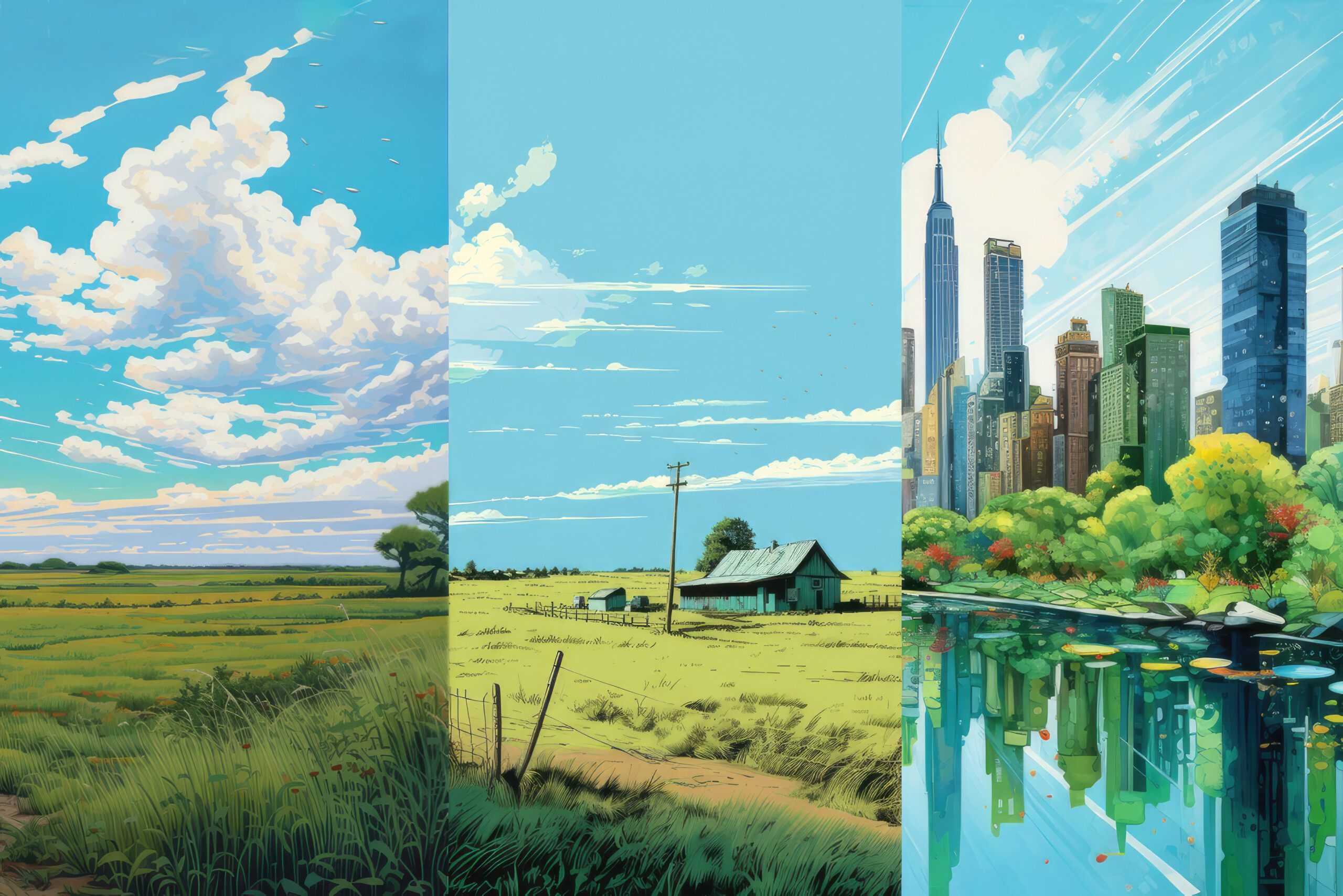
Imagine, if you will, the following scenario. It is 1723, and you are invited to dinner in a bucolic New England countryside, unspoiled by the ravages of the Industrial Revolution. There, you encounter a family of English settlers who left the Old World to start a new life in North America. The father, muscles bulging after a vigorous day of work on the farm, sits at the head of the table, reading from the Bible. His beautiful wife, dressed in rustic finery, is putting finishing touches on a pot of hearty stew. The son, a strapping lad of 17, has just returned from an invigorating horse ride, while the daughter, aged 12, is playing with her dolls. Aside from the antiquated gender roles, what’s there not to like?
As an idealized depiction of pre-industrial life, the setting is easily recognizable to anyone familiar with Romantic writing or films such as Gone with the Wind or the Lord of the Rings trilogy. As a description of reality, however, it is rubbish; balderdash; nonsense and humbug. More likely than not, the father is in agonizing and chronic pain from decades of hard labor. His wife’s lungs, destroyed by years of indoor pollution, make her cough blood. Soon, she will be dead. The daughter, the family being too poor to afford a dowry, will spend her life as a spinster, shunned by her peers. And the son, having recently visited a prostitute, is suffering from a mysterious ailment that will make him blind in five years and kill him before he is 30.
For most of human history, life was very difficult for most people. They lacked basic medicines and died relatively young. They had no painkillers, and people with ailments spent much of their lives in agonizing pain. Entire families lived in bug-infested dwellings that offered neither comfort nor privacy. They worked in the fields from sunrise to sunset, yet hunger and famines were common. Transportation was primitive, and most people never traveled beyond their native villages or nearest towns. Ignorance and illiteracy were rife. The “good old days” were, by and large, very bad for the great majority of humankind. Since then, humanity has made enormous progress—especially over the course of the last two centuries.
How much progress?
Life expectancy before the modern era, which is to say, the last 200 years or so, was between ages 25 and 30. Today, the global average is 73 years old. It is 78 in the United States and 85 in Hong Kong.
In the mid-18th century, 40 percent of children died before their 15th birthday in Sweden and 50 percent in Bavaria. That was not unusual. The average child mortality among hunter-gatherers was 49 percent. Today, global child mortality is 4 percent. It is 0.3 percent in the Nordic nations and Japan.
Most of the people who survived into adulthood lived on the equivalent of $2 per day—a permanent state of penury that lasted from the start of the agricultural revolution 10,000 years ago until the 1800s. Today, the global average is $35—adjusted for inflation. Put differently, the average inhabitant of the world is 18 times better off.
With rising incomes came a massive reduction in absolute poverty, which fell from 90 percent in the early 19th century to 40 percent in 1980 to less than 10 percent today. As scholars from the Brookings Institution put it, “Poverty reduction of this magnitude is unparalleled in history.”
Along with absolute poverty came hunger. Famines were once common, and the average food consumption in France did not reach 2,000 calories per person per day until the 1820s. Today, the global average is approaching 3,000 calories, and obesity is an increasing problem—even in sub-Saharan Africa.
Almost 90 percent of people worldwide in 1820 were illiterate. Today, over 90 percent of humanity is literate. As late as 1870, the total length of schooling at all levels of education for people between the ages of 24 and 65 was 0.5 years. Today, it is nine years.
These are the basics, but don’t forget other conveniences of modern life, such as antibiotics. President Calvin Coolidge’s son died from an infected blister, which he developed while playing tennis at the White House in 1924. Four years later, Alexander Fleming discovered penicillin. Or think of air conditioning, the arrival of which increased productivity and, therefore, standards of living in the American South and ensured that New Yorkers didn’t have to sleep on outside staircases during the summer to keep cool.
So far, I have chiefly focused only on material improvements. Technological change, which drives material progress forward, is cumulative. But the unprecedented prosperity that most people enjoy today isn’t the most remarkable aspect of modern life. That must be the gradual improvement in our treatment of one another and of the natural world around us—a fact that’s even more remarkable given that human nature is largely unchanging.
Let’s start with the most obvious. Slavery can be traced back to Sumer, a Middle Eastern civilization that flourished between 4,500 BC and 1,900 BC. Over the succeeding 4,000 years, every civilization at one point or another practiced chattel slavery. Today, it is banned in every country on Earth.
In ancient Greece and many other cultures, women were the property of men. They were deliberately kept confined and ignorant. And while it is true that the status of women ranged widely throughout history, it was only in 1893 New Zealand that women obtained the right to vote. Today, the only place where women have no vote is the Papal Election at the Vatican.
A similar story can be told about gays and lesbians. It is a myth that the equality, which gays and lesbians enjoy in the West today, is merely a return to a happy ancient past. The Greeks tolerated (and highly regulated) sexual encounters among men, but lesbianism (women being the property of men) was unacceptable. The same was true about relationships between adult males. In the end, all men were expected to marry and produce children for the military.
Similarly, it is a mistake to create a dichotomy between males and the rest. Most men in history never had political power. The United States was the first country on Earth where most free men could vote in the early 1800s. Prior to that, men formed the backbone of oppressed peasantry, whose job was to feed the aristocrats and die in their wars.
Strange though it may sound, given the Russian barbarism in Ukraine and Hamas’s in Israel, data suggests that humans are more peaceful than they used to be. Five hundred years ago, great powers were at war 100 percent of the time. Every springtime, armies moved, invaded the neighbor’s territory, and fought until wintertime. War was the norm. Today, it is peace. In fact, this year marks 70 years since the last war between great powers. No comparable period of peace exists in the historical record.
Homicides are also down. At the time of Leonardo Da Vinci, some 73 out of every 100,000 Italians could expect to be murdered in their lifetimes. Today, it is less than one. Something similar has happened in Belgium, the Netherlands, Switzerland, Germany, Scandinavia, and many other places on Earth.
Human sacrifice, cannibalism, eunuchs, harems, dueling, foot-binding, heretic and witch burning, public torture and executions, infanticide, freak shows and laughing at the insane, as Harvard University’s Steven Pinker has documented, are all gone or linger only in the worst of the planet’s backwaters.
Finally, we are also more mindful of nonhumans. Lowering cats into a fire to make them scream was a popular spectacle in 16th century Paris. Ditto bearbaiting, a blood sport in which a chained bear and one or more dogs were forced to fight. Speaking of dogs, some were used as foot warmers while others were bred to run on a wheel, called a turnspit or dog wheel, to turn the meat in the kitchen. Whaling was also common.
Overwhelming evidence from across the academic disciplines clearly shows that we are richer, live longer, are better fed, and are better educated. Most of all, evidence shows that we are more humane. My point, therefore, is a simple one: this is the best time to be alive.