
Summary: Trade tends to reduce prejudice by fostering cooperation, competition, and repeated interaction across groups. Economic theory and empirical research show that economic freedom and globalization are consistently associated with lower levels of nationalism, ethnocentrism, and discrimination. By enabling mutually beneficial exchange and expanding social contact, markets help cultivate tolerance and weaken “us versus them” thinking.
In earlier essays, I argued that trade makes us richer, more trusting, more honest, and more fair. Yet over the past decade or so, we have witnessed a growing populist backlash against globalization and international trade. Many critics portray international trade as an example of “foreign intrusions on national sovereignty.” At first glance, the backlash might seem to suggest that trade with outsiders breeds resentment, cultural tension, and ultimately prejudice. In this essay, however, I argue that trade mitigates discrimination and prejudice, paving the way for greater tolerance.
In Capitalism and Freedom, the late Nobel Prize–winning economist Milton Friedman dedicated a chapter to the market’s relation to discrimination. Drawing on Nobel Prize–winning economist Gary Becker’s groundbreaking work, Friedman wrote, “The preserves of discrimination in any society are the areas that are most monopolistic in character, whereas discrimination against groups of particular color or religion is least in those areas where there is the greatest freedom of competition.” He continued:
The man who objects to buying from or working alongside a Negro, for example, thereby limits his range of choice. He will generally have to pay a higher price for what he buys or receive a lower return for his work. Or, put the other way, those of us who regard color of skin or religion as irrelevant can buy some things more cheaply as a result.
Survey data can shed light on the relationship between trade and attitudes toward others. A study of international survey data published by the Brookings Institution found that feelings of national superiority and chauvinism were positively associated with opposition to global trade across multiple countries. On the flip side, pro-trade attitudes and greater exposure to global markets are negatively associated with nationalism, ethnocentrism, and prejudice.
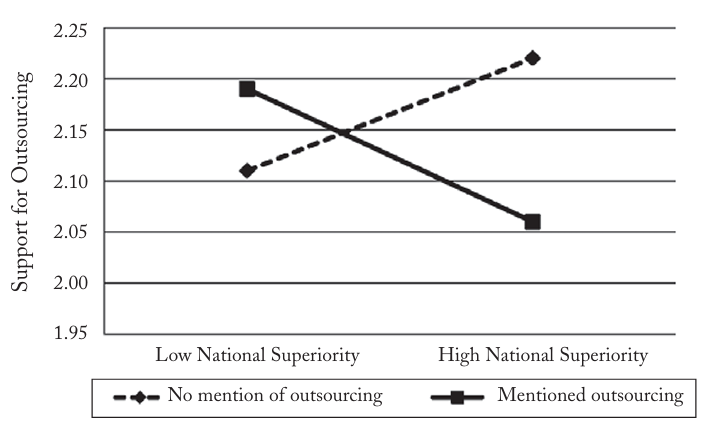
For example, negative attitudes among Americans toward outsourcing appear to be associated with an “us versus them” mentality. According to a study by political scientists Edward Mansfield and Diana Mutz, switching from the most isolationist to the least isolationist outlooks predicted a fivefold increase in support for outsourcing. Shifting from the least ethnocentric to the most ethnocentric attitudes predicted a 50 percent decrease in support for outsourcing. And changing from the least nationalistic to the most nationalistic views predicted a 25 percent decrease in support for outsourcing (see Figure 1).
Figure 1. Support for Outsourcing by Level of Nationalism
The evidence compounds. Employing data from the General Social Surveys conducted from 1977 to 2010, Northwestern University’s James Lindgren found that racism, intolerance toward out-groups (e.g., homosexuals, atheists, and others), anti-capitalism, and pro-redistribution go hand-in-hand. Even after controlling for gender, logged income, education, age, and year of the survey, Lindgren showed that racism and intolerance are still strong predictors of socialist pro-redistribution and anti-capitalist attitudes. Lindgren’s analysis led him to conclude, “Those who support capitalism and freer markets and oppose greater income redistribution tend to be . . . less traditionally racist” and “less intolerant of unpopular groups.”
That tracks with the work of the Mercatus Center’s Virgil Henry Storr and Ginny Choi, who compared respondents from market societies to those in nonmarket societies using the World Values Survey. When asked who they would not like to have as neighbors, those in market societies were less prejudiced against those of a different race, language, or religion, as well as foreign workers, homosexuals, and cohabitating couples (see Figure 2). Trade, it seems, is next to good neighborliness.
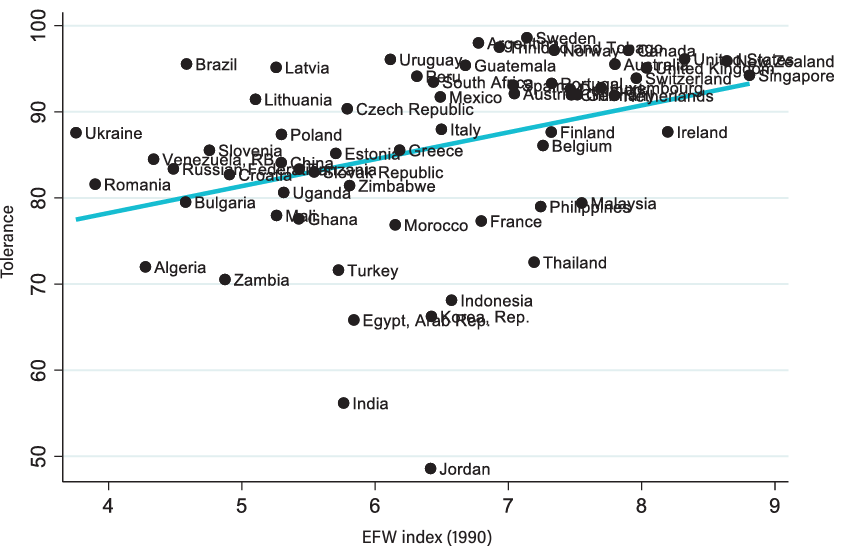
Several studies by economists Niclas Berggren and Therese Nilsson investigated the relationship between tolerance, economic freedom, and globalization. The evidence they gathered suggests a causal relationship between the level of economic globalization and the willingness of parents to teach their children tolerance. Another analysis found that economic freedom plays a seemingly causal role in parents teaching their children tolerance and fostering tolerance toward homosexuals and people of different races (see Figure 3). Focusing solely on the United States, Berggren and Nilsson found a similar causality: Economic freedom increases tolerance toward homosexuals, atheists, and communists. Another study found that economic freedom increases tolerance toward homosexuals, particularly in societies that are high in trust.
Figure 2. Market Societies Are Less Prejudiced
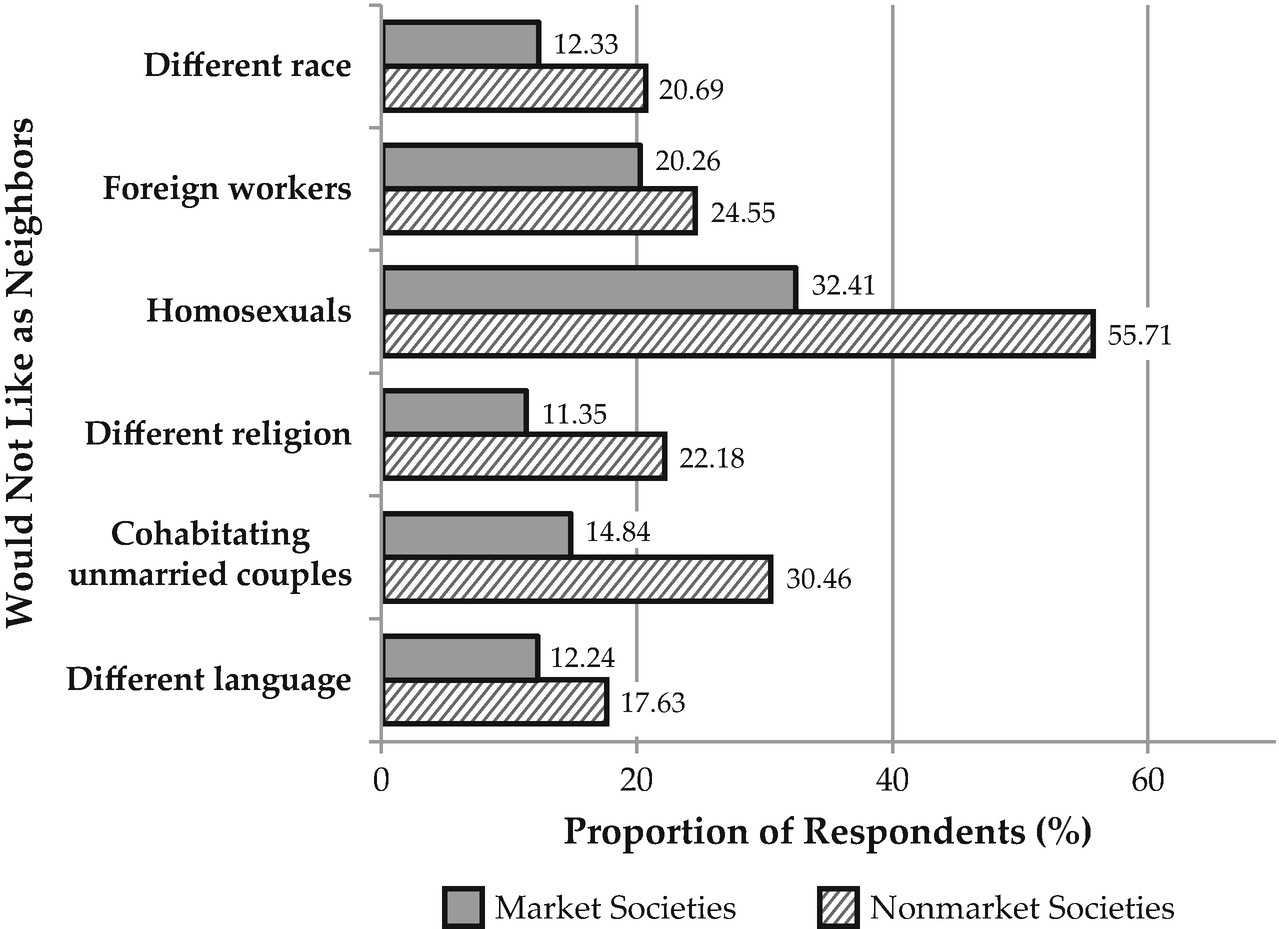
Figure 3. Racial Tolerance and Economic Freedom
And it’s not just parents teaching children tolerance. The media also plays a role in shaping our outlook. An interesting study by researchers at St. Olaf College, Stanford University, and George Mason University combed through a corpus of New York Times articles written over a 20-year period in search of moral language that Americans used in discussing other countries. They then measured the US market interaction with these countries by looking at bilateral trade flows and immigration statistics. Their results indicated that the more market interaction the United States had with a country through trade and immigration, the more news articles contained humanizing language toward that country. We tend to be cordial toward those we do business with.
Of course, it’s easy to say you’re tolerant in a survey or write nice things in an op-ed. It may even be socially desirable. We all want to look good. But does this translate into action? Several studies suggest that it does.
A clever set of experiments published in the European Economic Review showed that both local (monopsonist) and wholesale (competitive) buyers in the Bangladeshi rice market held prejudicial views of ethnic minorities. Prejudicial attitudes were the same across the board. Yet the wholesale buyers quoted the same price for both ethnic majority and minority farmers, whereas the local buyers did not. Why? The authors concluded, “This suggests that the taste-based discrimination that these buyers have against the ethnic minority group . . . can be eliminated if competition is strong enough.”
Those findings were supported by another set of experiments that demonstrated that market exchange decreases discrimination by increasing participants’ focus on their personal gains and reducing identification with their social in-group. Banking deregulation yielded similar results: As the financial sector was deregulated, competition intensified, leading to reduced discrimination against women and minorities.
Protectionist restrictions can exacerbate prejudicial attitudes. As the late economist Walter Williams explained, anti-competitive regulation “lowers the private cost of discriminating against the racially less-preferred person.” But when there is money to be made, trading only with groups who look or think like you doesn’t seem so important. And the more you trade with different groups, the more you realize that maybe, just maybe, they aren’t as bad as you thought.
But let’s go a step further. Researchers at the University of British Columbia and Bates College have also shown how trade can break down prejudice in practice. The researchers examined areas along the Silk Roads, a network of trade routes throughout Eurasia that has been used for over millennia. It turns out that areas within 50 kilometers of the Silk Roads today have higher economic activity compared to those that are 50–100 kilometers away. No real surprise there. But more importantly for our purposes, the former areas also have higher rates of intergroup marriage. It’s hard to find a better example of tolerance than asking someone of another ethnic group to become family and spend the rest of their lives with you.
You see this in 19th-century America as well. Railroad-driven market integration between 1850 and 1920 helped reshape American social horizons. A new study found that as counties gained better access to this intrastate trade, the likelihood of marrying someone outside the local community increased. That’s what’s called extra-community marriage. Other signs of tolerance and trust became apparent: Newspapers began to adopt language that reflected generalized trust. Parents began to give children nationally popular names rather than locally distinctive ones, implying a social circle that had extended beyond the local community. But one of the strongest findings was the increase in religious diversity: A 1 percent increase in market access raised religious diversity by 0.27 standard deviation, indicating a greater tolerance for religious identity and practice. Perhaps most striking, families who moved to these more market-integrated areas adapted quickly, especially those working in commerce-intensive industries such as agriculture, manufacturing, wholesale, retail, and transportation.
The available evidence suggests that repeated exchange softens suspicion toward outsiders. Sustained commercial contact makes unfamiliar people feel less distant and, consequently, less threatening. Trade provides a mechanism through which tolerance is learned and reinforced. As the 18th-century English theologian and scientist Joseph Priestly noted over 200 years ago,
By commerce we enlarge our acquaintance with the terraqueous globe and its inhabitants, which tends to greatly expand the mind, and to cure us of many hurtful prejudices. . . . No person can taste the sweets of commerce, which absolutely depends upon a free and undisturbed intercourse of different and remote nations, but must grow fond of peace, in which alone the advantages he enjoys can be had.