fbpx
01 / 05
Heroes of Progress: An Interview with Alex Hammond

Blog Post | Human Development

Heroes of Progress: An Interview with Alex Hammond

Summary: In a dialogue between Clay Routledge and Alex Hammond, the author of Heroes of Progress: 65 People Who Changed the World gives an overview of his exploration into the essence of human advancement. Hammond’s book embarks on a journey into the lives of remarkable individuals who defied odds and transformed the world. Hammond explains some defining characteristics of history’s heroes of progress, shedding light on their unwavering determination, tireless perseverance, and unyielding pursuit of meaningful innovation.


The following is an interview conducted by Archbridge Vice President of Research and Director of the Human Flourishing Lab Clay Routledge with Alex Hammond, author of the new book, Heroes of Progress: 65 People Who Changed the World, which is out March 19, 2024.

Clay Routledge: What inspired you to write a book on the topic of human progress?

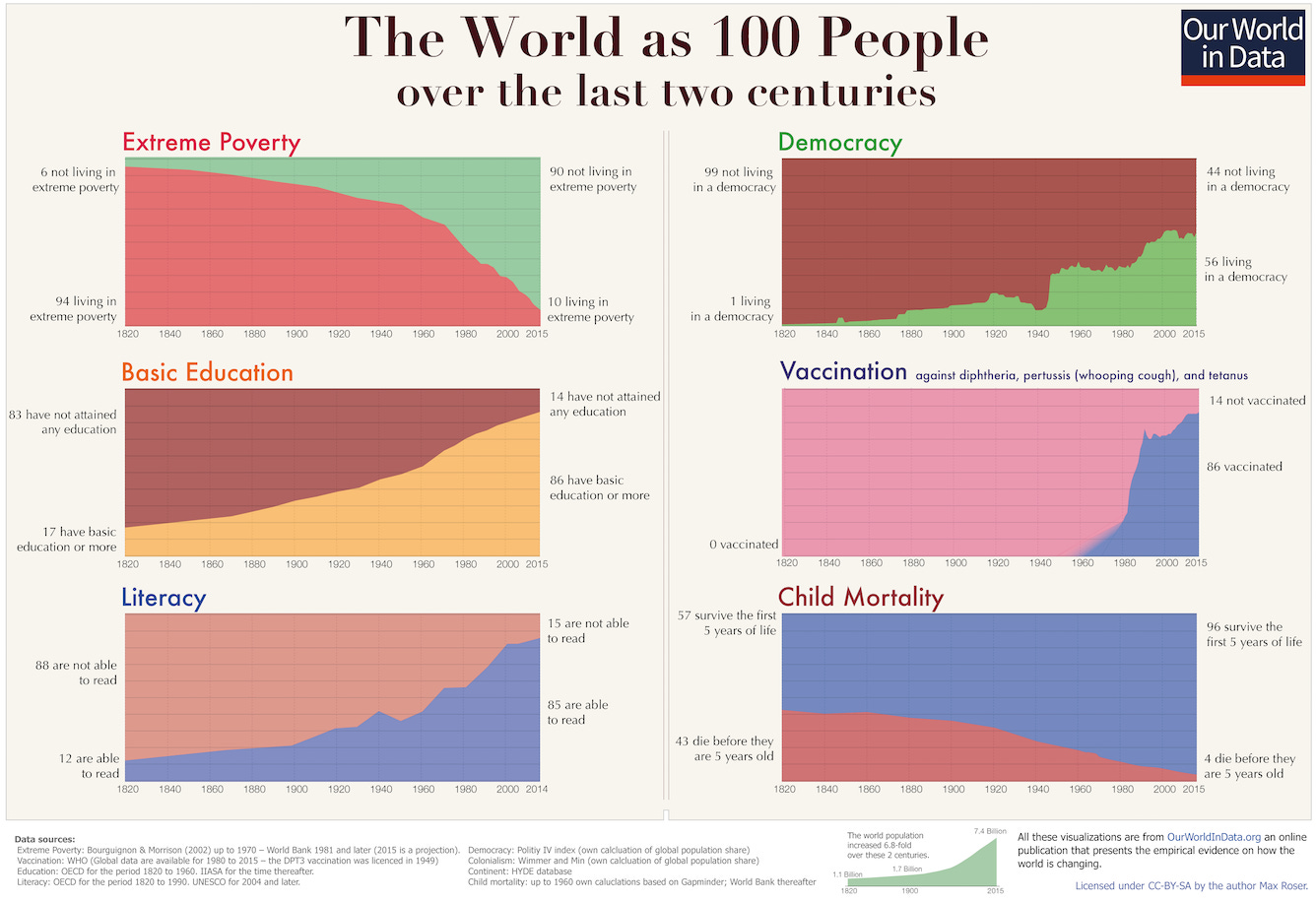
Alex Hammond: Over the past two centuries, humanity has experienced unprecedented progress. Between 1820 and 2020, extreme poverty (defined as living on less than $1.90 per person per day) declined by over 90 percent. Over the same period, average global life expectancy more than doubled, and illiteracy declined by over 86 percent.

Yet, despite this immense progress, most of us remain pessimistic and anxious about the state of the world. A 2020 survey by the global public opinion company YouGov asked my fellow Britons, “Generally speaking, do you think the world is becoming a better or worse place, or is it staying much the same?” A whopping 70 percent of respondents thought the world was becoming a worse place to live. Eighteen percent thought it was staying the same, and a measly four percent thought it was improving. When YouGov asked a similar question to Americans in 2016, 65 percent of respondents thought the world was worsening, and just six percent thought it was improving. Similarly, a 2022 national survey found that one-third of American adults and half of Americans under 30 report feeling anxious all or most of the time.

I believe the findings of the two studies above are inherently linked. As Harvard University psychologist Steven Pinker notes in the foreword to the book, “s[k]epticism often breeds apathy and fatalism.” This fatalism and apathy, I would argue, underpins much of our modern-day anxiety about the state of the world and humanity’s ability to overcome the most pressing problems of our day. Therefore, the question remains: what causes this skepticism? Pursuing this question led me to write this book.

I believe, perhaps due to a post-1960s intellectual climate that deems it uncool to celebrate those who have come before and media outlets who are becoming increasingly pessimistic about humanity’s outlook, that mass skepticism is rooted in our lack of knowledge about the incredible feats of progress that have come before. As such, Heroes of Progress was written to take readers on a journey through the lives of some of the most important people and explore the societal conditions that made their innovation possible. By sharing these stories, I hope this book will cause the reader to develop a sense of gratitude for what has come before and inspiration as to the endless capacity of free individuals to transform the world for the better.

Clay: What makes someone a hero of progress, and what was your process for selecting the individuals you feature in your book?

Alex: I have defined a “hero of progress” as someone whose work saved or improved the lives of millions of people, irrespective of field or area of expertise. From agronomists whose hybrid crops saved billions of lives, intellectuals who changed public policy and removed barriers to human flourishing, business people whose inventions raised living standards and revolutionized our societies, or scientists whose medical breakthroughs eliminated diseases and ended pandemics, the book features them all—and more!

However, it should be said that despite the narrow selection criteria, the book is not all-encompassing. It is likely that many other people, dead or alive, could fit the definition of a hero of progress. One challenge in compiling the heroes is that the innovation process is usually incremental, collective, and part of a network of information and improvements built on centuries or millennia of acquired knowledge. For simplicity’s sake, I only included those who played the clearest and most important part in developing ideas, processes, change, or goods that went on to save or improve millions of lives. That said, the book attempts to highlight many unsung people who changed the world for the better and without whom, we’d all be far poorer, sicker, hungrier, ignorant, and less free.

Clay: As a psychologist interested in human progress, I appreciate your emphasis on the human mind. You write, “Nations, governments, societies, businesses, committees, groups, algorithms, and computers don’t have ideas. Ideas spring forth from the human brain.” When researching the individuals you feature, did you find any indications of possible common psychological characteristics among these heroes of progress?

Alex: Although the heroes came from many different nations, fields, and historical eras, some common characteristics are evident. The first, and likely unsurprising, trait many heroes hold is their high level of industriousness, grit, and tenacity toward pursuing what they deem meaningful. Fritz Haber, for example, conducted thousands of experiments day in and day out for over a decade just to prove that synthesizing ammonia from hydrogen and atmospheric nitrogen was possible. While many people would have given up on these repetitive experiments, Haber believed his work was meaningful and couldn’t be stopped. Thanks to his perseverance, Haber’s breakthrough eventually led to the widespread adoption of synthetic fertilizer, which saved hundreds of millions, if not billions, of lives.

Similarly, most heroes wouldn’t take “no” for an answer, went into fields others told them they were incapable of being in (due to background, sex, race, etc.), and took any opportunity to work on what they believed was meaningful. Take Pearl Kendrick and Grace Eldering as an example. Their employers didn’t allow them to spend their workday developing a vaccine for whooping cough. Instead, they tirelessly worked in their lab during evenings and weekends over the course of years to develop the vaccine. In doing so, their work helped to save over 15 million lives so far.

Another trait, particularly common for heroes who lived roughly between 1500 and 1800, was their willingness to migrate. Many heroes moved nations (often several times) to gain freedoms, networks, mentorship, or an education that simply wasn’t available in their home country.

The desire to not take no for an answer, often ignore criticism, work relentlessly, and move abroad to pursue opportunity ultimately meant many heroes were exceptionally disagreeable. Take Maurice Hilleman, the man credited with saving more lives than any other medical scientist in the 20th century. One of his mentees noted that he kept a row of shrunken heads (fake ones, made by his children) on his desk as trophies for every employee he fired from his lab. He ran his laboratory like a military unit and refused to accept mandated classes run by his employers. Yet, he developed over 40 vaccinations and created eight of the 14 recommended in the current schedules. In my opinion, if many of our heroes had been around today, they would likely have been fired or canceled long before they could make their world-changing discovery. To me, this is one of the most unexplored elements in the modern free speech debate—though that’s an article for another day!

Clay: Even if someone has an amazing idea, her or his ability to turn that idea into something truly impactful is influenced by their environment. In the book, you also emphasize the importance of freedom. Why is freedom in all its forms—from free speech to free markets—so critical to human innovation and progress?

Alex: It is only when people have agency and freedom that they can then turn their ideas into innovations. To create ideas, humans must be free to speak, publish, associate, disagree, take risks, and, most importantly, disrupt the status quo. However, Diedre McCloskey said it best when she noted that innovation “isn’t enough [for technological and material progress]. It has got to be tested whether it is profitable to work.” Therefore, a broad range of pro-market policies are needed to allow individuals to save, invest, and trade, which ensures the best innovations rise to the top and, sometimes, even change the world forever.

The price mechanism, which serves as a useful device for innovators to separate good ideas from bad, must remain undistorted for innovation to flourish. The lack of economic and social freedom and a distorted price mechanism is why, for most of human history, our relationship with innovation was sporadic, episodic, limited, and often reversible.

In the second half of the 18th century, humanity’s relationship with innovation began to change when some states in Western Europe—first the Netherlands and the United Kingdom—stopped disincentivizing innovation. They allowed their citizens to develop new ideas and contradict old ones without fear of ostracism, harassment, imprisonment, or death. These freedoms, to varying degrees, have slowly spread across the world.

As the book presents the biographies of the heroes in chronological order, it is fascinating to see that as fundamental personal and economic freedoms begin to spread across the world in the 19th, 20th, and continuing into the 21st century, the backgrounds, ethnicities, and sexes of the heroes become increasingly diverse.

Clay: You make the important point that more people means more minds, which means more ideas. There is a lot of discussion today regarding declining fertility rates. Some see this as a good trend; others see this as a bad trend, often arguing that having more humans (more minds) is actually helpful for addressing challenges such as climate change and improving life for everyone.

I would put myself in this second camp and think that even if AI, robots, and automation can help resolve some of the problems that would result from a declining population, a world with a lot fewer children is, on the whole, bad for progress because children are a powerful source of meaning and existential inspiration. They remind us that we are part of something larger and more enduring than our individual mortal lives. This has an expansive effect on our decisions by encouraging us to improve the world. Do you have thoughts on how current fertility trends might influence progress going forward?

Alex: Due to the human mind’s unique ability to build on and improve past innovations, which in turn leads to technological progress and economic growth, I agree with the late University of Maryland economist Julian Simon’s analysis that the homosapien brain is the world’s “ultimate resource.”

I am deeply concerned about the threat of declining fertility as it relates to culture, geopolitics, governance, and, most importantly, innovation and continued progress. Free nations such as South Korea, where it has been estimated that for every 100 great-grandparents, there will be just 6.6 great-grandkids, will almost certainly experience less innovation and economic growth.

However, despite declining fertility, the sheer number of human minds is just one aspect of innovation. As noted above, there must also be freedom for innovation to flourish. Consequently, given billions of people worldwide lack the freedom of speech, association, ownership, trade, investment, and ultimately, the ability to test their ideas in a marketplace, there is an unfathomable amount of untapped potential for innovation in the world today. If all unfree nations become economically and socially free tomorrow, the rate of innovation and global economic growth would be immense.

Clay: Your colleague Chelsea Follett wrote a book focused on the places where major advances occurred. Beyond freedom and population, what are important factors that help people actualize their creative and innovative ideas to become heroes of progress?

Alex: As you mention, individuals’ freedom to choose and act without oppressive or insurmountable policy hurdles is a prerequisite for innovation. However, another aspect that also determines the rate of progress is the number of individuals with the skills (education) and mindset to believe that they can pursue meaningful tasks and test or develop their ideas. Without the skills and belief that you can pursue your goal and overcome hurdles, creativity and innovation are unlikely, if not impossible. Like the number of people living in free and open societies, there is immense untapped potential among people already on this planet to become empowered with the confidence and skills to innovate.

This Interview was published at Profectus on 3/12/2024.

Blog Post | Human Development

The New Right Manufactures Misery | Podcast Highlights

Marian Tupy interviews Yaron Brook about the pessimistic populism of the New Right.

Listen to the podcast or read the full transcript here.

Today I’m going to be joined by Yaron Brook, host of the very popular Yaron Brook show and a prominent advocate of free markets, individual liberty, and Objectivism.

Yaron, I want to talk to you this morning about a recent tweet by Matt Walsh, a very prominent American conservative. He’s the host of the Matt Walsh show and appears very frequently on the Daily Wire.

Here is what Matt Walsh posted on his Twitter: “It’s an empirical fact that basically everything in our day to day lives has gotten worse over the years. The quality of everything, food, clothing, entertainment, air travel, roads, traffic, infrastructure, housing, et cetera, has declined in observable ways. Even newer inventions, search engines, social media, smartphones, have gone downhill drastically. This isn’t just a random old man yells at clouds complaint. It’s true. It’s happening. The decline can be measured. Everyone sees it. Everyone feels it. Meanwhile, political pundits and podcast hosts, speaking of things that are getting worse, focus on anything and everything except these practical, real-life problems that actually affect our quality of life.”

So, Yaron, when you first read that tweet, what did you make of it? What was your first reaction?

Well, this was not new to me. I’ve been talking about Matt Walsh and the general populist attitude to human progress for the last 40 years. It’s a theme that the left used to advocate for. Now the populist right seems to have agreed on the idea that the 1970s were some kind of utopia where income was maximal, women didn’t have to work, you could buy a home, and everybody was happy.

I think Matt Walsh is just reflecting that deep-seated pessimism that exists today across the entire political spectrum. And of course, my response is that he’s wrong about almost all of the examples he gives.

Let’s first talk about this concept of American pessimism. What do you attribute it to?

One of my theories is that we’re experiencing a negative emotional contagion driven by competition within the media. We know that each additional negative word in a headline increases the click-through rate by about two and a half percent. And now you have traditional media competing with internet outfits, so if you want to get people’s attention, pessimism sells.

That’s definitely part of the problem, but I don’t think it’s the fundamental problem.

I believe that we are shaped by ideas, and therefore, we’re shaped by our intellectuals. And the intellectual class has completely betrayed Americans. They have rejected capitalism, which is the system that made us rich.

If you were a steelworker in Cleveland and you lost your job in the 1980s, what were you told? You weren’t told what we were told in America traditionally, which was “get in your car, drive to northwest Arkansas, and get another job.” You were told, “No, don’t worry, we’ll write you a check, and we’ll keep you on welfare while we, the intellectuals and the politicians, work on getting your job back.”

This has been the story that politicians have been telling workers for a long time. They’re lying; the steel job will never come back. And they’re destroying the worker’s self-esteem, that self-reliance that’s so core to the American ideal. So, 20 years go by, and the steel job doesn’t come back, and this person and the culture around him develop real resentments against the system.  And intellectuals have told Americans that their job loss is a consequence of capitalism, that capitalism caused the great financial crisis, and that they’re looking for an alternative, something to replace free markets, private property, and the dynamism of the marketplace.

One area in which America really is declining is in education. We have K-12 education that teaches kids to trust their emotions rather than their reason. We saw this maybe 10, 15 years ago with microaggressions and political correctness, and then that evolved into the woke phenomenon, which was all about avoiding hurt feelings or causing offense. So, we’ve created generations of people who are very attuned to their emotions but can’t really think, and as a consequence, rely on their primitive human instincts.

People don’t understand the world because they haven’t been taught how to think about it conceptually, so they revert to perceptions. They’re afraid because perceptions don’t lead them to knowledge, and when people are afraid, they join tribes. There’s comfort in tribes. So, you get tribalism and perceptual-level mentality, and that combination is what drives this spiral of fear and pessimism.

Let me ask you questions specifically about the GOP.

Back in the day, during the Reagan Era, it was all about America being the shining city on the hill. That there was nothing that Americans could not do, and our best days lay ahead. Now all of that seems to be gone. What happened to the Republican Party and the conservative movement?

I think it’s a combination of two things, one ideological and one historical.

Ideologically, the GOP has changed its composition and who it’s trying to appeal to. And I think the change actually happened under Reagan, who made religion a crucial part of what it meant to be a Republican. And I think that religion undermines the ability to think about the future in a positive way. Many evangelicals, particularly when they see cultural phenomena like the gay movement, Roe versus Wade, and immigration, are afraid of the future. That fear was reinforced by three major events.

The first was 9/11, which was completely misinterpreted by the American right. Ultimately, the Bush administration lied to all of us and engaged in endless wars that didn’t achieve any of their goals. So, a lot of American idealism died in Afghanistan and Iraq. And then there was the great financial crisis, which collapsed the image of American capitalism as this amazing economic engine of prosperity. Instead of intellectuals coming out and saying, “Oh, no, you misunderstood. The crisis happened because of particular regulations and the Federal Reserve,” the intellectuals came out and said, “This was caused by capitalism. We need a new model.” And finally, we had COVID, which undermined the concept of America as the land of the free. We got locked up in our homes, and the political and expert class panicked and had no clue what to do except infringe on our individual rights.

Those three crises have led Americans to be skeptical of everything that’s uniquely American, and, in the GOP, revert to a kind of religiosity that they imagine the Founding Fathers had. Michael Knowles, for example, who is also on the Daily Wire, has said, “I want a culture of 1220.” So there’s a certain medievalism in some people on the right today. They long for the certainty of religious dogma and simple life, and none of this exposure to foreign cultures or people with different sexual orientations.

Evolutionary psychologists tell us that there are certain permanent aspects of human nature. And amongst the things evolutionary psychologists say are pretty firm in human nature are tribalism and zero-sum thinking. You already argued that the right is deeply tribalist, and the left is clearly very driven by zero-sum thinking.

So, are promoters of freedom and capitalism simply fighting a losing battle against human nature?

Absolutely not. And the evidence for this is in the work you do at Human Progress. Look how far we’ve come. Look at how rich we are. It’s stunning. We were hunter-gatherers once, and we established cities, agriculture, philosophy, mathematics, and science. Every single step in those achievements was a consequence of the rejection of tribalism and zero-sum thinking. Every single step came from the use of reason. So I think human history repudiates the idea that we have to be tribal and zero-sum.

Now, it’s true that when people don’t think, when they refuse to put in the effort to actually use their mind, the default is zero-sum. Tribalism and zero-sum thinking are defaults people revert to when they’re overwhelmed by emotion. And when you have an educational system and intellectuals who undercut reason and elevate emotion above all, you get zero-sum thinking and tribalism.

To me, it’s all about the intellectuals. The intellectuals shape culture. It’s not an accident that America is a consequence of an intellectual movement called the Enlightenment. The Enlightenment sowed certain ideas, and those ideas flowered into the Industrial Revolution and the great wealth that we have since benefited from. Our intellectual class, though, has worked hard to undermine the Enlightenment for more than 200 years, basically since the Enlightenment ended. It is amazing how much we have progressed despite such lousy intellectual guidance.

So we need a new set of intellectuals who can guide Americans, and really all of humanity, towards an understanding of their own potential as thinkers, as reasoners, as builders and creators. And at whatever intellectual level you have, whatever IQ or whatever measure you use, you can produce, and you can be happy. If we can dominate the intellectual sphere, the world will change. But right now, what’s dragging us down are people like Matt Walsh and other intellectuals who are constantly feeding the public the exact opposite message: defeatism, anti-reason, anti-freedom, and anti-capitalism.

Well, the old intellectual lead has certainly disgraced itself and is on its way out because of Iraq, COVID, the great financial crisis and so forth. The problem is that the intellectuals who are waiting in the wings to replace them are worse. We are talking about people like, I’m sorry to say, Matt Walsh, Adrian Vermeule, and Curtis Yarvin.

Now we have to give the devil his due and talk about specifics. So, Yaron, is food in America now worse than it was in the 1970s?

It’s just funny to me to read something like that.

I mean, in the 1970s, the food was bland, and choices were minimal. Maybe there’d be one Chinese restaurant in the neighborhood. Now, the best of the best different foods from all over the world are available in any major city in the United States. I’m a foodie, so the joy of eating new foods with new flavors and in new combinations is just amazing. And we have restaurants that are super cheap. In LA, you can go buy tacos that are some of the most delicious in the world at a food truck. And if you go into a supermarket, you can get fruits and vegetables that only grow in certain regions of the world all year round, and at very reasonable prices.

So, we have such a variety and such a selection in the United States today, of all the things to pick on, food is comical.

Another point raised by Matt Walsh is air travel.

In the olden days, you simply didn’t travel by air. Holidays would be spent near where you lived. There’s a fantastic bit in Mad Men where these rich guys from New York decide to go to California and fly across the country, and it’s a big deal. The whole Office is talking about it, and they are bringing a bag of California oranges back to New York because you couldn’t get them otherwise.

Now, it is uncomfortable in economy class, yet tens of millions of people take economy class flights every year. They are voting with their wallets. What’s the tradeoff here?

The tradeoff is to get to where you want to go. The ability to travel, the ability to see the world. And it’s unbelievably cheap. In the 1950s and 60s, nobody could afford to take a cross-country trip by air. Today, almost everybody can afford to do that. In addition, air travel was not as safe back then. In America, except for that one accident at Reagan, we’ve had no fatal accidents for like 20 years. So, it’s super cheap, and if you want to pay more money, you can sit in business class and be more comfortable.

And there are discount airlines that specialize in bare-bones service and very uncomfortable seats, yet they’re always full.

There is this meme about the ability of the American worker to support a family on one income. But even today, you can have a 1950s or 1960s lifestyle on one income. It will mean that you are never going to fly across the country. It will mean that you are going to be living in a much smaller home without basic appliances. It will mean that you will have access to 1950s or 1970s health care. So, the point is, people opt to have two-income families because life is just so much more amazing that way.

Matt Yglesias had a really good essay on this, in which he found a house that is the same size as it was in the 1950s—about 1500 square feet, versus today’s over 3000—and yeah, it’s easily affordable on one income. When I grew up, there were six of us, four kids and two parents, with one bathroom. If you want every kid in their own bedroom and bathrooms, two or more cars, and to travel to Europe and see the world, then yeah, you need two incomes.

But there’s something even more important than that: the 1950s really, really sucked if you were a woman. You were stuck at home. You didn’t have many employment opportunities. There was real discrimination against women. And because there were no washers and dryers and dishwashers and all of that, women spent a lot of time taking care of the house.

Now, the opportunity cost for them to stay home is huge. They have an opportunity to build a career, go to school, develop themselves, and pursue the life they want. The consequence of that is two-income families that raise the standard of living. It’s shocking to me that people think that there’s something wrong, A, with women pursuing their own dreams and B, with people actually being richer and living in bigger homes.

You’ve already noted housing, and maybe that is the subject that we can end on.

If you look at what Mark Perry from the American Enterprise Institute calls The Chart of the Century, it shows that housing relative to income is about 10 percent cheaper than it was 20 or 25 years ago. That means wages have been increasing faster than housing prices. So, even though housing is much more expensive than it used to be, wage growth has been higher and, consequently, housing is actually more affordable on average in America.

Another thing that people do not account for is the great improvement in housing. They also focus far too much on particular problems in metropolitan areas such as New York City, whereas in the rest of the country, things are going pretty well. What’s your take on all that?

First of all, there is massive geographic diversity. You can find relatively affordable homes in Florida, Alabama, Mississippi, and in much of the center of the country. Certain metropolitan areas have oppressive laws that have made it very difficult to build, and, as a consequence, rents have gone through the roof. I made a lot of money on homes in California, not because I’m a speculator—I believe housing should be a consumption good, not an investment—but because nobody was building in the neighborhoods that I lived in. Demand was high because of the weather and economic opportunities. So prices just took off. Why isn’t supply matching demand? We know that when demand increases, prices will go up, then supply will enter, and prices will come back down. That doesn’t happen in these areas for political reasons. Homeowners don’t want new houses built, so they vote for people who ensure no new supply is added.

But there are also lots of places in the country where it’s hard to sell a home because nobody wants to live there, or there are plenty of homes. You know, rents and home prices have been dropping significantly in Austin, Texas. During COVID, demand in Austin increased significantly, and supply couldn’t match it immediately because it takes time to build a home. So, prices went up a lot. Then supply came online, and since then, prices have been drifting downwards. And you see that in a number of cities across the country where politics don’t severely restrict housing supply.

The second thing you mentioned is that houses are very different today. They’re dramatically bigger. The average home in America today is over 3,000 square feet with amenities that you couldn’t have imagined in the 1970s. Three-car garages, air conditioning, dishwashers, and so on. The construction quality is also much better. For example, houses are far more resistant to fire. Many more people died from home fires in the 1970s than today because we’ve figured out how to make cheaper fire-resistant materials.

So Matt Walsh could be talking to America about the great successes in GOP-dominated states where housing was deregulated, and rents and house prices are actually coming down. He could be promoting those successes and saying, “Look, if this can be done in Right America, it can also be done in Left America.” But instead, he’s embraced negativity.

The modern American right doesn’t want to highlight those things because that would highlight the successes of freedom and capitalism. The new right are not freedom lovers. Freedom scares them. I think they see that if you advocate for economic freedom, why stop with economics? Shouldn’t individuals be free to make all kinds of choices in their lives? What god to worship or not to worship, who to love. If they can’t tolerate freedom in the realm of personal choices, long-term, they’re not going to tolerate freedom in economic choices. That’s what we’re seeing with the right today. They used to only want to regulate our social choices, and now they want to regulate everything, just like the left.

The great tragedy of America right now is that there’s really nobody in politics who represents freedom in both the personal and economic realms.

Blog Post | Human Development

A Feast of Human Progress and Abundance

Let’s give thanks for how far we’ve come since the time of the Pilgrims.

Summary: A family group chat about Thanksgiving dinner reflects centuries of extraordinary advancement. The same journey that once separated families by months can now be made in hours. A meal that was once a rare luxury has become highly affordable. From instant communication to abundant food, everyday conveniences serve as a reminder that human ingenuity has transformed hardship into prosperity.


Two weeks before Thanksgiving, my sister sent a link to our family group chat. It wasn’t an RSVP form; it was closer to an online wedding gift registry. All the Thanksgiving classic foodstuffs were on the list—turkey, honey baked ham, mashed potatoes, gravy, stuffing, cranberry sauce, candied yams, green bean casserole, pumpkin pie, and more—each with a sign-up slot to commit to bringing the goods. This brief interaction represented numerous aspects of human progress, and I paused to take it in with awe and gratitude.

For one, I live in Boston, not far from where the original Thanksgiving Pilgrims settled in Plymouth, while my family lives in Los Angeles. The distance between us is almost identical to the distance between Britain and the New World, roughly 3,000 miles across land instead of ocean. Yet, the majority of Pilgrims never returned home and never even had the opportunity to stay in contact with the world they left behind. A letter across the Atlantic would cost days’ worth of wages and take months to arrive, if it found safe passage at all.

By the time the first Americans began settling in California in the 1840s, locomotives and the telegraph had been invented, but no transcontinental systems had yet been established. Most westward settlers knew they were signing up for a one-way journey taking many months, with high rates of death and disease. If they could maintain any contact with family on the other side of the continent, messages would take weeks via stagecoach. Even the extraordinarily speedy and expensive Pony Express system—with riders galloping nonstop at full speed, exchanging horses every 10-15 miles, and exchanging riders once or twice a day—still took 10 days to deliver messages across the country.

By the time the first transcontinental telegraph line was established in 1861, messages took minutes rather than weeks but were extraordinarily expensive—nearly a day’s average wage per word. Messages had to be brief and were largely reserved for the government, the military, and the ultra-wealthy. However, a decade later, the first transcontinental railroad was established, which, with the adoption of standardized domestic postage, meant most Americans could afford to send letters across the country and have them arrive within a week. Travel between Los Angeles and Boston became possible but still took weeks and cost several weeks’ worth of average wages.

Innovation accelerated even more rapidly during the 20th century with the invention and commercialization of telephones and air travel. By 1950, the luxuries of traveling between coasts in six hours and communicating across coasts in real time became possible. But these new services were still extraordinarily expensive. Transcontinental flights, both then and now, cost around $300; however, adjusted for inflation, a $300 flight in 1950 corresponds to well over $3,000 in today’s dollars. Likewise, while modern phone plans offer unlimited texts and calls for the equivalent of a few hours of the average minimum wage per month, transcontinental phone calls in the 1950s cost over $2.00 per minute, or over $27 per minute in today’s dollars. Only in the last 30 years, thanks to the economic engine of progress, did it become affordable for the average American to call long-distance for hours.

The technologies enabling long-distance communication and travel have improved immeasurably from the time of the Pilgrims.  That alone is reason enough to be thankful. But besides the amazing pocket-sized supercomputers and the satellite infrastructure that made my family’s group message possible, our exchange hinted at another amazing development that people often take for granted: food abundance.

My father grew up in a small Palestinian village in northern Israel, where most people were farmers. He was one of nine siblings and told stories of how chickens were slaughtered only on special occasions—red meat even rarer. A single bird was shared among a dozen people. “You were lucky if you got a drumstick,” my father said. Everything from feeding to slaughtering and plucking was done by hand. And without refrigeration, the meal had to be eaten at once.

By contrast, in the United States today, food is so cheap and plentiful that several relatives can volunteer to bring a whole turkey. At my local supermarket, frozen birds were recently on sale for $0.47 per pound. A 15-pound turkey, enough to feed a family, costs less than an hour’s minimum wage.

I am grateful for the world of superabundance, which has improved our lives and Thanksgiving holidays beyond what our ancestors could have dreamed. The fact that these interactions are commonplace enough to be taken for granted—communicating in real time across vast distances, flying across the country or around the world in hours, earning enough calories with a day’s wages to feed a family for a week—make our story of progress all the better.

This Thanksgiving, take a moment to consider how life has improved since the time of the Pilgrims. The food on your plate, the technology in your pocket, and the family who traveled long distances to be at the table were all made possible thanks to generations of compounding progress.

Reasons to be Cheerful | Child Abuse & Bullying

Moldova Is Making Orphanages Obsolete

“Moldova, like many post-Soviet nations, inherited a system heavily reliant on institutional child care. Prior to 2000, the country had over 17,000 children living in orphanages. Known in the country as residential institutions, they generally had austere conditions and provided a basic level of care and education…

But over the past two decades, the Moldovan government has been dismantling this legacy of institutional care, working with non-profits and UNICEF to prevent family separation and reform the child care system. Closing orphanages has given way to building new social support systems for disadvantaged families and single mothers, with the goal of keeping children with their birth families whenever possible. Introducing inclusive education for children with special needs has also been key, destigmatizing what it means to have a child with a disability. Developing a network of compassionate foster families has been at the heart of this shift.

The launch in 2007 of Moldova’s National Strategy to reform its residential childcare system aimed to deinstitutionalize 50 percent of children housed in orphanages as the country began focusing on raising social standards to align with the rest of Europe, all in preparation for EU membership, which it is still negotiating. Today, only around 700 children remain in Moldova’s orphanages. By 2027, the goal is to have none.”

From Reasons to be Cheerful.