Greece and Turkey, Long at Odds, Vow to Work Together Peacefully
“After years of tensions between Greece and Turkey, the countries’ leaders signed a ‘declaration on friendly relations and good neighborliness’ on Thursday, in what they described as a bid to set the two neighboring, rival nations on a more constructive path. The eventual goal, they said, was to resolve longstanding differences, which in recent decades have brought them to the brink of military conflict.”
“Global Fishing Watch was co-founded by Google, marine conservation body Oceana, and environmental group SkyTruth. The latter studies satellite images to spot environmental damage.
To try to better monitor and quantify the problem of overfishing, Global Fishing Watch is now using increasingly sophisticated AI software, and satellite imagery, to globally map the movements of more than 65,000 commercial fishing vessels, both those with – and without – AIS.
The AI analyses millions of gigabytes of satellite imagery to detect vessels and offshore infrastructure. It then looks at publicly accessible data from ships’ AIS signals, and combines this with radar and optical imagery to identify vessels that fail to broadcast their positions.”
Examining the places where major advances happened is one way to learn about the conditions that foster societal flourishing, human achievement, and prosperity.
Chelsea Follett —
Summary: Amidst the turmoil of modern times, evidence reveals significant progress across various metrics, from rising life expectancy to declining global poverty. Cities have emerged as epicenters of innovation and progress throughout history, fostering collaboration, competition, and freedom of thought. By exploring the unique environments of cities like Edinburgh and Paris, where intellectual liberty thrived, Chelsea Follett uncovers the vital role of peace, freedom, and population density in driving human achievement and societal advancement.
Has humanity made progress? With so many serious problems, it is easy to get the impression that our species is hopeless. Many people view history as one long tale of decay and degeneration since some lost, idealized golden age.
But there has been much remarkable, measurable improvement—from rising life expectancy and literacy rates to declining global poverty. (Explore the evidence for yourself). Today, material abundance is more widespread than our ancestors could have dreamed. And there has been moral progress too. Slavery and torture, once widely accepted, are today almost universally reviled.
Where did all this progress come from? Certain places, at certain times in history, have contributed disproportionately to progress and innovation. Change is a constant, but progress is not. Studying the past may hold the secret to fostering innovation in the present. To that end, I wrote a book titled Centers of Progress: 40 Cities that Changed the World, exploring the places that shaped modern life.
The origin points of the ideas, discoveries, and inventions that built the modern world were far from evenly or randomly dispersed throughout the globe. Instead, they tended to emerge from cities, even in time periods when most of the human population lived in rural areas. In fact, even before anything that could be called a city by modern standards existed, progress originated from the closest equivalents that did exist at the time. Why is that?
“Cities, the dense agglomerations that dot the globe, have been engines of innovation since Plato and Socrates bickered in an Athenian marketplace,” urban economist Edward Glaeser opined in his book The Triumph of the City. Of course, he was hardly the first to observe that positive change often emanates from cities. As Adam Smith noted in 1776, “the commerce and manufactures of cities, instead of being the effect, have been the cause and occasion of the improvement and cultivation of the country.”
One of the reasons that progress tends to emerge from cities is, simply, people. Wherever more people gather together to “truck, barter, and exchange,” in Smith’s words, that increases their potential to engage in productive exchange, discussion, debate, collaboration, and competition with each other. Cities’ higher populations allow for a finer division of labor, more specialization, and greater efficiencies in production. Not to mention, more minds working together to solve problems. As the writer Matt Ridley notes in the foreword he kindly wrote for Centers of Progress, “Progress is a team sport, not an individual pursuit. It is a collaborative, collective thing, done between brains more than inside them.”
A higher population is sufficient to explain why progress often emerges from cities, but, of course, not all cities become major innovation centers. Progress may be a team sport, but why do certain cities seem to provide ideal playing conditions, and not others?
That brings us to the next thing that most centers of progress share, besides being relatively populous: peace. That makes sense, because if a place is plagued by violence and discord then it is hard for the people there to focus on anything other than survival, and there is little incentive to be productive since any wealth is likely to be looted or destroyed. Smith recognized this truth, and noted that cities, historically, sometimes offered more security from violence than the countryside:
Order and good government, and along with them the liberty and security of individuals, were in this manner established in cities, at a time when the occupiers of land in the country, were exposed to every sort of violence. But men in this defenceless state naturally content themselves with their necessary subsistence; because, to acquire more, might only tempt the injustice of their oppressors. On the contrary, when they are secure of enjoying the fruits of their industry, they naturally exert it to better their condition, and to acquire not only the necessaries, but the conveniencies and elegancies of life. That industry, therefore, which aims at something more than necessary subsistence, was established in cities long before it was commonly practised by the occupiers of land in the country. […] Whatever stock, therefore, accumulated in the hands of the industrious part of the inhabitants of the country, naturally took refuge in cities, as the only sanctuaries in which it could be secure to the person that acquired it.
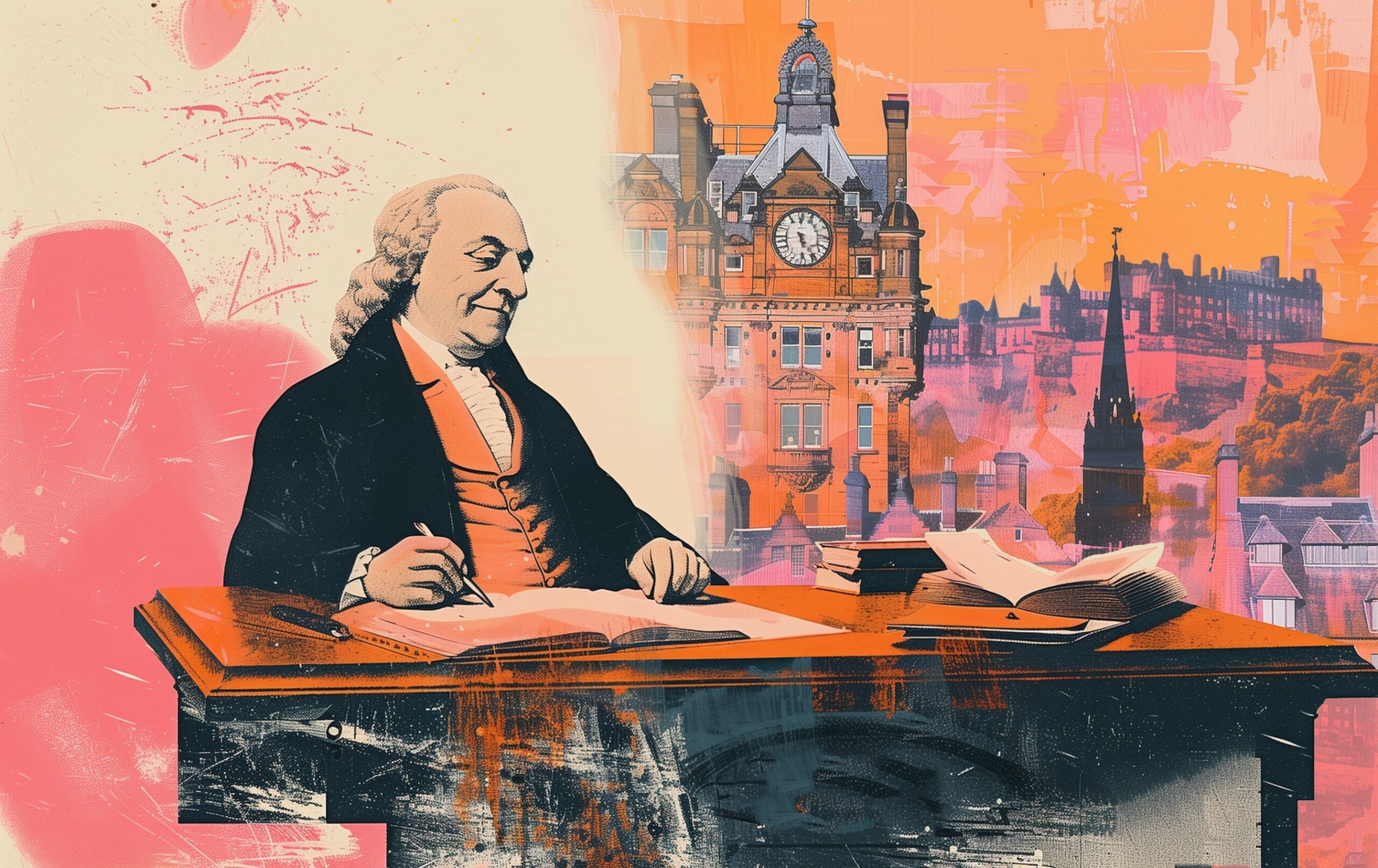
Of course, not all cities were or are peaceful. Consider Smith’s own city: Edinburgh. At times, the city was far from stable. But the relatively unkempt and inhospitable locale emerged from a century of instability to take the world by storm. Scotland in the 18th century had just undergone decades of political and economic turmoil. Disruption was caused by the House of Orange’s ousting of the House of Stuart, the Jacobite Rebellions, the failed and costly colonial Darien Scheme, famine, and the 1707 Union of Scotland and England. It was only after things settled down and the city came to enjoy a period of relative peace and stability that Edinburgh rose to reach its potential. Edinburgh was an improbable center of progress. But Edinburgh proves what people can accomplish, given the right conditions.
During the Scottish Enlightenment centered in Edinburgh, Adam Smith was far from the only innovative thinker in the city. Edinburgh’s ability to cultivate innovators in every arena of human achievement, from the arts to the sciences, seemed almost magical.
Edinburgh gave the world so many groundbreaking artists that the French writer Voltaire opined in 1762 that “today it is from Scotland that we get rules of taste in all the arts, from epic poetry to gardening.” Edinburgh gave humanity artistic pioneers from the novelist Sir Walter Scott, often called the father of the historical novel, to the architect Robert Adam who, together with his brother James, developed the “Adam style,” which evolved into the so‐called “Federal style” in the United States after Independence.
And then there were the scientists. Thomas Jefferson, in 1789, wrote, “So far as science is concerned, no place in the world can pretend to competition with Edinburgh.” The Edinburger geologist James Hutton developed many of the fundamental principles of his discipline. The chemist and physicist Joseph Black, who studied at the University of Edinburgh, discovered carbon dioxide, magnesium, and the important thermodynamic concepts of latent heat and specific heat. The anatomist Alexander Monro Secondus became the first person to detail the human lymphatic system. Sir James Young Simpson, admitted to the University of Edinburgh at the young age of fourteen, went on to develop chloroform anesthesia.
Two of the greatest gifts that Edinburgh gave humanity were empiricism and economics. The influential philosopher David Hume was among the early advocates of empiricism and is sometimes called the father of philosophical skepticism. And by creating the field of economics, Smith helped humanity to think about policies that enhance prosperity. Those policies, including free trade and economic freedom that Smith advocated, have since helped to raise living standards to heights that would be unimaginable to Smith and his contemporaries.
That brings us to the last but by no means least secret ingredient of progress. Freedom. Centers of progress during their creative peak tend to be relatively free and open for their era. That makes sense because simply having a large population is not going to lead to progress if that population lacks the freedom to experiment, to debate new propositions, and to work together for their mutual benefit. Perhaps the biggest reason why cities produce so much progress is that city dwellers have often enjoyed more freedom than their rural counterparts. Medieval serfs fleeing feudal lands to gain freedom in cities inspired the German saying “stadtluft macht frei” (city air makes you free).
That adage referred to laws granting serfs liberty after a year and a day of urban residency. But the phrase arguably has a wider application. Cities have often served as havens of freedom for innovators and anyone stifled by the stricter norms and more limited choices common in smaller communities. Edinburgh was notable for its atmosphere of intellectual freedom, allowing thinkers to debate a wide diversity of controversial ideas in its many reading societies and pubs.
Of course, cities are not always free. Authoritarian states sometimes see laxer enforcement of their draconian laws in remote areas, and Smith himself viewed rural life as in some ways less encumbered by constraining rules and regulations than city life. But as philosophy professor Kyle Swan previously noted for Adam Smith Works:
Without denying the charms and attractions Smith highlights in country living, let’s not forget what’s on offer in our cities: a significantly broader range of choices! Diverse restaurants and untold many other services and recreations, groups of people who like the same peculiar things that you like, and those with similar backgrounds and interests and activities to pursue with them — cities are (positive) freedom enhancing.
The same secret ingredients of progress—people, peace, and freedom—that helped Edinburgh to flourish during Smith’s day can be observed again and again throughout history in the places that became key centers of innovation. Consider Paris.
As the capital of France, Paris attracted a large population and became an important economic and cultural hub. But it was an unusual spirit of freedom that allowed the city to make its greatest contributions to human progress. Much like the reading societies and pubs of Smith’s Edinburgh, the salons and coffeehouses of 18th‐century Paris provided a place for intellectual discourse where the philosophes birthed the so‐called Age of Enlightenment.
The Enlightenment was a movement that promoted the values of reason, evidence‐based knowledge, free inquiry, individual liberty, humanism, limited government, and the separation of church and state. In Parisian salons, nobles and other wealthy financiers intermingled with artists, writers, and philosophers seeking financial patronage and opportunities to discuss and disseminate their work. The gatherings gave controversial philosophers, who would have been denied the intellectual freedom to explore their ideas elsewhere, the liberty to develop their thoughts.
Influential Parisian and Paris‐ based thinkers of the period included the Baron de Montesquieu, who advocated the then‐groundbreaking idea of the separation of government powers and the writer Denis Diderot, the creator of the first general‐purpose encyclopedia, as well the Genevan expat Jean‐Jacques Rousseau. While sometimes considered a counter‐Enlightenment figure because of his skepticism of modern commercial society and romanticized view of primitive existence, Rousseau also helped to spread skepticism toward monarchy and the idea that kings had a “divine right” to rule over others.
The salons were famous for sophisticated conversations and intense debates; however, it was letter‐writing that gave the philosophes’ ideas a wide reach. A community of intellectuals that spanned much of the Western world—known as the Republic of Letters—increasingly engaged in the exchanges of ideas that began in Parisian salons. Thus, the Enlightenment movement based in Paris helped spur similar radical experiments in thought elsewhere, including the Scottish Enlightenment in Edinburgh. Smith’s many exchanges of ideas with the people of Paris, including during his 1766 visit to the city when he dined with Diderot and other luminaries, proved pivotal to his own intellectual development.
And then there was Voltaire, sometimes called the single most influential figure of the Enlightenment. Although Parisian by birth, Voltaire spent relatively little time in Paris because of frequent exiles occasioned by the ire of French authorities. Voltaire’s time hiding out in London, for example, enabled him to translate the works of the political philosopher and “father of liberalism” John Locke, as well as the English mathematician and physicist Isaac Newton. While Voltaire’s critiques of existing institutions and norms pushed the boundaries of acceptable discourse beyond even what would be tolerated in Paris, his Parisian upbringing and education likely helped to cultivate the devotion to freethinking that would come to define his life.
By allowing for an unusual degree of intellectual liberty and providing a home base for the Enlightenment and the far‐ranging Republic of Letters, Paris helped spread new ideas that would ultimately give rise to new forms of government—including modern liberal democracy.
Surveying the cities, such as Edinburgh and Paris, that built the modern world reveals that when people live in peace and freedom, their potential to bring about positive change increases. Examining the places where major advances happened is one way to learn about the conditions that foster societal flourishing, human achievement, and prosperity. I hope that you will consider joining me on a journey through the book’s pages to some of history’s greatest centers of progress, and that doing so sparks many intelligent discussions, debates, and inquiries in the Smithian tradition about the causes of progress and wealth.
Over the past two centuries, humanity has become massively more prosperous, better educated, healthier, and more peaceful.
The underlying cause of this progress is innovation. Human innovation―whether it be new ideas, inventions, or systems―is the primary way people create wealth and escape poverty.
Our upcoming book, Heroes of Progress: 65 People Who Changed the World, explores the lives of the most important innovators who have ever lived, from agronomists who saved billions from starvation and intellectuals who changed public policy for the better, to businesspeople whose innovations helped millions rise from poverty.
If it weren’t for the heroes profiled in this book, we’d all be far poorer, sicker, hungrier, and less free―if we were fortunate enough to be alive at all.
Considering their impact on humanity, perhaps it’s time to learn their story?
Heroes of Progress Book Forum
On March 21st, the author of Heroes of Progress, Alexander Hammond, will present the book live at the Cato Institute in Washington, D.C. He will be joined by Marian Tupy, the editor of Human Progress, and Clay Routledge, the Archbridge Institute’s Vice President of Research, who will speak on the individual’s role in advancing human progress and the need for a cultural progress movement.
Making an inspiring case for progress at this time of skepticism and historical ingratitude is no easy feat. Yet, by relentlessly outlining the extraordinary ability of individuals to shape our world for the better, Alexander Hammond does just that.
— Steven Pinker, author of Enlightenment Now: The Case for Reason, Science, Humanism, and Progress
Innovation is a team sport achieved by people working together, using precious freedoms to change the world, so it’s sometimes invidious to single out one person for credit. But once an idea is ripe for plucking, the right person at the right time can seize it and save a million lives or open a million possibilities. Each of these 65 people did that, and their stories are both thrilling and beautiful.
— Matt Ridley, author of How Innovation Works: And Why It Flourishes in Freedom
The figures in this book are the overlooked and often unknown figures who have transformed the lives of ordinary people, for the better… This book is a correction to widespread pessimism and is both informative and inspirational.
— Dr. Stephen Davies, author of The Wealth Explosion: The Nature and Origins of Modernity
Superman and the Avengers are all very well, of course, but the real superheroes are thinkers, scientists, and innovators of flesh and blood who saved us from a life that used to be poor, nasty, brutish, and short. Alexander Hammond tells their inspiring stories in this magnificent book that will leave you grateful to be living in the world these men and women created.
— Johan Norberg, author of Open: The Story of Human Progress
The 65 innovators honored here made us happier, healthier, and longer-lived. Indeed, it is thanks to some of them that we are here at all. Their story is the story of how the human race acquired powers once attributed to gods and sorcerers―the story of how we overcame hunger, disease, ignorance, and squalor. I defy anyone to read this book and not feel better afterwards.
— Lord Daniel Hannan, president of the Institute for Free Trade
The 65 fascinating stories in Heroes of Progress are testaments to the ingenuity of humankind in delivering a richer, healthier, and hopefully freer world. Alexander C. R. Hammond provides an inspirational reminder that when individuals are free to speak, think, innovate, and engage in open markets, the heroic potential of humanity knows no bounds.
— Lord Syed Kamall, Professor of politics and international relations, St. Mary’s University
In Heroes of Progress, Alexander Hammond reminds us that human minds are the fundamental driver of every discovery, invention, and innovation that has improved our lives. By telling the stories of pioneering men and women who have advanced civilization, this book not only honors past heroes of progress, but also provides inspiration for the next generation to use their uniquely human imaginative and enterprising capacities to build a better future.
— Clay Routledge, Vice President of Research and Director of the Human Flourishing Lab at the Archbridge Institute
“In 1990, only five percent of Americans had a passport. Today, that number is 48%. More Americans can travel abroad now than at any time in our history.”