Summary: Marcus Aurelius faced temptations that feel surprisingly modern: comfort, excess, distraction, and uncertainty about how to use freedom well. His reflections offer one way to think about the psychological challenges of abundance, including the difficulty of balancing pleasure, purpose, and responsibility. As prosperity makes scarcity less central to everyday life, people must find new sources of meaning in work, relationships, service, and self-directed goals.
“In the morning when thou risest unwillingly,” Marcus Aurelius instructed himself, remember that “I am rising to the work of a human being.”
The most powerful man in the world did not want to get out of bed.
Book Five of Meditations begins with the Roman emperor and Stoic philosopher arguing with himself under the covers. Staying warm is more pleasant, he admits. Rest is necessary too. But nature has placed limits on rest, just as it has on eating and drinking. The problem, Marcus observes, is that he exceeds those limits when pleasure is involved and “stoppest short” when there is work to do.
Strip away the second-century diction, and this could be a transcript of someone bargaining with an alarm clock before a morning workout. Marcus tells himself to get up, stop overeating, do his job, and quit pretending that comfort is the purpose of life. Two thousand years later, we buy books and download podcasts that tell us the same things.
That helps explain Stoicism’s extraordinary revival. Annual sales of Meditations reportedly rose from around 12,000 copies in 2012 to 100,000 in 2019. Modern Stoic writer Ryan Holiday has sold millions of books to an audience spanning professional athletes, politicians, technology executives, and ordinary people trying to exercise before work. An ancient philosophy of self-command has found a mass market because the problems of self-command have found a mass market.
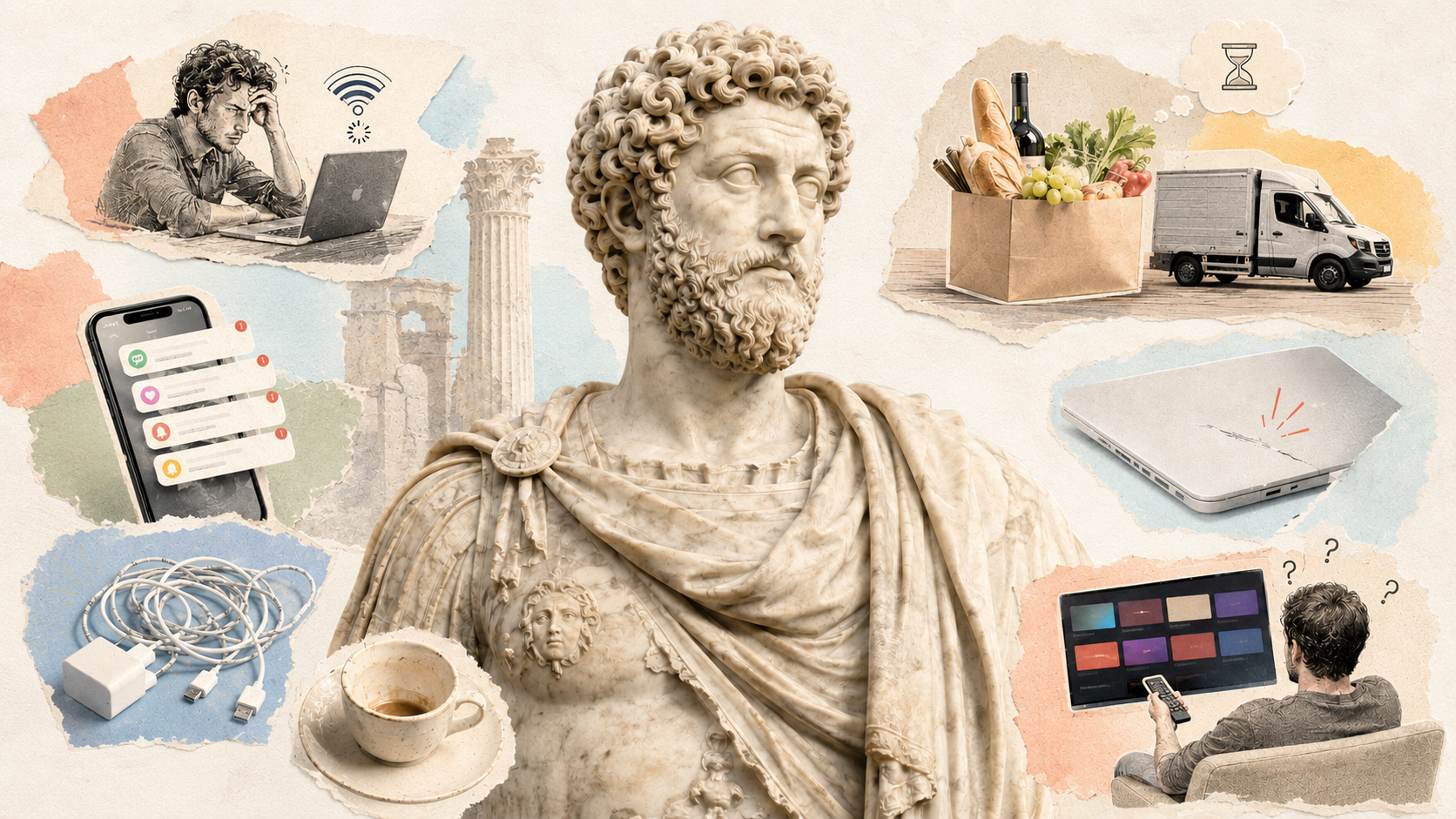
Marcus did not live an easy life. He ruled during frontier wars and the Antonine Plague. Several of his children died young. Much of Meditations was written to and for himself, apparently while on military campaign. But he also experienced a class of surprisingly recognizable “first-world problems” back when they were much rarer: too much food, too little movement, diffuse anxiety, irritation with other people, uncertain purpose, and the temptation to let comfort consume a life.
First-world problems were once emperor-world problems.
Marcus practiced a form of what psychologists today call cognitive reappraisal: changing an emotional response by changing how one thinks about something. When confronted with an elaborate meal, he reminded himself it is just a dead animal. Falernian wine, among the most prized luxuries in Rome, is “only a little grape juice.” Imperial purple, Rome’s finest clothing material, is just sheep’s wool stained with shellfish blood. The exercise, he explained in Book Six, was to strip away the prestige surrounding an object and see it clearly.
Marcus needed the Stoic operation because he inhabited an unusual ecology of evolutionary mismatch, much like that found in the developed world today.
For nearly all human history, calories were costly, physical exertion was unavoidable, and rest conserved energy that might be needed later. Today, the time prices of food are so low that many can afford a day’s worth of calories in under an hour of labor, all while working sitting down in an indoor climate-controlled environment. Many of us pay for gyms and manufacture strenuous movements that resemble pointless labor because ordinary survival no longer supplies enough activity.
The same principle extends beyond food and exercise. Humans evolved to monitor threats in a local environment. For most of history, only emperors and a small governing elite received a steady stream of dispatches from distant lands. Couriers and envoys brought Marcus news of wars, revolts, epidemics, and political intrigue from across the known world. Now a phone or TV news channel supplies every catastrophe on Earth in real time. And in economic life, we apply evolved intuitions built for small-group scarcity and zero-sum rivalry that fail to scale to modern global markets.
In 1930, John Maynard Keynes foresaw these problems of prosperity. Writing during the Great Depression, he predicted that technological improvement and compound growth could raise living standards to such a degree that we would be free from material scarcity. Once the absolute needs were met, humanity would confront what he called its “real, permanent problem”: how to use freedom from pressing economic cares “to live wisely and agreeably and well.”
Brink Lindsey borrows Keynes’s phrase for his recent book, The Permanent Problem. Lindsey argues that wealthy liberal democracies now occupy an awkward territory between mass plenty and mass flourishing. Food, shelter, safety, education, and medicine are more available than ever, but people still need status, purpose, belonging, and the sense that their efforts matter.
Imperial wealth solved the economic problem for one man nearly eighteen centuries before markets and technology began solving it for whole populations. Once freed from many ordinary constraints, Marcus encountered the permanent problem early. What should he do with comfort? How much pleasure was enough? Why work when others could work for him? How could he remain useful when status had removed the need to prove himself useful?
Critics sometimes find it amusing that a philosophy of indifference to wealth attracts wealthy executives. But Stoicism’s new popularity is less paradoxical than it seems. Stoicism developed among people living close to power and abundance because power and abundance exposed problems that scarcity had concealed. The philosophy of an emperor becomes more relevant when ordinary people begin living, in important respects, like emperors.
Poverty has not disappeared. But the characteristic problems of affluent societies increasingly concern regulating access rather than enduring absence: eating less of the food surrounding us, moving more despite labor-saving technology, limiting entertainment, directing attention, choosing among options, and finding commitments strong enough to organize freedom.
Stoicism offers a useful set of psychological tools for the task of finding meaning and navigating abundance. Its distinction between what is and is not under our control redirects threat monitoring toward action. Its practice of stripping luxuries down to their physical components weakens the stories that amplify craving. Voluntary discomfort teaches the nervous system that cold, hunger, exertion, and inconvenience are tolerable. Gratitude resets the comparison point against which abundance otherwise becomes invisible. Remembering death makes us appreciate life’s finitude.
But Stoicism was never only a collection of tricks for feeling calmer or becoming more productive. Marcus did not drag himself from bed merely to clear his imperial inbox. He was rising to fulfill a human purpose, which for a Stoic meant acting rationally, socially, and for the common good. Meaning came from duty voluntarily embraced and service to something beyond appetite.
That fits the evolutionary account. Humans are not built only to consume calories and conserve energy. We also evolved to cooperate, master difficult skills, earn esteem, care for kin, reciprocate favors, contribute to groups, and navigate moral concerns that sometimes pull in different directions. The pragmatic response is to choose ecologies that activate the better angels of our nature: difficult work with visible progress, physical exertion, face-to-face relationships, responsibility for others, and problems whose solutions improve a community. Realistic progress works with evolved psychology instead of pretending human beings are blank slates.
Historically, only a tiny elite had enough food to struggle with gluttony, enough leisure to struggle with lethargy, and enough freedom to struggle with what freedom was for. Marcus repeatedly reminded himself that pleasure, technology, wealth, or leisure were not vices themselves. The problem was surrendering judgment to them. He could enjoy the palace without becoming its slave. Likewise, we can enjoy the supermarket, smartphone, washing machine, and weekend, while recognizing the new, preferable challenges that abundance creates.
Emperor-world problems are still problems, but it is a triumph that they are increasingly part of ordinary life.