“Digital Twin” of Earth Could Make Super Fast Weather Predictions
“Scientists have created a ‘digital twin’ of our planet that can be used to predict weather far faster than traditional services.
The technology could help prevent some of the catastrophic impacts of disasters such as typhoons and flooding. The intensive data-crunching system could also give us a more detailed view of the future effects of climate change and reveal clues about how to mitigate it.”
Misunderstandings of the relationship between wealth and flourishing have obscured the anti-human implications of slowing growth rates.
Saul Zimet —
Summary: Economic growth has been a driving force behind the dramatic improvements in human wellbeing over the past few centuries. This growth has resulted from the Enlightenment, the Industrial Revolution and capitalism. Criticisms of growth stem in large part from misunderstandings of the relationship between economics and human values.
Why is the world as prosperous a place as it is? And why isn’t it much more prosperous? These questions are broad enough to admit countless answers, but as good an answer as any is the economic growth rate.
You might have heard that economic growth is overrated, that it’s a fine idea, but unsustainable, or even that it’s entirely counterproductive because it puts profits above people and the economy above the planet. These narratives have been widespread in recent years. They’re also based on a fundamental misconception of the nature of wealth and what a growing economy means for humanity.
Properly conceived, wealth is the actualization of human values in the real world. Economic growth is the upward trajectory of human achievement. The forms of prosperity that most of humanity strives for, such as health, knowledge, pleasure, safety, professional and personal freedom, and so many others, were vastly scarcer throughout most of human history—and would be orders of magnitude more abundant today if economic policies had been slightly different. That is the power of economic growth, and it is within our power to influence the world of future generations for better or worse.
The History of Economic Growth
Virtually everywhere and always throughout human history, economic growth was nonexistent. While pockets of momentary economic progress took place in certain instances, the overall trend was one of perpetual stagnation. But just a few hundred years ago, with the advent of the Enlightenment, the Industrial Revolution, and capitalism, that all began to change.
When the conceptual tools of science became widely applied to create the technological advancements of the Industrial Revolution, they brought an unprecedented optimism about the capacity for investment in new discoveries and inventions to reliably uncover useful knowledge of the natural world. This change inspired the broad transformation of mere wealth (resources hidden away in vaults and treasure chests) into capital (resources invested in new inventions and discoveries).
By the time Friedrich Engels and Karl Marx wrote their Communist Manifesto in 1848, the optimism of investment had already transformed Western Europe. As Engels and Marx saw it, “The bourgeoisie [capitalist class], during its rule of scarce one hundred years, has created more massive and more colossal productive forces than have all preceding generations together. Subjection of Nature’s forces to man, machinery, application of chemistry to industry and agriculture, steam-navigation, railways, electric telegraphs, clearing of whole continents for cultivation, canalisation of rivers, whole populations conjured out of the ground — what earlier century had even a presentiment that such productive forces slumbered in the lap of social labour?”
Marx and Engels misunderstand the complex reasons for increased productivity (attributing it to untapped “social labour”) but the quotation is significant because, despite their sympathy for state centralization of the economy, they could not ignore the success of capitalism.
While no year before 1700 saw a gross world product of more than $643 billion (in international inflation-adjusted 2011 dollars), by 1820 global GDP reached 1 trillion. By 1940 the number had passed 7 trillion, and by 2015 it had passed 108 trillion.
Contrary to the popular misconception that capitalism has made the rich richer and the poor poorer, this new wealth contributed to growing the economies of every world region while outpacing population growth. While the world’s extreme poor have become wealthier so too have all other economic classes.
What’s So Great about Growth?
A growing economy isn’t about stacks of paper money getting taller, or digits being added to the spreadsheets of bank ledgers. These things may be indicators of growth, but the growth itself is composed of goods and services becoming more abundant. Farms and factories producing more and better consumption goods; engineers creating better machines and materials; clean water reaching more communities; sick people receiving better healthcare; scientists running more experiments, poets writing more poems, education becoming more broadly accessible; and for whatever other forms of value people choose to exchange their savings and labor.
Gross domestic product or GDP (called gross world product or world GDP when applied at the global level) is an imperfect but useful and widely employed measure of economic growth, and its reflection in the real world takes such forms as rising life expectancy, nutrition, literacy, safety from natural disaster, and virtually every other measure of human flourishing. This is because, at the most fundamental level, “economic growth” means the transformation and rearrangement of the physical environment into more useful forms that people value more.
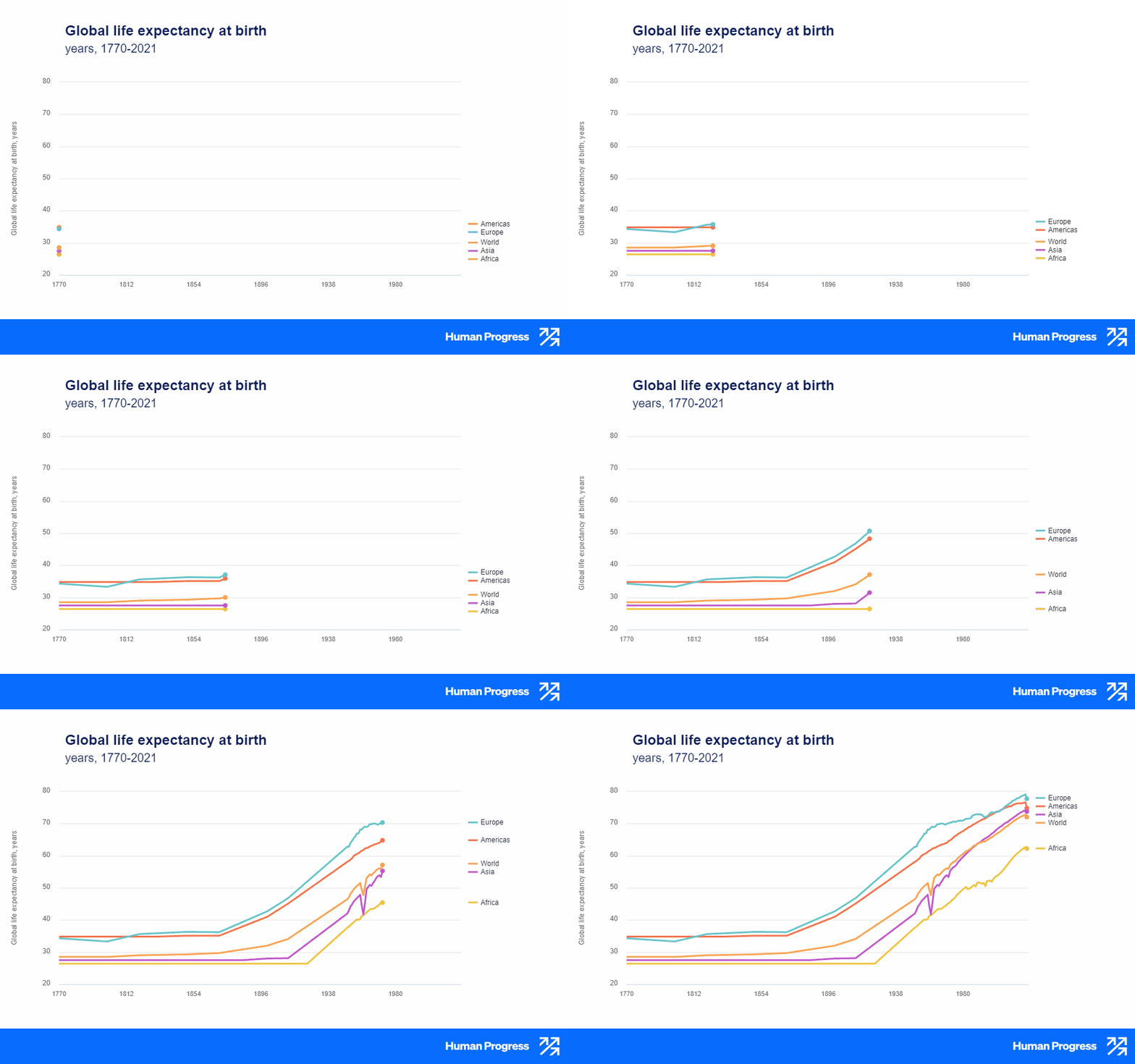
Before the year 1820, human life expectancy had always been approximately 30-35 years. But with the great decline in poverty and rise of capital investment in technology and medicine, global life expectancy has roughly doubled in every geographic region in the last century. Similar trends have occurred in global nourishment, infant survival, literacy, access to clean water, and countless other crucial indicators of wellbeing. While these trends are bound to take the occasional momentary downturn because of life’s uncertainties and hardships, the unidirectional accumulation of technological and scientific knowledge since the Age of Enlightenment gives the forward march of progress an asymmetric advantage. For example, the COVID-19 pandemic and lockdowns resulted in a brief and tragic decline in life expectancy, but the number has since risen to an all-time high of 73.36 years as of 2023.
What is the direct causal connection between economic growth and these improvements to human wellbeing? Consider the example of deaths by natural disaster, which have fallen in the last century from about 26.5 per 100,000 people to 0.51 per 100,000 people. More wealth means buildings can be constructed from stronger materials and better climate controls. And when those protections aren’t enough, a wealthier community can afford better infrastructure such as roads and vehicles to efficiently get sick or injured people to the hospital. When those injured end up in the hospital, a wealthier society’s medical facilities will be equipped with more advanced equipment, cleaner sanitation, and better-trained doctors that will provide higher quality medical attention. These are just a few examples of how wealth allows humans to transform their world into a more hospitable place to live and face the inevitable challenges of life.
The benefits of economic growth go far beyond the maximization of health and safety for their own sake. If what you value in life is the contemplation of great art, the exaltation of your favorite deity, or time spent with your loved ones, wealth is what awards you the freedom to sustainably pursue those values rather than tilling the fields for 16 hours per day and dying in your 30s. Wealth is what provides you access to an ever-improving share of the world’s culture by increasing the abundance and accessibility of printed, recorded, and digital materials. Wealth is what provides you with the leisure time and transportation technology to travel the world and experience distant wonders, remote holy sites, and people whose personal or professional significance to you would otherwise dwell beyond your reach.
As the Harvard University cognitive scientist Steven Pinker demonstrates in his popular book Enlightenment Now, “Though it’s easy to sneer at national income as a shallow and materialistic measure, it correlates with every indicator of human flourishing, as we will repeatedly see in the chapters to come.”
The Long-Term Future of Growth
Human psychology is ill-equipped to comprehend large numbers, especially as they relate to the profound numerical implications of exponentiation. If it sounds insignificant when politicians and journalists refer to a 1 percent or 2 percent increase or decrease in the annual growth rate, then like most people, you’re being deceived by a quirk of human intuition. While small changes to the economic growth rate may not have noticeable effects in the short term, their long- term implications are absolutely astonishing.
Economist Tyler Cowen has pointed out in a Foreign Affairs article, “In the medium to long term, even small changes in growth rates have significant consequences for living standards. An economy that grows at one percent doubles its average income approximately every 70 years, whereas an economy that grows at three percent doubles its average income about every 23 years—which, over time, makes a big difference in people’s lives.” In his book Stubborn Attachments, Cowen offers a thought experiment to illustrate the real-world implications of such “small changes” to the growth rate: “Redo U.S. history, but assume the country’s economy had grown one percentage point less each year between 1870 and 1990. In that scenario, the United States of 1990 would be no richer than the Mexico of 1990.”
Cowen gave the negative scenario in which the growth rate was 1 percent slower. US Citizens would have drastically shorter lifespans, less education, less healthcare, less safety from violence, more susceptibility to disease and natural disaster, fewer career choices, and so on. Now imagine the opposite scenario, in which US economic policy had just 1 additional percentage point of growth each year. The average American today would in all probability be living much longer, having much nicer housing, choosing from far more career opportunities, and enjoying more advanced technology.
Just imagine your income doubling, and what you could do for yourself, your family, or the charity of your choice with all that extra wealth. Something along those lines could have happened to most Americans. But instead, growth has been significantly slowed in the United States because taxes and regulations have constantly disincentivized and disallowed new innovations.
At the margins, many dying of preventable diseases could have been cured, many who spiraled into homelessness could have accessed the employment opportunities or mental health treatment they needed, and so on. While economic fortune seems like a luxury to those who already enjoy material comfort, there are always many at the margin for whom the health of the economy is the difference between life and death.
These are among the reasons that Harvard University economist Gregory Mankiw concludes in his commonly used college textbook, Macroeconomics, that, “Long-run economic growth is the single most important determinant of the economic well-being of a nation’s citizens. Everything else that macroeconomists study — unemployment, inflation, trade deficits, and so on — pales in comparison.”
When we think of the future our children or grandchildren will live in, depending on our choices between even slightly more or less restrictive economic policies today, we could be plausibly looking at a future of widespread and affordable space travel, life-changing education and remote work opportunities in the metaverse, new sustainable energy innovations, a biotechnological revolution in the human capacity for medical and psychological flourishing, genome projects and conservation investments to revive extinct and protect endangered species, and countless other improvements to the human condition. Or we could be looking at a drawn-out stagnation in poverty alleviation, technological advancement, and environmental progress. The difference may well hinge on what looks today like a tiny change in the rate of compounding growth.
At the broadest level, more wealth in the hands of the human species represents a greater capacity of humans to chart their course through life and into the future in accordance with their values. Like all profound and far-reaching forms of change, economic growth has a wide range of consequences, some intended and others unintended, many desirable and many others undesirable. But it is not a random process. It is directed by the choices of individuals, and allocated by their drive to devote more resources and more investment into those things they view as worthwhile. Ever since the Scientific Revolution, the Enlightenment, and the Industrial Revolution, the investment in human values has been on balance a positive sum game, in which one group’s gains do not have to come in the form of another group’s losses. This is demonstrated by the upward trends in human flourishing since the global rise in exponential economic growth. Indeed, it is intrinsic to the fundamental difference between a growing and a shrinking or stagnant economy: In a growing economy, everyone can win.
This article was published at Libertarianism.org on 11/17/2023.
A headline of progress that you might have missed.
Tony Morley —
Summary: Amidst the recent devastation caused by a significant earthquake in Taiwan on April 3, the nation’s response showcased its progress in earthquake readiness, often overlooked in the headlines. Since the 1999 Jiji earthquake, Taiwan has made substantial strides in fortifying its infrastructure, improving construction standards, and advancing early-warning systems. This can serve as a model for global disaster preparedness.
In the early hours of April 3, 2024, Taiwan was struck by a significant earthquake, with its epicenter located off the eastern coast. The quake, which was the strongest to hit Taiwan in 25 years and measured 7.4 on the Richter scale, sent tremors rippling across the island and awakened memories of past devastation. At the time this was published, the earthquake and subsequent tremors have claimed just under 20 lives and injured at least 1,099 people.
However, amid the destruction, injury, and loss of life, Taiwan’s response showcased a remarkable display of resilience and preparedness, underscoring the nation’s progress in earthquake readiness. It’s a story largely missing from the headlines.
For Taiwan, situated in the seismically active Ring of Fire in the Pacific Ocean, earthquakes are not unfamiliar. The island has endured numerous seismic events throughout its history, each leaving an indelible mark on Taiwan’s cities and people. The devastating 1999 Jiji earthquake, similar in magnitude to the April 3 quake, claimed more than 2,400 lives, injured more than 11,000 people, resulted in roughly $300 billion in damages, and caused widespread destruction; it served as a wake-up call for Taiwan to bolster its preparedness and earthquake response mechanisms.
In the decades since, Taiwan has made large strides in fortifying its infrastructure, implementing rigorous building codes, and fostering a culture of earthquake preparedness. These efforts were evident in the aftermath of the recent earthquake, where the impact, though significant, was mitigated in no small part by the progress Taiwan made toward earthquake readiness and response in the decades following the 1999 Jiji quake.
“Taipei 101 at night, in the style of 8-bit art—ar 16:9,” Midjourney, Generative Image AI, @tonymmorley
One of the cornerstones of Taiwan’s earthquake preparedness strategy is its robust infrastructure resilience. The country has invested heavily in constructing buildings, bridges, and critical infrastructure engineered to withstand seismic forces. Strict building codes, enforced through rigorous inspections and regulations, ensure that new structures adhere to stringent seismic standards. Additionally, retrofitting programs have been implemented to reinforce older buildings, reducing their vulnerability to earthquake damage. Such measures undoubtedly played a crucial role during the April 3 earthquake, preventing widespread collapse and minimizing casualties, injuries, and infrastructure damage.
Taiwan’s advanced early-warning system likely played a nontrivial role in mitigating the quake’s impact. The nation’s seismic network, comprising a dense array of sensors strategically positioned across the island, provides real-time data on seismic activity. This allows authorities to issue timely alerts, giving residents precious seconds to take cover and emergency services valuable time to prepare. The effectiveness of this system was demonstrated during the recent earthquake, with warnings disseminated swiftly, enabling individuals to seek shelter and prepare for the quake and, following aftershocks, minimizing the risk of injury. As an NBC News report says:
Taiwan’s sophisticated early-warning system is also an important part of its safety infrastructure. The system relies on an islandwide network of seismic instruments; when a large quake happens, the system sends messages to people’s phones and automatically cuts into live TV programming to give residents seconds of warning.
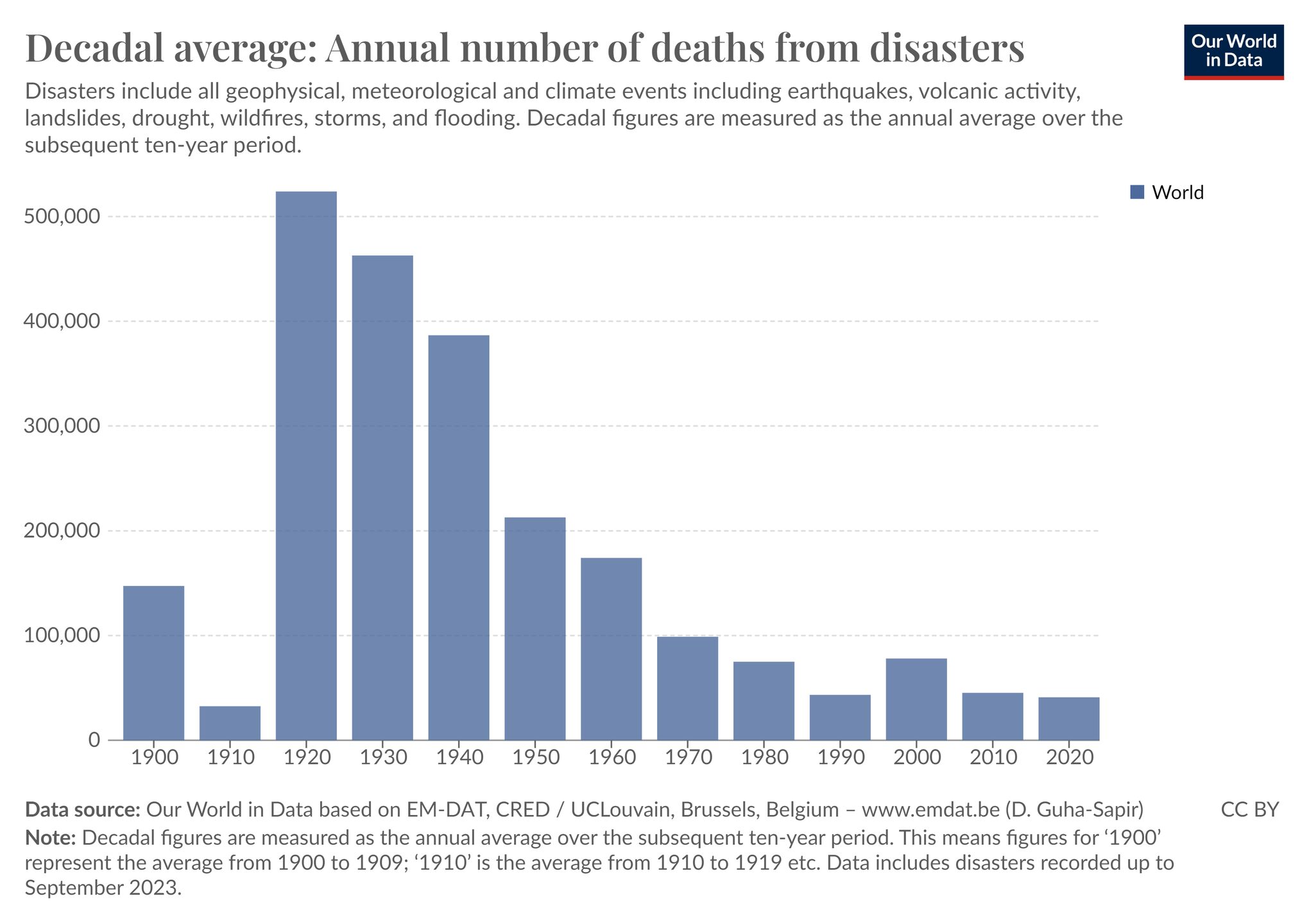
Taiwan’s success in preparing for and averting the worst-case scenario following such a large quake is part of a larger global trend of preparedness and resilience in the face of natural disasters. Annual deaths resulting from natural disasters of all types have been trending downward globally for over a century. Global economic growth has improved civilization’s capacity to build better structures, fortify critical infrastructure, and bolster emergency response, and the results are evident, both on the ground and in the data. In the last century, from 1920 to 2020, annual deaths from disasters fell from 523,892 to 41,046; still far too many individual human tragedies but also remarkable human progress.
Taiwan’s emphasis on public education and community preparedness has fostered a resilient society capable of responding effectively to seismic events. Through widespread awareness campaigns, educational programs, and drills, Taiwan has empowered its citizens with the knowledge and skills necessary to navigate emergencies confidently. Schools, workplaces, and households routinely conduct earthquake drills, ensuring that individuals are well versed in evacuation procedures.
Furthermore, Taiwan’s commitment to technological innovation has yielded groundbreaking solutions to enhance earthquake preparedness. The development of cutting-edge seismological research and monitoring technologies has enabled scientists to gain deeper insights into earthquake behavior, facilitating more accurate predictions and risk assessments. Additionally, advancements in engineering and construction techniques have led to the creation of innovative seismic-resistant materials and designs, further bolstering the resilience of infrastructure.
The recent earthquake in Taiwan serves as a sobering reminder of the ever-present threat posed by seismic activity. However, it also stands as a testament to Taiwan’s remarkable progress in earthquake and disaster preparedness. Through strategic investments, carefully considered regulation, and proactive measures, Taiwan has transformed itself into a global leader in earthquake resilience. The nation’s ability to withstand and recover from seismic events exemplifies the power of foresight, collaboration, and innovation in building a safer, more resilient future.
As Taiwan continues to navigate the complex challenges posed by natural disasters, the lessons gleaned from its experiences serve as invaluable guideposts for nations worldwide. By prioritizing preparedness, investing in resilient infrastructure, and building effective detection and communication systems, countries can mitigate the impact of earthquakes and safeguard the lives and livelihoods of their citizens. At the time of this writing, many families are still missing loved ones, and the economic costs and lives lost have yet to be fully understood. However, the progress in disaster preparedness made in the past two decades has undoubtedly saved many hundreds if not thousands of lives.
This article was published at the Progress Forum on 4/4/2024.
AI Is a Great Equalizer That Will Change the World
A positive revolution from AI is already unfolding in the global East and South.
Zion Lights —
Summary: Concerns over potential negative impacts of AI have dominated headlines, particularly regarding its threat to employment. However, a closer examination reveals AI’s immense potential to revolutionize equal and high quality access to necessities such as education and healthcare, particularly in regions with limited access to resources. From India’s agricultural advancements to Kenya’s educational support, AI initiatives are already transforming lives and addressing societal needs.
The latest technology panic is over artificial intelligence (AI). The media is focused on the negatives of AI, making many assumptions about how AI will doom us all. One concern is that AI tools will replace workers and cause mass unemployment. This is likely overblown—although some jobs will be lost to AI, if history is any guide, new jobs will be created. Furthermore, AI’s ability to replace skilled labor is also one of its greatest potential benefits.
Think of all the regions of the world where children lack access to education, where schoolteachers are scarce and opportunities for adult learning are scant.
Think of the preventable diseases that are untreated due to a lack of information, the dearth of health care providers, and how many lives could be improved and saved by overcoming these challenges.
In many ways, AI will be a revolutionary equalizer for poorer countries where education and health care have historically faced many challenges. In fact, a positive revolution from AI is already unfolding in the global East and South.
Improving Equality through Education and Health Care
In India, agricultural technology startup Saagu Baagu is already improving lives. This initiative allows farmers to increase crop yield through AI-based solutions. A chatbot provides farmers with the information they need to farm more effectively (e.g., through mapping the maturity stages of their crops and testing soil so that AI can make recommendations on which fertilizers to use depending on the type of soil). Saagu Baagu has been successful in the trial region and is now being expanded. This AI initiative is likely to revolutionize agriculture globally.
Combining large language models with speech-recognition software is helping Indian farmers in other ways. For example, Indian global impact initiative Karya is working on helping rural Indians, who speak many different languages, to overcome language barriers. Karya is collecting data on tuberculosis, which is a mostly curable and preventable disease that kills roughly 200,000 Indians every year. By collecting voice recordings of 10 different dialects of Kannada, an AI speech model is being trained to communicate with local people. Tuberculosis carries much stigma in India, so people are often reluctant to ask for help. AI will allow Indians to reduce the spread of the disease and give them access to reliable information.
In Kenya, where students are leading in AI use, the technology is aiding the spread of information by allowing pupils to ask a chatbot questions about their homework.
Throughout the world, there are many challenges pertaining to health care, including increasing costs and staff shortages. As developed economies now have rapidly growing elderly populations and shrinking workforces, the problem is set to worsen. In Japan, AI is helping with the aging population issue, where a shortage of care workers is remedied by using robots to patrol care homes to monitor patients and alert care workers when something is wrong. These bots use AI to detect abnormalities, assist in infection countermeasures by disinfecting commonly touched places, provide conversation, and carry people from wheelchairs to beds and bathing areas, which means less physical exertion and fewer injuries for staff members.
In Brazil, researchers used AI models capable of predicting HER2 subtype breast cancer in imaging scans of 311 women and the patients’ response to treatment. In addition, AI can also help make health resource allocations more efficient and support tasks such as preparing for public health crises, such as pandemics. At the individual level, the use of this technology in wearables, such as smartwatches, can encourage patient adherence to treatments, help prevent illnesses, and collect data more frequently.
Biometric data gathered from wearable devices could also be a game-changer. This technology can detect cancers early, monitor infectious diseases and general health issues, and give patients more agency over their health where access to health care is limited or expensive.
Education and health care in the West could also benefit from AI. In the United States, text synthesis machines could help to address the lack of teachers in K–12 education and the inaccessibility of health care for low-income people.
Predicting the Future
AI is already playing a role in helping humanity tackle natural disasters (e.g., by predicting how many earthquake aftershocks will strike and their strength). These models, which have been trained on large data sets of seismic events, have been found to estimate the number of aftershocks better than conventional (non-AI) models do.
Forecasting models can also help to predict other natural disasters like severe storms, floods, hurricanes, and wildfires. Machine learning uses algorithms to reduce the time required to make forecasts and increase model accuracy, which again is superior to the non-AI models that are used for this purpose. These improvements could have a massive impact on people in poor countries, who currently lack access to reliable forecasts and tend to be employed in agriculture, which is highly dependent on the weather.
A Case for Optimism
Much of the fear regarding AI in the West concerns the rapid speed at which it is being implemented, but for many countries, this speed is a boon.
Take the mobile phone. In 2000, only 4 percent of people in developing countries had access to mobile phones. By 2015, 94 percent of the population had such access, including in sub-Saharan Africa.
The benefits were enormous, as billions gained access to online banking, educational opportunities, and more reliable communication. One study found that almost 1 in 10 Kenyan families living in extreme poverty were able to lift their incomes above the poverty line by using the banking app M-Pesa. In rural Peru, household consumption rose by 11 percent with access to phones, while extreme poverty fell 5.4 percent. Some 24 percent of people in developing countries now use the mobile internet for educational purposes, compared with only 12 percent in the richest countries. In lower-income countries, access to mobile phones and apps is life-changing.
AI, which only requires access to a mobile phone to use, is likely to spread even faster in the countries that need the technology the most.
This is what we should be talking about: not a technology panic but a technology revolution for greater equality in well-being.
“While meteorological measurements improved over time, the massive step-change in predictions came with the use of computerized numerical modeling. This didn’t start until a century later, in the 1960s.
Forecasts have improved a lot since then. We can see this across a range of measurements, and different national meteorological organizations.
The Met Office says its four-day forecasts are now as accurate as its one-day forecasts were 30 years ago.”