
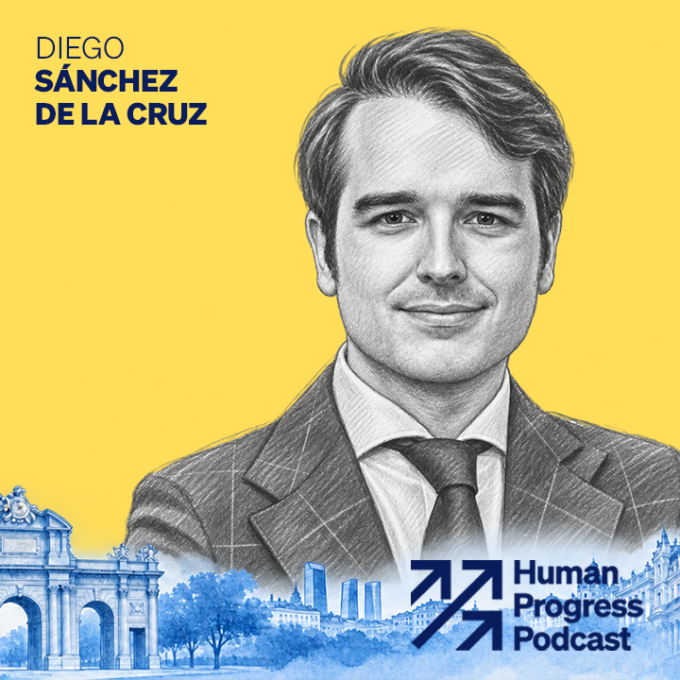
Marian Tupy: Hello and welcome to the latest episode of Human Progress Podcast. I’m Marian Tupy. I’m the editor and founder of HumanProgress.org. My guest today is Diego Sánchez de la Cruz, a Spanish economist, author, and one of Spain’s leading advocates of free market reform. Born in Santiago de Compostela in 1988, he’s the head of research at the Instituto Juan de Mariana, is the CEO of Foro Regulación Inteligente, and is an associate researcher at the Instituto de Estudios Económicos. Diego is a frequent commentator in the Spanish media and co-host of the English-language podcast Spain in the World, which launched as the Capitalismo podcast with Rashid Griffith. The program explores Spanish politics, economic history, and the political economy of Europe and Latin America. I have listened to about 10 hours of the podcast so far, and I highly recommend it to all of our viewers and listeners, especially those who are interested in Spanish politics, economics, but also broadly Latin America. Diego is the author of several books, including Sin medias tintas in 2014, Por qué soy liberal in 2017, and Un país sin casas, A Country Without Houses, which came out this year in 2026.
Marian Tupy: He’s also translated more than 25 books into Spanish, including works by Nobel laureate Robert Shiller, Ray Dalio, and of course our own Johan Norberg. Among his translations is Superabundance, the book that I co-authored with Gale Pooley in 2022, which was then republished in Spanish in 2023. Today, we’ll be talking about his latest book, The Madrid Model: How Freedom and Openness Created an Economic Powerhouse, which was published by the Cato Institute in September 2026. It examines how 25 years of tax cuts, deregulation, and openness to newcomers helped to turn Madrid into one of Europe’s most dynamic regional economies. So with that broad introduction, but heartfelt introduction, Diego, welcome.
Diego Sánchez de la Cruz: Thank you very much. I’m so happy to join you. I’m a regular listener, as you know. And yes, this is a great chance to talk about the book. I’m excited to discuss the Madrid model with your viewers and listeners. And this is quite—it’s probably Europe’s best-kept secret if you’re talking about successful free market reform. So it’s about time that we let people in the secret sauce that has turned Madrid into such an economic success.
Marian Tupy: Absolutely. And I think that for our readers and listeners, it’s important to emphasize why we would be looking at something like Madrid. You know, at Human Progress, we try to look at global success stories, how the world is improving, but we always have to be on the lookout for successful—even regions. So this is not a successful country we’ll be talking about, even though Spain is in some ways a very successful country. In some ways it’s not, but we’ll be talking about a particular region, which is, of course, the region of Madrid, the capital of Spain. But before we get there, so let’s start with the division of powers in Spain. What is the Community of Madrid, and how autonomous is it in its decision-making?
Diego Sánchez de la Cruz: That is a very good question. And whenever we speak about the political dynamics of the Kingdom of Spain, we normally find that many people overseas are unaware that we are actually one of the countries within the OECD with the highest degree of decentralization. And when I say decentralization, I mean both at the fiscal level, which means that the regional governments have extensive power to tax and spend, and also on the political power end of things, there is also a significant level of authority that is delegated to regional governments. So think of us as a quasi-federal, semi-federal, de facto federal type of country. Now, regions run healthcare policy, educational policies, social services, housing and planning. The bulk of everyday government is delegated to regional governments. In fact, there is a debate internally in Spain—I am not of that opinion—but some people do feel that we have way too much decentralization. So that kind of shows you that indeed we’re talking of a very decentralized political system. Also, the size here matters, because if this was a successful region but it was very small—we have some of those, like La Rioja, where some of our best wines come from, and indeed La Rioja is well run, but it’s a very tiny territory—but Madrid’s GDP is essentially as large as Portugal’s.
Diego Sánchez de la Cruz: So we are talking of a significant economic area with significant levels of fiscal and political authority. So Madrid can set 50 percent of the income tax. It’s not a state-level income tax like you see in the U.S., where it may be some extra added points on top of the federal income tax. No, here it’s 50 percent of it. It has full power to legislate over inheritance taxes, gift taxes, wealth taxes, transfer taxes, and it can run schools, hospitals. Even the police is delegated in some areas. So Madrid is very good proof that decentralization can work positively, and in fact it has become a success story in the last 25 years, although decentralization has been, on paper, allowed for almost half a century now, since we approved our 1978 democratic constitution.
Marian Tupy: Right. So you had this decentralization on the books, but Madrid is perhaps the first, certainly the most extensive example of a region that took advantage of all of these privileges or all of these devolved responsibilities to do something with it. And I think that that in itself is a lesson for other places, countries that have nominal decentralization but never take charge of it. So in addition to a very large GDP, the size of Portugal’s, it’s also home, in my understanding, to about 15 percent of people who live in Spain. So it’s quite large. But perhaps we can start by you telling us about the evidence that you’re using in order to prove that Madrid has outperformed the rest of Spain and perhaps analogous regions in other parts of the EU. So what is the evidence that Madrid is doing well?
Diego Sánchez de la Cruz: So it’s interesting that if we had this conversation in the mid-1990s, Madrid would be ranked number five in the country for GDP per capita. It would rank number four in terms of job creation. It would rank number four for GDP growth. In other words, there wasn’t that much excitement going on in the Madrid economy and society. It wasn’t by any stretch of the imagination a powerhouse like we see today. So what’s happened in the last three decades, more than a quarter of a century of continued political leadership pointing in that direction and renewed social support for these policies, is that, for instance, real GDP growth has averaged 3 percent regularly every year for the last 30 years. And that is a very high number for European standards. One would argue there are very few large metropolitan areas today in Europe that can exhibit this type of growth. In fact, when you compare it to the rest of Spain, you find that the rest of Spain has essentially stagnated in terms of the GDP per capita during this same period. Spaniards are, on average, just as far from average European incomes today as they were 30 years ago.
Diego Sánchez de la Cruz: So while the entire country was stagnating, Spain saw how Madrid was suddenly growing and growing by more than 3 percent annually, and this is in real terms we’re talking. So since then, since the mid-1990s all the way until today, our region has created 2 million jobs. So essentially the unemployment rate has not only not increased but actually come down. And this is very impressive because we’re talking of a territory that, as we’ll talk about later perhaps in more detail, is home to a very significant chunk of the population that comes over from either other territories in Spain and moves to Madrid or other countries. Many people from Latin America, many people from OECD countries have relocated to Madrid. So as of now, 50 percent of the workforce was not born in Madrid. Their origins are either other Spanish territories or other European countries, and yet there has been absolutely no issue in terms of economic integration. In fact, there has been an abundance of job creation and startup and company formation, and this has resulted, like I say, in 2 million new jobs being created in a region that is now the home to almost 8 million people.
Diego Sánchez de la Cruz: Most notoriously, we have traditionally been compared to Catalonia, to Barcelona, which is the other territory and the other regional capital which have the most fame overseas. And in fact, Catalonia was an economic powerhouse for long, but it has unfortunately fallen behind while Madrid was accelerating its pace of growth. And this is a result of diverging policies, because in this podcast we will talk a lot about the pro-market, pro-freedom policies that have been enacted in Madrid, and Catalonia and Barcelona have almost moved in the opposite direction with, again, the results that you could have—would have expected from that approach. And today, Madrid… has more jobs than Catalonia, although Catalonia has 1 million more inhabitants. Madrid has a higher GDP than any other territory, also in per capita terms, and Madrid has overtaken essentially any other region that was doing well in this indicator. So yes, this was not the case in the mid-1990s, but it is absolutely the case now. The Madrid story is one that shines while the rest of the country, quite frankly, has stagnated for the better part of the last three decades.
Marian Tupy: Yeah, I do want to revisit the Catalonia comparison a little bit later, but I do want to just remind people that when they hear 3 percent GDP growth, you know, here in this country, we have some politicians who poo-poo GDP growth. You know, people shouldn’t exist for the economy; the economy should exist for the people, and GDP growth doesn’t matter. But GDP growth is incredibly important because it allows you to build better schools, better hospitals, better roads. It’s highly correlated with all sorts of good things in life. So let us—I guess the following obvious question is: what has caused this great success of the Madrid community? What were the policies that were implemented to make it happen?
Diego Sánchez de la Cruz: So back in the mid-1990s, there was a clear mandate by voters to stop Madrid from going down the path of socialism, where it had been stuck for the previous 14 years. So Madrid was probably never going to be a poor territory. It was, after all, the capital of the nation for centuries, right, since 1738, if I’m not mistaken right now. And so it was certainly not a poor territory, but it was certainly a stagnant region in our economy. So in the mid-1990s, this changes, but the real reforms kick in a few years later when Esperanza Aguirre is elected as the governor of Madrid. And she has a clear vision of what she wants Madrid to be. She wants Madrid to be a business-friendly, an investment-friendly, a human capital attraction magnet. In essence, it wants to promote an open economy and an open society, and she was committed to these ideas from having worked through the years with the likes of Pedro Schwartz, who was perhaps one of the most relevant classical liberal thinkers in Spain in the 1970s and ’80s and up until recently was the president of the Mont Pelerin Society, and having worked also as a minister under Prime Minister Aznar, who was perhaps the most liberalizing leader in the political history of modern Spain.
Diego Sánchez de la Cruz: When she takes the reins of the region of Madrid, she took the approach of, okay, all of this delegated authority has never been used by any territory to introduce a different set of economic and fiscal incentives. So she decided to cut taxes, and she did so massively. And she actually started with a wealth tax, so that’s quite the statement, right? You’re going—you’re not just targeting small or medium incomes; you’re also targeting that sort of taxes that replicate class warfare rhetoric but, as we know, raise little revenue and create many distortions. So she targeted the wealth tax, got rid of several income tax brackets, consolidated and lowered them. She enacted freedom for businesses to open whenever they want in terms of business hours, opening days. So no type of the old European restrictions that are still the norm in the continent in many countries. And that began to get things moving forward, and that was the first big wave of liberalization and happened between 2003 and 2012. Included there is a significant change in the way that our basic services are run. So she introduced private management in several hospitals, freedom of choice for specialized doctor consultations in the healthcare system, and freedom of choice was also promoted extensively in the educational system, in the way that we have a system that is similar to a charter school type of model.
Diego Sánchez de la Cruz: And that is the first big wave of liberalization, and that got the Madrid model going and working. Now, she left active politics because she was diagnosed with cancer. She’s still with us. She survived and pulled through, but she left in 2011. And since then, that model stuck for eight years, and a new governor, the current governor, just enacted a series of second-wave reforms that were more focused on—speaking of Governor Isabel Díaz Ayuso, who’s a very well-known political figure not just in Spain but also outside. And she made sure to, A, keep Madrid open throughout the pandemic, which, as you know, was not the norm for many territories around the world, and then enact sweeping deregulation in several areas. So those two big waves of liberalization really pushed the Madrid model forward and have kept it going very strong for more than two decades now.
Marian Tupy: So we have two women liberalizers.
Diego Sánchez de la Cruz: Exactly.
Marian Tupy: That’s wonderful because Mrs. Thatcher was just the only one in Britain. So now you have two in succession. I should perhaps—
Diego Sánchez de la Cruz: In fact, Marian, Aguirre was often compared to Thatcher, and rightfully so. Her rhetoric and her Anglophile training in liberal ideas, classical liberal ideas, were there. Whereas our current governor is more on the Reaganite type of school. Her rhetoric, the rationale behind her motives as a governor, really resonates with many of the principles from Reagan. So many of the echoes of the, you know, greatest hits that the classical liberals played in the 1980s are still alive and well today in Madrid through the legacy of these two women.
Marian Tupy: Yeah, and I should perhaps mention for our American listeners and viewers that when we use liberal or liberalization, we use it in the European sense. In Spain and in Latin America, liberal means somebody who is devoted to individual freedom and small government, free trade, that sort of thing, whereas obviously liberal in the United States has a very different connotation. Okay, so you have these two women pushing through reforms, liberalizing reforms, increasing freedom. But what you’re saying is that productivity has increased beyond just simply growing the economy. You are not saying that the economy of Madrid is bigger simply because you have a lot of new immigrants, especially from Latin America, or new businesses moving from other regions of Spain. You are saying that actual productivity per hour of labor has increased at a faster rate in Madrid than elsewhere, thereby increasing wages of the workers there, correct?
Diego Sánchez de la Cruz: Yes, one element that has helped significantly is the growing attraction of foreign investment. Right now, Madrid is home, like you said, to roughly 15 percent of the national population, but it is acquiring 70 percent of the foreign investment that pours into Spain. So that is a significant number, way ahead of what the size of its population would suggest. Besides that, although overall business investment in Spain is actually down from where it was before the pandemic right now, Madrid is a happy exception to that norm and has, in fact, kept on increasing the capital formation by businesses. And this has had a cascading effect on job creation and salaries. Also, when your unemployment rate is lower, that also facilitates higher wages. That is a problem in a country like Spain, where historically average unemployment for the last 40 years has been above 18 percent. Think about that. Everyone would riot in the U.S. if the unemployment rate was even close to that figure. So with an average unemployment of 18 percent, Madrid is now hovering around 7–8 percent and keeps lowering that rate even more as years go by. So yes, it is a success story because with more investment comes more productivity.
Diego Sánchez de la Cruz: With more productivity comes more job creation and salaries. And right now, the average salary of a Madrid resident is roughly 10,000 euros above what it is in other territories. And these are remarkable differences that were non-existent some decades ago. In fact, some socialists in Spain want to stop Madrid from having full use of its regional authority because they believe that this is creating differences. But the differences are not coming at the cost of improving the welfare of some by making others poorer. It’s just that many territories are stagnating because they have not followed the same example, while Madrid has skyrocketed thanks to the same ideas that have created wealth through history anywhere they’ve been tried.
Marian Tupy: Well, as you well know, since socialists cannot build up, they like to tear down, right? In terms of economic growth, what was the reform that you think was the most impactful? And perhaps you can tell me about the reforms that didn’t work out.
Diego Sánchez de la Cruz: Okay, so I think the tax cut—the tax-cutting policy cannot be stressed enough here. Now, taxes affect behavior, taxes matter, taxes have consequences, and Spanish politicians seem to forget that you can maybe raise more revenue with a tax hike, but you’re certainly eroding the tax base and creating a race to the bottom in terms of your ability to create more jobs, create more businesses, right? Madrid has taken the other route, and its tax-cutting policies have actually been very radical. So when you hear about a tax cut these days, Marian, sometimes you hear a government saying that it will cut this little tax by 1 percent or increase this little deduction by a couple hundred dollars, right? When I’m talking tax cuts in Madrid, I’m talking real tax cuts. I’m talking of tax cuts that, for an average Madrid resident over the last 15 years, have paid back on average more than 20,000 euros per head, or 60,000 euros per household. So factoring that with dollars, you are speaking of an average household having more than 70,000 extra dollars in their pocket as a result of this tax policy.
Diego Sánchez de la Cruz: So we’re not speaking, like I said, of a little twitch here and there on the tax code, a little change in the tax bracket. No, we’re talking real tax cuts. The wealth tax was eliminated completely. The inheritance tax was eliminated—like, 99.9 percent of it was eliminated as well. And income taxes today, the brackets kick in much higher than they do in other territories in Spain and Europe. And the overall taxes, the brackets are simpler and also kick in, like I said, at higher income levels. So the tax cutting just cannot be understated. The second element here has been deregulation, and I have been directly involved with some of these reforms. For example, we helped pass—I’m very proud of that one because I was kind of the intellectual father behind—we passed the Open Market Law, and this is a reform that I think the U.S. and many other countries that are dealing with some of these problems that I’m about to describe could benefit a lot from. So you see, when you have a constitutional mandate that requires several activities to be regulated by regions, you can end up facing a problem by which you have licenses and permits that need to be given individually by every single polity within your state, right?
Diego Sánchez de la Cruz: So you have the licensing problem that we see in the U.S. and in other territories. Not in Madrid, because Madrid has enacted the Open Market Law that I helped design, and it automatically recognizes any business permit, any business license, any company, any sort of economic activity that has been declared legal by any other territory within the nation. So it is estimated that this licensing issue is reducing overall output in Spain by 4 percent, but Madrid has turned this into an opportunity. It has gone like, okay, so if the Constitution says this cannot be done nationally, and we cannot just harmonize these in a positive way, let’s just do it from the bottom up. Let’s just automatically recognize any sort of business permit, license or activity that is recognized in any other Spanish territory. And only that has created more than 50,000 jobs per year since it was enacted, because it facilitates expansion into Madrid. That is why many companies are moving into Madrid, either part of or sometimes all of their activity, because we just make it easier for them to operate here. There have been other elements of deregulation that have also been very powerful for growth.
Diego Sánchez de la Cruz: I was involved with designing what we call the line against hyperregulation—that’s the best translation I can give you—but it’s essentially like an inbox where you can just submit your complaints about bureaucracy and red tape and overregulation. And that in itself, just listening to citizens and companies, that has resulted in more than 700 deregulatory measures being enacted. And by the way, I’ve read recently about how Argentina has in the last few years sort of incorporated these reforms, and I have actually worked in a series of pilot projects with the Milei government on this. So they’ve been paying attention, they’ve been following what Madrid has done, and we’ve kind of set a blueprint in the Hispanic world of how to deregulate successfully.
Marian Tupy: That’s all very exciting. I was especially excited to hear about the deregulation of licensing because, as you rightly pointed out, here in the United States, you know, if you are a nurse who’s got permission to work in New Jersey, you cannot work in Philadelphia. I’m making up the states, but, you know, you certainly don’t have a right to work elsewhere throughout the United States. The same for lawyers, and it’s pretty bad. Now, here in the United States, we have something very exciting going on right now, and that is the sunset regulations in Idaho that I highly recommend both to our European friends but also to Americans listening to this. So Idaho has implemented a sunset clause that, unless a regulation gets actively renewed, it just dies. And I think they’ve very successfully gotten rid of something like 50 percent of the regulations so far. So that’s all very good. Let’s talk a little bit about the Laffer curve—
Diego Sánchez de la Cruz: Marian, if I can jump in just for a minute, we’ve actually enacted sunset clauses this month. So it’s now part of the Madrid model as well. It didn’t make it into the book because it’s just been approved now, but it had been hiding in someone’s drawer, who was dragging their feet. But now they went ahead with it in the last year of the legislature, but they did. So that’s a reality now here as well. And Idaho as well is a very good example of how positive it is to include this sort of incentive into the rulemaking process.
Marian Tupy: That’s very exciting. Tell me, these reforms, has there been a specific country or a specific politician that these two ladies had in their minds? Were they repeating or trying to recreate something that is so happening somewhere else, or was it all homegrown with the philosophical and economic input of people like you and Pedro Schwartz?
Diego Sánchez de la Cruz: Well, there is a very rich classical liberal, libertarian movement in Madrid. It is also home to a very rich conservative intellectual movement as well. And here conservatives and libertarians and classical liberals do tend to find themselves more in alignment than they do these days in other parts of the world. There is still some sort of big-tent mentality. We don’t see some of the splits that have happened. Of course, me being a libertarian, I don’t agree with everything, but we do partner and we collaborate a lot. So there is a very rich intellectual ecosystem. Think tanks matter, ideas matter, intellectuals matter. That has embedded a lot of these ideas into the policymaking cycle. But what’s interesting is that as people move to Madrid and vote with their feet, now these ideas have popular roots. For example, go tell a Venezuelan that fled his country—and there are many of them that live in Madrid now, hundreds of thousands—go tell them that socialism works when they have seen the evidence of that policy destroying their country, and now they are seeing why Madrid does better. So that is a defeating message that explains why left-wing policies in Madrid failed miserably whenever they have tried to target the Madrid model face front, right?
Diego Sánchez de la Cruz: And so inspiration comes from these intellectual circles, but also from, like, regular folks, because when COVID happened and Madrid decided not to shut down, essentially as soon as it was able to design its own COVID policy following the first weeks of lockdowns, which were a national mandate—but once that was done, Madrid essentially opened up. And the entire country was shocked. Only Sweden did this at the European level. I know Florida and some other states had a very open mind to this and pursued similar avenues. But as you know, in Europe it was essentially just Sweden and Madrid. And Madrid was described in the main paper of the left-wing circles in Spain, El País, as a viral—a bomb of potential virality about to explode, right? Whereas at the end of the pandemic, Madrid had lower mortality and a lower fall in economic growth. So this resulted positively. But the support for this came from the people, the regular folks, the folks that own small businesses, pop-and-mom shops. They just wanted to keep their jobs and keep their way of life going. So that’s been very influential.
Diego Sánchez de la Cruz: I just cannot stress the relevance and the respect that we have here in Spain for the—I mean, for institutions like the Cato Institute. Also our friends in Great Britain, the conservative movement there has significant influence in terms of ideas. So Aguirre was very much a Thatcherite, but it’s a combination of both. I would argue it was initially an intellectual revolt, an intellectual revolution, but then it became a very popular system in the sense that everyone—your folks on the street—they like lower taxes. They don’t want to tax the rich. They don’t want to extend government spending. They don’t fall for that. Madrid residents don’t vote that way, and this is a self-reinforcing cycle.
Marian Tupy: So I was going to ask you about the political sustainability of these reforms. Why haven’t we seen retrenchment? Is part of the reason that the population of Madrid is better educated and perhaps understands economics better than a median voter in the rest of Spain or the rest of Europe? Or is it more that these reforms have managed to produce positive results that are sort of self-reinforcing?
Diego Sánchez de la Cruz: I think the results have validated the system 100 percent. That would be my answer. Now, education, however, it’s important to touch upon this. We have freedom of choice within a charter school type of system, and that’s something that you just don’t see in most large OECD nations these days, but you do see it in Madrid. In the last decade, 80 percent of the pupils that have entered the school system have done so in essentially non-government-run schools. Even government-run schools are run under competition, so your parents can take their kids to—they’re not bound by zip code, as is the case in several states across the OECD. And they’re also free to choose private providers, you know, maybe Catholic schools, independent schools, foundations running schools. So that has sure led to better educational outcomes, and it could be playing a factor in the future. But from the get-go, I would argue that the good results of the Madrid model create a self-reinforcing cycle. And the second largest political party—because essentially Madrid is run by the Popular Party, but Madrid’s Popular Party is not the same as the Spanish Popular Party.
Diego Sánchez de la Cruz: It’s way more market-friendly, way more libertarian-leaning than the national party is. In a way, you could compare it to that split you have among regular conservatives in Germany and the Bavarian conservatives in Germany, right? From the CDU and the CSU. But again, that is on the conservative end of the spectrum here. I’m making more of a libertarian separation of ideas. You have a more moderate party at the national level and a more radical, in the libertarian sense of the term, party in Madrid. The second largest party is our old right party, which is Vox. So if Madrid residents would not be voting for libertarians right now, which they do massively, their second option would be a very conservative party. So socialist ideas just do not resonate with the electorate anymore.
Marian Tupy: Right. So now a critic listening to you might say something along the lines of, “Okay, so you’ve cut all of these taxes, but you have starved healthcare and education, and you created—you turned Madrid into sort of a ‘man is another man’s wolf’ kind of situation.” So what happened to the tax revenue as you lowered it? Has the government been able to finance its basic functions?
Diego Sánchez de la Cruz: Well, it’s very interesting that on aggregate, income tax receipts grew roughly by 10 billion throughout the last decade, which would be one third of the original budget for that decade, in spite of all of these tax cuts, right? So we have a self-reinforcing cycle here as well, playing out in front of our own eyes, because we lower taxes, we create more economic activity, we broaden the tax base, more people come into Madrid, more capital is poured into Madrid, more businesses are formed in Madrid. As a result of this larger tax base, more revenue is generated. But the Madrid politicians are not just jumping on the Laffer curve to get more money out of taxpayers. No, they’re actually using that added revenue to keep lowering taxes. So that is the best use you can make of the Laffer curve. And let me tell you, I was with Art Laffer here in Madrid a few weeks ago, and he was ecstatic to see how his whole theory is still very much alive and well here because, as you see, the overall tax revenues have increased year after year in spite of these tax cuts being very aggressive, as I said before.
Diego Sánchez de la Cruz: Now, when you look at the overall number, there are some elements here that are very interesting. For example, what’s the percentage of the top-income earners that live in Madrid? As we said, Madrid is home to 15 percent of the national population, while more than 50 percent of high-income individuals reside in Madrid. Catalonia is home to 20 percent of the population, but only 20 percent of high-income individuals live in Catalonia. So whereas Madrid more than doubles the share that would be expected because of the size of its population, Catalonia essentially has not even an extra percentage point of high-income individuals living and paying their taxes there. So this results in, obviously, very positive dynamics. Also, let me tell you that our lower taxes and our tax cuts have enabled the shadow economy to become much lower. And as it became apparent during the global financial crisis, many economies in Southern Europe—and Spain was another example of that—saw how, with excessive tax burdens, workers would just eventually jump out of the official economy and into the shadow economy. But it has reduced the shadow economy. This has poured 20 billion more into the official regulated economic activities, and this also results in more tax revenues that then enable more tax cuts.
Diego Sánchez de la Cruz: So those that would argue that we have starved basic services are absolutely wrong. We have Europe’s best metro system. People come to Madrid to study the underground transport system. More than 100 kilometers of extra metro trains were built under the Madrid model. The educational system, like I mentioned before, outperforms the rest of Spain except one region and performs higher than some of the best-performing OECD nations. So although the—on average, Spain doesn’t do well. In fact, we just had our worst-ever PISA results in the OECD report. But Madrid does rank—if it was a separate country, it would rank among the best in the OECD. And healthcare-wise, I’ll just give you a number. Madrid is the European region with the highest life expectancy, so how about that?
Marian Tupy: It seems like I have to move to Madrid. Now, we’ve been teasing our listeners with the comparison between Madrid and Catalonia. So what’s going on there? What are the biggest differences between the two regions?
Diego Sánchez de la Cruz: Well, the first one, I just have to make a little joke, but I would say we have a better football team. But obviously, when this topic comes up, it’s kind of motivated by two different dynamics that are obvious, right? The first one, Madrid represents the capital of the kingdom, and Catalonia represents the capital of a territory that has historically had a strong separatist movement. So it’s logical to make these comparisons. And then, sure, you have the sports analogies there of Real Madrid and Barcelona and so on, so it just makes sense to compare. And quite honestly, Catalonia was doing quite well for itself up until the mid-1990s, but I think Catalonia chose to venture into one particular area of identity politics that is not perhaps the one you are thinking about right now if you’re an American, right? So it did not jump into the 2030 agenda type of dynamics. No, it wasn’t that. It jumped into actually pushing for separatism day in and day out. So schools became centered around separatist propaganda. Government spending became all about propping up the elements that can increase support for the separatist movement.
Diego Sánchez de la Cruz: The tax policy was all about raising more revenue to fund these causes, which led to higher taxes. Immigration has not been able to flow naturally and easily to Catalonia because a language barrier has been created, and this is not necessarily the—
Marian Tupy: The language
Diego Sánchez de la Cruz: case
Marian Tupy: barrier
Diego Sánchez de la Cruz: in other areas.
Marian Tupy: being that people now have to speak Catalan rather than Spanish, right?
Diego Sánchez de la Cruz: Yes, you’re kind of forced to speak Catalan if you want to study at university, if you want to study at school, if you want to apply for a government job, if you want to apply for a job with a private company that may have to deal with the public sector at some point. You’re required to have these certificates. So that explains why the population—the migration flows have essentially almost stopped, and right now Catalonia has only really captured a significant chunk of immigrants flowing from Northern Africa and Arab countries. That’s the only flow of migration that has remained there, and we also know that has led to some tensions socially. So meanwhile in Madrid, which does have a large population from this area of the world as well, Northern Africa and the Middle East, but has kept attracting people from other Spanish territories, other European and OECD nations, and several people from Latin America. One out of seven individuals in Madrid emanates from Latin America originally, right? So this open society approach that Madrid has versus the closed identity that Catalonia has sort of pushed into its political and economic and social model has created a divergence.
Diego Sánchez de la Cruz: Now, I have a chart in my book that is self-explanatory, and this shows how Catalonia has sort of stagnated through the last 30 years, and its share of GDP has not increased. It has not decreased, but it has not increased. It has remained stuck staunchly at around 20 percent, while Madrid, with 15 percent of the population, with this 1 million people less than Catalonia, has actually overtaken Barcelona and Catalonia not just in relative terms but also in absolute terms. So think about that. You have 1 million inhabitants less, but you have more overall output, also more relative GDP per capita, more job creation, more jobs on the net being available, although being a smaller territory. So that kind of speaks for itself. I feel like Catalonia would benefit a lot from staying away from the sort of rhetoric that it has been cultivating and just becoming again what it once was. It was seen as a very European and open society. Many people, if you’re above 35, you still remember the Olympics and the city that was once seen as a light around Europe. But these days all you see from Catalonia are just pictures from violent strikes.
Diego Sánchez de la Cruz: You get more news about identity politics creating more divergence and discord between individuals, and economic-wise, it has fallen behind.
Marian Tupy: I’m old enough to remember the Barcelona Olympics. Freddie Mercury sang, and Montserrat Caballé. It was a great opening ceremony with the archer lighting the Olympic fire, I think. Is part of the problem with Catalonia that they obviously hate Madrid as the center of Spanish power and politics? So is it because Madrid is moving in a free-market direction that Catalonians—Catalans—almost feel like they have to go in the opposite direction just to make themselves different?
Diego Sánchez de la Cruz: Well, there’s a few. I mean, Madrid—I actually got that wrong before. I said 1761. I actually meant to say 1561. So Madrid has been the capital of the kingdom for a very long time. But this rhetoric has sort of become very entrenched in the last several years. As soon as Madrid was pursuing different policies, the different realities in outcomes began to become more apparent. At the political level, however, it is true that while Madrid has seen successful political leaderships that have been celebrated worldwide—because, for example, our current governor, Ayuso, I mean, she’s obviously not as famous as others, as heads of state, but she’s one of the most famous politicians that have come out of Spain in the last decade, for sure—whereas in Catalonia, the current governor is the one that was responsible for healthcare policy and lockdown policies under Sánchez, believe it or not, when we saw the highest mortality of all of Europe. So sometimes it’s very hard to read Catalan politics because they are hurting themselves a lot by pursuing these policies. But to sort of make the case for Catalans here, this is very, maybe, niche, but I think it’s worth making this point.
Diego Sánchez de la Cruz: Catalonia has four provinces, and its electoral system allocates the same number of MPs to each of these four provinces, in spite of the fact that 80 percent of them live in Barcelona and in Tarragona. So if the parliament did reflect, with the slightest sense of proportionality, the population basis, you wouldn’t see separatist governments in Catalonia. So that is something that must be kept in mind. It should also be kept in mind that, according to the Catalan government’s own polls, support for separatism is at the lowest it has been in several decades. So some things have moved, but perhaps too little, too late. I’m afraid that’s the case. But at least they have a shining example of what to follow. You can just copy what Madrid is doing. They will do well if they follow.
Marian Tupy: Let me go back to immigration for a moment. So immigration, especially of people from Latin America to Madrid, is generally considered to be a success story. I have a number of questions for you. One is, is it a success story primarily because the cultural difference between a typical Spaniard and somebody from Latin America is relatively small? Secondly, is part of the success, to the extent that it is successful—you have to tell me if you don’t think it is—but if it is successful, is part of it that people from Latin America are encouraged to work, whereas people from North Africa who go and live in Catalonia don’t necessarily enter the job market very easily, precisely because of the language barrier?
Marian Tupy: Lastly, how do the people in Madrid react to the massive influx of people from South America?
Diego Sánchez de la Cruz: Well, those are very good questions. I took some notes as I was listening to you. So first of all, the expats do well too, like highly qualified migrants from OECD nations in Spain—Americans, French, Nordics—they do very well. So Madrid does seem to have a system that is able to assimilate large numbers of population. In fact, before it became an international magnet for talent, it was a national magnet for talent. I myself—you said it, you had a very good pronunciation there—I come from Santiago de Compostela. I come from Galicia. There’s a Galicia in Poland as well, but I come from the Spanish Galicia. And so I moved there, and just like one quarter of the population in Madrid is not originally from Madrid, it was born elsewhere in Spain. Then you have another quarter that was born in other countries, and then 50 percent was born in Madrid. So that has led to a successful integration story. The differences, the cultural differences, are indeed relatively small. Sometimes I use a kind of a sentence to summarize this in Spanish that I could translate as, “It’s easier to integrate when you pray to the same gods, speak the same language, and dance to the same music,” if that makes sense, right?
Diego Sánchez de la Cruz: Shakira was performing here. She has notoriously left and fled Spain following a highly disputed case with the tax authorities. The tax authorities at the national level are just crazy. They’re more than enough to maybe not consider some of the good elements of Madrid, but we have a general election, and that could change. But like I was saying, she was performing here at her European residency, and famous as she is, she was making these very bold claims that Madrid has become the capital of Latin America, in the sense that so many Latin Americans have moved here. Like I said, one out of seven civilians in the region is of Latin American origin. And I wouldn’t have it any other way, by the way. I love it. It is a work-based migration. So that clearly has a dissonance with the system in Catalonia. And—
Marian Tupy: So—
Diego Sánchez de la Cruz: It—
Marian Tupy: People who moved to Madrid from, say, Argentina are required to work. They are not put on welfare to grow resentment.
Diego Sánchez de la Cruz: Don’t—we don’t have that much welfare for anyone that is not, you know, deserving of it, to put it in that sense. So if you don’t work, what are you going to make a living off? If you are in Catalonia, there are several subsidies, several programs, social programs, all sorts of basic rents that guarantee you a certain minimum of income. None of that exists in Madrid. Madrid, you come to work and work your way up and pay. And when I was promoting the Spanish version of the book, some well-meaning journalist titled his interview with me, “One Comes to Madrid to Suffer.” So I guess I was trying to—the point I was trying to make was not that. In fact, Madrid is known for a very happy lifestyle, a very vibrant cultural scene. But the point I was making is that you don’t come to Madrid to get a handout. In that sense, what most people associate with the successful story of migrants moving into the U.S. is similar to Madrid, in the sense that you come to Madrid to work. It is expected that you will work.
Diego Sánchez de la Cruz: You come to Madrid knowing that you will have to work. If you do not want to work, there is not that much welfare to fall upon. So it’s either work or just go somewhere else, because you’re not going to be able to live off of everyone else’s effort that easily here. Whereas in other areas like Catalonia, that wouldn’t be the case. And in fact, the fastest-rising political force in Catalonia right now is a far-right party that is tackling this issue head-on, and that is creating a dissonance for many people because they are a separatist group, but they are arguing that in order to have a separate Catalonia, they first need to have a Catalonia that works and doesn’t have so many people, migrants and non-migrants, living off of welfare. So that has—many people’s heads have exploded. I myself recognize it’s a very complex political phenomenon. It’s called Aliança Catalana. It stands to maybe win power in the next regional election, and it didn’t even exist five years ago. But it just shows you how the welfare case and the immigration debate have become a big topic there.
Diego Sánchez de la Cruz: In Madrid, not a significant problem. Sure, Spain has seen 8.5 million people moving into the country from overseas in the last eight years. So that is a very big number for a country with 45 million inhabitants. Now we’re about 50 million. So that is a very big number. But although immigration may have become more of a contested issue in other areas of Spain, it’s certainly not the case in Madrid.
Marian Tupy: So a critic—once again, playing the devil’s advocate here—a critic will listen to you and say, “OK, so you’ve got all of these immigrants coming in. You don’t have enough housing. House prices are going up. You have street revolts that have forced an early election. How is this sustainable? What’s happening to the housing in Spain?”
Diego Sánchez de la Cruz: Yes. Well, when you see a square full of people, you’re thinking, “OK, this is massive. Everyone is on board with this. And if the government is calling for a snap election, then that surely shows that—” No, let’s not—let’s take it a step back here. Those demonstrations that you saw in Madrid and elsewhere were run by very specific far-left groups that work sort of in coordination with the government to try and push into the agenda what would, in essence, be outright abolition of real private property. That’s what was being said at those demonstrations in the city center of Madrid and other cities in Spain. So yes, the government called an election. But when you’re Pedro Sánchez and your wife is about to go on trial for corruption charges, your brother has just been condemned for corruption as well, your party secretary general is in jail, and the one that followed is under investigation as well—your party, today, just today as we’re recording this, the police have gone into their offices to see about their illegal financing. Apparently, they even have links to the Delcy Rodríguez regime in Venezuela, and there was an unauthorized flight by the Venezuelan authorities that came into the European airspace where they’re not supposed to land.
Diego Sánchez de la Cruz: They don’t have permission to land in the European airspace, and several pieces of luggage full of gold reserves from the Bank of Venezuela were, in fact, shared around two members of the Socialist Party in exchange for their support to their foreign policy of the Bolivarian regime. Add to this 22 reported cases of corruption around Pedro Sánchez, each involving relevant high-ranking politicians. So he called an election because he was not able to pass a budget since 2022, because he’s doing extremely poorly in the polls, and because he’s surrounded by corruption scandals. So that’s why he called the election, okay? Now, housing. Big topic. Let’s not… You mentioned how one of my books can be translated as A Country Without Homes, and that is indeed what we are. And unfortunately, it’s selling very well because we are a country without homes, and I’ve been proven right along with my co-authors. Now, the problem there is that we have a Soviet-style mentality towards housing planning. The term planning in itself is just very reflective of the way we design our cities, and Madrid has not been an exception to that rule until recently.
Diego Sánchez de la Cruz: And that has created rising prices in rent and in homes for sale as well. However, Madrid has started to deregulate its housing as well and has unlocked roughly 200,000 home units that will be developed, that are being developed now, and that have been cleared in the last few years. I was a big proponent of two large urban transformation projects that have now been unlocked at last, but they had been caught in red tape for more than 30 years. I’m 38. One of these projects was first suggested 41 years ago, so it’s older than me. And now the first construction is finally taking place. So the sooner Madrid continue—I mean, the sooner other regions copy, the better. Now, consider this, though. Madrid may have high prices in rent, but it has a supply of homes for rent. Why? Because it did not enact rent control. Catalonia did. Again, the difference couldn’t be more obvious. Catalonia also has very high rent prices, but it has also suffered an 80 percent fall in the stock, in the supply of housing that is available for rent. So yes, you have a problem with housing right now, but it is not the same to deal with it with three times more home units available for rent, although Madrid is smaller in terms of population, whilst in Catalonia you have the same issue with prices and then 80 percent less supply than it did before it enacted rent controls.
Diego Sánchez de la Cruz: So I guess that kind of sums up the current situation, but certainly the book does include a discussion of how housing policy has been perfected in the last few years. And a new land law is about to pass, and hopefully it’s a good one. And following the election, PP has promised to also roll back many of these policies if it takes government, which I’m positive they will. I think we can discuss the election later, but I am
Marian Tupy: So I guess
Diego Sánchez de la Cruz: making the call. Yeah.
Marian Tupy: So I guess we are now moving away from the regional politics to more the national politics. So I guess I have a two-part question. One is, what was the reaction of the Spanish central government to what is happening in Madrid? Have they been helpful? Have they been harmful? And what else could the central government do to help Madrid and other communities to prosper? What are the national-level obstacles to further reform and increasing growth, for example?
Diego Sánchez de la Cruz: So it has definitely been a harmful national government because, for political reasons, it has regularly taken more and more money out of the Madrid region and poured more and more money into Catalonia, because that’s where the base of the support for the separatist allies comes from. So since the separatist parties that supported this government, the Sánchez government, Pedro Sánchez government, were demanding more money being sent to them, this resulted in more fiscal asymmetries. Now, Madrid, thanks to that Laffer curve effect that we described before, has not really suffered the consequences. But it is true that when you factor in how some national investments in infrastructure are done, you do see a clear asymmetry there. Even worse than that, because I don’t focus that much on that front, because still, you don’t want state-led investment. You want the real private investment to be leading the charge, although it is important to have some basic infrastructure, and that asymmetry there is a bit—or quite—unfair, I will argue. But it’s been especially harmful because everything Madrid has done to try and distance itself from the prevailing socialist paradigm that Spain has suffered, the national government has tried to do something against it.
Diego Sánchez de la Cruz: It’s gone to the courts to try and stop certain tax cuts. It’s going to the courts to try and stop the strategy against COVID. So it’s essentially trying to do everything it can to sabotage the Madrid government, and this was the case under Aguirre before. She was often seen as the main leader of the opposition to Zapatero, our prime minister at the time, who is now under investigation for his links with different regimes, including the Venezuelan one. But anyway, maybe I shouldn’t mention this because every socialist leader in Spain is under investigation these days. But anyway. And Ayuso, Governor Ayuso, she’s also seen very often as the real leader of the opposition to Pedro Sánchez, but she’s not actively looking for this. It’s more of a defense for all the times that she’s trying to enact a policy that Madrid residents support, and then the Sánchez government tries to sometimes somehow somewhat curtail it. For example, the wealth tax abolition has been challenged by the national government, and since the national government packed the Constitutional Court under Sánchez, they are also trying to roll back Madrid’s abolition of the wealth tax, in spite of the fact that it is a regional area of authority.
Diego Sánchez de la Cruz: So if the region decides to cancel the tax, it has full power to do so. But again, everything they’ve done has been harmful. I think the best way—the best the central government could do—I’m going to sound very much like a Southern American conservative here—but it’s just get out of the way and just let Madrid do its thing and other regional governments do their thing, and that would be more than enough. We have a well-designed decentralized system if you let it work.
Marian Tupy: It sort of almost reminds me of the Swiss system, where the cantons actually actively compete with one another for wealthy individuals or successful entrepreneurs by basically offering them different kinds of tax rates and so on and so forth. Moving to the future, do you see anywhere in Europe—so obviously we are not just concerned here with Madrid and Spain, we are concerned here with the European Union, which has been shrinking as a share of the global economy. It is suffering from a very low growth rate, and those of us who care about Europe want to see a renewed and vibrant Europe. Do you see places in Europe where similar things are going on, perhaps at a regional or state level, where you have a lot of deregulation and tax reform in order to drive growth forward?
Diego Sánchez de la Cruz: I am very disappointed when I look at the overall picture because indeed Europe has fallen behind, and all these videos that were circulating during the football World Cup of Europeans being fascinated at American abundance, they do have a point in the sense that it is true that the continent has fallen behind. And the average income of many Europeans used to be somewhat lower than Americans’, but today it’s starting to become quite a big gap. And the reaction to this has been very timid. Too little, too late. You see, some European governments have come out with a letter supporting a regulatory pause at the European level. And I think that would be okay, that would be a start. But that’s just a letter that has been signed by some governments. It has led to no real changes. In fact, much was said around the Draghi report, the Mario Draghi paper that essentially made a decent diagnosis of the reasons why Europe was lagging. Yet still today around only 20 percent of its recommendations have been implemented, and many of the issues involving high taxes, excessive red tape, they’re still around.
Diego Sánchez de la Cruz: Now, Europeans do not need to look elsewhere if they want to learn what can work for them. They can just look into those territories within Europe that are doing pretty well. One can argue that, I mean, sure, many of the former Soviet republics have been superstar reformers, and in historical terms they have done phenomenally well by pursuing free-market policies. You have the Baltics as another shining example, but you also have the Nordic countries that pursued the socialist path and rolled it backwards starting in the ’90s because it just doesn’t work, and today they present very high levels of economic freedom. Then you have other systems—and I’m sorry, and countries—that do not get brought up in discussion that much, but like Luxembourg, that have clearly stayed the course with free-market policies and done tremendously well. Ireland would be another example of that. It was one of Europe’s poorest nations, and today it’s one of its richest. And if you look at Southern Europe, I would argue that the Portuguese and the Germans—sorry, the Portuguese and the Greeks—for all the flak they caught from the Germans in the last financial crisis, they have done more to open up their economies than certainly Germany or France have done.
Diego Sánchez de la Cruz: I’m just hoping that Spain and Italy could play a more constructive role in the European debate. Europe
Marian Tupy: Now,
Diego Sánchez de la Cruz: needs
Marian Tupy: I know
Diego Sánchez de la Cruz: more…
Marian Tupy: from your podcast that you believe. That ultimately the European nation states have enough autonomy to undertake deregulation and liberalization. You don’t believe that the EU, the EU Parliament, the European Council, whatever, is that much of an obstacle to individual countries becoming prosperous. But if I were to press you and ask you if there’s one reform that you would love to see at the European level that you feel very, very strongly actually harms European growth, what would it be?
Diego Sánchez de la Cruz: Stop the nonsense with the Green New Deal and let us have an area of superabundance based on innovation, efficiency, and competitive markets. Everything around the Green New Deal, sort of the green package, the Pacto Verde, we call it in Spanish, has done a lot of damage to European industry. Spain, for example, more than 10 percent of our GDP comes from car making. Now, people don’t know this because we don’t have relevant Spanish brands, but we produce many of the German and French brands that are very famous, at least in the continent and also overseas. So if you have 10 percent of your GDP there and you’re just tossing around this legislation trying to stop, you know, combustion-engine cars and similar limits and restrictions, that has a very negative effect on industry. And there’s no way that national governments can curtail a regulation that is meant to be applied at the European level. So that is something I would focus on, because environmental progress comes with, you know, freer markets, innovation, and efficiency. It does not come from more regulation. On the other hand, I do see how—so look, I’ve done this crazy project of analyzing every law that has been approved in Spain since 2004.
Diego Sánchez de la Cruz: I guess that’s why I’m wearing glasses while I wasn’t many years ago, because I’ve essentially lost half my vision doing this, right? But we’ve gone through it. There are some videos of me floating around the internet with these stacks of papers. And if you recall Milton Friedman’s Free to Choose and him with the Federal Register, those are small towers of papers, I tell you, compared to the ones that we actually work with. But one thing I’ve learned from this is that very often national governments will take a European directive that essentially calls on them to enact some sort of regulation, the minimums in most cases, and then they will take that to the advantage of a pro-intervention, pro-government action plan where it will just add several unrequired layers of legislation into whichever industry Europe has discussed that should be somewhat regulated. Data protection, for example, that’s a big issue. Europe has a big data protection act that has been stopped for now, but it should just be wiped out of the floor of the Commission and the Parliament to begin with. But at the national level in Spain, I compare ourselves to Estonia, which is a pioneer country in terms of e-government and e-services and technology and digitalization.
Diego Sánchez de la Cruz: We have five times more regulatory burden in that particular transposition of a European directive, and it comes as no surprise that those with a leaner legislation in that area also have better performances. So yes, I would roll back many of the excesses that we’ve seen at the EU level, mostly the Green New Deal type of legislation that has been the most burdensome and negative. But again, national governments do have a lot of leeway to act, so they should enact those.
Marian Tupy: Yeah, I think that the term for it is gold plating, because I’ve encountered it when I was working on the EU some time ago. What about the precautionary principle? How damaging is that to European innovation?
Diego Sánchez de la Cruz: I will give you one simple example that I think sums it all up. We have created in Spain an agency to regulate artificial intelligence. We don’t have any artificial intelligence company to begin with. What are we regulating? We don’t even know this technology. We’re just incorporating it and rolling with it as it goes. If there are some elements of legislation that may be needed, it will become apparent as this market is rolled out. But the idea that you first want to ban, legislate something that doesn’t even exist, it’s like, I don’t know, it’s like the economic abortion of many unborn industries, because you see how all of this innovation and dynamism and economic output that could be going and working towards our benefit are just unrealized as a result of this approach. I think it’s very damaging, and
Marian Tupy: So—
Diego Sánchez de la Cruz: I think that some regulation is needed, but surely not to the point that it kills industries before they even get started.
Marian Tupy: So it seems to me like the first step would be to repeal the precautionary principle at the EU level, but there is no guarantee that individual European states wouldn’t create their own precautionary principles depending on the philosophy with which they approach economics. Okay, the last question I have for you, and that is always my favorite question: if you had a magic wand and you could implement one more deregulation or liberalizing reform in Madrid tomorrow, what would it be?
Diego Sánchez de la Cruz: Listen, we’ve been preparing a lot of paperwork and reports because we have a general election coming up, but I always insist that there is one tax reform that would change the entire nature of the relationship between taxpayers and government. That would cost zero. And that is the perfect music to any politician’s ears. Like, I’m not asking them to spend a dime on this. I’m just asking them to enact this. You see, the withholding system that we have in our tax system hides a lot of the tax burden. And the way the VAT taxes are paid in Spain, it also hides the real burden of this indirect tax, which, as you know, is much higher in Europe than it is with the sales taxes in American states. So I advocate for making this existing burden transparent so
Marian Tupy: Mm-hmm.
Diego Sánchez de la Cruz: that people don’t have to learn from this once a year when I publish my report about the real tax burden of taxpayers, but rather they see it with their own eyes. So I would love every Spanish taxpayer to see the full—not just Madrid residents, everyone—to see the full labor cost that the companies pay for them, and then see in their bank account how the different concepts—social security tax, income tax, and other levies—are withdrawn and therefore reduce their take-home pay. As well as with making the VAT tax something that happens at the counter. I don’t advocate for prices including VAT. I would actually like
Marian Tupy: So
Diego Sánchez de la Cruz: it
Marian Tupy: right
Diego Sánchez de la Cruz: to be outside.
Marian Tupy: now, right now, if you pick up a bottle of milk in a Spanish supermarket, at the checkout, the receipt, does it tell you, “This is the price, this is the VAT, this is the total price,” or it doesn’t?
Diego Sánchez de la Cruz: There is—VAT is more transparent in that sense,
Marian Tupy: Yeah.
Diego Sánchez de la Cruz: but at the same time, the full price that you see, what I’m going for is with the big price that you see on the supermarket stand or when you’re walking and you see the window of a store, that does not include the VAT. Sorry, it includes the VAT. So
Marian Tupy: Yeah.
Diego Sánchez de la Cruz: I’m advocating here for making taxes transparent, and the best way to make it transparent is, A, with the direct taxes, put the whole payment in and then withhold everything visibly in front of the eye of the taxpayer in their tax statements. And with the prices, the VAT should be either acknowledged whenever a price is shown out. I would actually legislate that and make sure that the VAT is outlined and takes up, I don’t know, say 30 percent of the space whenever you put the price, so that the taxpayer clearly knows what is the chunk that the government is taking away. Or maybe just don’t advertise the VAT. When you go pay, it happens like in the U.S. It would happen to me when I lived in California, and it would make me angry. And it should make me angry because I’m suddenly paying the sales tax and I did not know that was embedded in the price, and so I’m not—
Marian Tupy: Right. You are picking up—so you would be picking up a bottle of milk that says one euro. But
Diego Sánchez de la Cruz: Exactly. Exactly. Exactly.
Marian Tupy: At the checkout, it would be 1.25 because of the VAT, something like that. Okay.
Diego Sánchez de la Cruz: Either that or just advertise the price with a clear, visible distinction between the full price and the price without VAT. But beyond the VAT, what I focus on the most is the direct tax. So just paying the full wage and then visibly seeing how the different levies are subtracted from you. That does not change your tax bill. But it changes the mentality.
Marian Tupy: The mentality. I mean, here we have the withholding tax, which means that, you know, if you pay your taxes throughout the year, you never have to send in a check for any amount of money to the IRS. But if Americans were at the end of the year required to actually write out a check for tens of thousands of dollars to the federal government, which hasn’t been withheld in those previous 12 months, I think that would create a revolution. Well, you’ve been extraordinarily generous with your time. I’m very grateful to you. Once again, today I was talking to Diego Sánchez de la Cruz, who’s got a new book out, The Madrid Model: How Freedom and Openness Created an Economic Powerhouse. I recommend it. To our listeners and viewers, thank you very much, and very good luck with further liberalization in Madrid and in Spain. Thank you.
Diego Sánchez de la Cruz: Sure. Thank you. This was my pleasure.