Summary: Autonomous vehicles are following the classic adoption path of a general-purpose technology — the same S-curve that steam, electricity, and the automobile once traced. If current growth rates hold, human driving has one to two decades left as an everyday activity. The payoff: reclaimed time, far fewer road deaths, cities rebuilt around people instead of parking, and a wave of new businesses made viable by cheaper transaction costs.
In 1939, five million people queued at New York’s World’s Fair to ride Futurama, General Motors’ model of America in 1960. Among the marvels were highways and mountain roads where cars, with no driver, whizzed their passengers across the country. Riders left wearing a pin: “I Have Seen the Future.” Sixty-six years later than General Motors expected, that driverless future is here.
The adoption of self-driving cars, also known as autonomous vehicles (AVs), is growing fast. In just two years, Waymo’s weekly paid rides are up tenfold to 500,000 across ten American cities. Using cameras, laser-based sensors (LiDAR), and machine learning trained on physical surroundings and movement, a new kind of car is outgrowing the human driver.
The industry calls today’s technology “Level 4” autonomy: self-driving with no need for human backup, but only within intensively mapped and geofenced areas. So far, no company has reached “Level 5” autonomy: a car that can self-drive wherever a human driver can. Yet, even without Level 5 autonomy, AV rides per week are ballooning. If that keeps up, the AV boom will soon rival the AI boom in scale and consequence, transforming transportation, cities, and the economy along the way.
That is what the arrival of a general-purpose technology looks like. It’s one of the main ways that capitalism keeps overhauling the human condition for the better. Lured by profit or chased by the fear of obsolescence, plenty of people and companies are working hard to bring human progress about. The rest of us will sit back and enjoy the ride.
On General-Purpose Technologies
Economists, starting with Bresnahan and Trajtenberg, call certain inventions “general-purpose technologies,” or GPTs. The name “ChatGPT” is a lucky mnemonic: while it actually stands for “Generative Pre-trained Transformer,” the pun is apt. AI is earning its place in the GPT list, alongside steam, steel, electricity, refrigeration, the internal combustion engine, telecommunications, the automobile, mass production, the transistor, the computer, the internet, and the smartphone. AVs may be next GPT.
GPTs stand out for being transformative, not merely additive. They spawn new infrastructure, chart-topping companies, redraw human geography, create and destroy whole occupations, define eras of macroeconomic history, and accelerate productivity. The key is that a GPT becomes a hub that almost every supply chain runs through. It gets built into existing supply chains and spins off new ones, ending in new downstream products. Some GPTs reach mass consumer adoption in the home too.
Today, AI is transforming office work, but its victories are in bits rather than atoms, in data rather than stuff. Vehicle autonomy is likely the first mass application where AI becomes physical.
The AV S-Curve
Extrapolation is a good way to forecast the future. Extrapolate a fast growth rate, and you get exponential acceleration. Moore’s Law, the rule of thumb that computer power roughly doubles every two years while costs drop, is the classic example of exponential acceleration: it persisted for decades, expanding computing power in a way few initially predicted. But exponential growth doesn’t last forever. For new technologies, it eventually levels off, tracing an “S-curve”: flat, then steep, then flat again, as in Figure 1:
Figure 1: The Adoption S-Curve
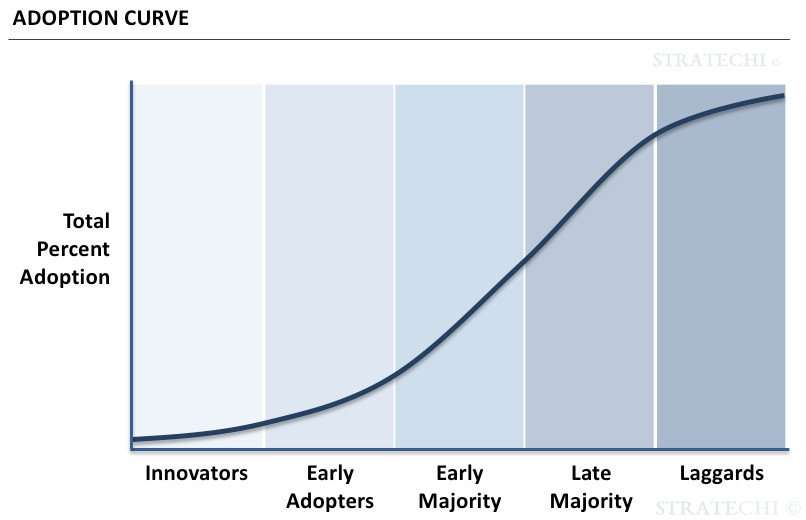
Figure 2 shows adoption patterns for specific technologies among US households:
Figure 2: Technology Adoption in US Households, Percent
In Figure 2, the steep part of the adoption curves is when a new technology transforms the human experience and the economy. AI is on the steep part now, with its computing power and the volume of data it processes growing more than fivefold a year. And AVs might achieve that growth rate soon.
Waymo, the market leader, runs about half a million paid robotaxi rides a week across ten U.S. cities — up from roughly 10,000 a week in 2023. They are targeting a million rides a week by the end of 2026, with expansions into Tokyo and London next. From spring 2024 to spring 2025, rides per week increased fivefold. From spring 2025 to spring 2026, they roughly doubled— a slowdown widely attributed to a limited supply of vehicles, not waning demand. With almost every car ride in the world still human-driven, there is lots of room for annual growth to keep doubling or even increasing fivefold.
Project that growth forward and the math becomes mind-boggling.
A million rides a week sounds big, but there are around 1.4 billion cars on the world’s roads. If global travel trends mirror American habits of around 1.9 trips per vehicle a day (number of vehicle-trips divided by number of vehicles), that implies upwards of 18.6 billion personal car rides worldwide every week, maybe 20 billion once commercial trips are factored in. That means AV trips currently account for a fraction of one percent. At fivefold annual growth, a million becomes 5 million by end-2027 and 125 million by end-2029, still under one percent. AVs won’t reach mass adoption this decade.
But keep that fivefold growth going, and AVs hit the steep part of the S-curve and 3 billion rides a week by the end of 2031. A year or two later, they would account for most rides worldwide. Even at a mere doubling per year, the takeoff arrives by the late 2030s.
On present trends, driving has one to two decades left as an ordinary part of life. Most of us will live to see it sunset.
The Driverless Revolution
The coming AV revolution is exciting. Start with time. Americans spend about an hour a day behind the wheel, one of their least favorite times of day. With eyes off the road, this time becomes phone calls, reading, movies, work, or sleep. It should save lives too, as algorithms and infrastructure keep improving in ways human reflexes can’t. Road crashes, with human error being the critical reason for 90%+ of them, kill some 1.16 million people a year and are the leading cause of death for those aged 5 to 29.
Urban planners will get millions of acres of downtown parking to repurpose as AVs park themselves somewhere cheaper or move on to the next fare. Children, the elderly, the disabled, and the undocumented all become more mobile. Eventually, traffic lights will vanish as cars communicate with each other, making brake lights and turn signals obsolete.
Household budgets will become simpler as car ownership becomes optional. Expect mobility to become a service, where you summon the vehicle that fits the trip. That will breed more specialized vehicles: one-seaters for solo trips, cargo haulers, sleeper cabins that compete with short flights.
Some jobs, especially long-haul trucking and ride-hail driving, will disappear, but the same shift will ease the work of anyone who drives between appointments, from plumbers to real estate agents to music teachers. Their road time will become fun and/or productive, and access to those jobs will widen because driving will no longer be required. Expect more home health aides, babysitters, house cleaners, landscapers, and domestic services generally.
Without human driver wages, last-mile delivery will become cheap enough to overhaul traditional retail and reduce brick-and-mortar market share. Picture a store sending your order in a refrigerated pod that keeps the ice cream hard. You get a notification as the robot-on-wheels opens your garage with a one-time code and starts loading your fridge. A micro-AV takes a service elevator and goes fifty floors up.
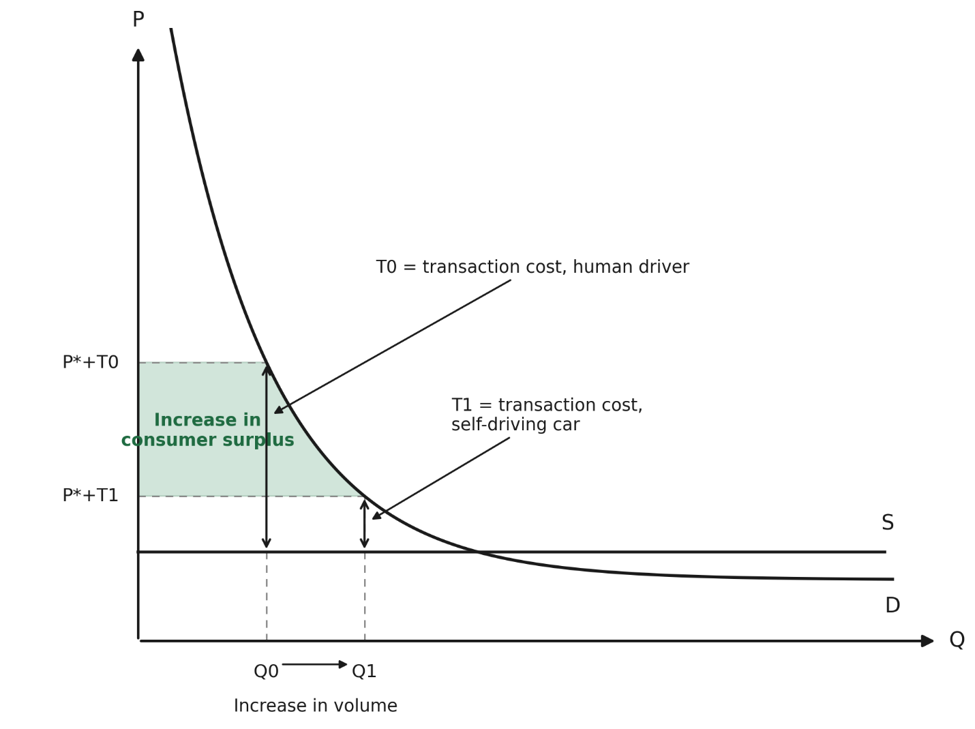
The larger pattern, as economist Xiaokai Yang showed, is that economies grow through greater specialization and variety when transaction costs, the hassle and expense of getting buyers and sellers together and of contracting and shipping, fall. AVs are poised to become a prime technology that reduces transaction costs, enabling a boom in small-scale local trade because “come pick it up” will no longer mean an hour in traffic. Figure 3 shows how falling transaction costs will let many businesses, from restaurant takeout to device repair, charge less and sell more.
Figure 3: How AVs Will Boost Business
Even more interesting are the new businesses that are uneconomic right now, but that AVs will make viable. Figure 4 shows why:
Figure 4: How AVs Make New Businesses Possible
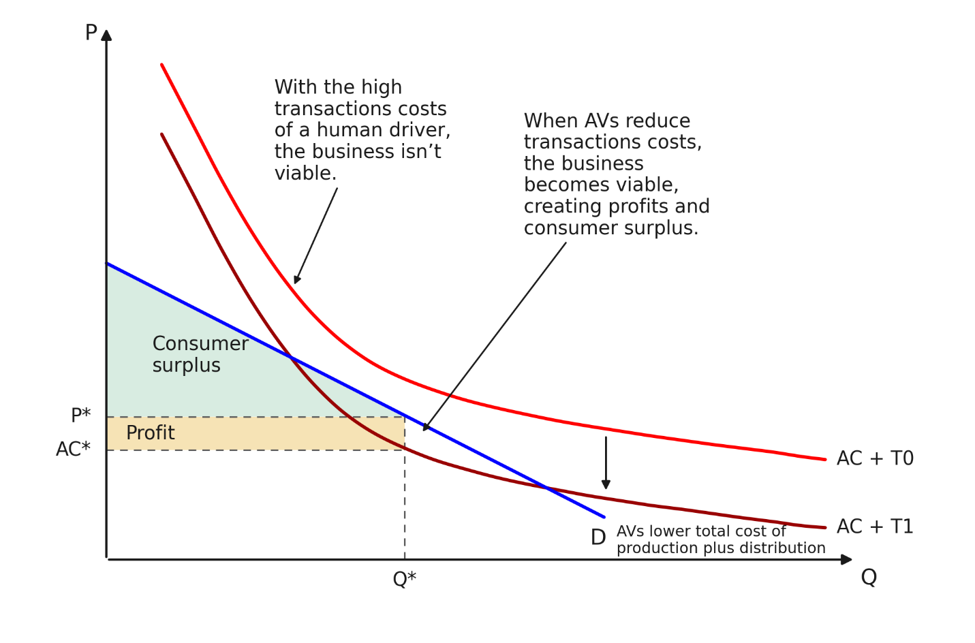
Most businesses can produce more cheaply as they grow, because fixed costs are spread across more sales. If what consumers are willing to pay is less than the average cost, the business folds, or never begins. By reducing transaction costs, AVs will flip some businesses from uneconomic to viable. Think of home kitchens offering takeout, new community farms, an artistic home tinkerer with a 3D printer, and things you never imagined. That’s where AVs will really earn their spurs as a GPT.
Freedom in the Robotaxi Age
For a century, freedom of movement has meant holding a license and keeping a machine in the driveway. Cheap driverless rides extend a freedom many of us take for granted to teenagers, the elderly, the disabled, and many others. But a self-coordinating traffic network could also become a system that knows where everyone went and when, so early safeguards against mass AV surveillance are important.
Steam, electricity, and the automobile gave ordinary people options their grandparents could not have bought, no matter the price. The robots taking the wheel are the next installment. Let them drive.