
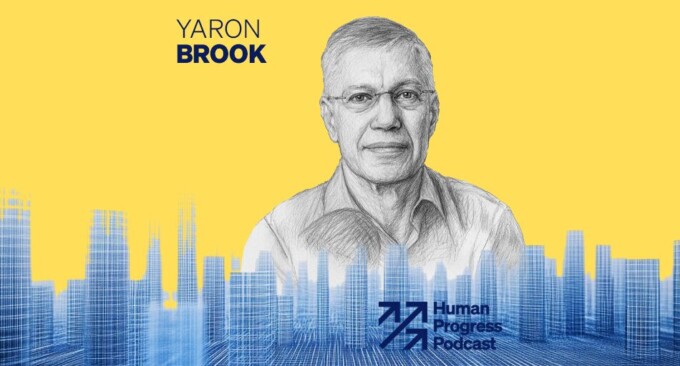
Marian Tupy: Hello and welcome to a very special episode of Human Progress Podcast. Today I’m going to be joined by Yaron Brook. Yaron is of course a host of a very popular and much frequented Yaron Brook show, but he is also a prominent advocate of free markets, individual liberty and objectivism. He was born in Israel, he was educated in the United States and holds a PhD in Finance from the University of Texas in Austin. And he is also the former executive director of the Ayn Rand Institute. Yaron, welcome to the show.
Yaron Brook: Oh, thanks for having me on.
Marian Tupy: So, I want to talk to you this morning about something that you discussed on your show, possibly yesterday, maybe early this morning, but it’s such an interesting subject and it’s so topical that I really wanted to have a conversation with you rather than anybody else. And the conversation really has to do with a recent tweet by Matt Walsh. Matt Walsh is of course a very prominent American Conservative with 4 million followers on Twitter. He’s the host of the Matt Walsh show and appears very frequently on the Daily Wire. Daily Wire, which is Ben Shapiro’s outfit, actually quite positive about the United States, about capitalism, you know, can do American optimism. This is what I associate with somebody like Ben Shapiro. But here is what Matt Walsh posted on his Twitter I quote,
“It’s an empirical fact that basically everything in our day to day lives has gotten worse over the years. The quality of everything, food, clothing, entertainment, air travel, roads, traffic, infrastructure, housing, et cetera, has declined in observable ways. Even newer inventions, search engines, social media, smart phones, have gone down hill drastically. This isn’t just a random old man yells at clouds complaint. It’s true. It’s happening. The decline can be measured. Everyone sees it. Everyone feels it. Meanwhile political pundits and podcast hosts,” I guess that will be two of us, “speaking of things that are getting worse, focus on anything and everything except these practical real-life problems that actually affect our quality of life.”
So, we are going to, in spite of what Matt says, we are going to be focusing on these aspects of daily life and we are going to separate, as Jordan Peterson likes to say, the wheat from the chaff, see what’s real and what’s not. So Yaron, when you first read that tweet, what did you make of it? What was your first reaction?
Yaron Brook: Well, I mean this is a theme for Matt Walsh. So, this was not new to me. I’ve been talking about Matt Walsh and I guess generally the populist attitude to human progress, to the Progress in America in particular over the last 40 years. It’s really a theme that I remember as being something that the left used to really advocate for. So it’s not even a political issue. It’s kind of, it’s the populist left, Populist right seem to have agreed on this idea incomes have not risen since the 1970s. Indeed the 1970s, a view to some utopia where income was maximal, where you could do amazing things with one income. And women didn’t have to work and everybody was happy and things were great. You know, crime is out of control today. It reminds me of the idea of carnage in the streets of America when crime rates at some of the lowest rates, particularly if you go back to 2015, ’16, all the way to ’19, some of the lowest rates they’ve ever been. And yet people are convinced that you can’t walk the streets of New York at night, that you can’t.
Yaron Brook: America is just riddled with crime. And then of course, we hear constantly that you can’t buy a home. And in the 60s and 50s you could buy a home, that you can’t afford anything, that everything is more expensive. And I think Matt Walsh is just reflecting that. He’s reflecting this deep seated pessimism that exists today across the entire political spectrum. And it is reinforced by intellectuals, intellectuals on the left and intellectuals on the right. Elizabeth Warren and Matt Walsh are constantly referring to this American decline, the end of this country. And so, it didn’t surprise me. And of course my first response was he’s wrong about nine out of 10 of the examples he gives, maybe doesn’t give exactly 10. But yes, there’s certain areas where I agree that America’s declined, but on almost everything else he’s just wrong.
Marian Tupy: Okay, so let’s first talk about this concept of American pessimism. What do you attribute it to? Because one of my theories is that what’s happening here is that we have a negativity emotion contagion driven primarily by hyper competition within media. In other words, we do know that an inclusion of every additional negative word in a headline produces, increases click through rate by about two and a half percent. So, instead of writing a normal headline, as you would, if you can introduce, you know, a man gets eaten by a shark with laser beams attached to his head in a bloody showdown on a Miami beach, people will read it. And now you have the traditional media, you have TV, you have radio, you have the press competing with internet outfits. So, really if you want to get people’s attention, pessimism is what sells. Is that part of the problem or do you subscribe it to something else?
Yaron Brook: I mean, I think that’s definitely part of the problem, but I don’t think it’s a fundamental problem. I mean, I believe that really we are shaped by ideas, we’re shaped by philosophies, we’re shaped by our intellectuals. Our intellectual class really is the class that is supposed to guide society and help us make sense of the world. And my view is over the last 50, 60 years, the intellectual class has completely betrayed Americans. They have rejected capitalism, which is a system that made us rich. They have told Americans that their lives are no good because they don’t fit into the economic and political and philosophical model. The intellectuals have. They get…. I use the example of if you’re a steel worker in Cleveland and you lost your job in the 1980s, what were you told? You weren’t told kind of what traditionally we were told in America, which was get in your car, drive to, I don’t know, northwest Arkansas and get a job. You were told, no, don’t worry, we’ll write you a check, we’ll keep you on welfare while we, the intellectuals and the politicians, work on getting your job back. You know, Donald Trump didn’t come up with the idea of bringing manufacturing back.
Yaron Brook: This has been a story politicians have been telling workers for a long time. So, tell people the job is going to come back and here’s a welfare check in the meantime. What you’re doing is destroying their self esteem because you’re denying them a job by giving them welfare. You’re taking away that self reliance that Americans, I think always had and were so core to the American ideal. And you’re lying to them because the steel job will never come back. We know the steel job will never come back. So, 20 years go by and the steel job doesn’t come back. This person and the culture around him and the culture generally develops real resentments against the system. Also, intellectuals have told Americans, you know, everything going on today in America, primarily your loss of jobs is a consequence of capitalism. This is capitalism. The capitalism caused the great financial crisis. We were told. And I think that was a pivotal event in people’s attitude towards the economy and in terms of American self confidence about the world in which they lived. They were told that capitalism caused it and they lost all trust in the capitalist system.
Yaron Brook: And they’re still looking for an alternative and looking for solutions and looking for something to replace free markets and private property and the dynamism of the marketplace. All of this, ultimately, if you add to this the fact that in one area and think we which America is declining is in education, I think educational institutions have betrayed America. We have K through 12 education that teaches kids to feel, to emote, to trust their emotions instead of their reason. It doesn’t teach them to think. It teach them to socialize and to feel and to be captured by emotions. And we saw this maybe 10, 15 years ago with microaggressions and with political correctness a long time ago. And then that evolved into the whole woke phenomena which it was all about emotions. It was all about you can’t hurt my emotions, you can’t say anything that offends me in any kind of way. So, we’ve created generations of people that are very attuned to their emotions, can’t really think and as a consequence rely on kind of the primitive in us as human beings. And that is kind of a perceptual level non cognitive. We see the world as a zero sum.
Yaron Brook: We respond to everything from a most of perspective. Then the media comes in and plays on that and emphasizes that. And now you get this, you know, the disaster that is what is going on right now in terms of the pessimism. People afraid they don’t understand the world. And then on top of that again they don’t have they haven’t been taught how to think about it conceptually. So they revert to perceptions. They’re afraid because that doesn’t lead them to knowledge. And when people are afraid, what they do is they join tribes. There’s comfort in tribes. So, you get tribalism and perceptual level mentality. That combination is I think what drives this. And it just reinforces the fear, and it’s a circle, it keeps getting worse. It’s a spiral.
Marian Tupy: Let me ask you questions specifically about the GOP. So, back in the day, during the Reagan Era, it was all about America being the shining city on the hill. It was all about American workers, there is nothing that they cannot do. The future is going to be better than the past, our best days lie ahead. Now all of that seems to be gone. What happened to the Republican party? What happened to the conservative movement? What’s behind this extraordinary level of pessimism about America?
Yaron Brook: Well, I mean, I think it’s a combination of two things, one ideological and one in terms of what happened. Historical facts that happen on the ground that were misinterpreted. I think ideologically the GOP has changed, it’s changed in terms of its composition. It’s changed in terms of who it’s trying to appeal to. And I think the change actually happened under Reagan, he projected this optimism. But one of the things that Reagan did to the Republican Party that I think completely changed its nature is he brought into it the moral majority. He made religion be an essential, crucial part of what it meant to be a Republican. The GOP became much more of a religious political party in the post Reagan Era. And look, I think that religion undermines some of kind of this ability to conceptualize, to think about the future in a positive way. Many of the evangelicals, particularly when they see certain cultural phenomena, like, I don’t know, the success of the gay movement, Roe versus Wade. But even immigration and the fact that people were coming into this country, that started to look dramatically different than what people perceive as historical Americans are.
Yaron Brook: I think all of that played to this new majority within the GOP. It played to a certain xenophobia, played to a certain cultural and conservatism, social conservatism. And that elevated the fear factor. The fear factor elevated as a consequence. And that was all reinforced by two, really, ultimately, three major events. But the first major event was 9/11, which was completely, I think, misinterpreted by the American right. Ultimately, the Bush administration lied to all of us, engaged in wars that were endless, that didn’t achieve any of their goals. Thousands of American kids died, and it’s not clear, particularly looking back from today, for what, because none of the goals were achieved. We were going to bring democracy to the world. So, a lot of this idealism, American idealism, right, this idea of positive we can conquer the world, we can change the world, died with Afghanistan. It died in Iraq. And then, as I mentioned, the great financial crisis happens. So, the image of America is this amazing economic engine of prosperity, and capitalism is the solution. Suddenly that all that collapsed, and instead of intellectuals coming out and saying, oh, no, no, you misunderstood. That all happened because of too much regulation and particular types of regulation and the Federal Reserve and this and that, no, the intellectuals came out and said, no, no, you’re right.
Yaron Brook: This is caused by capitalism. Capitalism failed us, we need a new model. So, the two bases on which people had a positive view of America, national defense failed. Capitalism failed. And then you get COVID, where the whole conceptual of America as being the land of the free got locked up when we all got locked up in our homes and when the political class and many of our experts panicked and had no clue what to do about that panic, except infringe on our individual rights as a consequence. And I think those three crises have basically led Americans to be skeptical of everything American, everything that’s uniquely American, and revert back to, in the GOP, revert back to a kind of religiosity that they imagine the Founding Fathers had. But I’ve seen people, Michael Knowles, for example, is also on the Daily Wire, has said, and I think has said, seriously, I want a culture of 1220. I mean…
Marian Tupy: 1220.
Yaron Brook: 1220, yes. I mean, there’s a certain medievalism in some people on the right today. They really long for kind of the certainty of religious dogma and simple life. And none of this, I don’t know, foreigners exposed to foreign cultures, people whose sexual orientation might be different than your own. This diversity of people’s values is something that they find very, very hard to cope with in the 21st century, which is shocking. But again, the 21st century started. We’ve had these three, I think, cataclysmic events, 9/11, financial crisis and COVID that have really shattered the confidence Americans have in America, particularly Americans on the right.
Marian Tupy: I was at BYU Provo a couple of weeks ago giving a talk, and I was amazed by how optimistic and pro American the Mormons are. But they may well be a minority. That doesn’t improve, that doesn’t disprove your thesis and certainly looking at the Internet and seeing how many people are longing for medieval religiosity and medieval ways of organizing social life, including desire for absolute monarchy, is certainly something that is jarring. You wouldn’t expect that in Anno Domini 2025.
Yaron Brook: No. And what’s surprising about the monarchy is Curtis Yarvin, who is the advocate for establishing monarchy. He is in Silicon Valley and his influence is in Silicon Valley and he’s influenced people like Peter Thiel and Marc Andreessen. And here you have the place of American optimism, the place where innovation is happening, where human progress is happening. Silicon Valley, where people are oriented towards the positive and the exciting. These entrepreneurs, these are people who take huge amounts of risk. And yet we have been so corrupted, I think, ideologically we’ve become so pessimistic about the future and about our own values and about the idea of America that is that shining city on the hill, the idea of the founders, the idea of freedom and capitalism and individual rights. We’re so cynical about all of those that now we have somebody within Silicon Valley of all places, having the Ability to spread the idea of monarchy as a solution. Now, of course, Silicon Valley was also very susceptible to the craziness of the left. So, maybe there’s something about the Valley that makes it open to these crazy ideas, but I think it comes from ultimately a cynicism about what made this country great and an ignorance about what made this country great and actually what made Silicon Valley great.
Yaron Brook: I mean, what makes it possible for Silicon Valley to be Silicon Valley? I don’t think they know the ideas of capitalism, the ideas of free markets, the ideas of individual rights and a limited role of government. Nobody is out there aggressively and defending them and explaining them and teaching them and presenting them to an audience. People are just ignorant of how we got to where we are today. On the positive side, yeah, it seems.
Marian Tupy: To me that what the Silicon Valley values more than anything else is iconoclasticism. If I have the word right, meaning, that that’s whatever is the established dogma, people basically wanting change. And, and of course progress is very often about change. But we do also have history behind us. We have thousands of years of history of human beings being oppressed by absolute monarchs and tyrants of all kinds. We have 100 years of experimenting with socialist policies all around the world which have been a failure without fail. And it seems to me that there are certain ideas that cannot be improved upon. The notion that people should rely on reason, facts, evidence, seems to me like an idea that cannot be improved upon. A reliance on human freedom. As opposed to top down dictates bottom up emergence of information and social structure as opposed to top down also seems to me like that’s something that should have, should have been accepted long time ago, but that’s not happening.
Yaron Brook: But if you think about it, those ideas have been under attack for 200 plus years since the enlightenment, kind of advocated for those ideas brought ideas into the forefront. Those ideas were attacked by the German romantic philosophers, by the French philosophers Comte, but even the British, ultimately Bentham telling you individual rights are not stilts and, and Mill’s utilitarianism. I think ultimately the fundamental, the core ideas of the American Revolution, the core ideas of the American founders, were controversial at the start and have been fought against by almost every intellectual trend out there. And when free market economists came about, whether it’s the Austrians or the Chicago school, they were attacked by mainstream economics. They were not accepted, they were not embraced, and they still have not been embraced. So the reality is that capitalism properly understood capitalism as a System of individual rights, of real freedom, and a system based on what you just said, fact, reality, reason, that is still today, as radical as it was in 1776. And we’re still fighting the same fight. We’re fighting the same fight against the same kind of reactionary avenue that was reactionary. Ultimately, communism and fascism are reactionary to a pre Enlightenment era.
Yaron Brook: We’re fighting the same battles. And part of the challenge we have i, s that in order for people to understand capitalism and understand freedom, they have to rise to this conceptual level. They have to be willing to think, they have to be willing to engage in the. And put forward the energy to engage in conceptual knowledge. It’s much simpler, much easier in terms of energy to just let yourself drift and absorb kind of whatever ideas in the zeitgeist of the culture. And too many people are like that. It’s much easier to join a tribe and just do what the tribe tells us. In a sense, we’re the real radicals, right? Socialism is boring, tried many times, as you say, Fascism is boring, tried and failed. All of these other ideas and these ideas of reason, logic, freedom, these are the radical ideas that should get people excited, but they require people to really make an effort to think ideas through, to examine history objectively, to see where this leads. And they have to embrace. A new morality, a new philosophical approach. I mean, this is, I think, the great contribution of Ayn Rand to the whole liberty movement, if you will.
Yaron Brook: It’s that she presents a philosophy. She’s not just showing that it works economically, but she actually presents a philosophy to ground it all. And I think it’s that philosophical discussion about what’s the purpose of life, something Jordan Peterson talks about, right? Meaning. Where does meaning come from? I think people are way off on that, and it diverts them away from freedom and liberty. A discussion about morality. What is the purpose of life? What moral value should you pursue? Should you pursue, you know, should you pursue sacrifice for others, or should you pursue your own happiness? These are the core ideas. And then where does knowledge come from? Does knowledge come from revelation or does knowledge come from reason? These are perennial philosophical discussions. And the reality is that those of us on the side of reason, happiness, capitalism, are losing. We’re losing the hearts and minds. And I think we’re losing because of tribalism and because then willingness of people to engage in actual thought.
Marian Tupy: Okay, so this leads me to the following question. So, we are having perennial debates about the role of freedom, reason, et cetera. We have hundreds of years of history showing what works and what doesn’t? And yet people are reverting back to those old primitive and not working or unworkable ideas time and time again. So, here’s a question for you. Evolutionary psychologists tell us that there are certain permanent aspects of human nature. We have evolved in a certain environment of scarcity and war, et cetera. And amongst the things that, that evolutionary psychologists say are pretty firm in human nature is tribalism and zero sum thinking. So, you could think about tribalism as a motivating factor of the right. And you already basically conceded that the right is deeply tribalist. And on the left we are talking very much about zero sum thinking that every time that Jeff Bezos makes a buck it has to come out of my pocket as though he’s done nothing for me, which is of course nonsense. So are we really as libertarians and as objectivists, promoters of freedom and capitalism, are we simply fighting a losing fight against human nature?
Yaron Brook: No, absolutely not. And the evidence of this is in the work you do all of human progress. And we progressed a lot. I mean, indeed we’re a young species and look how far we’ve come. I mean, look at how rich we are, I mean it’s stunningly how rich we are, particularly when, you know, over the last 20, 50 years. But even before that we were hunter gatherers once and we established cities and agriculture and we came up with philosophy and mathematics and science. I mean, it’s stunning what we’ve achieved. Every single step in that achievement is a consequence of the rejection of tribalism and a rejection of zero sum. Every single step in that process is the use of reason and rationality in trying to solve real problems. So the only way we progress is through the use of reason and rationality. And reason and rationality are features of the individual, not features of a tribe. There’s no collective consciousness. And indeed the individuals will often have moved us forward, we burn them at the stake and only later imagine realize how brilliant they were and how much they’ve moved us forward. So I think all of human history repudiates the idea that we have to be tribal and that we have to be a zero sum.
Yaron Brook: Now it’s true, I think the default when people don’t think, when they don’t engage with reason, when they refuse to put in the energy, the effort to actually use their mind. The default is zero sum, because that’s what you can see versus thinking requires the understanding that trade is mutually beneficial and therefore win, win. Perceptually, it just looks like zero sum, but the fact is, throughout history, we have. Some people have been able to engage in the rational faculty. And indeed, there have been periods, whether it’s. Greece, ancient Greece, or whether it’s the Enlightenment, or whether it’s capitalist. In the 19th century, people have, as mass movements, even large numbers, let’s say, have embraced the ideas of liberty and freedom and these more abstract ideas. So, no, I don’t think. I think these are defaults. I think we revert to these defaults, or people revert to these defaults when they’re overwhelmed by emotion. And when you have an educational system and when you have intellectuals who subvert reason, undercut reason and elevate emotion, above all, you get zero sum and you get tribalism. And here, look, if there are problems in the world, and there are many, many problems in the world, and this is a big one, I blame the intellectuals.
Yaron Brook: To me, it’s all about the intellectuals. The intellectuals shape a culture, they guide a culture. It’s not an accident that America is a consequence of an intellectual movement called the Enlightenment. The Enlightenment comes it seeds certain ideas, and those ideas flower in the industrial revolution and in America and in the great wealth that we have since benefited from. Our intellectual class, though, has worked hard to undermine the Enlightenment over and over and over again for 200 years now, since the Enlightenment really ended in the end of the 18th century, it’s been undermined by intellectuals to a large extent. It is amazing. How much we progressed, how successful we have been in spite of such lousy intellectual guidance. So to me, it’s about, we need to replace these intellectuals. We need to fire them all. We need a new set of intellectuals who can guide Americans, or humanity, really all human beings around the world towards an understanding of their own potential, an understanding of how wonderful life can be, of their own potential as thinkers, as their own potentials of reasoners, at their own potentials, as builders and creators. And at whatever intelligent intellectual level you have, or whatever IQ you have, whatever measure you use, you can produce and you can be happy.
Yaron Brook: So, if we start emphasizing happiness and start emphasizing the human potential, and of course, what you guys do is constantly showing how human progress, in spite of the barriers, is breaking through and we’re advancing and we’re getting better at certain things if we can emphasize those things and what makes that possible, Freedom, for example, then if we can dominate the intellectual sphere, the world will change. But right now, what’s dragging us down are people like Matt Walsh and other intellectuals who are constantly feeding the American public and the global public the exact opposite mess message of defeatism, of anti reason, of anti freedom and anti capitalism.
Marian Tupy: Well, the old intellectual lead has certainly disgraced itself and is on its way out because of Iraq, because of COVID because of the great financial crisis and so forth. The problem that we are facing is that the so called intellectuals who are waiting in the wings to replace them are worse, are worse. We are talking about people like, I’m sorry to say, Matt Walsh, we are talking about Adrian Vermeule, we are talking about Curtis Yarvin.
Yaron Brook: And of course on the left are no better. I mean the horrors of the whole woke movement and intersectionality and the post colonialism and everything that the left has done over the last 30, 40 years, the whole intellectual base is rotten to the core. So, you really look at the intellectual landscape and there are very few shining lights that actually are going to orient people towards reason, towards individualism, the pursuit of happiness and ultimately towards capitalism. But that’s what we need. We need more voices like that. That is what will shape the culture.
Marian Tupy: Well, I’m glad that you made it bipartisan or rather nonpartisan because that’s what we are all about. We are on neither right nor left. We are trying to get at the truth. And who knows, maybe as the left and the right completely discredit themselves intellectually, maybe we’ll have a chance to squeak through the middle and make a difference.
Yaron Brook: And if we do, then here’s the challenge, I think we have to learn from, if you will, our failures over the last 200 years to defend the Enlightenment and improve our strategies and really focus on the philosophical battle, on the key core ideas that are necessary and try to articulate an inspiring case for reason above all, I think, and then for individualism and capitalism, I think our predecessors, if you will, including some of our leading light predecessors, were not successful and ultimately the influence that they had faded. And it’s, you know, we need to learn also from the failures of kind of the pro free market movements so that we don’t repeat them. And when we get that opportunity, we take full advantage of it.
Marian Tupy: Now we have to give the devil his due and talk about specifics, not just keep it at a high intellectual level. So, Yaron is food in America in the year of our lord 2025, worse than it was in the 1970s when I assume you came to this country.
Yaron Brook: I lived in this country in the 1970s for a couple of years as a teenager and then I came to the country in the late 1980s. And it’s just funny to me to read something like that. I mean, if you go out in any major city in the United States, the variety and the selection, for example, of restaurants that you have available to you, the best kind of the best different foods from all over the world you can get now in any metropolitan area in the United States anywhere. And the choices are amazing. And then if you go into a supermarket in the United States, oh my God, I mean, you can get kiwis all year round, you can get vegetables that only grow in certain regions in the world, you can get them in the United States all year round. And it’s at very, very reasonable prices. I mean, we haven’t talked about it, but globalization is an amazing phenomena. It’s one of the great achievements of mankind. And I know this will give me a lot of enemies, but our ability to enjoy the products of people thousands and thousands of miles away from us and trade with them in win win transactions, remember it’s always win win is just magnificent. So, no food in America today, I mean, in the 1970s, food was bland and choices were minimal. The only, I mean, a Chinese restaurant….
Marian Tupy: No grapes from Chile, no oranges from South Africa.
Yaron Brook: No kiwis. And then, and then in terms of restaurants, I mean, maybe once in a while there’d be one Chinese restaurant in the neighborhood. And you think about the kind of ethnic food that exists in America today, the variety., I mean, the joy that comes, I mean, if you’re…. I’m a foodie, so the joy that comes from eating new food with new flavors and in new combinations and fusion food or whatever it’s, whatever people call it, is just amazing. And you can get restaurants that are super cheap. In LA, you can go buy tacos that are some of the most delicious in the world at a food truck all the way to three star Michelin restaurants where you can spend three and a half hours on an amazing world class meal that is better than anything they have even in Paris. So, we have such a variety and such a selection in the United States today, of all the things to pick on food is comical.
Marian Tupy: Another point raised by Matt Walsh, air travel. Now, it seems to me that there are two points to be made. One is that in the olden days you simply didn’t travel by air travel. Holidays would be spent nearby, wherever it was that you lived. There’s a fantastic bit in Mad Men where these rich guys from New York decide to go to California and fly across the country and it’s a big deal. The whole Office is talking about it and they are bringing a bag of California oranges back to New York because of course you couldn’t get them otherwise. Now it is uncomfortable in economy class and yet millions of people, tens of millions of people take the economy class flight every year. They are voting with their feet or voting with their wallets. What’s the trade off here?
Yaron Brook: The trade off is to get to the place that you want to get to. The ability to travel, the ability to see the world. Not just America, but the world. And it’s unbelievably cheap. The reason in the 1950s and 60s very few people traveled by air is because airlines were heavily regulated. And the government literally set the price of airfares. That was only deregulated under Jimmy Carter in the 1970s and therefore it was very expensive. So, to take a cross country trip by air was just, for a family of four, nobody could afford to do that. Today almost everybody can afford to do that. In addition, and this is something people don’t talk about, air flight was not that safe back then. Crashes happened, people died. In America, the number of casualties in airplanes over the last I think 25 years, with the exception of the one accident in Reagan, at Reagan, there’d be no accidents for like 20 years with fatalities, with that one exception. It’s truly stunning how safe if is. So, it’s super cheap. If you want to pay more money, you can pay more money and sit in business class and you’ll be more comfortable, which a lot of people do.
Yaron Brook: Right. And business classes only expand. But there are discount airlines. They’re airlines that specialize in just bare bones services and very uncomfortable seats. And yet they’re always full. In Europe you can fly between countries sometimes for $20. Get on a plane, it’s not comfortable, you’re not going to get any food, you can’t check a bag, fine. But people choose to do that. Those airlines are packed and full and very successful because the value of travel is so much greater.
Marian Tupy: In other words, people are willing to sacrifice discomfort for four or five hours in exchange for a hundred dollar ticket.
Yaron Brook: But it’s more than that. They’re willing to give up, they’re willing to be discomfort for the opportunity to travel. Yeah, remember in 1950s they didn’t travel. It’s not that travel was super comfortable in the 1950s and everybody loved traveling and everybody was flying around and then it’s descended. No, nobody… Very few people traveled in the 1950s. Now everybody travels. That’s the big leap is just the sheer number of people traveling today by airplane versus the 1950s and ’60s, it’s just astronomical. And so, a few very wealthy people were very comfortable in the 50s and 60s when they traveled. They’re still comfortable today because they do it in business class or first class. The rest of the people who couldn’t afford to travel in the ’50s or ’60s now can travel. That is an incredible increase in utility, in benefit to individual human beings.
Marian Tupy: So, that brings me to a subject that I know you’ve discussed before, so have I, but I just want to remind our listeners of it. There is this meme, this myth on the right, but also on the left, I think, about the ability of the American worker to support a family on one income. And you’ve made this point, but I’m just going to outline it and then I’ll let you to expand on it. Yes, even today you can have a lifestyle of an American from the 1950s and 1960s on one income. It will mean that you are never going to fly across the country country, let alone on a holiday to Europe or to Thailand. It will mean that you are going to be living in a much smaller home without basic appliances. It will mean that you will have access to 1950s or 1970s health care. So, the point is, there is a reason why people opt to have two income families because life is just so much more amazing than anybody would be willing to put up with. But what do you think about that whole shtick?
Yaron Brook: No, it’s absolutely, actually Matt Yglesias had a really good essay on this. In which he actually went and looked and found a house that is the same size as what it was in the 1950s, about 1500 square feet versus today’s houses that are all over 3000. And yeah, you can afford that. You can afford it on one income easily and one car instead of two or three or four. Remember that, when I grew up there were six of us, right? Four kids, parents, one bathroom, the whole place, one bathroom. Yeah, you can find places like that and you can afford those. If you though, want to have every kid in his own bedroom and bathrooms for everybody and two cars and then when the kids get to gauge 16, maybe buy them cars and so on. If you want to travel and go on not vacations by, you know, just by car, but actually be able to travel to Europe and go and go see the world, then yeah, you need two incomes. But there’s something even more important than that, and that is the reality was that the 1950s really, really sucked if you were A woman, you were stuck at home. And you were stuck at home because employment opportunities were not really there. There was real discrimination against women. You can see that in Mad Men. I mean, one of the shocking things about Mad Men is how they talk to women and how they treat women. And you forget, yeah, that’s how it was just, what, 60 years ago. They didn’t have the opportunities. And because there were no washers and dryers and dishwashers and all of this, and robotic, what do you call, vacuum cleaners, women spent a lot of time taking care of the house.
Yaron Brook: And as a consequence, they didn’t have the opportunity for many of them to manifest their own kind of ideas and their own lives in career and in education that men have had the opportunity to do for a couple of hundred years. We men haven’t had it for very long either. People need to remember this is a product of capitalism, the idea of a career, an idea of actually getting an education. So, women were significantly oppressed and now the opportunity cost for them to stay home is huge. Now they have an opportunity to have a career, they have an opportunity to go to school they have an opportunity to develop themselves, to pursue whatever life they want to pursue. The consequence of that, two income families that raise the standard of living, which make it possible for them to have the kids and have the cars and everything like that and still be able to, be able to afford that kind of lifestyle. And it’s shocking to me that people think that there’s something wrong, A, with women pursuing their own dreams and B, with people actually being richer, living in bigger homes. And yeah, they’re busy.
Yaron Brook: But you know what? That family in 1950s was busy as well. So, unless I think what drives a lot of this, certainly on the right, what drives it is a harkening back to tradition for tradition’s sake. I mean, Matt Walsh has said that his wife is at home, she cooks for him, she takes care of, and he enjoys that. And look, some women enjoy that. And there’s nothing wrong with that, right? There’s absolutely nothing wrong with a woman choosing to raise her kids and to take care of the home. But having the options is incredibly valuable. And that’s what modernity is allowed us.
Marian Tupy: Absolutely. It’s about the options in life, which, as you said, we haven’t had till very recently, men and women, you’ve already noted housing and maybe this is the subject that we can end on. If you look at, I believe that Mark Perry from American Enterprise Institute calls it the chart of a century. It actually shows that housing relative to income is about 10% cheaper than what it was 20 or 25 years ago. Now I want to expand on this so that people understand what it means is that wages have been increasing at a faster pace than housing prices. So, even though housing is much more expensive than it used to be, the wage growth has been higher and consequently there is that gap that housing is actually cheaper but that’s on average, right? On average in America. Average house in America. It seems to me that there is a lot of things going on here. One of them is that people are not accounting for the great improvements in housing, which perhaps you want to talk about, but also that people focus far too much on particular problems in metropolitan areas such as New York City, et cetera. Whereas in the rest of the country things are going pretty well. What’s your take on that?
Yaron Brook: So, absolutely, first of all, there’s massive geographic diversity. You can find relatively affordable homes in Florida. You can find them certainly in Alabama, Mississippi and Ohio, in much of the center of the country there are certain metropolitan areas that have really, really oppressive zoning laws that have made it very, very difficult to build. And as a consequence rents have gone through the roof. And in some places, I mean, I made a lot of money on homes in California. Not because I’m a speculator, I believe housing should be a consumption good, not an investment, but because nobody was building in the neighborhoods that I lived in. Demand to move to California has always been high or used to be high because of the weather and because of the economic opportunities there. And prices just took off. It took off in a way that in a free market we would say, huh, what’s going on here? Why isn’t supply matching demand? We know that when demand increases, prices will go up, then supply will enter and prices will come back down. Why does not that, that doesn’t happen in these areas Purely because of political reasons. Homeowners don’t want it to happen because they’re enjoying the write up. So, they vote for people who zone new supply out. They make sure that new supply is not added to the inventory.
Yaron Brook: But that’s a phenomenon that exists in places where there’s high demand. There are lots of places in the country where it’s hard to sell a home because nobody wants to live there or people or there’s plenty of homes. Right? You can build with no limit. You know, right now rents have been dropping since COVID rents and home prices have been dropping significantly in Austin, Texas. During COVID demand to go to Austin increased significantly, supply couldn’t match it immediately because it takes time to build a home. So, prices went up a lot. Then supply came online because there’s a gap between when you start building and when you can put it online. Supply came online and since then prices have been drifting downwards and Austin is much more reasonable today than it was during COVID. And you see that in a number of cities around the country where the politics don’t restrict supply of housing. So that’s a huge issue. So on average, housing has not gone up. But if you live in California, yeah, I don’t know how anybody can afford a house in California. It’s ridiculous the prices that have gone up. But the fault there is not markets, the fault there is politicians.
Yaron Brook: And then the second thing you mentioned is houses are very different today. They’re dramatically bigger. Average home in America today is over 3,000 square feet. They have already amenities built in that you couldn’t even imagine happening. Having, 40 years ago, three car garages, you have air conditioning just as a standard feature in most homes in the US today, you have all the others like dishwasher and things like that built into the kitchen already. The quality of the finishes is much higher. The quality of the construction is significantly better. They’re far more resistant to, for example, to fires. Many more people died from home fires in the 1970s than do today because the quality of our construction has just increased as these materials have become cheaper, as we’ve figured out how to make fire resistant materials, fire resistant roofs and so on. So, quality has gone up. And. In most of the country, prices have not gone up. So, it acts like pretty much all the other parts of that, what is it, the graph of the century? That is anything government touches, everything government regulates. And to the extent that it regulates and funds it has gone up in price relative to wages dramatically.
Yaron Brook: And that’s education and that’s health care. And that to some extent housing, to the extent that government is zoning everything, the government has stayed away from and doesn’t regulate or doesn’t regulate as much because it regulates everything, but it doesn’t regulate as much has come down in price. And the big one here, I think is TVs which are down like…
Marian Tupy: Food.
Yaron Brook: Food and electronics and toys and furnishings and all of that.
Marian Tupy: And clothes.
Yaron Brook: And things like that, all of that has come down dramatically. So…
Marian Tupy: What’s so interesting…
Yaron Brook: Instead of learning the lesson from that, we now want to regulate all these other industries more.
Marian Tupy: Well, speaking about learning lessons, what’s so interesting about that Matt Walsh tweet is that what he could be doing as a card carrying member of the right is to actually talk to America about the great successes in GOP dominated states and GOP dominated cities where housing was deregulated and where rents and house prices are actually coming down. He could be promoting those successes and showing, look, look, if this can be done in right America, it can be also done in left America. But instead of that, he’s embraced this negativity which I don’t think is going to help them in the midterms next year, but one way or another….
Yaron Brook: But this is really the tragedy of the modern American right that it doesn’t want to highlight those things because that would highlight the successes of freedom and capitalism, that would highlight the success of deregulation and all the things that they’re against. I mean, this new right is anti Reagan, it’s anti free markets. And they have no incentive to highlight that they want their people to control the central planning instead of the other guys, the other tribes people to control the central planning. They are not freedom lovers. They are not, because they see, and I think this is what scares them again. I think they see that if you advocate for economic freedom, why stop with economics? Shouldn’t individuals be free to make all kinds of choices in their lives? What God to worship or not to worship, any God or who to love and who to have sex with and all kinds of things like that. And that they can’t tolerate. And if they can’t tolerate freedom in the realm of personal choices, long term, you’re not going to tolerate freedom in economic choices. And that’s what we’re seeing with the right today. They used to only want to regulate our social choices and now they want to regulate everything, just like the left. And it’s the great tragedy of America right now where there’s nobody in politics really who represents freedom in any kind of sense in the personal and in the economic realm.
Marian Tupy: Wise words, Wise words. To end on, I’m deeply grateful for the time that you have taken to speak to me. I know how busy you are, you’ve got your own show, which I highly recommend, the Yaron Brook Show.
Yaron Brook: Thank you.
Marian Tupy: And we’ll try to get this out as soon as possible.
Yaron Brook: Wonderful. I really appreciate it. This was fun.