Summary: Many imagine that humans lived more harmoniously with nature in the preindustrial world than they do today, but Richard Hoffmann’s book reveals a very different story. Long before the Industrial Revolution, humans were already transforming landscapes, using massive amounts of resources, eroding soil, and driving animal species to extinction. Hoffmann’s work uncovers how deeply and irreversibly medieval Europeans altered the natural world.
Prior to industrialization, humanity lived in perfect harmony with the natural world, which was largely left unmolested as a vast pristine wilderness, or so claims a popular narrative. Historian Richard Hoffmann, “a pioneer in the environmental history of pre-industrial Europe,” reveals in his book An Environmental History of Medieval Europe that the reality was far more complicated. While many of today’s environmental challenges—such as climate change and plastic pollution—differ from the problems our forebears faced, it sadly turns out that environmental degradation and poor treatment of animals are not recent innovations. From deforestation to driving animal species extinct, human beings have been altering their environment in many ways since long before industrialization.
Preindustrial Europeans “colonized nature to create new anthropogenic ecosystems. The interventions had deep environmental effects.” Europe was hardly unique in this regard. The landscapes of the Americas, for example, were also significantly modified by human beings. European colonists falsely viewed the Americas as unaltered, virgin territory. That was an illusion enabled by the fact that in the Americas, a lack of immunity to viruses common in Europe decimated the former continent’s native population upon the latter’s arrival. As a result, “the American continents were emptied, creating what Europeans perceived as primeval wilderness where once had flourished anthropogenic landscapes shaped by hunter-gatherers, agriculturalists, and indigenous urbanizing cultures.”
Indeed, any long-inhabited environment bears the mark of generations of active human alteration. “The Europe inherited by the Middle Ages [was not] in any way pristine. From the Neolithic to the age of classical Mediterranean civilization successive human cultures had repeatedly affected and transformed European landscapes. Even Pleistocene and post-Pleistocene hunters deployed fire to make game more accessible. Subsequent agricultural adaptations (arable and pastoral) further opened European woodlands.” Intentional fires “to manage landscapes for game created open ‘parkland’ woods and in northwestern Britain, even anthropogenic steppe grasslands.”
Some changes to the environment were unintentional, while others were the product of active land management. “Since deep human prehistory, Europeans both adapted to their natural surroundings and actively modified them in ways people had intended, ways they found surprising, and ways of which they remained seemingly quite unaware.”
Preindustrial people were largely unworried about their environmental impact. In fact, “adversarial relations between humans and nature are a continuing strand in medieval thought.” Indeed, “late antique and early medieval writers often articulated an adversarial understanding of nature, a belief that it was not only worthless and unpleasant, but actively hostile to . . . humankind.” Consider a vivid example of this mindset:
At the far end of the Middle Ages the struggle between humans and nature [inspired] a vision poem by a Saxon humanist, Paul Schneevogel (Paulus Niavis, 1460/65–after 1514), who contemplated his native Erzgebirge, the ‘ore mountains’ today between Germany and the Czech Republic. That mining district appears as an arena of mutual wars of attrition between aggressive men who burrowed into the earth, destroyed woodlands, and befouled streams, and an earth that fought back, caving in the tunnels, poisoning the waters, and blighting harvests. This struggle against nature is, the poem concludes, the inescapable fate of Humankind.
Given such views, it is not surprising that most people had no interest in anything like the modern concepts of environmental conservation or stewardship. “Environmental protection for its own sake had no meaningful role in official discourse.” Any legal limitations on the use of natural resources revolved strictly around how such rules affected human beings. For example, most hunting limitations were focused on keeping the peasants from engaging in an activity (hunting) perceived as above their station in life. “By the later Middle Ages in most parts of Europe commoners were barred from hunting and the activity reserved to nobles. . . . This grievance, among others, helped trigger the German Peasants’ War of 1525. English rebels in 1381 carried a dead rabbit on a pole as a standard.” Note that moral consideration for animals or the natural environment played essentially no part in preindustrial debates on hunting, fishing, forestry, and land use.
First, consider deforestation. Even paleolithic peoples cleared and altered the landscape; they mined flint and other materials. “Salt they obtained by mining or boiling the water from brine springs, burning much wood to do so.” Over time, more woodland was cleared. “Bronze Age clearances for pasture in Denmark strained local wood supplies to the point that some pasture was left to grow back as trees.” Among Iron Age northern peoples such as the ancient Celts and Germanic tribes, “since dwellings were made of wood and human use depleted both local woodland and soil, after a generation or so farmers commonly abandoned their dilapidated houses and rebuilt elsewhere.” Ancient Romans were also “overusing and misusing their woodlands, so they ceased to exist and/or to provide natural habitats and landscapes as before.” In fact, “being subject to regular human use, Mediterranean woods had long been not pristine old-growth ecosystems but rather parts of managed landscapes.”
Cutting down so many trees affected the broader ecosystem. “As domestic animals used the woodland for pasture, it was further opened up. This changed the species composition in the woodland. During the Bronze Age and Iron Age most of the woods of central and western Europe shifted towards a dominance of beech, which more than some previous species favours a more open situation. What some have believed to be the pristine deep woods of central Europe, full of beeches, have rather resulted from the ways in which humans and their livestock have exploited those woodlands since the Bronze Age.”
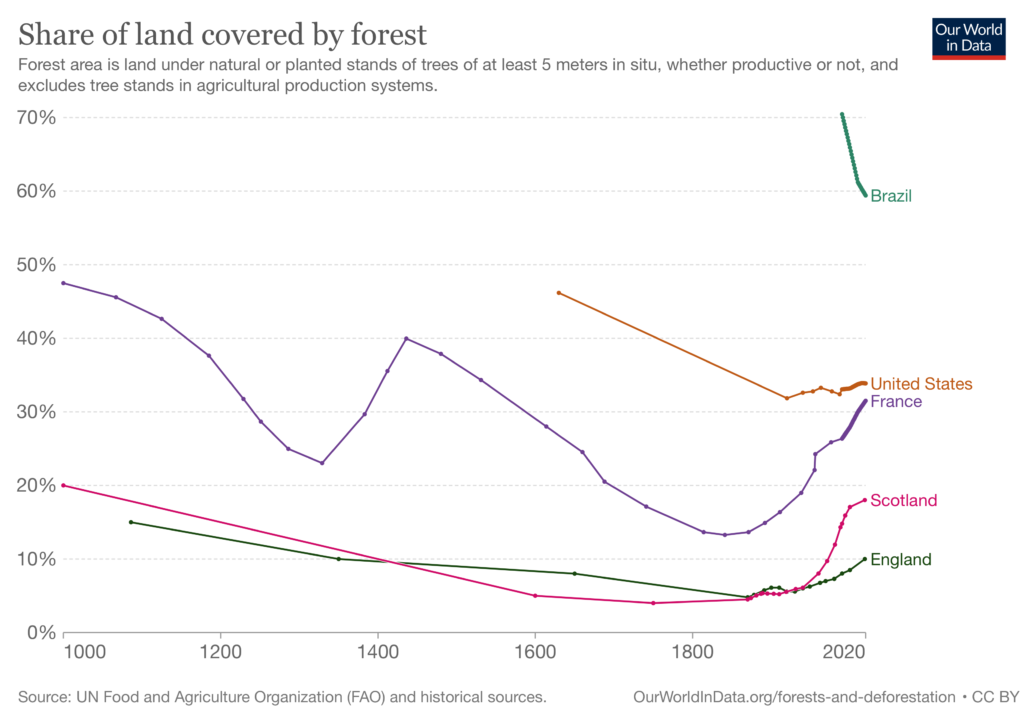
By the 14th century, human action had reduced “central Europe’s wooded cover to a mere 10 per cent of land area.” To this day, many of Europe’s landscapes bear the imprint of medieval alterations. For example, “the countrysides now visible in Tuscany, on the north German plain, or in Ireland were largely formed during the Middle Ages as a result of how people on the land . . . made use of their surroundings.”
“Landscapes of northern Europe were transformed during the course of the central and high Middle Ages. What had been mostly covered with multi-use woodland, including parcels that were for short periods of time used as farmland and then left to go back to woods, then became permanent arable.” This transformation involved extraordinary effort. “Even with the help of fire, medieval people had to tear the trees out one at a time by muscle power, open the soil surface for plough agriculture, and convert the land from woodland to arable fields.”
Trees were cut down to make way for farmland and to provide wood; over time, deforestation was increasingly driven by the latter motivation. “Through the whole of the Middle Ages Europe was deforested mainly for the sake of arable agriculture. But as those arable clearances slowed in the course of the late twelfth and the thirteenth century until they stopped in the fourteenth, fuel demand came to exert the greater pressure on remaining woodlands.”
England, where most removal of forest area occurred long before industrialization, provides a case of rapid deforestation. “William the Conqueror’s 1086 Domesday survey of English resources found trees on only about 15 per cent of the realm; by 1340 that ratio had dropped to 6 per cent.” In fact:
Clearances were well under way in Anglo-Saxon England long before the Norman conquest of 1066. King William’s Domesday survey conducted in 1086 found England only 15 per cent wooded, a figure some modern writers argue indicates prior loss of a half to two-thirds of the country’s early medieval tree cover. . . . Continued clearance took England to barely 6 per cent wooded by 1348, a decline of 60 per cent since Domesday. During those two and a half high medieval centuries English men, women, and draught animals removed the tree cover from nearly twelve thousand square kilometres.
Next, consider France. “The 55 million hectare territory of modern France (not, of course, its medieval boundaries) around the time of Charlemagne included something in the range of 30 million hectares of woodland, but by the time of King Philip IV (1285–1314) only around 13 million. Over those five centuries, the wooded cover shrank by more than half (56 per cent).” Meanwhile, in Poland, “the roughly 16 per cent of the terrain now in that country under the plough in 1000 had risen to 30 per cent by 1540, approximately a doubling of the agricultural land use.”
“What motivated the agricultural clearances and transformation of European landscapes? The answer is that medieval peasants came under pressure. Pressure came from subsistence needs: growing families that embodied the rising European population had to have more calories to feed everyone.”
Preindustrial farming practices did not just result in deforestation but affected the environment in other ways. Consider soil. Even before the Middle Ages, “lowland and foothill woodlands [were] cleared [by the Romans] for agricultural use and wetland swamps drained and cut. Consequences included more irregular hydraulic regimes, aridization [and] erosion,” among other things. Soil erosion was not the sole environmental challenge of antiquity. “Soil depletion in the classical Mediterranean was further associated with environmental damage from overgrazing and deforestation.” Still, it is well established that “the classical Mediterranean world [experienced] soil depletion due to erosion and other forms of soil exhaustion.”
Deforestation itself can cause soil erosion. “A switch from woodland to permanent fields altered the runoff regime, which affected soil erosion and deposition, and all this affected the habitat for animals.” Medieval people themselves sometimes described this process:
In the late thirteenth century a Dominican in the town of Colmar on the Rhine wrote tellingly about what had changed in the area between the Vosges mountains and the river during his own lifetime. He said the trees had been removed that once grew along the mountain slopes and the loss of woody cover had resulted in more rapid and erratic runoff. Alsatian streams now alternated seasonally between springtime floods and dry beds in summer droughts. This he attributed to the clearances.
In many parts of the world, “in historic agrarian societies soil erosion [and] nutrient loss” have posed problems. Livestock also contributed to soil erosion. “Hooves may alternatively churn up the soil surface and so open it up for erosion. Introducing meaningful numbers of animals into a landscape thus triggers a whole array of potential ecological consequences.”
Much soil erosion and nutrient depletion resulted from a lack of modern scientific understanding. “To sustain successful agricultural colonization requires management of a whole soil ecosystem which pre-industrial peoples could neither see nor imagine, but had rather to learn and negotiate by local trial, error, and oral transmission of results.” Unsurprisingly, such a haphazard approach often failed. For example, “influential French medievalist Georges Duby blamed what he saw as food shortages and death rates increasing from the 1290s, if not earlier, on . . . cultivation of infertile, soon-exhausted, soils.”
Modern research reveals the extent of soil damage in preindustrial times. “In Germany, geomorphologists find that soil erosion had for several prior millennia averaged less than 5 mm per year. But after the woodland cover was reduced to a mere 10 per cent of surface area by the end of the thirteenth century, extreme precipitation during 1313–19 thrust this alluviation rate up to five times the annual mean, in other words, 25 mm per year or a hand’s span of soil loss in less than a decade.”
The soil was clearly abused, but what about the quality of life for farm animals? Today, animals are bred to be larger, producing more meat. But in the medieval period, farm animals actually shrank in size compared to antiquity, with inadequate feeding resulting in their diminution over generations:
Domestic animals diminished in size. Skeletal remains show Roman cattle stood on average about a head taller than later Frankish cattle. While Romans had typically practised stall feeding, the new agrarian regime used rough pasture, where a smaller animal is more likely to succeed. Perhaps because husbandry of sheep and swine changed less, those beasts shrank less—though the latter did so even in northern Spain—while dogs and horses remained unaffected.
Domesticated animals nonetheless fared better than certain wild species. Species loss is sometimes thought of as a purely modern phenomenon, but in fact, many species were exterminated from large parts of their native habitats or even driven to extinction (such as the auroch) in the preindustrial era. A fact that should perhaps be more widely known is that lions, hyenas, and leopards are all native to Europe but were eliminated from the continent by human activity:
Lion, hyena, and leopard had vanished from Mediterranean Europe by the first century BCE and bear populations in both the Balkans and the Apennines were much reduced. Elimination of all the now proverbially ‘African’ animals—lion, elephant, zebra, etc.—from areas north of the Sahara was complete by the fourth century CE. Besides these purposely targeted ‘trophy’ organisms, pursued on cultural grounds beyond all reasonable expenditure of energy, economic pressures took their toll on other biota. Capture and export of sturgeon from the Rhône delta to Roman markets, for example, caused steady shrinkage in their average size and eventual near disappearance from the archaeological record.
People killed animals in many ways, including gladiatorial fights and mass slaughters during celebrations. “Animals, preferably large, fierce, and exotic ones, put on show or goaded to fight other beasts or men in the arena gave prestige to the sponsor and entertainment to the audience. Their huge numbers—one triumph of Emperor Trajan in 107CE killed 11,000”—are boggling to the modern mind. The animals thus killed may have included elephants, lions, and bears.
In the medieval period, torturing and killing animals for entertainment remained popular. Also, it was widely believed that animals could become possessed by demons, which made people drive away or kill the animals. For example, “when seventh-century wandering Irish ascetic Gall went into the Alpine foothills south of the Bodensee, he had to drive demonic otters from the pool beneath a waterfall.” One wonders whether animals deemed possessed may have had rabies or other illnesses that altered their behavior in a way that the medieval people interpreted as demonic possession or whether in such cases people actually harassed perfectly healthy animals.
Overfishing also harmed some local species. “Almost as soon as references to fish prices appear in mid-twelfth-century documents, their upward movement reveals imbalance between supply and demand. Fishing pressure is shown, too, in the shrinking size of favourite varieties recovered from archaeological sites of long-term consumption. In kitchen middens along the southern shore of the Baltic, for example, early medieval sturgeon were of great size, those of the twelfth century much smaller, and the species nearly disappeared thereafter. Some local runs of salmon and sturgeon were extirpated from the twelfth century onwards.”
Overhunting was another issue. “Such prized game as bear, wolf, and wild pig were extirpated from the British Isles by the end of the Middle Ages. The last individual specimen of the great native European wild ox, the aurochs, was killed by a known noble hunter in Poland in 1637.” Perhaps human activity resulted in “a western Europe lacking pine marten or sturgeon.”
Habitat loss also reduced the numbers of many local animal species. “Remains of woodland birds dominate in archaeological sites around Madrid dating to the fifth to twelfth century, but lost importance in the later Middle Ages,” when clearing of woodlands resulted in habitat loss for such birds, and their numbers plummeted. “Through central medieval centuries up to the twelfth, overhunting and habitat destruction in the form of the great clearances had damaging effects on wildlife populations. Western fur-bearers were depleted or extirpated. By the high and later Middle Ages a beaver was but vaguely known to most western European naturalists. . . . Wild cats disappeared, and so, too, did most animals larger than the smaller weasels from all but the most remote and rough uplands in the west.”
The examples of species depletion go on and on. “By the end of the Middle Ages the southernmost breeding population of walrus on the Scottish North Sea coast had been extirpated and Basque and other whalers had so depleted some varieties from European waters as to move operations promptly to newly found coastal North America.” In Iceland, “by the twelfth and thirteenth centuries nearly all the scrubby valley woodlands had been destroyed and some areas in the more densely settled south were likely overgrazed to the point of erosion. Fuel wood had become scarce and timber supplies dependent on driftwood or imports. The resident walrus of the southwest coast were extirpated.”
New settlements also drove species loss in some cases. For example, “after 1425 Portuguese settlement on the uninhabited archipelago of Madeira triggered massive clearances of primeval indigenous woodlands and the extermination of native animal species in the jaws of European domesticates (pigs), commensals (rats), and introductions (rabbits).”
That brings us to invasive, or nonnative, species. The human introduction of such species to environments has been occurring since classical times. “Roman soldiers or their camp followers knowingly carried grape vines to Britain in their baggage and unknowingly the malaria parasite to the Rhine delta in their bloodstream.”
The introduction of new species sometimes coincides with the loss of native species. Hoffmann poses questions, such as, “Did the spread of an exotic animal, the rabbit, in thirteenth-century England and the Low Countries have anything to do with the simultaneous extirpation of native wild boar from Britain? And the arrival of an exotic fish, the common carp, in France at the very time that native salmon were vanishing from streams of coastal Normandy?”
In the medieval period, hunting devastated the populations of many species and motivated the introduction of nonnative species, all while contributing very little to food security. Hunting for food was rare, especially among the nonelite, and even among the elite, hunts tended to be largely ceremonial or cultural events rather than practical outings in pursuit of food. “On twenty-six long-inhabited archaeological sites in northern France dating from the thirteenth century through to the seventeenth, for instance, game animals provided but 2 per cent of the food bones at secular elite locations (lord’s houses, castles) and less than 0.5 per cent everywhere else (towns, monasteries, peasant villages).” While hunts did not significantly increase the food supply, they did have profound effects on the environment:
Interest in the hunt motivated medieval elites to introduce exotic animals to Europe. Besides the rabbit, a small species of deer, the fallow deer (Dama dama), was also brought to Europe, probably under French noble auspices. These originated in China but European populations likely descended from an earlier transfer into Persia (also for hunting) that drew the attention of crusading aristocrats. In the thirteenth century the French crown owned several herds of fallow deer. Peasant neighbours were called out on corvée (forced labour) to dig ponds to water the deer, build fences to keep them protected, and plant crops for their fodder. Anglo-Norman lords brought fallow deer to Britain along with rabbits and pheasants, another animal exotic to Europe.
Once introduced to the continent by humans, rabbits spread rapidly, altering Europe’s ecosystems. “Rabbits are native to North Africa and the Romans had introduced them to Iberia. By the 1100s rabbits were present in France and by the 1200s had been brought to the Low Countries and England. Around 1500 they were crossing the Vistula in Poland and had arrived on the plains of Hungary.” Invasive rabbits soon outcompeted their native relative, the European hare. “The rabbits, having adapted ever more successfully to their new habitats, themselves went feral and spread all over the continent. At the same time the native member of the related family, the European hare, seems to have dwindled and in some areas disappeared. Good comparative zooarchaeological evidence from a wide sample of medieval sites shows hare remains diminishing in proportion to rising numbers of rabbits.”
“Twelfth-century France saw intentional construction of artificial pond structures to grow fish on landed estates and the next century their proliferation along with techniques to rear a species exotic to western Europe, the common carp. . . . Like rabbits, carp established feral populations too.”
In short, preindustrial people inhabited a world that was far from an untouched wilderness. “Medieval Europeans changed their natural world, even permanently.” Hoffmann’s book helps to raise “awareness that even early medieval Europe was no pristine natural system . . . but already fully marked by long human presence, learning, use, and adaptation of its ecosystems.” As Hoffmann’s book makes clear, some preindustrial practices would give a modern-day environmentalist ample cause for dismay.