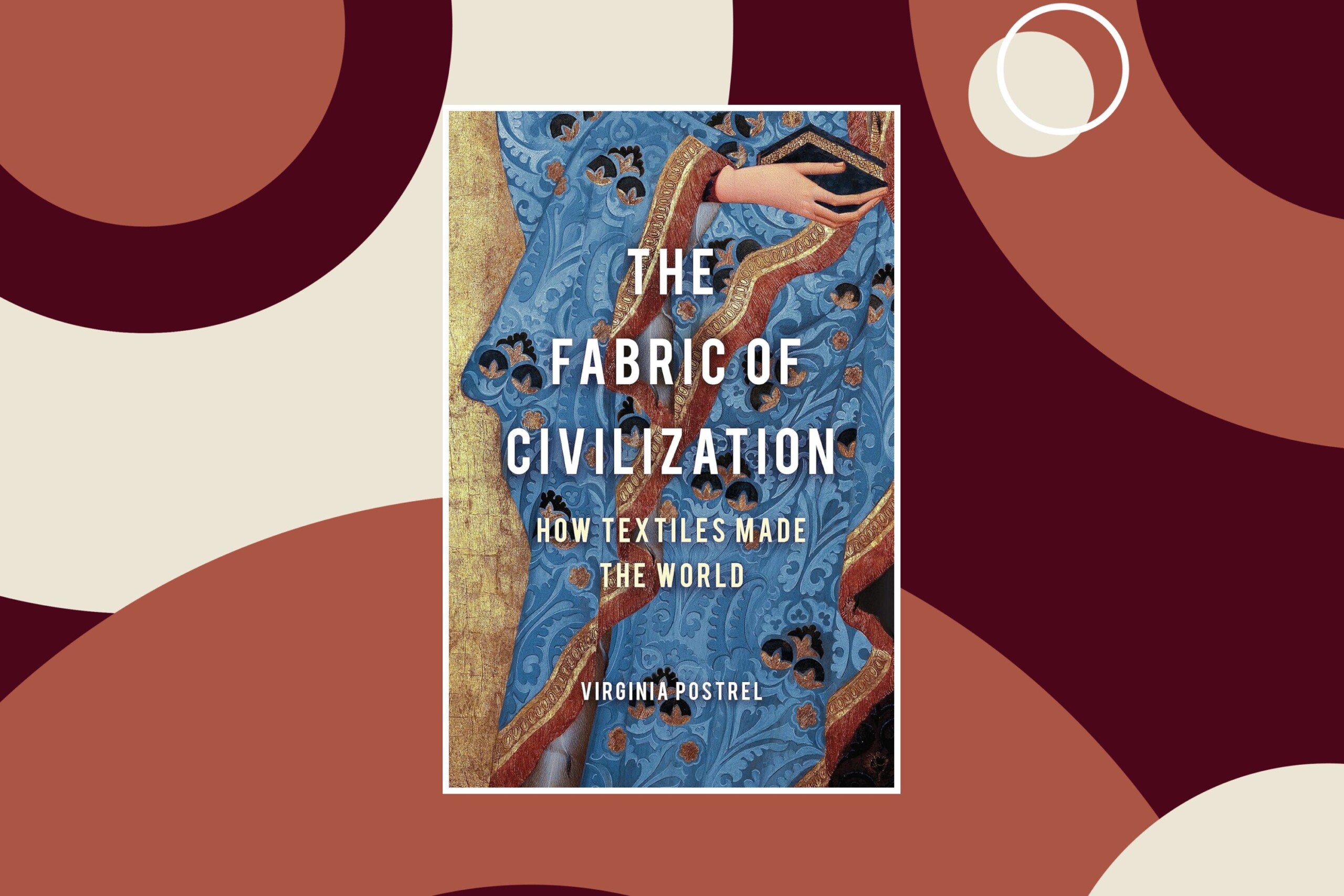
Summary: Virginia Postrel’s book weaves a sweeping history of textiles as both drivers of innovation and toil. From ancient women spinning for months to make a single garment to brutal sumptuary laws and dye trades steeped in labor and odor, it is revealed how fabric shaped the foundations of human society.
Virginia Postrel’s The Fabric of Civilization: How Textiles Made the World is the riveting story of how humanity’s quest for thread, cloth, and clothing built modern civilization, by motivating achievements from the Neolithic Revolution to the Industrial Revolution and more. While much of the book contains inspiring tales of innovation, artistry, and entrepreneurship, the parts of the book about the preindustrial era also reveal some dark and disturbing facts about the past.
In the preindustrial era, clothing was often painstakingly produced at home. Postrel estimates that, in Roman times, it took a woman about 909 hours—or 114 days, almost 4 months—to spin enough wool into yarn for a single toga. With the later invention of the spinning wheel, the time needed to produce yarn for a similarly sized garment dropped to around 440 hours, or 50 days. Even in the 18th century, on the eve of industrialization, Yorkshire wool spinners using the most advanced treadle spinning wheels of the time would have needed 14 days to produce enough yarn for a single pair of trousers. Today, by contrast, spinning is almost entirely automated, with a single worker overseeing machines that are able to produce 75,000 pounds of yarn a year—enough to knit 18 million T-shirts.
Most preindustrial women devoted enormous amounts of time to producing thread, which they learned how to make during childhood. It is not an exaggeration to say, as Postrel does, “Most preindustrial women spent their lives spinning.” This was true across much of the world. Consider Mesoamerica:
At only four years old, an Aztec girl was introduced to spinning tools. By age six, she was making her first yarn. If she slacked off or spun poorly, her mother punished her by pricking her wrists with thorns, beating her with a stick, or forcing her to inhale chili smoke.
These girls often multitasked while spinning: “preindustrial spinners could work while minding children or tending flocks, gossiping or shopping, or waiting for a pot to boil.” The near-constant nature of the task meant that prior to the Industrial Revolution, “industry’s visual representation was a woman spinning thread: diligent, productive, and absolutely essential” to the functioning of society, and from antiquity onward cloth-making was viewed as a key feminine virtue. Ancient Greek pottery portrays spinning “as both the signature activity of the good housewife and something prostitutes do between clients,” showing that women of different social classes were bound to spend much of their lives engaged in this task.
Women of every background worked day and night, but still, their efforts were never enough. “Throughout most of human history, producing enough yarn to make cloth was so time-consuming that this essential raw material was always in short supply.”
Having sufficient spun yarn or thread was only the beginning; it still had to be transformed into cloth. “It took three days of steady work to weave a single bolt of silk, about thirteen yards long, enough to outfit two women in blouses and trousers,” although silk-weavers themselves could rarely afford to wear silk. According to Postrel, a Chinese poem from the year 1145, paired with a painting of a modestly dressed, barefoot peasant weaving silk, suggests that “the couple in damask silk . . . should think of the one who wears coarse hemp.”
Subdued colors often defined the clothing of the masses. “‘Any weed can be a dye,’ fifteenth-century Florentine dyers used to say. But that’s only if you want yellows, browns, or grays—the colors yielded by the flavonoids and tannins common in shrubs and trees.” Other dye colors were harder to produce.
In antiquity, Tyrian purple was a dye derived from crushed sea snails, and the notoriously laborious and foul-smelling production process made it expensive. As a result, it became a status symbol, despite the repulsive stench that clung to the fabric it colored. In fact, according to Postrel, the poet Martial included “a fleece twice drenched in Tyrian dye” in a list of offensive odors, with a joke that a wealthy woman wore the reeking color to conceal her own body odor. The fetor became a status symbol. “Even the purple’s notorious stench conveyed prestige, because it proved the shade was the real thing, not an imitation fashioned from cheaper plant dyes.” The color itself was not purple, despite the name, but a dark hue similar to the color of dried blood. Later, during the Renaissance, Italian dyers yielded a bright red from crushed cochineal insects imported from the Americas, as well as other colors that were created by using acidic bran water that was said to smell “like vomit.”
Numerous laws strictly regulated what people were allowed to wear. Italian city-states issued more than 300 sumptuary laws between 1300 and 1500, motivated in part by revenue-hungry governments’ appetite for fines. For example, in the early 1320s, Florence forbade women from owning more than four outfits that were considered presentable enough to wear outside. Postrel quotes the Florentine sumptuary law official Franco Sacchetti as writing that women often ignored the rules and argued with officials until the latter gave up on enforcement; he ends his exasperated account with the saying, “What woman wants the Lord wants, and what the Lord wants comes to pass.” But enough fines were collected to motivate officials to enact ever more restrictions.
In Ming Dynasty China, punishment for dressing above one’s station could include corporal punishment or penal servitude. Yet, as in Florence, and seemingly nearly everywhere that sumptuary laws were imposed, such regulations were routinely flouted, with violators willing to risk punishment or fines. In France in 1726, the authorities harshened the penalty for trafficking certain restricted cotton fabrics, which were made illegal in 1686, to include the death penalty. The French law was not a traditional sumptuary law, but an economic protectionist measure intended to insulate the domestic cloth industry from foreign competition. Postrel quotes the French economist André Morellet lamenting the barbarity of this rule, writing in 1758,
Is it not strange that an otherwise respectable order of citizens solicits terrible punishments such as death and the galleys against Frenchmen, and does so for reasons of commercial interest? Will our descendants be able to believe that our nation was truly as enlightened and civilized as we now like to say when they read that in the middle of the eighteenth century a man in France was hanged for buying [banned cloth] to sell in Grenoble for 58 [coins]?
Despite such disproportionate punishments, the textile-smuggling trade continued.
Postrel’s book exposes the brutal realities woven into the history of textiles; stories not just of uplifting innovation, but of relentless toil, repression, and suffering. Her book fosters a deeper appreciation for the wide range of fabrics and clothes that we now take for granted, and it underscores the human resilience that made such abundance and choice possible.