01 / 05
Why Our Economic Intuitions Are Often Wrong

Blog Post | Progress Studies

Why Our Economic Intuitions Are Often Wrong

Such tendencies stem from our evolutionary psychology.

Summary: Many common economic misconceptions stem from evolved psychological instincts shaped in small, zero-sum tribal environments rather than modern market systems. These “folk-economic beliefs” lead people to misinterpret trade, immigration, profit, and regulation in ways that conflict with core economic principles, often resulting in support for counterproductive policies. Because these intuitions are predictable products of human evolution, they help explain why flawed policy ideas persist. Recognizing their origins can help counteract misleading instincts while reinforcing those that support cooperation, openness, and exchange.


Economic models, rooted in assumptions of rational agents maximizing utility under constraints, have long provided elegant frameworks for understanding human behavior in markets and societies. Yet, a persistent friction exists between these idealized portrayals of human beings and the ways humans actually navigate economic choices. People frequently champion policies that contravene basic economic principles, including minimum wages presumed to boost income without increasing unemployment, rent controls expected to enhance housing affordability without reducing supply, or tariffs that run counter to comparative advantage and affordability. 

People also often harbor counterproductive intuitions, including a belief that markets erode social bonds, despite evidence that markets foster cooperation and thus generate wealth. Those tendencies stem not primarily from information deficits or irrationality, but from our evolutionary psychology. Our economic intuitions were shaped over thousands of years in a world of tight-knit coalitions and zero-sum intergroup rivalry, rendering modern market dynamics counterintuitive. As such, markets are often rejected even when they are beneficial.

Perhaps the most parsimonious theory explaining why people often behave in economically harmful ways is the evolutionary cognitive model of folk-economic beliefs, proposed by anthropologist Pascal Boyer and political scientist Michael Bang Petersen. Folk-economic beliefs are those convictions about economics held by laypeople untrained in the discipline, which frequently diverge from fundamental economic tenets. These encompass mental representations of varied topics, from prices, taxes, and tariffs to welfare and immigration policies. 

Economists have traditionally critiqued those as irrational beliefs or mere byproducts of ignorance, but an evolutionary lens reveals them as predictable outcomes. Ensuring fairness in trade, sustaining social ties, forming stable coalitions, and resolving ownership disputes are all responses to ancestral challenges.

If this theory is right, both actual economic behavior and theories generated to explain one’s own economic behavior are predictable outputs shaped by evolution. When folk-economic beliefs are wrong, they are wrong in predictable ways. We talk about impersonal markets as if they were tribal conflicts. We treat economies built on innovation and surplus as if they were competitions over a fixed pile of resources.

Consider the intuition that international trade is harmful because another country’s gain must come at our expense. From the perspective of standard economics, this belief contradicts the well-established principle of comparative advantage. People benefit from specializing in what they produce most efficiently relative to other goods, even if a trading partner could produce everything more cheaply in absolute terms. For example, a surgeon who happens to type faster than his or her secretary still benefits from hiring the secretary and devoting more time to the operating room. Likewise, America could manufacture its own consumer electronics, but every dollar and worker devoted to assembling phones is one not devoted to designing the software, chips, and financial services where American companies dominate globally. The result is more total output and mutual gain. 

But our evolutionary psychology wasn’t built for comparative advantage, especially not across nations or tribes. Human groups historically competed for territory, food, and status in genuinely zero-sum ways. If a rival coalition grew stronger, it often meant danger for one’s own group. When modern individuals read that another nation is exporting more goods to us or running a trade surplus, our tribal instincts activate automatically. Nations are cognitively represented as tribes, and the success of one tribe is interpreted as a threat to another. The idea that both sides could benefit simultaneously—one of the central insights of the founder of economics, Adam Smith—runs against these deeply ingrained intuitions.

The same coalitional logic helps explain folk intuitions about immigration. People opposed to immigration often claim that immigrants steal jobs from native workers while also claiming that immigrants siphon welfare benefits without working. At the level of policy argument, these beliefs are apparently contradictory. But at the level of psychology, it is an expression of a single concern: Outsiders are draining scarce resources, whether the resource is employment or benefits. Humans evolved in groups where membership conferred access to shared resources—food, protection, or status—and where vigilance against free riders was essential to sustaining cooperation. Newcomers were therefore automatically treated with suspicion until they proved themselves contributors rather than exploiters. 

When this ancestral heuristic is applied to modern societies, it produces the intuition that outsiders must be consuming resources that properly belong to the in-group. Whether the imagined resource is employment or welfare benefits—or even whether the resources are truly being drained at all—matters less than the perceived threat that group boundaries are being crossed without reciprocal contribution.

The psychology of free-rider detection also helps explain the peculiar ambivalence that many people feel toward welfare programs. While people readily endorse the idea that society should help those who fall on hard times through no fault of their own, they also often worry that welfare encourages laziness or dependency. These views appear inconsistent only if one assumes that the public is applying a unified economic theory. In reality, they reflect two separate intuitions inherited from ancestral exchange systems. 

Communal sharing evolved as a form of insurance against bad luck—injury, illness, or an unsuccessful hunt—where helping unlucky group members benefited everyone in the long run. But the same systems also evolved to punish individuals who accepted benefits without contributing. Modern welfare debates, therefore, activate both intuitions simultaneously: compassion toward the unlucky and hostility toward perceived free riders.

Another common folk-economic belief concerns the relationship between labor and value. Many people feel instinctively that hard work should determine how much something is worth. In the hunter-gatherer economy that prevailed throughout most of human history, where the value of goods was closely tied to the labor required to obtain them, strenuous physical effort was intrinsically linked to value production itself. Hunting, gathering, building shelter, or crafting tools all involved visible effort, and individuals who contributed more effort typically produced more resources. When applied to modern economies, however, the same intuition can generate confusion. A programmer writing code, an entrepreneur coordinating supply chains, or an investor allocating capital may create enormous value without performing visible physical labor. Yet because our ownership psychology is sensitive to effort and physical transformation, profits earned through organization or innovation are often framed as morally suspect, particularly in socialist ideology, as if they are thought to represent extraction rather than creation.

Some common opposition to the profit motive itself is explained by evolutionary psychology. In face-to-face exchange within small groups, unusually large gains might indeed signal exploitation or hoarding of limited resources, especially since producing anything of value typically required communal effort. Someone who consistently benefited more than others from trades might be suspected of manipulating information or violating norms of fairness. Modern markets, however, often reward individuals precisely when they discover new ways to produce value—whether by inventing technologies, improving logistics, or coordinating complex networks of production. Because these gains arise in impersonal systems where the beneficiaries are distant strangers rather than known partners, the profits they generate can appear less like the rewards of innovation and more like evidence of exploitation. Our evolved moral intuitions struggle to track value creation in dispersed and opaque market economies. 

Likewise, many popular beliefs about regulation reflect ancestral intuitions that authorities can directly control outcomes. If the chieftain declared that food should be shared in a particular way, the order could be enforced through social pressure or direct monitoring. Everyone knew everyone else, contributions were visible, and deviations from the rule could be punished immediately. This experience makes it intuitively plausible that governments—which our minds intuitively represent as tribal coalitions—can simply command economic results. If rents are too high, they can seemingly be capped. If wages are too low, they can seemingly be raised. In naive folk economic theories, prices behave like promises: If the authority decrees a new price, the outcome should follow.

Take rent control. The intuition behind it is straightforward and morally compelling. If landlords raise rents beyond what tenants can afford, people may feel exploited: The owner of a scarce resource is extracting more money without providing more housing. A government rule limiting rents, therefore, appears to be a simple act of fairness. Ostensibly, the authority steps in, declares that rents may not exceed a certain level, and housing becomes affordable again. But in a large market economy, rent is not just a moral claim between two parties; it is also a signal that coordinates investment and construction of new housing. When rents are capped below market levels, the signal changes. Developers build fewer apartments, landlords convert rental units into other uses, and maintenance becomes less attractive when returns are limited. Over time, the supply of housing shrinks, and the shortage intensifies the very scarcity that drove up rents in the first place. The policy fails because the mechanism through which housing supply adjusts is invisible to the mental model that produced the intuition.

The same dynamic appears in debates over minimum wages. If workers are paid very little for difficult or unpleasant jobs, the situation feels unfair. But in a modern labor market, wages also function as signals that coordinate hiring decisions across the entire economy. When the legal wage floor rises above the productivity level of some jobs, employers do not simply pay the higher wage and continue as before. They reduce hiring, substitute machines for labor, or restructure tasks so fewer workers are needed. When the price signal changes, behavior adjusts in ways that the regulation does not anticipate. That often results in the direct opposite of the desired effect.

Our minds are not utility-maximizing computers that simply deviate from optimal choice due to insufficient information or computing power. They are toolkits. Our brains have evolved specialized cognitive inferences, or intuitions, that solved specific recurrent problems in our ancestral environments: “Who is trustworthy enough for exchange?”; “Who belongs to us, and who is a rival?”; “Who is contributing, and who is free riding?”; “Who owns what, and by what right?” These intuitions can be triggered by modern economic situations that resemble ancestral ones, even when the actual circumstances are entirely new. 

Folk-economic beliefs persist not because people are irrational, but because they are reasoning with tools that evolved for cooperation in small bands rather than coordination among millions of strangers. The challenge for modern societies is therefore not simply to correct mistaken beliefs, but to build policies that work with—rather than against—the grain of human psychology. 

Modern market societies represent one of humanity’s most remarkable cultural achievements. They sprang into existence by harnessing a set of different ancient social instincts—ones that enable cooperation on an unprecedented scale. Systems of property rights, contract enforcement, and voluntary exchange allow millions of strangers to coordinate their efforts in mutually beneficial ways. 

The claim here is not that markets are infallible. It is that our evolved intuitions often misidentify the nature of the problem and thus point us toward remedies that make matters worse. In modern economies, visible losses are concentrated, immediate, and emotionally salient, while gains are diffuse, gradual, and spread across millions of consumers and workers. A serious defense of markets should therefore acknowledge adjustment costs and real harms without conceding the larger error: namely, the belief that mutual gain, price signals, profit, and exchange are themselves forms of exploitation.

Some of our evolved instincts—like valuing reciprocity, rewarding contribution, and building reputations for trustworthiness—remain essential foundations of prosperous societies. Markets themselves depend on these deeply rooted norms of cooperation and exchange. Other intuitions, however—such as zero-sum thinking about trade, suspicion toward profitable innovation, or faith that authorities can simply command prices—reflect cognitive shortcuts suited to environments of scarcity and small-group control rather than decentralized abundance.

Recognizing that distinction should not slide into a blanket dismissal of public concern. Not every market outcome is benign, and not all economic anxieties are mere illusions. Trade, technological change, and broader shifts from manufacturing to services can impose real, concentrated losses on particular workers, firms, and regions, especially on lower-skill laborers whose jobs are exposed to offshoring or displaced by new forms of production. A person who loses a job to foreign competition is not simply trapped by faulty intuition. He is often responding to a real personal setback, even if the economy as a whole still becomes more productive and prosperous. The same is true in recessions or cases of fraud and negative externalities. 

The question, then, is how societies can address those real costs without defaulting to the very intuitions that misdiagnose their causes. 

Human beings are unusual among species in our ability to revise intuitive judgments through abstract reasoning and accumulated knowledge. Economic theory, empirical evidence, and institutional experimentation provide ways of testing whether our intuitions about markets actually match the systems we inhabit. Over time, societies that learn to distinguish between intuitions that promote cooperation and those that misread economic signals tend to design more effective institutions. 

Much of the progress of the last two centuries reflects this process of institutional learning precisely. Expanding trade networks, protecting property rights, encouraging innovation, and allowing prices to coordinate decentralized decisions have produced levels of prosperity that would have been unimaginable in the environments where our economic intuitions evolved. Understanding the evolutionary roots of folk-economic beliefs, therefore, helps explain why certain policy ideas remain politically attractive despite poor outcomes—and why sustained progress often depends on institutions that counteract some of our most natural intuitions while reinforcing others that support cooperation, openness, and exchange.

This article was originally published at The Dispatch on 4/21/2026.
Blog Post | Happiness & Satisfaction

Critiques of Progress, Pt. 2: Anomie and the Loss of Meaning

Modern life has not emptied the world of meaning; it has given more people the freedom to create their own.

Summary: Today marks the second installment of a new series of essays on HumanProgress.org written by Dr. Stephen Davies titled “Critiques of Progress.” Each of the fifteen essays in this monthly series will examine the origins, nature, and validity of recurring critiques of the modern world. This essay examines the old complaint that modern life has drained the world of meaning and argues that, where this complaint holds at all, it is a result of prosperity and freedom. You can read the first part of this series here.


One of the recurring arguments made against the modern world is that it is marked by an intensifying loss of meaning. The argument is not that the natural world or human life and society are actually objectively emptied of meaning but that they are increasingly perceived and understood as such. This is, in other words, an argument about a pervasive state of mind and mental outlook, supposedly produced by the experience of living in the modern world and by the impact of modernity’s essential and predominant ways of thinking on the collective mentality of people. The argument is that people increasingly experience what is often called “anomie” (literally “normlessness”), a state of mental exhaustion, drift, and feeling that nothing means anything and that there is no point to life or to any human action or choice.

That, it is argued, has extensive and harmful effects on the way people live and act, and on the wider culture and ways of life. Anomie creates paralysis and lassitude that are paradoxically combined with restlessness and agitation. The feeling of futility and pointlessness leads to harmful and destructive actions and behaviors such as suicide or substance abuse, producing what are now called “deaths of despair.” Anomie is often claimed to be the source of reluctance to have children or to commit to the future. In culture and the arts, anomie is seen as producing work that is either trivial and shallow or dark and tormented.

The diagnosis of this widespread state of mind and the actual term anomie was classically formulated by the French sociologist Émile Durkheim, in his 1897 book Suicide. That book, however, was inspired by an earlier work in 1881, Suicide and the Meaning of Civilisation by Thomas Garrigue Masaryk (later the first president of Czechoslovakia). Masaryk argued that suicide was an individual response to a wider crisis of meaning and purpose in modern civilization. The main cause of anomie for Masaryk and Durkheim was the breakdown of structures and rules that constrained personal choice, combined with a loss of belief in formal religion, which meant that the idea of the universe as a whole and particular entities within it having a telos or goal that determined people’s proper existence (the final cause in classical philosophy) disappeared. Instead, they argued, people faced an overwhelming range of choices with no structure to guide them, and no idea of life’s ultimate purpose other than their own personal preferences or choices.

Durkheim and Masaryk were only two of many who arrived at this diagnosis. Other authors made similar cases in the late nineteenth and early twentieth centuries, after which this kind of argument became a standard part of the anti-modernist repertoire. Prominent examples include Fyodor Dostoevsky (notably in The Brothers Karamazov but also elsewhere), Friedrich Nietzsche, and Thomas Hardy. Anomie is also a main theme in the work of French philosopher Albert Camus, particularly in The Stranger. Interestingly, not all of the authors saw the loss of meaning as the inevitable and inescapable result of living in modernity. Both Nietzsche and Camus, for example, believed that one could escape anomie through conscious choice at the individual level, although neither thought there was a collective solution to the problem. Masaryk, by contrast, thought that such an escape could be achieved through the development of new forms of collective purpose. Most, however, followed Durkheim in concluding that the anomic state of mental affairs was an inevitable result of how people now lived and of the disenchantment of the world by rationalism and utilitarianism.

How and why, though, was this state of despair and lack of meaning connected to the modern world, for its diagnosticians? Their answer was that anomie was the inevitable result of core features of the modern world. The main one for many such features was loss of religious faith and its supplanting by materialism and (in moral philosophy) utilitarianism. However, several other reasons were given. A prominent one was urbanization and the way that cities supposedly cut people off from the natural and the sublime. Another was the artificial routine produced by modern work, which forced people into a repetitive way of living that had no obvious goal or purpose for most, since it was work oriented towards someone else’s purpose — that of the capitalist, for example. One common argument was that the modern world was too comfortable and lacked challenge or danger, since the latter truly gave life meaning.

This argument led to positions and arguments in the later nineteenth century that will now strike many as bizarre or wrongheaded. Most notably, it led to a valorizing of war as something that created meaning for those caught up in it, even if it came at the cost of death or injury. One classic exposition of this view was German soldier and author Ernst Jünger’s account of his experiences on the Western Front, Storm of Steel, but he was one of many. Another example was the Irish patriot and revolutionary Patrick Pearse, who argued (in 1915!) that young men were lucky to have been born at that time because they had the chance to escape the stultifying boredom and meaninglessness of bourgeois society for the danger and heroism of war. Even after the horrors of the World Wars and other conflicts, authors such as Michael Easter and Anna Lembke still argue that modern life lacks challenge and, therefore, meaning.

In addition to secularization, two other arguments were made. First, that the modern world created too many choices between options that had no substantive difference, so that the choice itself had no real consequence. This range of choice overwhelms people, and the effect of being confronted with choices with no significance (such as choosing between 23 different types of deodorant, in Bernie Sanders’ famous quip), it is argued, undermines the very idea of meaningful or purposive action. Second, that the modern condition both created and valorized individualism and personal autonomy. For the critics, that meant that people were no longer part of a social structure that provided them with meaning and purpose, even though by its nature this social integration also restricted individual expression. That was Durkheim’s principal argument, although, interestingly, he also argued that too much integration and collective rules would ironically produce similar results to the lack of rules. This argument, of meaninglessness as a product of a lack of generally accepted rules and norms, is why the term anomie came to be widely used.

What to say about all that? One obvious comment is that the phenomena in question fall under the heading of what we now call “first world problems.” Worrying about a lack of meaning produced by too much choice and comfort, and the lack of clear rules, is not a problem for those wondering where their next meal is coming from, how to get food and shelter, or living under the kind of strict rules enforced historically by religious authorities and the state. Much of the argument can be described fairly as “luxury complaints”: the kinds of difficulty one might face when actual serious and life-limiting or threatening problems have been dealt with. In other words, to the extent that many people do feel that their life is lacking in meaning or purpose, we can fairly describe this as a problem of success — the kind of problem that it is good to have in many ways.

Second, it is not at all clear that there is anything particularly modern about anomie. Philosophers and religious thinkers from the Stoics and the Buddha onwards have been making the point about the lack of inherent or transcendent meaning in life and the world and suggesting ways of dealing with it. The psychological phenomena described were extensively written about by ancients and Christians under the heading of “accidie,” a term that interestingly is making a comeback in popular psychology as well as theology and moral philosophy. The Christian sin of sloth also corresponds to the feeling of pointlessness and the state of lassitude that it produces (a sin because it rejects the joy and purpose that God offers). In the seventeenth century, before modernity, Robert Burton examined the state of mind described earlier in his massive 1621 work The Anatomy of Melancholy. Clearly, this kind of state of mind and being was not unknown before the modern world.

The critics’ response, of course, is that it has now become more widespread, even normal, as opposed to unusual and pathological. Even if, for the moment, we grant that, it does not follow that anomie is inescapable as a cost of modernity, much less that anomie is a ground for rejecting the benefits of modernity. As several of the authors who diagnose this malady argue, there are ways of dealing with it, most of which involve either simply accepting the lack of transcendent meaning and getting on with living (this was English philosopher Bertrand Russell’s position, for example) or creating meaning in life through one’s own deliberate choices and valuations (the view of Nietzsche and existentialists such as Camus, for example).

The last is the key point. What these complaints share is the belief that human beings are not equipped to bear the burden of full autonomy, and that meaning can only ultimately come from outside the individual, either from God and revelation, or from a collective entity (which mysteriously turns out to consist of flesh-and-blood humans who do the actual choosing). There is actually no reason to accept the case granted pro arguendo above that this existential anxiety is widespread. Most people seem to feel that their life and their relations are perfectly meaningful and do not suffer the angst described. We should remember that suicide, which Durkheim and Masaryk treated as the ultimate expression of a supposed crisis of meaning, is a rare event that’s becoming rarer in most rich countries. Quite simply, the modern world is in many ways founded upon the belief that it is choice and purposeful action by individuals that is the source of meaning, along with relations with other people. The thesis that meaning can only come from outside the individual is rejected. The empirical evidence that secular and open societies are happier supports this view.

Modern life values personal choice and increases the range of choices open to ordinary people. In modernity, the quest for meaning and purpose is fulfilled through individual and voluntary collaborative action. As such, we should reject the complaints of anomie and, to the extent that they have a foundation, regard it as a problem of success.

Blog Post | Progress Studies

Critiques of Progress, Pt. 1: The Revolt against Modernity

Some say the modern world could be better. Others say it is rotten at the core.

Summary: Today marks the launch of a new series of essays on HumanProgress.org written by Dr. Stephen Davies titled Critiques of Progress. Each of the fifteen essays in this monthly series will examine the origins, nature, and validity of recurring critiques of the modern world. This introductory essay distinguishes between two broad critiques of modernity and explains which one this series will address and why.


Today’s world is one of liberal modernity, the result of a transformative process dating back to the end of the 17th century. This process has brought enormous benefits to everyone alive today, as well as many who lived during the three centuries leading up to today. The most obvious benefit is the dramatic rise in average incomes over that period, especially globally. This rise in real incomes (and therefore living standards and material conditions) has no precedent in human history. It also started slowly and in a limited part of the globe, but it has accelerated and spread to almost every location, not steadily, but nonetheless in a progressive fashion.

However, while liberal modernity has improved human life, rising living standards are foundational but not the most important. More significant are the second-order consequences of economic growth and rising living standards, which are related but distinct. Second-order effects include a dramatic increase in the range of life options and ways of life available to ordinary people, a decline in crime and violence, a transformative change in the status and life experience of women, and improved health outcomes for people of all ranks and positions. Independent but related benefits include the enormous increase in our knowledge about, and understanding of, the natural world, and the increased sociability that comes from the shift from a rural society where most lived in small communities to a majority urban society where an increasing share of the global population lives in large cities or towns.

All of that is a transformation in the extent and variety of human flourishing. It is, by many ethical standards, the biggest improvement in human life in recorded history. Nevertheless, the modern world has as many critics as celebrants, in fact even more so. For every author or artist celebrating that things are better for most people than ever before, several complain and paint the contemporary world, or parts of it, in dark colors. At first glance, this chorus of criticism might seem united and singular, but a closer look reveals something more interesting.

On examination, criticisms of the modern world fall into two broad categories. The first are those we could call “Yes, but…”. In these arguments, critics accept the modern world as good, or at least better than what came before. Critics argue that, despite that, the modern world is deeply flawed: it is marked by deep inequality or injustice, harms the environment, or is plagued by persistent poverty, for example. In these arguments, the positive agenda is to say that the modern world needs to do better or radically reform in some way to realize its promise. It is better than the pre-modern world but has a foundational flaw that needs correction (private property and capitalism are the most common examples, but critics also cite the continued existence of the state and systemic advantages and disadvantages). These criticisms of modernity can be described as radical (or, in their milder versions, reformist).

The obvious example is Marxism. For the German philosopher Karl Marx, capitalist modernity was undoubtedly progressive at first and a clear improvement on feudalism, let alone slavery. He saw the modern world of his time as transitional, moving toward a truly liberated future where all human potential would be realized. The point of his criticisms of bourgeois society and modernity was that they had inherent contradictions and injustices that would be resolved through a dialectical process of historical development. That made the modern world unjust and flawed but also necessary and, in many ways, progressive. It was the contrast between the actuality of the modern world and what he saw as its potential that sparked his ire. He never had anything but the deepest contempt, forcefully expressed, for the apologists of the pre-modern world (as also for those whose objections to the modern world were founded in ethics rather than a ‘scientific’ approach like his own).

However, from the very first intimations of the modern world in the 1690s and 1700s, a second category of critiques emerged, of a very different type. These analyses and polemics argue that something about modernity is at least deeply regrettable, or (more often) profoundly bad. They argue that key aspects of modernity, including the ones listed earlier, should be morally condemned because of their harmful consequences for people and the natural world. The point is that these arguments don’t argue that the modern world is good but flawed, or potentially good but failing to realize that potential. Instead, they reject the modern world tout court and see the modernization process as a tragic wrong turn for all of humanity. That is a much more fundamental critique than the first type.

This second category is also more widespread, though you might not realize it because these critiques and the movements they inspire either attract little attention from scholars or are misrepresented as belonging to the first category. In reality, critiques, movements, and analyses of this kind appear in every society that begins to modernize and seem to be one of the most universal responses to that process. What is striking is how the same specific themes and arguments recur across contexts and societies that are otherwise wildly different. Ian Buruma and Avishai Margalit captured that in a remarkable little book, Occidentalism, published in 2004. They framed their work as a response to Edward Said’s Orientalism and presented the ideas and movements they analyzed as driven by a negative stereotype of “the West.” In reality, what they identified was the recurring tropes and arguments of anti-modernity (their framing came from the notion that modernization was identical to westernization – understandable but incorrect).

Buruma and Margalit captured how movements such as anti-imperialism, Japanese nationalism, 19th-century romanticism, and fascism, as well as individual intellectuals of many kinds, produced similar arguments against the world the modernization process produced and even employed similar rhetoric. This suggests that the shock of modernity triggers a similar response and analysis across traditional or pre-modern societies, regardless of how different those societies might be. These responses and arguments are not limited to political arguments and polemics. In fact, they are even more widespread in literature, historiography, and the arts. Many of the most important cultural figures of the last two centuries are associated with them; one could point to Wagner, Dostoyevsky, Ruskin, and T. S. Eliot, for example. In more popular culture we could cite authors such as Lovecraft, C. S. Lewis, Tolkien, or any number of writers of fantasy and adventure fiction.

The point is that this second category of criticisms of modernity attacks the very idea and foundational features of the modern. What most people, including the first kind of critic, would celebrate is seen as something to regret or deplore. A common theme is that the modern world, or main and essential aspects of it, are incompatible with human nature, with what it is to be human and to live a truly human life. If the more familiar kinds of critique can be labelled “radical” then these can be described as “conservative” or “reactionary.” We should be cautious about those terms, however. Although many of the exponents did indeed see themselves as conservatives or reactionaries, many did not.  They are not often seen as radical opponents of the status quo – although increasingly, as time passed, that is what they were. Many also regret modernity but see it as irreversible and argue for “reactionary modernism,” in which high technology and science combine with deeply anti- or pre-modern beliefs and social structures. This kind of view is found in people as varied as fascists and Nazis, ante-bellum fire-eaters, and many nationalist movements.

What are some examples of the family of arguments we are speaking of here? To give a few: that the modern world is godless and denies the transcendent; that it degrades the nature and meaning of personal relationships, making them ephemeral and insignificant; that it destroys the concept of honor and a whole range of virtues, replacing them with base materialism; that it undermines true connection between people and true community for a deracinated individualism; that it destroys excellence in the name of bland equality and uniformity; that it separates humans from the natural world; that it destroys true masculinity and femininity and the proper relations between men and women; and that it cuts the connection between people and places, rendering all of us rootless.

Over the next fourteen essays, we will explore the second kind of critique of progress and other arguments, examining what lies behind them, the forms they take, and why they are sometimes factually incorrect and usually grounded in false moral principles. We are familiar with the first kind of critique, but increasingly we need to address these more foundational and fundamental ones.

Blog Post | Communications

What If Smartphones Aren’t Killing Romance, but Saving It?

Smartphones did not start the decline in dating and fertility, but they may help reverse it.

Summary: Smartphones are often accused of weakening romance and contributing to falling birth rates, even though many of these trends began before smartphones became widespread. Most new couples now meet online, and digitally formed relationships can be just as stable and satisfying as those formed offline. As AI improves matchmaking, smartphones may become even more effective at bringing compatible partners together.


My husband and I met in the same academic building where my parents first met decades earlier as students.

When we recently returned to that spot around our 10th wedding anniversary, we joked with our children that if they attended the same college, perhaps they’d meet their future spouses in that very building, too. Part of me hopes they do. It would make for a cute family story across generations.

But statistically, I know they’re far more likely to one day find love with the help of an online matchmaker. That doesn’t make me sad. I think of the couples I know who met online. They were brought together by an algorithm, yet their marriages are no less happy, and their children are no less loved because of it.

Some, however, lament this new mode of family formation. Others contend, more despairingly, that humanity is about to “scroll its way out of existence,” believing that smartphones are a drag on fertility. Are these devices replacing in-person interaction, romantic relationships, and children?

Most Couples Meet Online

The available research suggests smartphones have become the most common way couples meet, which makes them one of the most powerful matchmaking technologies ever built.

According to research from Stanford University, in 2021 more than 50% of new U.S. couples met online, a category that includes meeting through digital forums, social media and dating apps.

That may actually understate the role of technology as an effective matchmaker. The Stanford data also appear to show a post-2010 rise in couples first meeting in “bars and restaurants,” but according to the researchers, that “is due entirely to couples who met online and subsequently had a first in-person meeting at a bar or restaurant.”

A 2024 survey of nearly 8,000 newly engaged couples similarly found dating apps were the single most common way they met, ahead of every offline route. That survey, from The Knot, an online wedding services platform, found couples first connected through a variety of different dating apps including Hinge, Tinder, Bumble, OkCupid, Match, Plenty of Fish and eHarmony.

Technology has long been blamed for inadvertently hindering family formation. Recent research from Northwestern University suggests the typewriter may have lowered birth rates by bringing more women into the workforce. Yet the same research also suggests the typewriter led to many “office romance” marriages — and, presumably, many children.

Today, technology continues to bring couples together. Smartphones are increasingly accused of fueling the global decline in fertility, but the evidence that smartphones reduce fertility is weaker than many think. For example, some economists point out that most of Italy’s fertility decline preceded smartphone adoption.

Studies on average marital satisfaction between couples who met online and offline show mixed results, but some research suggests slightly higher marital satisfaction among the former as well as slightly less separation and divorce. Digital introductions can lead to lasting partnerships, and divorce rates are at their lowest point in half a century. That trend is driven by highly committed married millennials, many of whom met their spouse online.

Although dating apps and other online mechanisms are the leading way couples first connect, there is still significant room for improvement. Rates of couple formation (and, consequently, fertility) declined across many countries, even though most single young adults say they are aspiring toward marriage.

Some would blame the phones. Yet, some data shows a decline in teen dating that predates smartphones, starting in the early 1990s. And research suggests the widespread adoption of online dating between 2008 and 2021 had remarkably little effect on individuals’ romantic preferences or selectivity — that is, their pickiness — to the researchers’ surprise. Nonetheless, many singles still struggle to meet the right person.

Traditional matchmakers are expensive, but AI holds the promise of dramatically lowering the cost and democratizing access to high-quality, personalized matchmaking as well as enhancing matchmaking through higher success rates.

The race is already on to harness AI to improve digital courtship. For example, the company Keeper AI bills itself as “AI-assisted matchmaking for serious, long-term relationships” and claims that with their app, “1 in 10 first dates lead to marriage.” Other new AI-powered dating platforms include Known and Overtone.

Older dating apps also aim to improve their effectiveness with AI. Earlier this year, Bumble introduced an AI-powered profile guidance feature providing users with feedback on their bios, and plans to entirely replace swiping with AI-based matchmaking later this year in select markets. Meta similarly says its AI assistant for Facebook Dating helps users optimize their profiles and highlight their best qualities to appeal to potential matches.

Smartphones and dating apps are frequently criticized for undermining traditional courtship and contributing to declining fertility. Yet if they were to suddenly disappear, couple formation would likely suffer, given that most couples now first meet online. Smartphones, perhaps paradoxically, act as vital family-formation infrastructure in the modern world.

This article appeared on Deseret News on August 23, 2026.

Blog Post | Human Development

From Stone Tablets to Solid-State Drives

Civilization has advanced by learning to preserve more knowledge with less matter.

Summary: Human progress depends not only on discovering knowledge but also on preserving and transmitting it. From stone tablets to printed books and solid-state drives, storage media have become vastly lighter, denser, and faster. Over five thousand years, humanity has increased data density by trillions, making accumulated knowledge cheaper and more accessible than ever.


The astonishing conveniences and prosperity of modern civilization rest on two pillars: our mastery of energy and our relentless discovery of knowledge. Yet, discovering new knowledge alone was not enough for civilizational progress. To accumulate and build on discoveries across generations, humanity needed a way to encode knowledge onto a medium outside of our collective nervous system. From etching hieroglyphs into stone to digitally controlling electrons in modern solid-state drives (SSDs), humanity’s advancement in creating affordable, lightweight, and reliable data storage is astonishing.

Before the invention of written language, people usually transmitted knowledge orally. Fables and other knowledge had to be memorized and accurately recited to pass from one generation to the next. Transmitting knowledge this way, where data is stored only in the human mind, risks significant data loss. When Joe Huntergatherer, the only member of the tribe who had memorized the story of the Great Elder, was killed by an arrow, that story was forever lost. The fragility of oral transmission is why almost all human history, spanning hundreds of thousands of years, is lost to the erosive sands of time.

The invention of writing, the ability to etch, carve, or paint characters onto clay tablets, stone, and cave walls, allowed humans, for the first time, to store information outside the brain. The first clay inscriptions with readable script date from ~3,400 B.C. So long as another person was trained to interpret the inscribed hieroglyphs, characters, or letters, that knowledge was no longer subject to fallible human memory. However, stone inscriptions had relatively low information density.

To create a formula to measure the data density of storage media over time, I convert characters (letters and punctuation) into bits of information, then divide by the number of grams of matter needed to encode that information. A bit is a single binary digit, a zero or one, and roughly eight bits make up a single character. (View these calculations not as precise figures, but as order-of-magnitude approximations, since data density varies considerably from stone to book to drive.)

Let’s begin with stone engravings, using the famous Rosetta Stone as an example. The Rosetta Stone weighs roughly 750kg and contains the same text in three languages: Ancient Egyptian hieroglyphs on top, Egyptian Demotic script in the middle, and Ancient Greek on the bottom. To estimate the data density, I focused on the Greek portion of the stone, which accounts for roughly 1/3 of the stone’s total weight (about 250kg).

No source I could find provided a reliable count of the surviving Greek characters, so I calculated it twice independently. First, I compared a 19th-century publication’s line-by-line count with a high-resolution photo of the stone, which puts the original, undamaged text at about ~7,290 characters. Adjusting that figure for the approximately 20 percent of the stone that’s damaged or missing gives an estimated ~5,832 surviving characters. Second, I ran an AI optical character count directly off the damaged stone, which returned ~5,800. The two methods are close, so I use ~5,800 characters going forward.

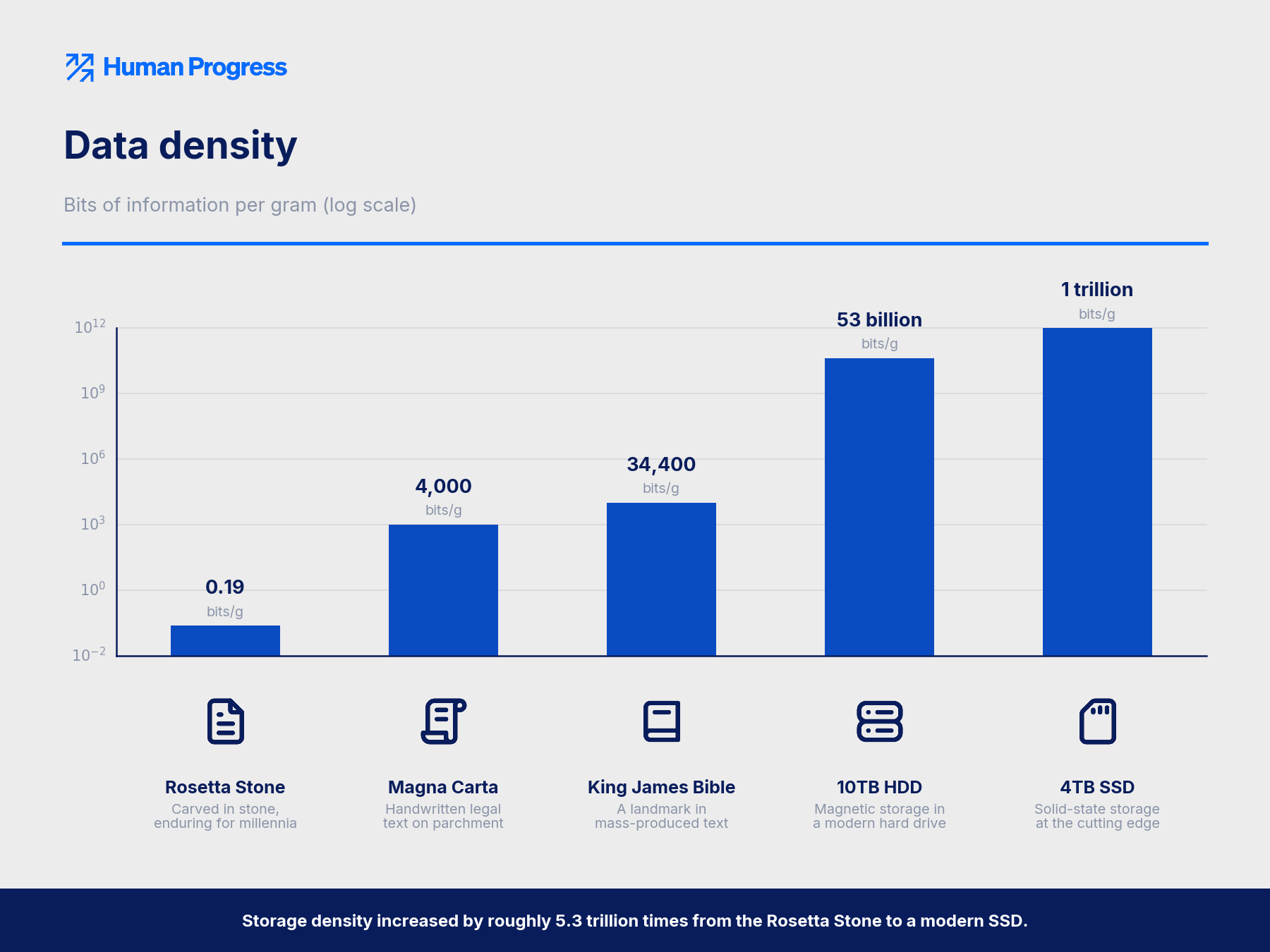
Since a single character of text equates to about 8 bits of information, the surviving 5,800 characters store 46,400 bits of data. Divided by the 250kg weight of the Greek portion, we arrive at a data density for the Rosetta Stone of ~0.19 bits/g.

With the discovery of agriculture and the rise of agrarian civilizations, the demands for knowledge storage and transmission media grew. The human population expanded, and a small but notable fraction began to congregate in small towns. As social and economic complexity grew, so did administration, trade, tax, and legal systems. Humans needed an easy way to perform and store the outputs of mathematical calculations, record taxes, and codify rules and regulations for personal and business conduct. Agrarian civilization, in short, demanded a storage medium with higher information density and faster read/write speeds (throughput). Enter papyrus, parchment, and paper.

Early forms of “paper” included papyrus and animal-skin materials like parchment and vellum. Papyrus was made from the papyrus plant, which grew in the Nile Delta in ancient Egypt. To make papyrus, strips of the plant were cut, laid into overlapping layers, and then pressed and dried into sheets. Papyrus was first used for writing as early as 2,500 B.C. and was one of the primary writing materials for thousands of years. Compared with stone, papyrus was far more data-dense; we could fit more characters on a given surface area, the substrate was lighter, and it could be folded or rolled into a scroll.

Parchment, made from cleaned and stretched animal skin, was developed long after papyrus and, thanks to its superior durability, quickly became the medium of choice for important documents. The Magna Carta, made from parchment, contains about 3,500 words or ~25,000 characters, which equates to about 200,000 bits of information. Medieval parchment weighs about 100–180 g/m², meaning the Magna Carta weighs roughly 50 grams. Using our formula, the Magna Carta’s data density comes out to around 4,000 bits/g.

Even the Magna Carta pales in comparison to modern paper with printed text. “Paper”, the flexible plant-fiber sheets we know of today, was invented in China as far back as the 2nd century B.C.. It took centuries for it to spread outside China. Paper could be made thinner and lighter than parchment or papyrus, and the printing press made it possible to fit more words on a sheet. The King James Bible, for instance, contains around 789,000 words. That’s roughly 4.3 million characters, or 34,400,000 bits of data. A standard hardcover Bible weighs about 1 kg. Even if we conservatively include the weight of the binding, the information density comes to ~34,400 bits/g, about 8.6 times the density of the Magna Carta.

Our eyesight is limited, and text can only be so small before we can no longer resolve it. The next revolution in data storage came in the form of more exotic “machine-readable” media. Examples include magnetic storage such as hard drives and magnetic tape. Here, data is encoded on magnetized material directly as bits of information – ones and zeros – by carefully controlling the polarity of magnetic domains. This technology was a wondrous breakthrough, and it’s still improving. Today, for a few hundred dollars, you can purchase a hard drive that can store tens of terabytes of data! A commercially available 10TB HDD that weighs ~1500 g can store ~80 trillion bits of data, a data density of ~53 billion bits/g, 1.54 million times higher than the King James Bible.

Yet today, hard disk drives already feel antiquated. Instead, most phones, desktops, tablets, and external drives use solid-state storage (SSDs). It’s easy to see why SSDs have become so dominant in recent years; they are ideal for mobile devices. They have no moving parts, are more durable, use less energy, and still have higher data density. Solid-state media store data by trapping electrons in a grid of floating-gate transistors to represent bits of information. A commercially available 4TB (~32 trillion bits) SSD weighs 32 grams; a data density of 1 trillion bits/g, about 19 times higher than a comparable hard drive, or about 5.3 trillion times the data density of the Rosetta Stone!

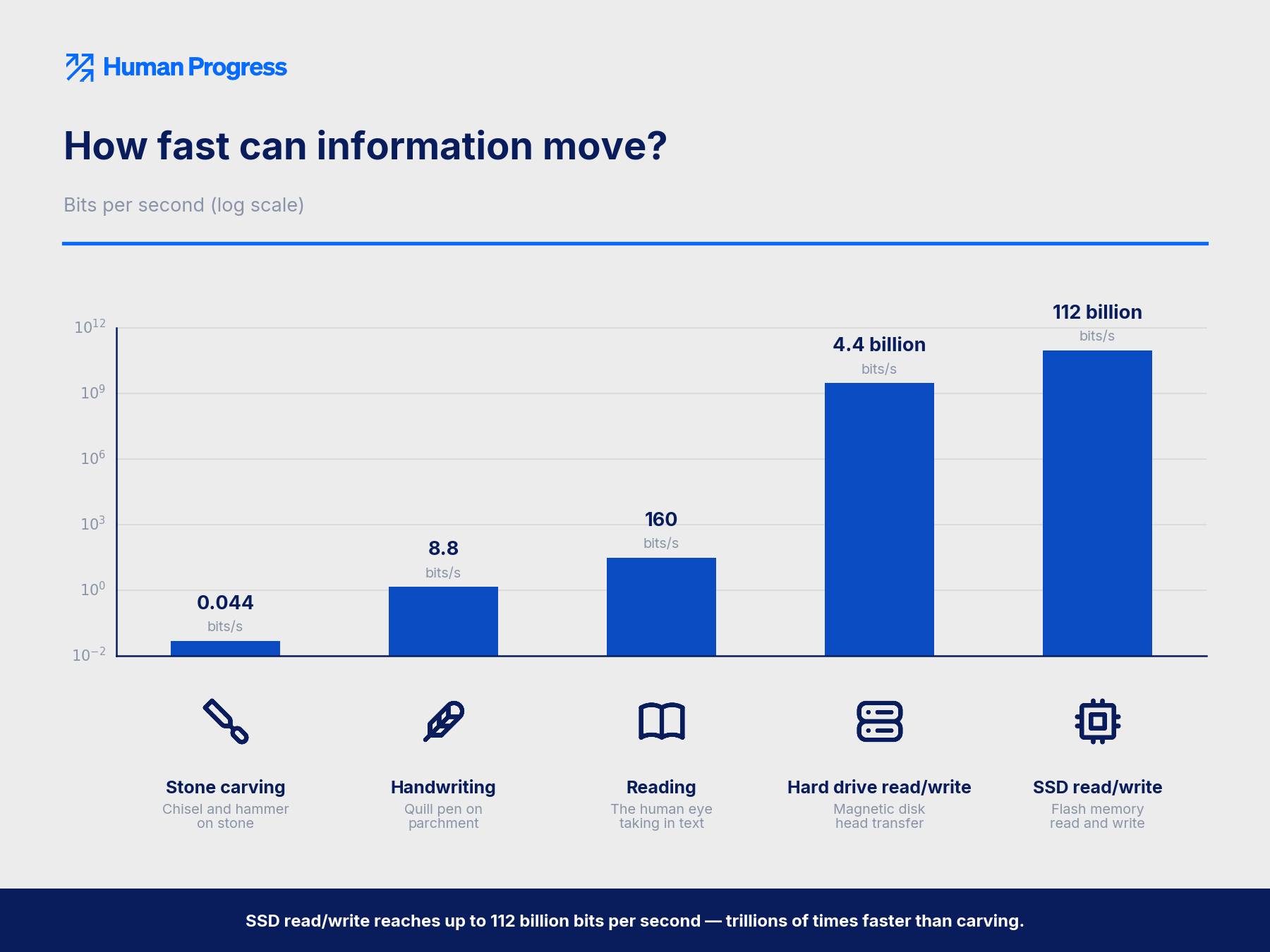
Commensurate with improvements in data density came higher read/write speeds, or “throughput.” People read about 4 words a second and with an average word length of around 5 characters; that’s about 160 bits per second. A professional stone carver might be able to write up to 20 letters an hour, or about 0.044 bits per second. Paper and paper-like media dramatically increased writing speed. A human writes about 1.1 characters per second, or roughly 8.8 bits per second – 200 times faster than carving into stone, though still slower than reading. Printing machines, of course, could print text far faster than any human could write by hand.

But none of this compares to magnetic storage, such as modern hard drives, where read/write speeds (which are similar) are currently about 4.4 billion bits per second. SSDs are faster still, reaching read/write speeds up to 112 billion bits per second. That’s about 700 million times faster than reading, and nearly 13 billion times faster than writing by hand, roughly 2.5 trillion times faster than carving into stone!

In roughly five thousand years, we’ve pushed the density of our storage media up by a factor of trillions, and the leaps keep coming faster. It took five millennia to get from stone to the printed page, representing a 180,000-fold gain in data density. In the seventy years since the invention of the hard drive, and with SSDs, humanity has multiplied that density by another 29 million times. For perspective, the text of the King James Bible carved in stone would weigh around 185 tons, nearly as much as a Boeing 747 (without fuel). On an SSD, it weighs less than a grain of sand.