01 / 05
Why Free Economies Are Honest Economies

Blog Post | Trust

Why Free Economies Are Honest Economies

Market freedom rewards honesty. Regulation breeds corruption.

Summary: Many people assume that markets breed dishonesty, but the opposite is true. Commerce depends on trust. Repeated exchange and reputation make honesty not just virtuous, but profitable. When trade is open and competition thrives, deceit is punished and integrity is rewarded. By contrast, heavy regulation invites corruption and favoritism. A truly commercial society, grounded in voluntary exchange and mutual accountability, is also a more honest and trustworthy one.


In my previous essays, I argued that a trade society is both a prosperous and trust-based society. Trust and trustworthiness in society revolve around norms of honesty. Dishonesty breeds distrust and frays the threads of our social fabric. Some may worry that dishonesty is the lifeblood of a commercial society: a system that runs on lies, with an every-man-for-himself attitude and shady opportunists around every corner. In fact, greater honesty is best achieved through reputational pressures and the mutual accountability that is fostered by frequent exchange; frequent exchange is enabled by the removal of corrupting restrictions.

In his Lectures on Jurisprudence, the Scottish economist Adam Smith described the commercial society in the following terms:

Whenever commerce is introduced into any country, probity and punctuality always accompany it . . . Of all the nations in Europe … the most commercial, are the most faithfull to their word … A dealer is afraid of losing his character, and is scrupulous in observing every engagement … When people seldom deal with one another, we find that they are somewhat disposed to cheat … When the greater part of people are merchants they always bring probity and punctuality into fashion, and these therefore are the principal virtues of a commercial nation.

In Smith’s view, fear of reputational damage and unemployment prevents fraud and dishonesty. He believed that success within a commercial society stems from “prudent, just, firm, and temperate conduct” and “almost always depends upon the favour and good opinion of … neighbours and equals; and without a tolerably regular conduct these can very seldom be obtained. The good old proverb, therefore, that honesty is the best policy, holds, in such situations, almost always perfectly true.” For Smith, the market in many ways makes us accountable to each other: repeated dealings and fear of reputational damage incentivize honest behavior. And plenty of empirical evidence supports his outlook.

Laboratory experiments demonstrate that trade teaches participants whom to trust and whom not to. Dishonest behavior is punished in the marketplace, providing an incentive for participants to be honest in their dealings. For example, one study found that adding market competition to the experiment reduced sellers’ over-diagnosis of high-quality treatment (when lower-quality would suffice) and increased buyer trust. Another experiment found that introducing market competition into one-off exchanges boosted trust and efficiency to match that of trading networks built on repeated interactions. Adding market competition and private reputation information in one experiment tripled trust and trustworthiness while increasing efficiency tenfold. By practicing honesty to protect their reputations, trade participants eventually internalize honesty as a habit.

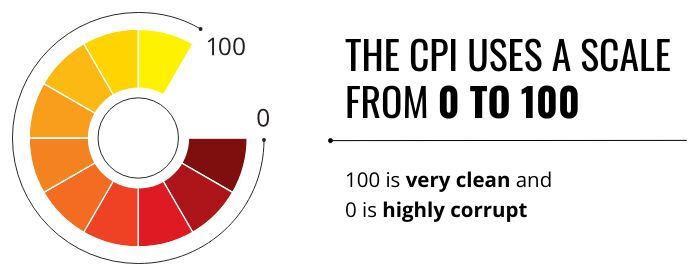
Conversely, trade restrictions lead to greater dishonesty. For example, Transparency International’s Corruption Perceptions Index (CPI) measures the perceived levels of public sector corruption across numerous countries using multiple surveys of business people and country experts (Figure 1). Various studies that rely on the CPICPI have shown that a greater amount of international trade and foreign direct investment and low levels of state control of the economy curtail corruption. High levels of regulation—including regulation on trade—tend to be a strong predictor of corruption. Even seemingly small adjustments to trade procedures can make a difference. For example, the World Bank’s 2020 Doing Business report found that “economies that have adopted electronic means of compliance with regulatory requirements . . . experience a lower incidence of bribery.” That includes digital trade reforms such as electronic single-window systems, e-payments, paperless clearance, online certificate issuance, and more.

Figure 1. Corruption Perceptions Index scale
More recently, a 2023 study looked at firm-level data across 138 countries and confirmed that the imposition of more red tape in public services—such as import licenses—is associated with a greater tendency to pay bribes, particularly in nondemocratic countries. Similarly, a recent study found that India’s trade liberalization since the early 1990s, especially tariff reductions, significantly reduced the economic advantages of politically connected firms by decreasing their reliance on political favoritism. It appears that the friendlier a nation’s economy is to trade, the less corrupt it tends to be. Economic restrictions and regulations allow corruption to grow, instead of the economy. By reducing barriers, more trade is unleashed, which in turn promotes the “probity and punctuality” that Smith described.

When the level of economic freedom within countries is compared to their level of corruption, economically-free countries come out looking relatively clean. And the scores of the freest countries are more than twice as high as those of the least free countries (Figure 2). That’s because various aspects of economic freedom—including trade openness—are associated with less corruption. Freer trade makes reputation king, mitigating corrupt incentives and embedding honest norms throughout society.

Figure 2. Economic freedom and corruption
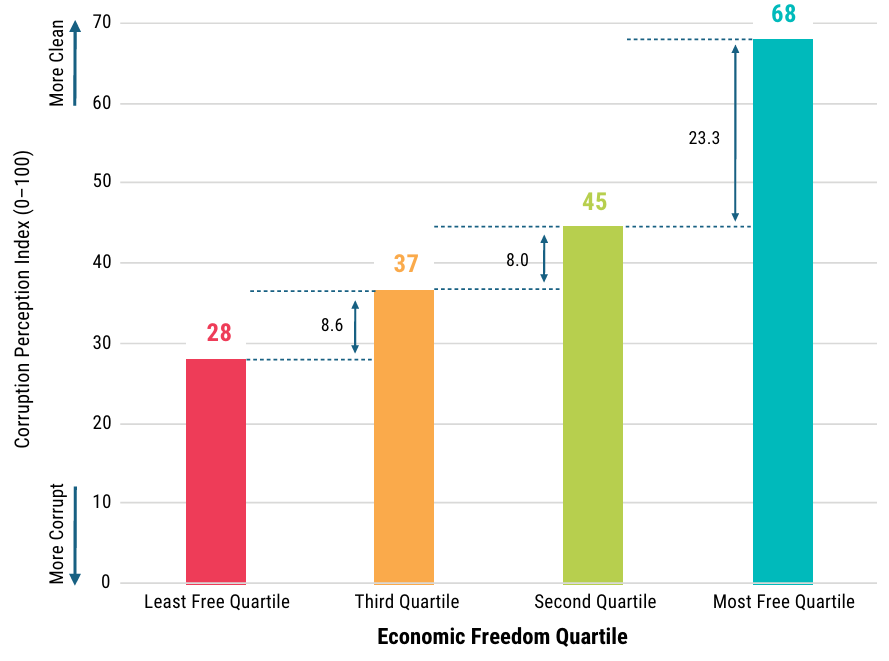
Source: Robert Lawson, Ryan Murphy, and Matthew D. Mitchell, “Economic Freedom of the World in 2022,” in Economic Freedom of the World: 2024 Annual Report, eds. James Gwartney, Robert Lawson, and Ryan Murphy (Fraser Institute, 2024), p. 33. Higher CPI scores denote less corruption.

As a case in point, East Germany suffered under severe trade restrictions prior to the fall of the Berlin Wall. After testing randomly selected German citizens on their willingness to cheat at a die-rolling game, researchers found that those who had East German (communist) roots were significantly more likely to cheat compared to those with West German (capitalist) roots. It was also shown that the longer the person had exposure to communism and its trade barriers (i.e., those who were at least 20 years old when the Berlin Wall fell in 1989 compared to those who were only 10 years old), the greater their likelihood to cheat.

These findings are supported by the work of the Mercatus Center’s Virgil Storr and Ginny Choi, who discovered a significant difference in attitudes between members of nonmarket and market societies: More than double the number of nonmarket residents versus market residents believe that avoiding fares on public transport, cheating on taxes, and bribery are justifiable. Those from nonmarket societies are also more accepting of theft compared to those from market societies (Figure 3).

Figure 3. Market versus nonmarket societies on dishonest behavior
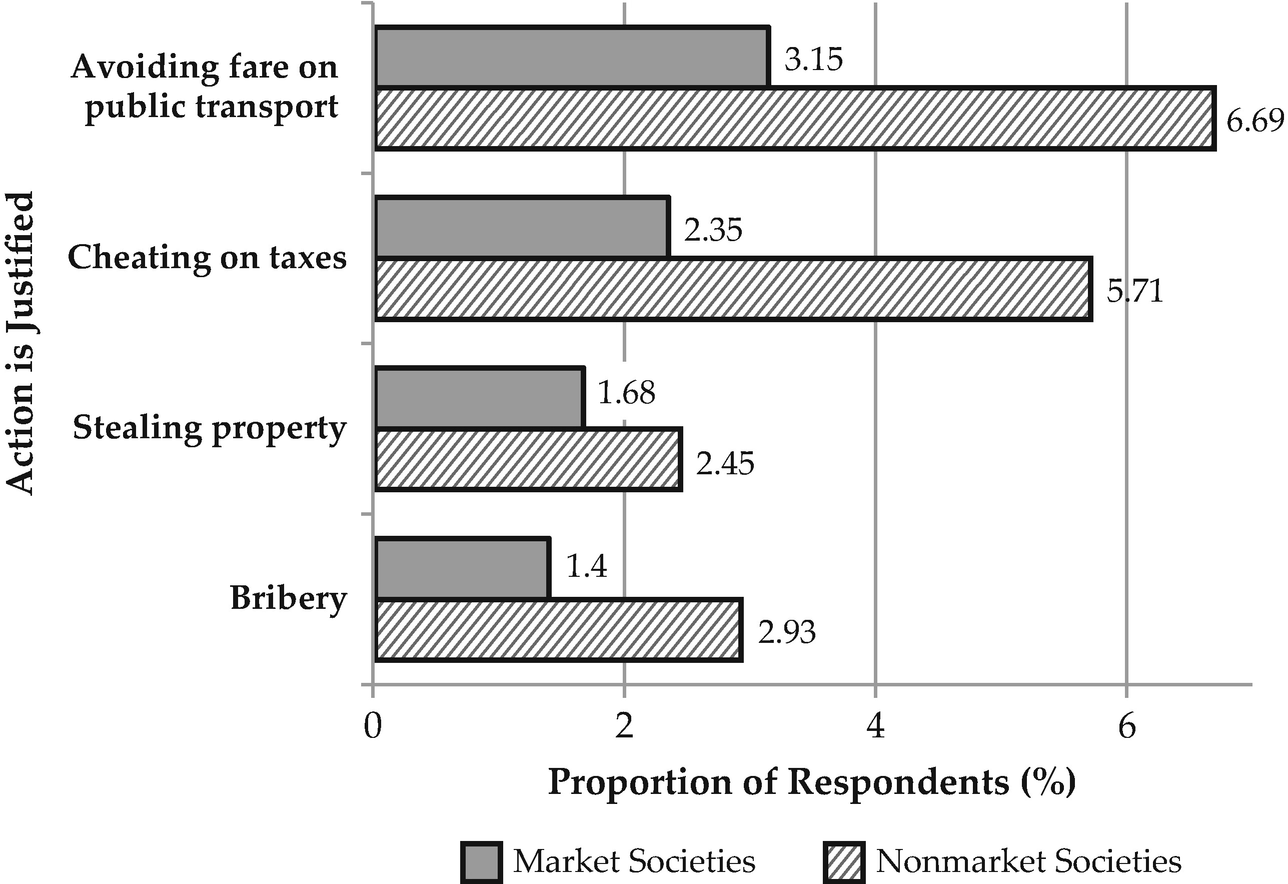
Source: Virgil Henry Storr and Ginny Choi, Do Markets Corrupt Our Morals? (Palgrave Macmillan, 2019), p. 172.

Follow-up studies by other researchers have drawn similar conclusions about market societies and honest behavior. For example, a 2023 study surveyed residents in both market and nonmarket societies on their attitudes toward claiming government benefits to which they are not entitled, avoiding fares on public transport, and cheating on taxes. After controlling for a number of variables, they found that those with greater exposure to markets were less likely to justify these dishonest actions. What’s more, individuals who preferred markets (“market thinking”) were also less likely to justify dishonesty. The researchers concluded that there is “a universal association between markets and morality” and “a robust association between an increase in market exposure and an increase in civic morality.”

Even within communist countries, research shows that the more trade-oriented areas tend to be the least corrupt. A study in China Economic Review employed the National Economic Research Institute (NERI) Index of Marketization, which measures five major fields of Chinese marketization with 23 indicators. Examining different provinces in China, the authors’ analysis found that deregulation and trade reduce corruption: a 1 percent increase in the marketization index leads to a 2.72 percent reduction in corruption. Regions that increased trade openness by 1 percent experienced a 0.35 percent reduction in corruption.

Overall, the evidence overwhelmingly suggests that open economies stifle the spread of corruption and reinforce honest habits through reputation-building exchange. The removal of trade barriers allows for more commerce to take place and, consequently, more reputations to be a stake—a powerful incentive to keep honorable reputations intact. The most enduring way to achieve this is through genuinely honest conduct. A commercial society is, at its core, a society of integrity: it limits the opportunities for corruption and encourages honest behavior in the process. The norms of commerce—Smith’s “probity and punctuality”—settle in like a kind of glue, helping to bind society together.

Manhattan Institute | Economic Freedom

Idaho Nearly Halved Its Regulatory Code

“For decades, most state regulatory systems have operated on autopilot. Once a rule is adopted, it usually stays in force unless someone can marshal the time, political will, and technical knowledge to repeal it. That default favors regulatory accumulation. Agencies add rules to address new problems, implement new statutes, satisfy federal requirements, or respond to isolated incidents. But old rules rarely receive the same scrutiny. Over time, the regulatory code grows not because every rule remains necessary but because inertia protects what already exists.

Idaho broke that pattern. And that state’s example can teach a lesson to states all over the country.

Beginning in 2019, Idaho used two related mechanisms to reset and then review its entire administrative code. First, after the legislature did not enact the customary bill extending existing rules, Governor Brad Little directed agencies to republish only the subset of rules considered necessary to that agency. But crucially, these were retained as temporary rules.

Second, the governor issued Executive Order 2020-01,[1] which required executive-branch agencies to review and generally repeal and replace each remaining rule chapter on a staggered five-year schedule covering 2021–25, with a legislative review concluding in 2026.

This issue brief refers to these combined steps as Zero-Based Regulation (ZBR). Through these two steps, instead of asking only which regulations should be repealed, Idaho required agencies to justify which provisions should remain. That shift produced one of the most dramatic state-level regulatory reductions in recent memory: by the end of the ZBR cycle on July 1, 2026, Idaho had eliminated roughly half (49.1%) of its regulatory code. Regulatory volume fell in each of the eight annual code publications from 2019 to 2026 under ZBR.”

From Manhattan Institute.

Blog Post | Economic Freedom

How Pessimism Puts Progress at Risk

There are dangers in believing the myth that everything is getting worse.

Summary: Humanity enjoys unprecedented prosperity and longevity, yet many people believe the world is getting worse. That misdiagnosis risks fueling populist policies, from tariffs and immigration restrictions to wealth taxes and hostility to technology, which threaten the freedom and openness that made modern progress possible. Sustaining progress requires recognizing its achievements and defending the principles that made them possible.


It was not in his celebrated oath but rather in Of the Epidemics that Hippocrates wrote: “As to diseases, make a habit of two things—to help, or at least to do no harm.” 

That principle reflects a basic truth of medicine: The misdiagnosis of a disease can be worse than no treatment at all. A serious illness—thought to be something minor—can progress untreated until the patient suffers serious damage or mortality. And mistaking one condition—or no condition at all—for another can result in treatment that is ineffective at best and dangerous at worst.

The same logic applies to what is happening today in the United States and other major countries around the world. At a time of unprecedented prosperity, technological advances that continue to make lives better and longer, and unparalleled distributions of these benefits to every corner of the globe, we endure a constant drumbeat of negativity that tells us this progress is an illusion. The public is persistently told that “the system is rigged” against them, that they are becoming poorer rather than richer and that their children will be the first generation in centuries to be worse off than their parents. The “American carnage” cited by US President Donald Trump in his first inaugural address is the very embodiment of this mindset.

It’s not true. By virtually any measure—income, longevity, hours at leisure, the harnessing of technology for convenience and entertainment, and the diminishment of extreme poverty around the world—today is the best time ever to be alive as a human being nearly anywhere on the planet.

In other words, humanity today is in better health than it has ever been. Populists, in response, are recommending chemotherapy.

And like any misdiagnosis, this one carries big risks of doing harm. It has stoked a populist backlash threatening to move us away from the freedom and openness that have been the engines of our success. It also increases the likelihood that we will double down on bad policies and unhelpful government interventions that are themselves the source of many economic challenges.

Age of Abundance

Humorist P.J. O’Rourke was fond of reminding us that the ordinary men and women of today’s world are freer and enjoy more material benefits than at any time since the beginning of civilization. If we were to think there was a golden era of the past in which we’d rather live, P.J.’s famous quip sobers us up with one word: dentistry.

The point is not that the past lacked virtues, but that we often overlook the quiet improvements that make life much better. Extreme poverty has disappeared for much of the world. In 1981, 42 percent of the world’s population lived on less than $3 per day. Today, that has fallen to less than 10 percent. And in the developed world, incomes and gross domestic product (GDP) per capita continue to grow nearly every year.

Innovation doesn’t just make us richer. Medical breakthroughs are removing barriers to longer, better lives: Smallpox has been eradicated; polio is on the ropes; HIV is now treatable for many; and vaccines prevent millions of deaths every year. Since 1990, the global mortality rate for children under five has fallen more than 50 percent, enabling millions more children every year to survive to adulthood. 

Time, they say, is our most precious resource, and medical innovation, better nutrition and more comfortable living conditions are creating much more of it. Since 1900, global life expectancy has more than doubled from about 32 years to more than 73 years today. And just recently we learned that life expectancy in the United States likely reached another record high of nearly 80 years in 2025.

Have these data been cherry-picked? Jump into these extensive datasets and explore trends in longevity, income and wealth, medicine, nutrition, violence and tolerance, the environment and more. Decide for yourself. It won’t take long for you to be convinced that human well-being has never been greater in a world that is freer and more peaceful than ever before.

Engine of Prosperity

The tremendous progress of the past 300 years has created the extraordinary living standards and conditions we enjoy today. Before this, the human condition had barely changed for thousands of years.

Freedom and openness, exemplified by the ideas of the Enlightenment and the values of the American Revolution, created the conditions under which this improvement could occur. As absolute government gave way to self-government that better protected citizens’ rights and liberties and as freedom allowed entrepreneurs to reap the benefits of their hard work and novel ideas, an incentive structure was created that encouraged individual initiative and innovation.

Meanwhile, freedom and individual liberty engendered the openness by which innovation and progress could flourish: open trade, freer migration and greater receptiveness to new ideas and experimentation. The experience of these last few centuries is a vindication of Adam Smith’s contention that “little else is requisite to carry a state to the highest degree of opulence from the lowest barbarism, but peace, easy taxes, and a tolerable administration of justice”. 

Smith’s formula captured the essential conditions for sustained progress. Peace provides a positive environment for trade, migration and the sharing of ideas. Easy taxes ensure that entrepreneurs, workers and investors retain enough of the rewards of their efforts to encourage risk-taking innovation. And a tolerable administration of justice preserves the individual rights and freedoms on which markets depend.

As with today’s living standards, this can also be confirmed with data. In the Economic Freedom of the World: 2025 Annual Report, co-published in the United States by the Fraser Institute and the Cato Institute, the degree of economic freedom is calculated and compared for 165 countries. Economic freedom is measured by reference to the size of government, the protection of property rights, monetary soundness, the freedom to trade and the amount of regulation.

Based on the 2023 data used in the report, the correlation between freedom and income is compellingly strong. The world’s countries are divided into quartiles from least free to most free. Measured by per capita GDP, people in the 25 percent most-free countries earn on average in excess of six times more than people in the 25 percent least-free countries.

And the advantages of living in a free country go well beyond money. Compared to those in the least-free quartile, those in the most-free quartile live an average of 17 years longer and work nearly 17 percent less. In the least-free quartile, the poverty rate is 25 times higher, and the rate of infant mortality is nearly 10 times higher compared to the most-free quartile.

Cognitive Dissonance

So, if things are so good, why are we reluctant to believe it? Why are we willing to listen to populists on both sides when they tell us that things are bad and life is getting tougher?

The first reason is that there’s a market for bad news. If The New York Times proclaimed on its front page: “115,000 People Worldwide Escaped from Extreme Poverty Yesterday”, would it sell more newspapers? Probably not. Or at least not as well as a political scandal, natural disaster or other tragedy. But that astounding statistic is, in fact, the average daily drop in extreme poverty over the past 25 years.

Second, without a doubt, life can be difficult. It’s natural to focus on one’s daily challenges and not consider how well off we are in the context of history. Even today, certainly the best time to be alive, earning a living and raising children aren’t easy. And as well off as we may be, there will always be someone more fortunate or some item of consumption that’s out of our reach. This makes us feel worse off.

Many middle-class Americans, while living better than their parents and grandparents, can feel strapped by the high costs of housing, health care for their families and higher education for their children. Ironically, the challenge of accessing these key products has stimulated government interventions that have greatly increased their costs and exacerbated accessibility challenges.

In each of these sectors, policies have been pursued that have restricted supply (for example, through licensing requirements, zoning and land-use regulations or accreditation) while subsidizing demand through a variety of mechanisms. Any economics undergraduate should recognize that simultaneously restricting supply and subsidizing demand will generate price inflation. Yet when it does, the policy response is often not to unwind these counterproductive approaches but to double down and further subsidize demand. Thus, policies that are well-intentioned at best—or politically motivated at worst—can create what is perceived as an affordability “crisis”.

Do No Harm

To believe things are getting worse when they have, in fact, never been better is a classic misdiagnosis. And like a medical misdiagnosis, it risks ill-advised treatment when a popular groundswell for government intervention encourages populist leaders happy to oblige. Yet such policies will always have the opposite effect—exacerbating the problems they’re intended to address. 

By far the most worrisome dynamic is that these interventions could move us away from the freedom and openness that have been the source of our prosperity and well-being, compromising the beautiful trendline of progress and rising wealth that has persisted for more than two centuries. And the continuation of that trend is not a foregone conclusion. This misdiagnosis fuels zero-sum thinking that motivates attacks on the very things—such as freer trade and migration—that have contributed substantially to our benefit.

Already, this is happening. The index of global economic freedom highlighted in the Economic Freedom of the World: 2025 Annual Report hit an all-time peak in 2019. It has since declined sharply, particularly in the wake of the heavy-handed policy responses to the COVID-19 pandemic. (But the rise of economic populism and discontent in developed economies has likely also played a part.) The index of economic freedom in the United States has steadily eroded since 2000 and has dropped sharply since 2017.

But beyond any index, we can see these threats clearly in the policy environment, particularly in the backlash against immigration in much of the West, the turn against open trade and the imposition of high and erratic tariffs in the United States. The US political arena has also experienced a stoking of class warfare, attacks on entrepreneurs as “oligarchs” and agitation for the imposition of wealth taxes. Antipathy toward technology companies exists on both extremes of the political spectrum. And this sentiment is spreading to technology itself, as exemplified by the growing resistance to artificial intelligence (AI) and attendant infrastructure such as data centers.

It’s nothing short of dangerous when public sentiment turns against innovation and innovators and against the very openness and freedom that have created our wondrous modern world. And it’s ironic when this is driven by misperceptions about the true state of the world and the economy. As Daniel Hannan, a notable British advocate for openness and trade, observed, “Open markets lifted billions from poverty, added decades to our lives, gave us powers that previous generations attributed to wizards or gods. And we never noticed.”

It’s time for us to take notice and to defend the principles that have brought us to this point. This is how the upward march of progress and prosperity will continue, creating the brightest possible futures for those who come next.

This article originally appeared in International Banker on 9/15/2026.

Blog Post | Income & Inequality

Solving the Conundrum of Status Competition

A free-market economy does not abolish the competition for status, but it gives people more places to compete.

Summary: Prosperous societies can produce more educated, ambitious people than established prestige systems can accommodate. When recognition depends on a narrow set of institutions, status competition intensifies and frustration grows. Independent platforms, new institutions, and emerging industries can create alternative paths to achievement. Economic and technological dynamism can therefore ease the pressures of status competition by expanding the arenas in which people can succeed.


The Democratic Socialists of America are having a moment. The group’s membership passed 120,000 members in July, overtaking the Eugene Debs-era Socialist Party of the early 20th century as the largest socialist organization in American history. New York Mayor Zohran Mamdani is a democratic socialist, and DSA candidates won a handful of primary elections over the summer. The DSA’s rise is often attributed to inequality, resentment, or ambition. But critics have pointed out that many DSA members are highly educated or come from wealthy families, so something else must be at play. 

People compete for more than income. They compete for reputation, recognition, influence, and rank. The economist Fred Hirsch described such goods as “positional” in his Social Limits to Growth (1976). More food, housing, or energy can make many people better off simultaneously. Status works differently. Simply handing out more titles within a single hierarchy does not create more prestige, because relative rank within any given ladder is zero-sum.

Joseph Schumpeter identified a related problem in Capitalism, Socialism and Democracy (1942). He argued that prosperous societies would educate more people than established prestige systems could absorb. Many would acquire the education and expectations associated with elite positions without obtaining them. Some, he thought, would respond by turning against the source of that prosperity—the free-market system. Schumpeter’s prediction has not aged badly. 

Status competition is most consequential when many people depend on the same hierarchy for recognition, income, or professional identity, especially when alternatives are scarce and exit is costly.

Academia illustrates the mechanism. Scholars compete for jobs, tenure, publications, grants, and recognition within the same institutional system. Years of specialized training can make exit difficult. A scholar who has invested a decade acquiring specialized skills may have few opportunities to obtain comparable income and standing elsewhere.

Relative advantage can be pursued by improving one’s own position or by reducing the standing or opportunities of competitors. The first can involve producing research, teaching, or discovery. The second can involve challenging a rival’s competence or fitness for membership without producing an equivalent intellectual contribution. That does not mean criticism is illegitimate or that every dispute is driven by status. Ideological disagreements can be sincere, and institutions need mechanisms for identifying error and misconduct. The narrower point is that institutional arrangements affect incentives. When one hierarchy controls a large share of available rewards, the potential payoff from influencing membership and advancement within it increases.

For much of the 20th century, journalism operated in a similar way. A small number of newspapers, magazines, and television networks controlled access to national audiences. Losing a position at an important publication could mean losing both income and public visibility.

The internet changed that. Journalists and commentators can now reach audiences through newsletters, podcasts, YouTube, and other platforms. A writer rejected by a newspaper can publish directly on Substack or a personal website and promote work via social media. A broadcaster without a network contract can still reach millions on X or YouTube. Competition for status remains and has arguably grown harsher, but failure in one hierarchy no longer determines a person’s prospects elsewhere.

Academia is beginning to experience the same change. Scholars can reach readers through subscription platforms, podcasts, and online lectures. Preprint servers allow research to circulate before journals approve it. Private laboratories and research institutes offer employment outside conventional departments. Organizations such as Arcadia Science and the Arc Institute are experimenting with funding scientists rather than rigid project proposals, providing multi-year support to follow promising questions without the constraints of predefined deliverables.

Alternative teaching institutions are also emerging outside legacy university systems. The University of Austin—founded as an independent, tenure-free institution dedicated to open inquiry—enrolled its first undergraduate class in 2024. Meanwhile, Peterson Academy bypasses campus infrastructure entirely, offering low-cost, recorded university-level courses that have attracted more than 80,000 subscribers. These institutions remain small, but they do not need to replace established universities to matter. They need only provide credible alternatives for some students, teachers, or scholars.

Those alternatives remain incomplete. Scientific research can require laboratories, equipment, teams, and funding that individuals cannot access or provide independently. Credentials still matter in medicine, law, and other professions. Capital requirements and network effects can also concentrate opportunities.

Government policy can strengthen or weaken this concentration. When research funding, accreditation, licensing, or other forms of authorization channel people through the same institutions and evaluation systems, policy can reinforce common hierarchies. Dispersing authority among independent funders, accreditors, jurisdictions, and institutions can create more routes to advancement.

The objective should not be to eliminate hierarchy. Reputation conveys information. Organizations need ways to identify competence. Competition for recognition can motivate effort and discovery. Relative rank cannot become abundant in the way food or energy can. The objective should be to multiply independent arenas in which people can succeed.

That is one reason economic and technological dynamism matters beyond higher income. New firms, industries, technologies, and institutions create new occupations and forms of achievement. The automobile created the mechanic and the highway engineer. Software created the programmer and the product manager. Each of these technologies built ladders that did not exist before.

Stagnation creates fewer such openings, and collectivist policies tend to yield stagnation, whether they come from the left or the right. Ambitious people must compete for a more fixed set of positions, making success or failure within existing institutions more consequential. A free-market economy does not abolish the competition for status, but it gives people more places to compete.

This article originally appeared in The Dispatch on 9/15/2026.

Reason | Economic Freedom

New York City Moves to Cut Small-Business Red Tape

“New York City government isn't known for cutting red tape. But this week, New York Mayor Zohran Mamdani (yes, the democratic socialist) announced more than 50 reforms that would eliminate unnecessary regulations and high permitting and licensing fees for small businesses.

The reforms, unveiled on Monday, cover a variety of small business issues, from outdoor dining rules to pawnbroker licenses. During a speech in the Bronx, Mamdani announced that the city would work with the state to eliminate the frozen dessert permit, which requires restaurants that already have food permits to 'seek out a superfluous second permit for what they're already doing.'

He also said the current state of regulatory affairs for barbershops is 'anti-fade,' as shop owners must obtain three different permits to operate their business. Mamdani announced the city would work with the state to streamline those permits as well. Among dozens of other reforms, the Mamdani administration will also reduce street fair vendor permit fees, speed up restaurant inspections, and cut equipment registration fees from $110 to $0 for 12 months…

In addition to these proposed regulatory changes, Mamdani signed an executive order on Monday creating a task force of city agencies that will continue to identify opportunities for reform.”

From Reason.