01 / 05
What Ma and Keynes Get Wrong About Progress

Blog Post | Adoption of Technology

What Ma and Keynes Get Wrong About Progress

Desire for greater material well-being is not a moral failing. Yearning for a better life has driven progress over the past 250 years.

British economist John Maynard Keynes once said that “[p}ractical men who believe themselves quite exempt from any intellectual influence, are usually the slaves of some defunct economist.” It’s unclear whether Chinese tech billionaire Jack Ma is a Keynes discipline, or considers himself immune to economists’ musings. But in forecasting that technology and automation might deliver a 12-hour working week, Ma certainly echoes Keynesian thinking about economic progress.

Sharing a stage with U.S. entrepreneur Elon Musk in Shanghai, Alibaba founder Ma this week predicted that artificial intelligence and automation will deliver unheard of gains to productivity. Offering an upbeat story of its effects, he suggested that producing more with fewer workers will reduce the desirable working time to just “three days a week, four hours a day.” Instead, we will be able to spend extra time enjoying “being human beings” and going to “karaoke in the evening.”

In a 1930 essay entitled “Economic Possibilities for our Grandchildren,” Keynes made a similar prediction. Within a century, he believed we’d be four to eight times as rich. Such would be the technological advances in production driving more output with less labor input, our economic needs could be fulfilled by just working “three-hour shifts or a fifteen-hour week.” Even working that long would be reflective of our natural human desire to stay occupied, rather than out of necessity. Keynes even mused that people would have more time to sing too!

As we contemplate the long hours we’ll spend at our desks this next week, it’s easy, in retrospect, to dismiss Keynes’ musing as a flight of fancy. But in fact, a lot of what he wrote was prescient. What he got wrong should make us think skeptically about Ma’s musings of what it means to be human.

Keynes’ forecast of our prosperity boom was unnervingly accurate. With a decade to go, the U.S. is already six times as rich in real GDP per capita terms as on the eve of 1930.

Improvements in the technology of domestic appliances has meant that traditional “household work” — the basics of laundry, cooking, and cleaning — have fallen time-wise from being a near full-time occupation (38 hours) in 1930 to just 15 hours in 2015. If Keynes’ prediction had been about chores, he hit the bullseye.

What he got wrong was what technology and innovation would mean for paid working hours. Yes, full-time production workers’ average hours have fallen from 48 hours to 40 hours since 1930. Productivity improvements, in other words, delivered a whole extra day off, as we saw the birth of the modern weekend. As a result of more part-time and flexible work, an average employed person’s working hours have fallen from 38 hours per week in 1950 to 34 hours per week in 2014 too. Yet we are clearly nowhere near the 15-hour work week he projected.

Keynes severely underestimated that, when free to choose, most of us seek further material advancement and betterment, and value the inherent dignity that comes from productive labor in the service of others. As progress raises wages, the opportunity cost of leisure rises. Faced with this trade-off, we still maintain substantial hours of employment.

This search for greater material well-being is not some moral failing, as Keynes implied. In fact, it’s precisely this yearning for a better life that has driven progress in the past 250 years. Most people are not content with modestly rising living standards driven by technological improvements producing slightly more with fewer and fewer workers, allowing us to “have fun.” They want to enjoy the best goods, services and experiences possible for their families. They want to feel the dignity of their services being needed. They want to see their living standards propelled.

If predictions about automation are correct, then the next 30 years could well see rapid improvements in technology, as Ma implies. Service sector employment could be revolutionized, with lots of tasks currently undertaken by lawyers or doctors ripe for automation or being replaced with artificial intelligence or robotics. This will make us rich, and disrupt established occupations and work patterns. From a policy perspective, that will bring demands for jobs to be protected and innovations restrained. Predictions of “mass worklessness” will feed calls for huge social programs too, whether universal basic income us or government project jobs to give people meaningful purpose.

But the past century shows we shouldn’t fear technological change, nor presume its labor market effects will have vast destructive social consequences or change who we are. As the opportunity for leisure time and greater comfort has risen, we’ve maintained our desire for betterment and meaningful labor. That shows there’s no discrepancy between employment and “being human beings.” Striving and toiling is part of who we are.

Contra Ma and Keynes, then, I doubt increased productivity will result in mass karaoke singing. We will enjoy more comfort and the option of more family and leisure time, yes. But the recent past suggests that workers will shift into jobs delivering new entrepreneurial pursuits, into meaningful vocational activities, and new jobs where human contact and effort are highly prized by further enriched customers.

This first appeared in Medium.

Blog Post | Employment

Human in the Loop: Why Technology Destroys Jobs and Creates Better Ones

Past waves of automation have kept humans in the loop, and AI is unlikely to be different.

Summary: Job losses in individual industries can accompany a growing, increasingly prosperous economy. By lowering costs and increasing purchasing power, technology expands demand and supports employment elsewhere in the economy. AI is likely to follow this pattern, raising productivity while sustaining demand for human judgment and physical skills. Although some workers face painful transitions, history offers reason to expect higher wages and better working conditions.


In one scene in John Steinbeck’s The Grapes of Wrath, set in Oklahoma in the mid-1930s, a tractor arrives, and one man on a machine suddenly does the work of a hundred people. Families of farm workers, like the Joads, the novel’s protagonists, are driven off the land, and tragedy follows as the family heads west, where promised work proves scarce to come by. Today, as AI spreads across the economy, the old fear of machines putting humans out of work is running high once again.

However, technology has advanced for centuries, shuffling workers among occupations, industries, and regions without making human labor obsolete. As machinery pushed millions of Americans away from farming over the past century, most workers moved to factories, towns, and cities. They ended up with more comfortable lives than their predecessors plowing the fields. The AI economy will likely follow the same path: destroying jobs while creating better ones.

In the vocabulary of AI engineering, a “human in the loop” is a person who reviews, approves, or corrects what an automated system does. The phrase also fits a much larger pattern. Tools and machines keep saving human labor, yet humans stay in the loop, doing what machines still can’t, and more work remains as machines raise total output. The economist Joseph Schumpeter called the process of technology destroying old jobs, firms, and industries while creating new ones “creative destruction.” Workers in a dynamic economy need to be adaptable, yet history gives us reason to feel more excitement than fear about AI-driven job loss.

The Great Declines in Farm and Factory Work

Technological job loss is real, and farms are Exhibit A. In 1800, about three-quarters of American workers were farmers. The farm share of the workforce fell over the 19th century, but the number of farm workers continued rising, reaching 11.6 million in 1910 in one historical series. Then farm employment entered a long decline. Between 1948 and 2017 alone, it fell 81 percent, even as agricultural output nearly tripled. By 2022, direct on-farm employment accounted for just 1.2 percent of US jobs. Americans today eat more and spend far less of their income on food. In 1929, buying food accounted for 23.4 percent of an average person’s disposable income and only 9.7 percent in 2025.

Three forces drove declining farm employment. Technology was the biggest: tractors, combine harvesters, better seeds, pesticides, and fertilizer let farms grow more with far less labor. Rising wages sped things up. As factories bid up labor costs, machines that were too expensive when hired hands were cheap became a bargain. Rising demand for food pulled in the opposite direction, toward the need for more farm jobs, but only mildly. People buy more food as they get richer, but not that much more, because there’s only so much a person can eat, and more of each food dollar goes to factory processing and restaurants.

Steinbeck’s story captures a real collapse in the farming sector, but the Joads’ miseries owed less to tractors than to the Great Depression, which technology didn’t cause. Milton Friedman traced its severity to a catastrophic monetary contraction in 1929–1933. Jobs in town disappeared. Farm employment actually rose in the early 1930s as jobless city dwellers retreated to the land. In normal times, farm workers drifted steadily into factory and town jobs that were more comfortable and better paid.

Manufacturing followed a similar path decades later. Factory employment peaked at 19.6 million in 1979, drifted down until 2000, and then fell by nearly six million jobs in a decade, driven by trade and productivity growth. However, it has since regained about one million. One Ball State University study attributed about 88 percent of the decline in US manufacturing employment between 2000 and 2010 to productivity growth, rather than foreign trade. Factories have become Exhibit B for technology-driven job loss.

These transitions weren’t painless. Some displaced workers never regained their former earnings, and some towns have emptied. My grandmother grew up in Osgood, Idaho, then a community of potato farmers. When I visited in 2024, little of that community was left. But most displaced workers, and especially their children, went on to do better-paid and more comfortable work somewhere else.

Who’s next? Self-driving vehicles may take millions of drivers’ jobs, and AI is already displacing substantial amounts of customer service work. What’s new about AI is that it threatens highly educated workers who never expected to be automated. Software engineers, writers, and translators are feeling the disruption now, and doctors, lawyers, and professors are wondering whether a machine could do their jobs better. But the disappearance of particular jobs does not mean the disappearance of work.

Where the Lost Jobs Go

To see why work will remain, follow the money. When technology cuts costs on the farm, food gets cheaper, and people buy more of it, but they also have more money left to spend on something else, like health care, travel, restaurant meals, education, and new gadgets. Jobs multiply in sectors with elastic demand or slower productivity growth.

Looking only at the industries that shed workers and concluding that work is disappearing is what economists call a “fallacy of composition.” What’s true of some of parts of the economy may not be true of the whole. The typical pattern is for technology to shrink employment in one industry, or several industries, even as the purchasing power it releases supports jobs elsewhere, and the total number of jobs increases.

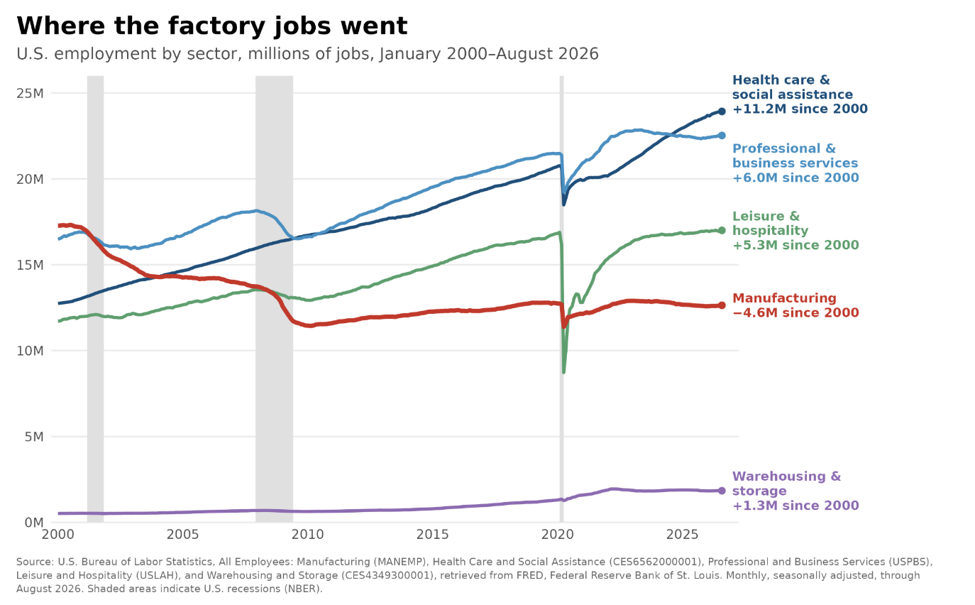
Since 2000, as the United States lost about 4.6 million factory jobs, just four sectors added nearly 24 million. New jobs in health care and social assistance, professional and business services, leisure and hospitality, and warehousing and storage have far outpaced factory job losses. Employment in all of these sectors grew faster than population growth, jointly adding more than five jobs for every factory job lost (Figure 1).

Figure 1

How Jobs Get Better

Jobs don’t just return; they improve over time. When a major new technology raises productivity across many industries at once, as AI is expected to, the whole economy grows richer. As real incomes rise, demand grows fast enough that many industries sell far more and need more workers, not fewer. Because each worker produces more, employers can and must compete harder for workers, offering higher pay, shorter hours, and safer, more pleasant conditions.

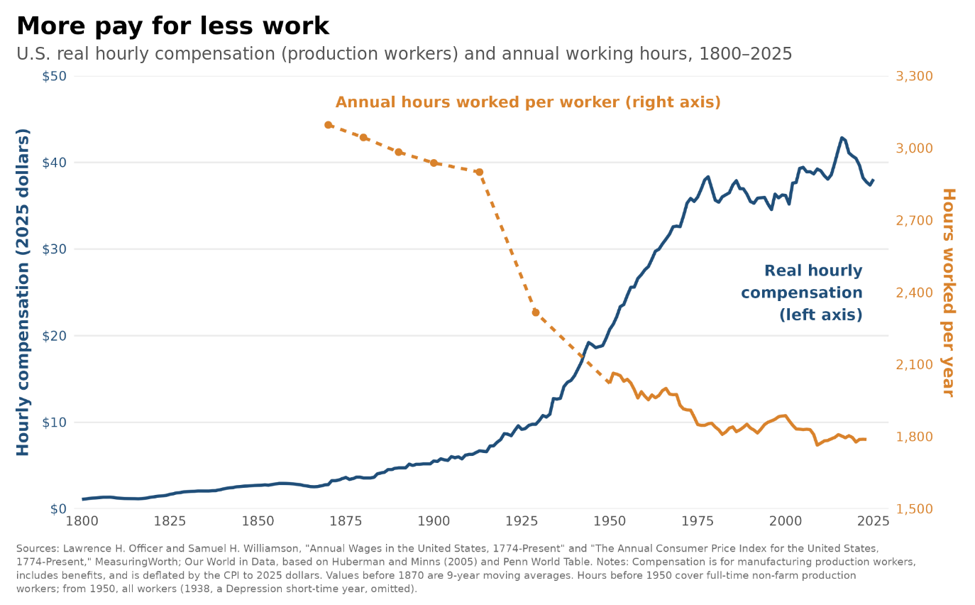
Henry Ford’s Model T is the classic example of this dynamic. Its nominal price fell from about $825 in 1909 to under $300 by the mid-1920s, and sales soared into the millions. In inflation-adjusted terms, the price drop was even steeper. In 1914, Ford famously doubled wages to $5 a day to attract and keep workers. From the late 19th century through the mid-20th century, as railroads, cars, electricity, telephones, and assembly lines spread through the economy, many industries followed that pattern. For workers, the result was dramatic: far higher pay for far fewer hours of work (Figure 2).

Figure 2

Pay and hours aren’t the only gains from creative destruction. Work has also grown far safer: by the time the Occupational Safety and Health Administration was created in 1971, worker fatalities had already fallen by roughly two-thirds from their pre-World War I levels. Machines have taken over much of the drudgery, leaving people with more work that calls for judgment and creativity.

Measured wage growth slowed beginning in the 1970s, along with productivity growth, though HumanProgress’s time-price analysis finds that an hour of work still buys about 20 percent more goods and services than it did in 2000. That statistic, along with Figure 2, likely understates recent gains because both use the Consumer Price Index, which likely overstates inflation. Still, the fast wage growth of the mid-20th century hasn’t returned. A powerful new general-purpose technology like AI should, if anything, end what economist Tyler Cowen calls “the Great Stagnation” and bring fast wage growth back.

The Future Flourishing of Human Labor

In May 2025, Anthropic CEO Dario Amodei warned that AI could wipe out half of all entry-level white-collar jobs and push unemployment to 10–20 percent within one to five years. Goldman Sachs estimates that 15 million workers, or nine percent of the workforce, will be displaced over the next decade. History casts doubt on these forecasts. Still, displacement over a decade differs from unemployment at any one time. Workers move on to new jobs.

Humans will stay in the loop for two reasons. First, AI still depends on people for initiative, judgment, creativity, and critical thinking. Second, as the roboticist Hans Moravec observed, computers find tasks that are intellectually “hard” far easier than physically “easy” tasks that almost anyone can do. Right now, investment in AI training data centers is creating thousands of construction jobs. A 2024 study from Virginia’s Joint Legislative Audit and Review Commission estimated 35,000 direct jobs from AI, mostly in construction, supported by the data center industry. Similarly, a Goldman Sachs analyst forecast 500,000 net new jobs by 2030, especially for construction workers and electricians, as power-generation capacity expands to meet the needs of growing data centers. The Economist reports an AI jobs boom. As AI makes the economy richer, the wealth it creates keeps pulling workers back into the loop at higher wages.

Steinbeck’s story deserves to be remembered, not as a prophecy or even a cautionary tale, but as a reason to be grateful that we’ve left it behind. The Joads took to the road in search of work, a home, and a better future for their children, and found only disappointment. Today’s workers face much better fortunes, even if a few surprises and setbacks are likely. Despite everything, human labor is already thriving as never before, and the work of the future will be even better.

Blog Post | Computing

Machines Can Crunch Numbers, but Humans Still Need to Understand Them

In the age of AI, humans remain the ultimate resource.

Summary: Recent AI breakthroughs invite the question of whether human minds are still the “ultimate resource,” as Julian Simon claimed. AI can generate answers far faster than humans can check them, but Joel Mokyr’s distinction between knowing that something works and knowing why shows that both kinds of knowledge must advance together. Candidate proofs are not theorems, and predictions are not findings. That is why the age of AI calls for more educated minds, not fewer.


Last week, OpenAI published more than 370 mathematical results spanning algebra, theoretical computer science, and mathematical logic. Most came from a single prompt and about three hours of computing time. “If a human did this, it would be an instant Fields Medal, no questions asked,” wrote Alex Kontorovich, a professor of mathematics at Rutgers University.

In his 1981 book, economist Julian Simon called people “the ultimate resource” because nothing else can create new ideas. Simon argued that new human ideas lead to innovation, and innovation drives economic growth and underpins modern prosperity. Forty-five years on, and with announcements of AI breakthroughs dominating headlines almost every week, it’s easy to be skeptical of Simon’s claim.

OpenAI announced last month that after 88 hours of work, its AI had cracked the Navier-Stokes existence and smoothness puzzle, one of the seven Millennium Prize Problems that has baffled mathematicians for almost a century. On the same day, Google DeepMind released AlphaGenome Atlas, which maps the predicted molecular effects of all nine billion possible single-letter changes to human DNA. If the nature of innovation is changing, are we still “the ultimate resource”?

Ideas, as the science writer Matt Ridley wrote in 2010, “have sex.” In The Rational Optimist, Ridley argued that innovation is not the work of solitary geniuses but happens when human minds come together. As societies become increasingly open and specialized, more people with different expertise meet, discuss, and recombine ideas. The result is what Ridley called the “collective brain”: the knowledge spread across society that no individual holds.

For recent AI breakthroughs, every system runs on humanity’s collective brain. OpenAI’s agents worked from a cached copy of the internet, and AlphaGenome was trained on thousands of experiments on human and mouse DNA, all of it somebody’s lab work. For years it was implied – simply because no alternative existed – that for ideas to have sex, both partners had to be human. If ideas no longer need two human minds to have sex, as Ridley put it, one might conclude the collective brain has found a replacement for humans altogether.

That assessment is overly pessimistic, however. Since these breakthroughs recombine ideas humans had already written down (albeit at inhuman speeds), the machines look less like second parents and more like a very fast medium through which human ideas meet and get down to business. One-nil, humans.

Beyond depending on existing human knowledge, OpenAI’s breakthrough also relied on human methods. To tackle Navier-Stokes, OpenAI ran about 10,000 agents at once, divided into groups that explored different areas and talked among themselves. As groups made progress, the most useful insights were consolidated and fed back to the other agents. Roughly 2.7 million messages were exchanged before an answer emerged.

Many rival agents working in parallel, immense specialization, most of them failing while the rest built on what was most valuable. Free market galore!

Humanity is surely better off with the additional knowledge AIs produce. Yet whether it is agents creating mathematical proofs that could solve centuries-old problems, or my own AI delivering thousands of words of research reports I haven’t found time to read, the bottleneck to innovation still lies with us.

In DeepMind’s case, AlphaGenome Atlas can predict what genetic variants can do, but it doesn’t comprehend the biology beneath them. A list of predictions settles nothing on its own. A human mind must decide which subset to study, and Atlas’s predictions are not findings until somebody in a laboratory confirms them. Knowing that a DNA variant matters isn’t the same as knowing why.

In OpenAI’s case, mathematicians worldwide are still assessing the proof’s validity. Three days after the announcement, without naming any company, 25 Fields Medal winners published an open letter about AI and the discipline of mathematics, noting that “solving problems is only a tool and proxy for achieving the primary goal of conceptual understanding and insight.” The signatories note that AI can accelerate mathematical work, but human understanding produces the next question worth asking.

The gap between output and understanding predates AI. The economic historian Joel Mokyr, who won the 2025 Nobel, distinguishes two types of knowledge. “Prescriptive knowledge” is knowing that something works. Think Edward Jenner knowing that exposure to cowpox provides immunity against smallpox, long before anyone knew why. “Propositional knowledge” is understanding why something works, such as comprehending the underlying science or natural laws. Mokyr’s answer to why the Industrial Revolution did not stall like earlier golden ages is that Europe got both types of knowledge moving together.

The latest wave of AI discoveries could make one pessimistic about humanity’s role in the future of innovation. But Mokyr’s point is that the two types of knowledge should move together, and understanding why something works matters just as much as knowing that it does. Candidate proofs are not theorems, and predictions are not findings.

AIs can crunch statistical correlations, draw on what humans already know, and generate prescriptive knowledge far faster than any human mind can convert the output into something verified, trusted, and useful. That is why we need more educated minds, not fewer. The scarce resource, indeed the ultimate resource, is still us.

A version of this article was first published in the Washington Examiner on 10/13/2026.

The Economist | Employment

AI-Related Jobs Are Growing in the US

“"The Economist tracked five industries at the heart of the data-centre build-out, from electrical contracting to equipment manufacturing. Since 2023 employment in them has risen by roughly 320,000 more than broader construction and manufacturing trends would suggest. The Bureau of Labour Statistics (BLS) expects utilities to be the fastest-growing big sector between now and 2035…

AI is also creating a new class of white-collar jobs…

Preliminary research by Gad Levanon, chief economist at the Burning Glass Institute, uses the research outfit’s career history database (which mostly relies on LinkedIn career histories) to identify jobs that would not exist without AI, whether at AI-native firms or because they are AI-specific roles at other companies. He reckons roughly 1% of professional jobs are now 'AI jobs'—on the order of 1m positions in America. In computer occupations and life sciences—including researchers using AI to discover new drugs—the share is 4-5%. LinkedIn’s own analysis points to roughly 640,000 new AI-specific jobs between 2023 and 2025…

A third source of jobs comes from productivity gains. AI allows lawyers to draft contracts faster and analysts to comb through financial filings in minutes. If higher productivity lowers the cost of professional services, it is possible that demand for them can rise enough to create more work overall.

Some of the occupations once believed to be most vulnerable to AI appear to be benefiting from this effect. Between 2023 and 2025 employment among paralegals rose by about 11% and among market-research analysts by 6%, compared with a national average of around 2%.””

From The Economist.

Federal Reserve Bank of New York | Technological Readiness

Regional Businesses Adopt AI Without Widespread Layoffs

“The ongoing advancement and adoption of artificial intelligence continues to raise concerns about widespread job losses. Over the past three years, our regional business surveys have asked firms about their AI adoption and its effects on their workforces. This year, we found that AI use among regional businesses has continued to rise sharply, with more than 60 percent of service firms and about half of manufacturers now using AI—a notable increase from 40 percent and 26 percent, respectively, reported in 2025. Despite this rapid adoption, regional firms’ investments in AI are generally modest, usage tends to be concentrated among a small share of workers within firms, and layoffs have remained uncommon. And, while some firms have scaled back hiring due to AI, others have added workers to help them use it. Retraining employees in response to AI remains the primary way firms are adjusting their workforces.”

From Federal Reserve Bank of New York.