01 / 05
What If AI Chatbots Are Saving Lives?

Blog Post | Mental Health

What If AI Chatbots Are Saving Lives?

The case for banning teens from AI chatbots rests more on fear than evidence.

Summary: The GUARD Act would require age verification for AI chatbots and ban minors from using companion chatbots. Evidence that these restrictions would reduce youth suicide is limited, while AI tools may provide mental health support for some users who lack other options. The proposal could restrict privacy, speech, and innovation. More targeted policies may offer a better way to protect vulnerable users.


The Senate Judiciary Committee advanced Senator Josh Hawley’s Guidelines for User Age-verification and Responsible Dialogue (GUARD) Act. The bill would require every American to verify their age before using a generative AI chatbot and would bar anyone under eighteen from using a “companion” chatbot at all. In the room during the markup were the parents of children who died by suicide after conversations with AI products. Their grief is unimaginable, and their motives are beyond reproach. But concerningly, such a policy might quietly cost rather than save lives.

The strongest claim animating this bill is the belief that restricting minors’ access to AI chatbots will prevent suicide. On the available evidence, that claim is closer to a hypothesis than a finding—and a hypothesis that runs against several decades of data on how young people die. 

According to the Centers for Disease Control and Prevention, the American suicide rate began climbing around the year 2000—before ChatGPT, smartphones, or social media even existed. It accelerated through the 2010s, then, contrary to popular narrative, plateaued and modestly declined after 2018—even as generative AI moved from research labs into the pockets of nearly every teenager in the country. If chatbots were a meaningful driver of adolescent suicide, the curves should have moved together. They have not, and, importantly, suicide rates among young Americans remain the lowest among any age group. 

While any loss of a young life to suicide is a tragedy, whatever is killing young Americans predates the technology that lawmakers now propose to ban them from using. 

What the GUARD Act’s sponsors do not seriously consider is the other side of the ledger. There are cases where AI could help Americans of all ages when it comes to mental health. Roughly half of Americans with a diagnosable mental health condition never seek professional help; stigma, cost, and fear of involuntary intervention keep them silent. For some of them—especially adolescents in households where therapy is unaffordable, unavailable, or unsafe to disclose—a chatbot is their most reliable form of emotional support. 

In a survey of over 1,000 adolescents and young adults, 13 percent had used a chatbot for mental health support, and more than 90 percent of those found it helpful. In another study of over 1,000 users of Replika, a popular AI chatbot, 30 reported without solicitation that their artificial companion saved them from suicide. 

We do not know how many lives generative AI has saved by improving access to mental health care. But for every incidence of AI psychosis or suicide, there may be dozens of unobserved positive outcomes. Policy that presumes only the worst outcomes also prevents the best.

The consequences of the proposal could also dissuade investment or chill speech that would make better options available. Faced with $100,000 per-violation penalties, providers will not invest in better suicide-detection models and instead likely remove any content that could be related to such a topic, thus limiting resources to crisis hotlines for those who are struggling. It would also limit the availability of information for those seeking to understand a deeply traumatic event or help a friend who may be struggling. Clinicians have known for decades that abrupt treatment referrals without first building rapport can deepen shame and shut down disclosure. The best science suggests suicide-prevention frameworks place trust-building before resource provision precisely because the order matters. A regulatory regime that punishes providers for nuance will produce less of it.

Beyond being bad policy, such laws are almost certainly unconstitutional. The underlying policy is not based on a compelling government interest nor is it narrowly tailored. It impacts the speech rights and anonymity of all users of online tools, not just minors, on the basis of justifications that are far from accepted. The compliance regime is broad enough to capture homework helpers, customer-service chatbots, and search engines that produce conversational responses, placing a “papers, please” approach to a broad and growing swath of the internet. To enforce it, every American adult would have to upload a government ID or submit to biometric scanning to ask a question, complete a customer service interaction, or practice a foreign language.

More measured and better policy responses are available if policymakers want to support parents and teens who may encounter difficulties with AI chatbots or generative AI. That includes training and providing appropriate resources for law enforcement to go after the bad actors who abuse technology to create or solicit sexual content from minors. Investment in AI literacy, of the kind Idaho recently codified into its public schools, equips young people to use these tools the way they will inevitably need to use them as adults and can include information on what to do if they encounter problems. 

Far from being a problem, liability shields modeled on Section 230, paired with safe-harbor incentives for providers that invest in better mental-health detection, would reward the kind of careful development the current bill punishes. None of those would deliver the cathartic clarity of a ban, but all of them are more likely to save lives. Importantly, they also empower parents and other trusted adults, not policymakers, to be the ones who determine what makes sense when it comes to kids and teens’ AI use.

The bill’s sponsors are not acting in bad faith. The cases motivating them are real, and the impulse to protect the vulnerable is one of the more honorable features of our political instincts. But the pattern is familiar from earlier moral panics over comic books, rock music, and video games. Each was sincerely felt. Each rested on weak social science amplified by strong public emotion. Each produced a policy that aged poorly.

The GUARD Act asks us to trade a measurable loss of liberty and privacy for an unmeasured, and possibly negative, impact on safety. The forces that drive people toward suicide—isolation, family conflict, untreated illness, loss of meaning—operate on timescales and through mechanisms that no technology policy will address. To pretend otherwise is to offer grieving families a consolation that policy cannot honestly deliver while quietly closing a door through which other young people, less visible to us, are still walking toward help.

This article was originally published at Cato at Liberty on 5/5/2026.

International Telecommunication Union | Communications

More People Worldwide Are Using the Internet

“An estimated 6.3 billion people, or 76 per cent of the world’s population, are using the Internet in 2026, according to Facts and Figures 2026, released today by the International Telecommunication Union (ITU).

The figure is up from a revised estimate of 6.1 billion people, or 74 per cent, in 2025. Despite the continued growth in connectivity, 2 billion people remain offline.”

From International Telecommunication Union.

Blog Post | Communications

What If Smartphones Aren’t Killing Romance, but Saving It?

Smartphones did not start the decline in dating and fertility, but they may help reverse it.

Summary: Smartphones are often accused of weakening romance and contributing to falling birth rates, even though many of these trends began before smartphones became widespread. Most new couples now meet online, and digitally formed relationships can be just as stable and satisfying as those formed offline. As AI improves matchmaking, smartphones may become even more effective at bringing compatible partners together.


My husband and I met in the same academic building where my parents first met decades earlier as students.

When we recently returned to that spot around our 10th wedding anniversary, we joked with our children that if they attended the same college, perhaps they’d meet their future spouses in that very building, too. Part of me hopes they do. It would make for a cute family story across generations.

But statistically, I know they’re far more likely to one day find love with the help of an online matchmaker. That doesn’t make me sad. I think of the couples I know who met online. They were brought together by an algorithm, yet their marriages are no less happy, and their children are no less loved because of it.

Some, however, lament this new mode of family formation. Others contend, more despairingly, that humanity is about to “scroll its way out of existence,” believing that smartphones are a drag on fertility. Are these devices replacing in-person interaction, romantic relationships, and children?

Most Couples Meet Online

The available research suggests smartphones have become the most common way couples meet, which makes them one of the most powerful matchmaking technologies ever built.

According to research from Stanford University, in 2021 more than 50% of new U.S. couples met online, a category that includes meeting through digital forums, social media and dating apps.

That may actually understate the role of technology as an effective matchmaker. The Stanford data also appear to show a post-2010 rise in couples first meeting in “bars and restaurants,” but according to the researchers, that “is due entirely to couples who met online and subsequently had a first in-person meeting at a bar or restaurant.”

A 2024 survey of nearly 8,000 newly engaged couples similarly found dating apps were the single most common way they met, ahead of every offline route. That survey, from The Knot, an online wedding services platform, found couples first connected through a variety of different dating apps including Hinge, Tinder, Bumble, OkCupid, Match, Plenty of Fish and eHarmony.

Technology has long been blamed for inadvertently hindering family formation. Recent research from Northwestern University suggests the typewriter may have lowered birth rates by bringing more women into the workforce. Yet the same research also suggests the typewriter led to many “office romance” marriages — and, presumably, many children.

Today, technology continues to bring couples together. Smartphones are increasingly accused of fueling the global decline in fertility, but the evidence that smartphones reduce fertility is weaker than many think. For example, some economists point out that most of Italy’s fertility decline preceded smartphone adoption.

Studies on average marital satisfaction between couples who met online and offline show mixed results, but some research suggests slightly higher marital satisfaction among the former as well as slightly less separation and divorce. Digital introductions can lead to lasting partnerships, and divorce rates are at their lowest point in half a century. That trend is driven by highly committed married millennials, many of whom met their spouse online.

Although dating apps and other online mechanisms are the leading way couples first connect, there is still significant room for improvement. Rates of couple formation (and, consequently, fertility) declined across many countries, even though most single young adults say they are aspiring toward marriage.

Some would blame the phones. Yet, some data shows a decline in teen dating that predates smartphones, starting in the early 1990s. And research suggests the widespread adoption of online dating between 2008 and 2021 had remarkably little effect on individuals’ romantic preferences or selectivity — that is, their pickiness — to the researchers’ surprise. Nonetheless, many singles still struggle to meet the right person.

Traditional matchmakers are expensive, but AI holds the promise of dramatically lowering the cost and democratizing access to high-quality, personalized matchmaking as well as enhancing matchmaking through higher success rates.

The race is already on to harness AI to improve digital courtship. For example, the company Keeper AI bills itself as “AI-assisted matchmaking for serious, long-term relationships” and claims that with their app, “1 in 10 first dates lead to marriage.” Other new AI-powered dating platforms include Known and Overtone.

Older dating apps also aim to improve their effectiveness with AI. Earlier this year, Bumble introduced an AI-powered profile guidance feature providing users with feedback on their bios, and plans to entirely replace swiping with AI-based matchmaking later this year in select markets. Meta similarly says its AI assistant for Facebook Dating helps users optimize their profiles and highlight their best qualities to appeal to potential matches.

Smartphones and dating apps are frequently criticized for undermining traditional courtship and contributing to declining fertility. Yet if they were to suddenly disappear, couple formation would likely suffer, given that most couples now first meet online. Smartphones, perhaps paradoxically, act as vital family-formation infrastructure in the modern world.

This article appeared on Deseret News on August 23, 2026.

Blog Post | Human Development

From Stone Tablets to Solid-State Drives

Civilization has advanced by learning to preserve more knowledge with less matter.

Summary: Human progress depends not only on discovering knowledge but also on preserving and transmitting it. From stone tablets to printed books and solid-state drives, storage media have become vastly lighter, denser, and faster. Over five thousand years, humanity has increased data density by trillions, making accumulated knowledge cheaper and more accessible than ever.


The astonishing conveniences and prosperity of modern civilization rest on two pillars: our mastery of energy and our relentless discovery of knowledge. Yet, discovering new knowledge alone was not enough for civilizational progress. To accumulate and build on discoveries across generations, humanity needed a way to encode knowledge onto a medium outside of our collective nervous system. From etching hieroglyphs into stone to digitally controlling electrons in modern solid-state drives (SSDs), humanity’s advancement in creating affordable, lightweight, and reliable data storage is astonishing.

Before the invention of written language, people usually transmitted knowledge orally. Fables and other knowledge had to be memorized and accurately recited to pass from one generation to the next. Transmitting knowledge this way, where data is stored only in the human mind, risks significant data loss. When Joe Huntergatherer, the only member of the tribe who had memorized the story of the Great Elder, was killed by an arrow, that story was forever lost. The fragility of oral transmission is why almost all human history, spanning hundreds of thousands of years, is lost to the erosive sands of time.

The invention of writing, the ability to etch, carve, or paint characters onto clay tablets, stone, and cave walls, allowed humans, for the first time, to store information outside the brain. The first clay inscriptions with readable script date from ~3,400 B.C. So long as another person was trained to interpret the inscribed hieroglyphs, characters, or letters, that knowledge was no longer subject to fallible human memory. However, stone inscriptions had relatively low information density.

To create a formula to measure the data density of storage media over time, I convert characters (letters and punctuation) into bits of information, then divide by the number of grams of matter needed to encode that information. A bit is a single binary digit, a zero or one, and roughly eight bits make up a single character. (View these calculations not as precise figures, but as order-of-magnitude approximations, since data density varies considerably from stone to book to drive.)

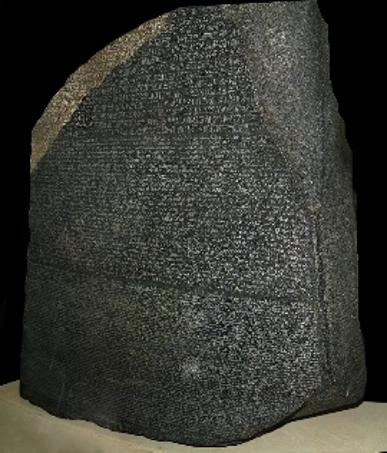
Let’s begin with stone engravings, using the famous Rosetta Stone as an example. The Rosetta Stone weighs roughly 750kg and contains the same text in three languages: Ancient Egyptian hieroglyphs on top, Egyptian Demotic script in the middle, and Ancient Greek on the bottom. To estimate the data density, I focused on the Greek portion of the stone, which accounts for roughly 1/3 of the stone’s total weight (about 250kg).

No source I could find provided a reliable count of the surviving Greek characters, so I calculated it twice independently. First, I compared a 19th-century publication’s line-by-line count with a high-resolution photo of the stone, which puts the original, undamaged text at about ~7,290 characters. Adjusting that figure for the approximately 20 percent of the stone that’s damaged or missing gives an estimated ~5,832 surviving characters. Second, I ran an AI optical character count directly off the damaged stone, which returned ~5,800. The two methods are close, so I use ~5,800 characters going forward.

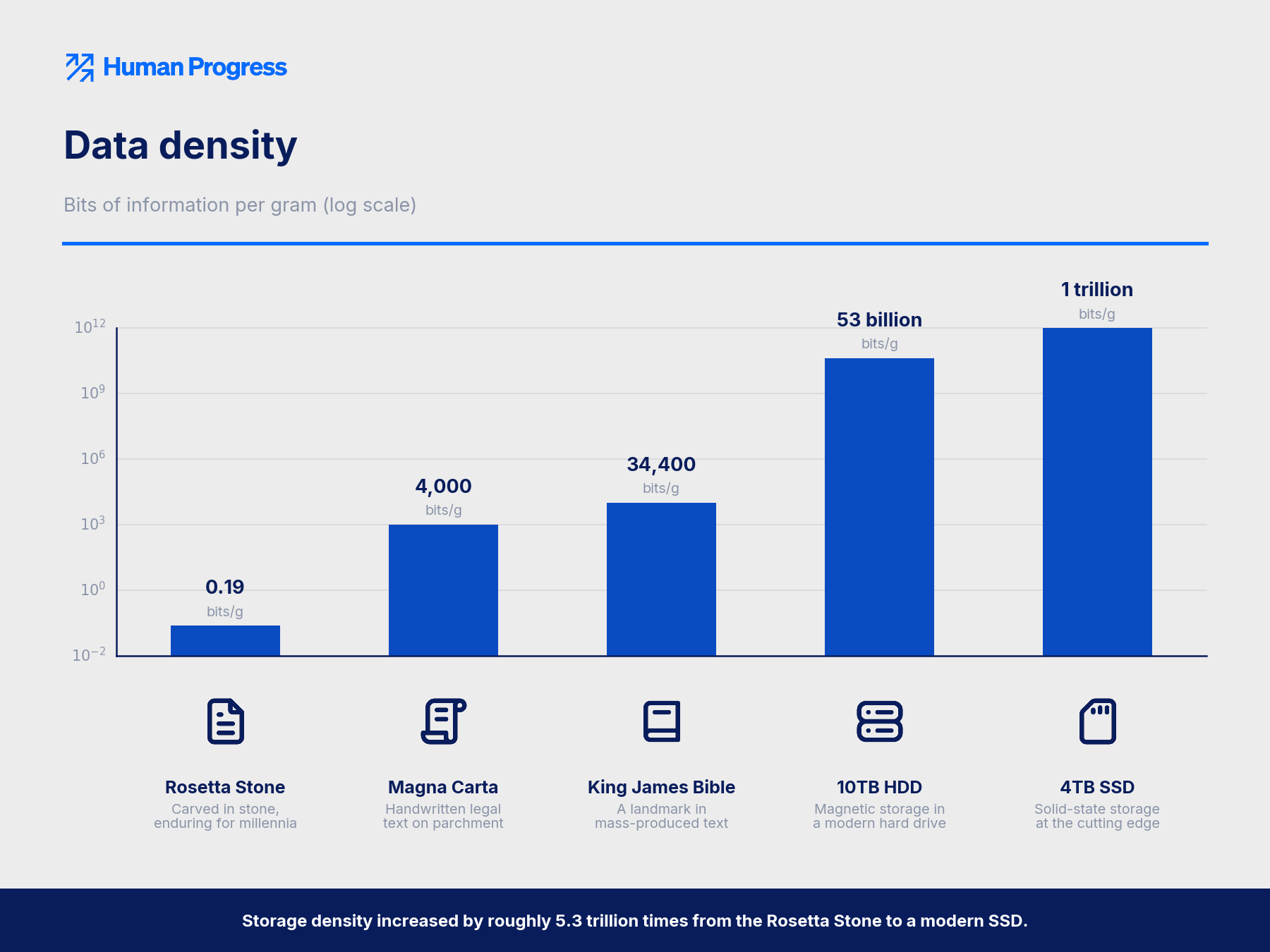
Since a single character of text equates to about 8 bits of information, the surviving 5,800 characters store 46,400 bits of data. Divided by the 250kg weight of the Greek portion, we arrive at a data density for the Rosetta Stone of ~0.19 bits/g.

With the discovery of agriculture and the rise of agrarian civilizations, the demands for knowledge storage and transmission media grew. The human population expanded, and a small but notable fraction began to congregate in small towns. As social and economic complexity grew, so did administration, trade, tax, and legal systems. Humans needed an easy way to perform and store the outputs of mathematical calculations, record taxes, and codify rules and regulations for personal and business conduct. Agrarian civilization, in short, demanded a storage medium with higher information density and faster read/write speeds (throughput). Enter papyrus, parchment, and paper.

Early forms of “paper” included papyrus and animal-skin materials like parchment and vellum. Papyrus was made from the papyrus plant, which grew in the Nile Delta in ancient Egypt. To make papyrus, strips of the plant were cut, laid into overlapping layers, and then pressed and dried into sheets. Papyrus was first used for writing as early as 2,500 B.C. and was one of the primary writing materials for thousands of years. Compared with stone, papyrus was far more data-dense; we could fit more characters on a given surface area, the substrate was lighter, and it could be folded or rolled into a scroll.

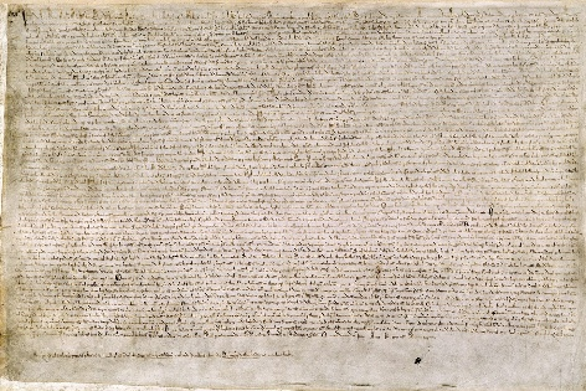
Parchment, made from cleaned and stretched animal skin, was developed long after papyrus and, thanks to its superior durability, quickly became the medium of choice for important documents. The Magna Carta, made from parchment, contains about 3,500 words or ~25,000 characters, which equates to about 200,000 bits of information. Medieval parchment weighs about 100–180 g/m², meaning the Magna Carta weighs roughly 50 grams. Using our formula, the Magna Carta’s data density comes out to around 4,000 bits/g.

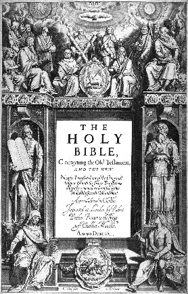
Even the Magna Carta pales in comparison to modern paper with printed text. “Paper”, the flexible plant-fiber sheets we know of today, was invented in China as far back as the 2nd century B.C.. It took centuries for it to spread outside China. Paper could be made thinner and lighter than parchment or papyrus, and the printing press made it possible to fit more words on a sheet. The King James Bible, for instance, contains around 789,000 words. That’s roughly 4.3 million characters, or 34,400,000 bits of data. A standard hardcover Bible weighs about 1 kg. Even if we conservatively include the weight of the binding, the information density comes to ~34,400 bits/g, about 8.6 times the density of the Magna Carta.

Our eyesight is limited, and text can only be so small before we can no longer resolve it. The next revolution in data storage came in the form of more exotic “machine-readable” media. Examples include magnetic storage such as hard drives and magnetic tape. Here, data is encoded on magnetized material directly as bits of information – ones and zeros – by carefully controlling the polarity of magnetic domains. This technology was a wondrous breakthrough, and it’s still improving. Today, for a few hundred dollars, you can purchase a hard drive that can store tens of terabytes of data! A commercially available 10TB HDD that weighs ~1500 g can store ~80 trillion bits of data, a data density of ~53 billion bits/g, 1.54 million times higher than the King James Bible.

Yet today, hard disk drives already feel antiquated. Instead, most phones, desktops, tablets, and external drives use solid-state storage (SSDs). It’s easy to see why SSDs have become so dominant in recent years; they are ideal for mobile devices. They have no moving parts, are more durable, use less energy, and still have higher data density. Solid-state media store data by trapping electrons in a grid of floating-gate transistors to represent bits of information. A commercially available 4TB (~32 trillion bits) SSD weighs 32 grams; a data density of 1 trillion bits/g, about 19 times higher than a comparable hard drive, or about 5.3 trillion times the data density of the Rosetta Stone!

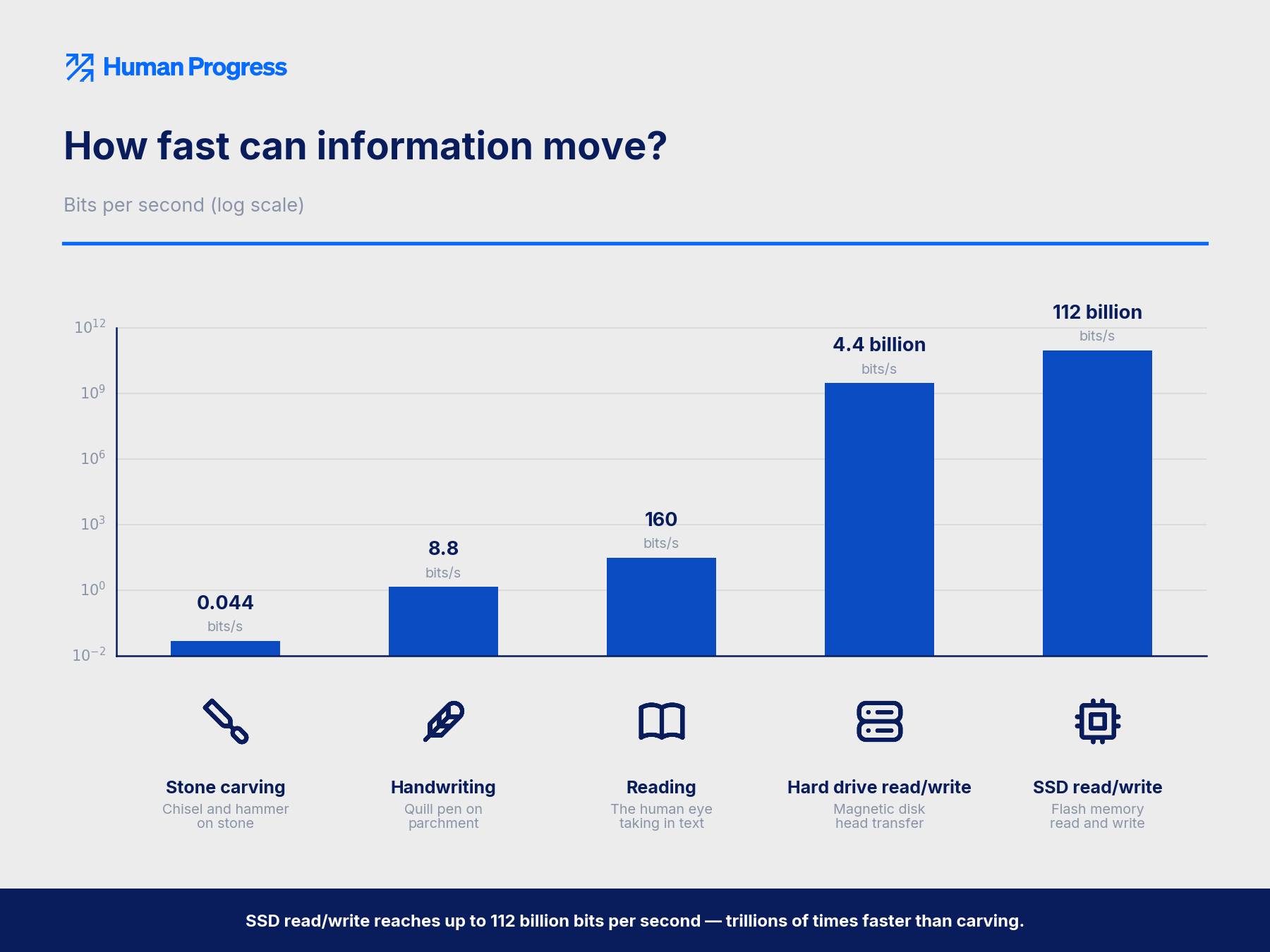
Commensurate with improvements in data density came higher read/write speeds, or “throughput.” People read about 4 words a second and with an average word length of around 5 characters; that’s about 160 bits per second. A professional stone carver might be able to write up to 20 letters an hour, or about 0.044 bits per second. Paper and paper-like media dramatically increased writing speed. A human writes about 1.1 characters per second, or roughly 8.8 bits per second – 200 times faster than carving into stone, though still slower than reading. Printing machines, of course, could print text far faster than any human could write by hand.

But none of this compares to magnetic storage, such as modern hard drives, where read/write speeds (which are similar) are currently about 4.4 billion bits per second. SSDs are faster still, reaching read/write speeds up to 112 billion bits per second. That’s about 700 million times faster than reading, and nearly 13 billion times faster than writing by hand, roughly 2.5 trillion times faster than carving into stone!

In roughly five thousand years, we’ve pushed the density of our storage media up by a factor of trillions, and the leaps keep coming faster. It took five millennia to get from stone to the printed page, representing a 180,000-fold gain in data density. In the seventy years since the invention of the hard drive, and with SSDs, humanity has multiplied that density by another 29 million times. For perspective, the text of the King James Bible carved in stone would weigh around 185 tons, nearly as much as a Boeing 747 (without fuel). On an SSD, it weighs less than a grain of sand.

The Guardian | Energy & Natural Resources

British Telecom Is Recovering Copper from Old Telephone Cables

“BT is on track for an estimated £2bn-plus windfall over the next decade from selling off old copper cabling, as it cashes in on soaring prices amid the AI market frenzy and switches the UK’s network to full-fibre broadband.

Copper is one of the main beneficiaries of the ‘electrification of everything’, essential for the rapid growth of AI datacentres, electronics and the fast-growing renewable energy industry.

The metal hit its highest-ever closing price of $14,294 a metric tonne on Friday, close to the record intraday high of $14,500 reached earlier this year amid global shortage fears.

BT has a recycling deal with EMR, the UK’s largest cable granulation company, and has now received £99m upfront for thousands of tonnes of surplus stripped copper.”

From The Guardian.