
01 / 05
Time Pricing the Fourth of July Cookout

Blog Post | Food Prices

Time Pricing the Fourth of July Cookout

Independence and abundance.

Summary: The dollar price of a traditional Fourth of July cookout has increased since 2016, but rising wages have more than offset those higher prices. As a result, Americans spend less time working to earn this year’s Independence Day meal than they did a decade ago. Measured in time rather than dollars, the data show that abundance has continued to grow as the population has increased.


Every year, the American Farm Bureau Federation estimates the cost of a traditional Independence Day cookout. The basket includes summer cookout staples such as cheeseburgers, chicken breasts, pork chops, potato chips, pork and beans, fresh strawberries, homemade potato salad ingredients, fresh-squeezed lemonade ingredients, chocolate chip cookies, and ice cream.

Since 2016, the dollar cost of this basket has risen 30.3 percent, from $56.67 to $73.82. At first glance, that suggests celebrating the Fourth of July has become significantly more expensive.

But money prices tell only half of the story. The real question is not how many dollars the meal costs, but how much time people must work to earn those dollars. Since 2016, blue-collar worker hourly earnings increased 50.4 percent, from $21.48 to $32.31 per hour.
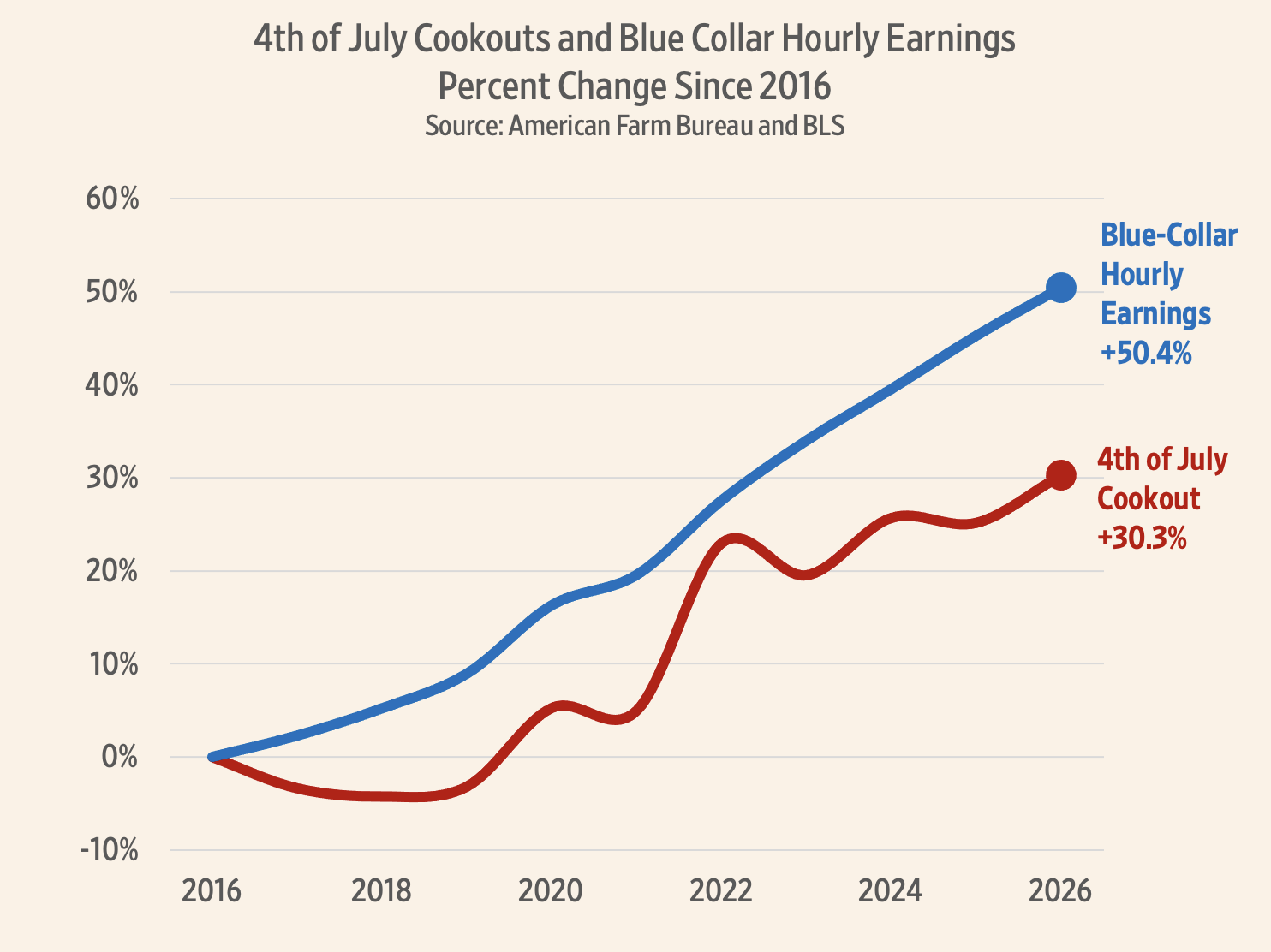
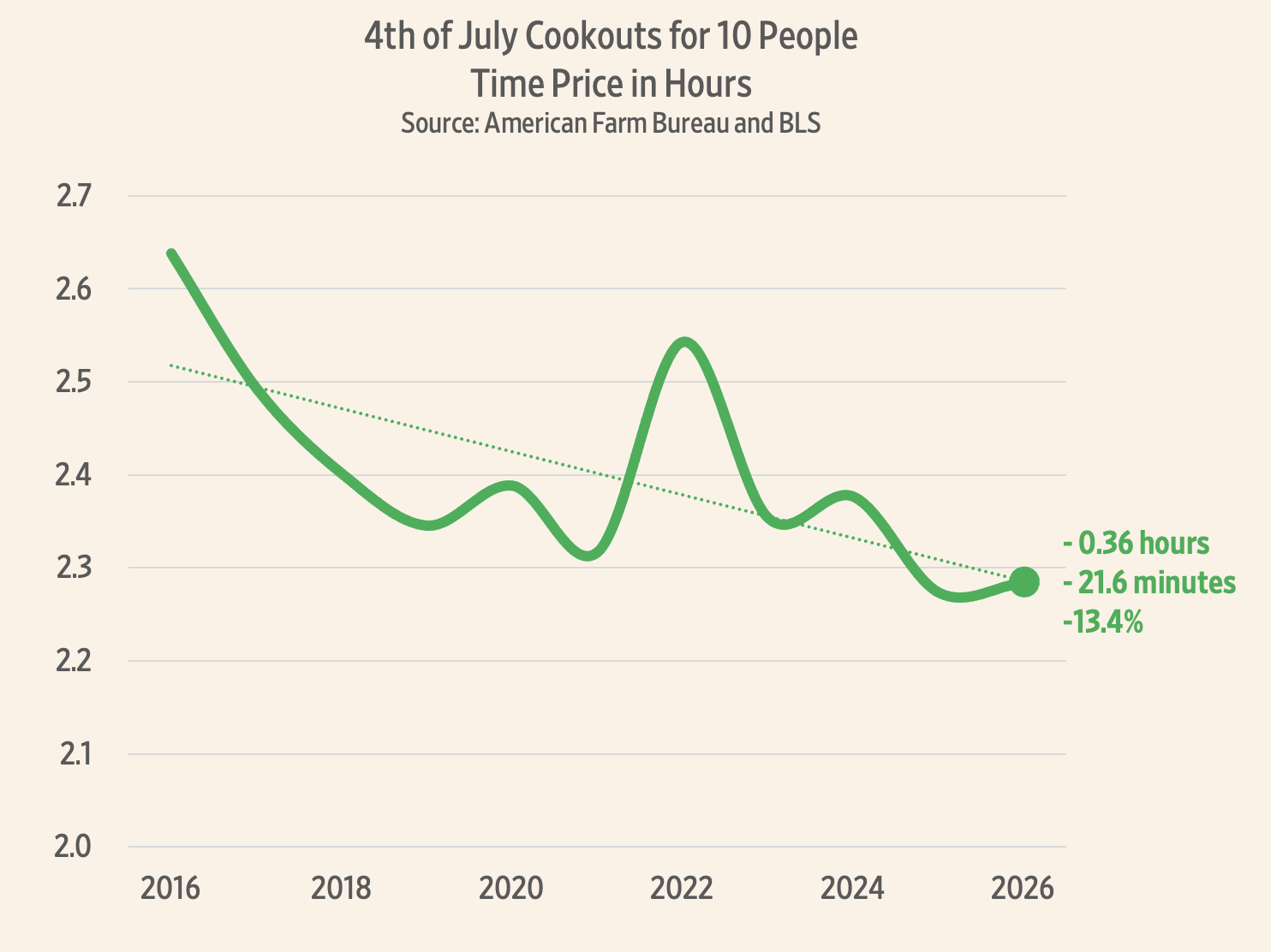
Because wages rose faster than prices, the time price of the cookout actually fell 13.4 percent—from 2.64 hours of work in 2016 to just 2.28 hours today, a savings of 21 minutes.
Another way to measure progress is to ask: How much more does the same hour of work buy? We call this the abundance multiplier. Compared with 2016, the same amount of work today buys 15.5 percent more.
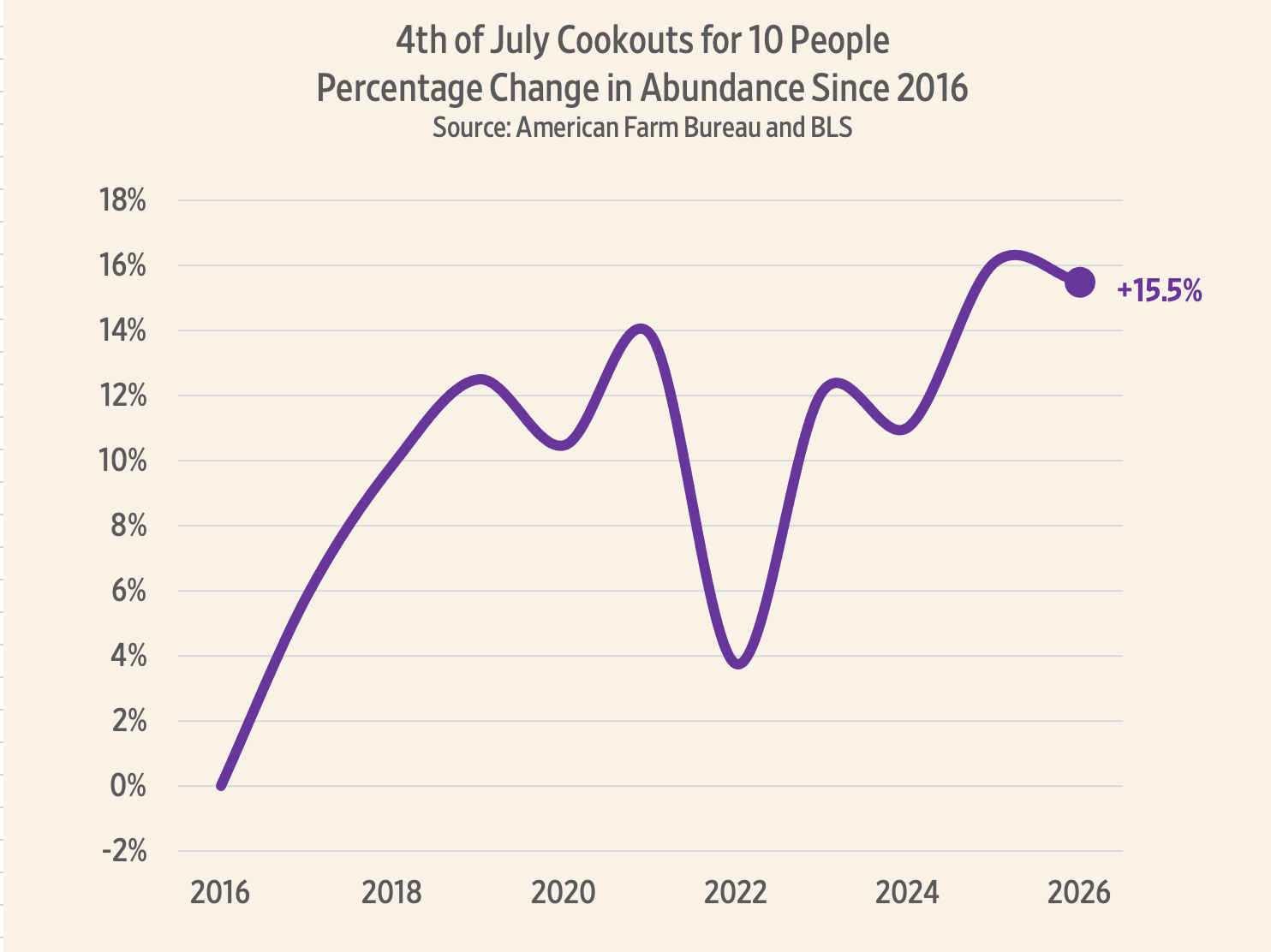
America added 22 million people between 2016 and today, a population increase of 6.8 percent. Yet abundance didn’t merely keep pace with population—it grew 2.28 times as fast. Every 1 percent increase in people produced a 2.28 percent increase in cookout abundance. That’s the signature of superabundance: on average, every additional person contributes more than they consume. Even though there are 22 million more of us, we’ll actually spend 7.5 percent less time working as a country to pay for our celebration compared with 2016.

Americans may spend more dollars, but they spend less of their lives earning this year’s Independence Day feast.

Government money printing during the COVID-19 pandemic did cause a temporary spike, but we have returned to the long-term trend of decreasing time prices and increasing abundance.

This year saw a slight reversal. Compared with the record-low time price in 2025, food prices increased 4.1 percent while blue-collar hourly earnings rose 3.5 percent. As a result, the time price of the cookout edged up by just 0.5 percent—less than one minute of additional work. Even after that small increase, the Independence Day cookout remains substantially more affordable in time than it was a decade ago.

Find more of Gale’s work at his Substack, Gale Winds.

Phys.org | Food Production

Norway’s Automated Farm Sends Lettuce to Stores

“Norway's first fully automated facility for vegetable production was put into operation last fall. This spring, the first products hit store shelves…

'In this facility, no one touches the lettuce from the time it is sown, grown and packaged until it ends up on the store shelf and is finally opened by the customer at home in their kitchen,' says SINTEF researcher Ottar Bakås.”

From Phys.org.

Phys.org | Cultivated Areas

US Irrigation Avoids More Emissions Than It Emits

“Irrigating U.S. crops prevents higher greenhouse gas emissions by avoiding land conversion, new research by Colorado State University shows. Agricultural irrigation allows the United States to grow more food on less land. If irrigation were suddenly shut off, the land-use change required to make up for lost yields would produce significantly more greenhouse gas emissions than irrigation emits—363 times more.

CSU scientists estimate the emissions saved by avoiding land-use change would equate to 363 years' worth of today's U.S. annual greenhouse gas emissions from irrigation.

Converting natural ecosystems to agricultural use releases carbon stored in soil and vegetation. Land use and land conversion for agriculture to produce food, fiber and fuel contribute nearly a quarter of global greenhouse gas emissions, making the sector a key priority for emissions reductions, the study published in Proceedings of the National Academy of Sciences states.”

From Phys.org.

CGIAR | Food Production

More Can Tho Rice Farmers Adopt Mechanized Seeding

“When the Fertilize Right (FerRight) project began working with rice farmers in Can Tho's Thanh An, Thanh Phu, Thoi Xuan, and Trung Hung communes, mechanized direct seeded rice (mDSR) was practiced by fewer than 1 in 100 of them. Two years later, the project's midline farmer survey found that 18% of farmers in these communes had adopted the technology — up from a 2023 baseline of just 0.7%. Fertilizer deep placement, a complementary practice often paired with mDSR, has also taken hold, now reaching 0.5% of farmers and growing. Together, the numbers are one of the clearest signals yet that the project, funded by the United States Department of Agriculture (USDA) and implemented by the International Rice Research Institute (IRRI), is changing how farmers cultivate their rice.

Unlike traditional broadcast seeding, mDSR, paired with fertilizer deep placement, uses dynamic, air-assisted row seeders to place seed precisely 1 to 2 mm into the soil and deliver nutrients directly to the root zone. Multi-season field trials with the Cuu Long Rice Research Institute (CLRRI), spanning four crops from 2024 to 2026, show why the technology is catching on: seed rates fall by at least 50%, nitrogen fertilizer use drops by at least 20%, and the carbon footprint per kilogram of rice produced falls by at least 10%, alongside more uniform stands and greater resilience to pests, disease, and lodging.

Those gains show up in farmers' fields, too. Comparing mDSR adopters with farmers who still broadcast-seed, the project's farm-level adoption study found mDSR fields yielded 6.81 tons per hectare against 6.67 tons for broadcast seeding — a 2.1% advantage — with nitrogen-use efficiency up 1.4% and net income up 2.7% per hectare.”

From CGIAR.

BBC | U.S. Agriculture

Autonomous Crop Dusters Commercially Approved in US and Brazil

“Self-flying planes have been slower to emerge than self-driving cars, despite operating in what is generally considered a more structured and predictable environment.

That is partly because big tech companies 'doubled down' on cars, pouring vast sums into the technology, says Mykel Kochenderfer, an expert in safe aviation autonomy at Stanford University.

But it is also because aircraft are held to stricter safety standards than cars, creating a much higher bar for deployment…

In the US, the largest autonomous fixed-wing aircraft approved for commercial civilian use so far is Pyka's crop sprayer, which won authorization last year.

Though operations are limited to a tightly defined agricultural setting and require a ground operator and visual observer. It earlier secured similar approval in Brazil, where rules are more permissive…

Supporters say autonomous aircraft could address pilot shortages, remove people from dangerous work such as crop spraying, improve efficiency – for example, by allowing aircraft to carry more cargo – and cut costs if one operator can oversee many planes.

They also argue automation could make flying safer, pointing to past declines in accidents as more automated systems have been introduced.”

From BBC.