
01 / 05
Time Pricing Big Macs Around the World

Blog Post | Food Prices

Time Pricing Big Macs Around the World

Even if a Big Mac is more expensive in money, it can be less expensive in time.

Summary: Big Mac prices across countries can be better understood by measuring them in terms of time rather than money—specifically, how long people must work to afford one. Comparing time prices reveals meaningful differences in wages and productivity that aren’t obvious from currency values alone.


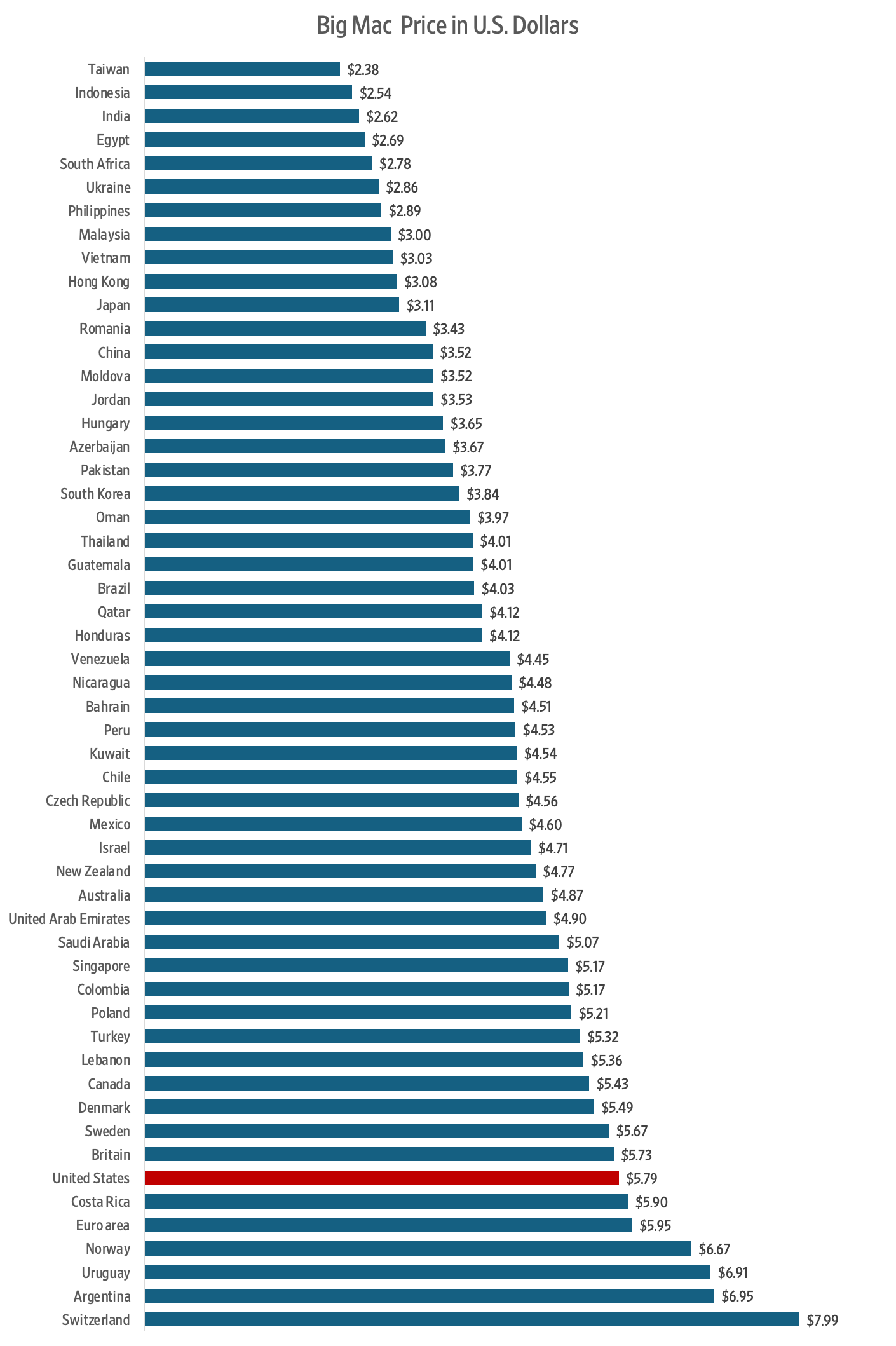
McDonald’s operates in over 100 countries worldwide. Since 1986, The Economist magazine has published the Big Mac Index, built on the theory of purchasing power parity (PPP)—the idea that exchange rates should equalize the price of an identical basket of goods across countries. The following shows the dollar price of a Big Mac in each country, sorted by price:
But we can go one step further.

Instead of comparing currencies, we can compare time.

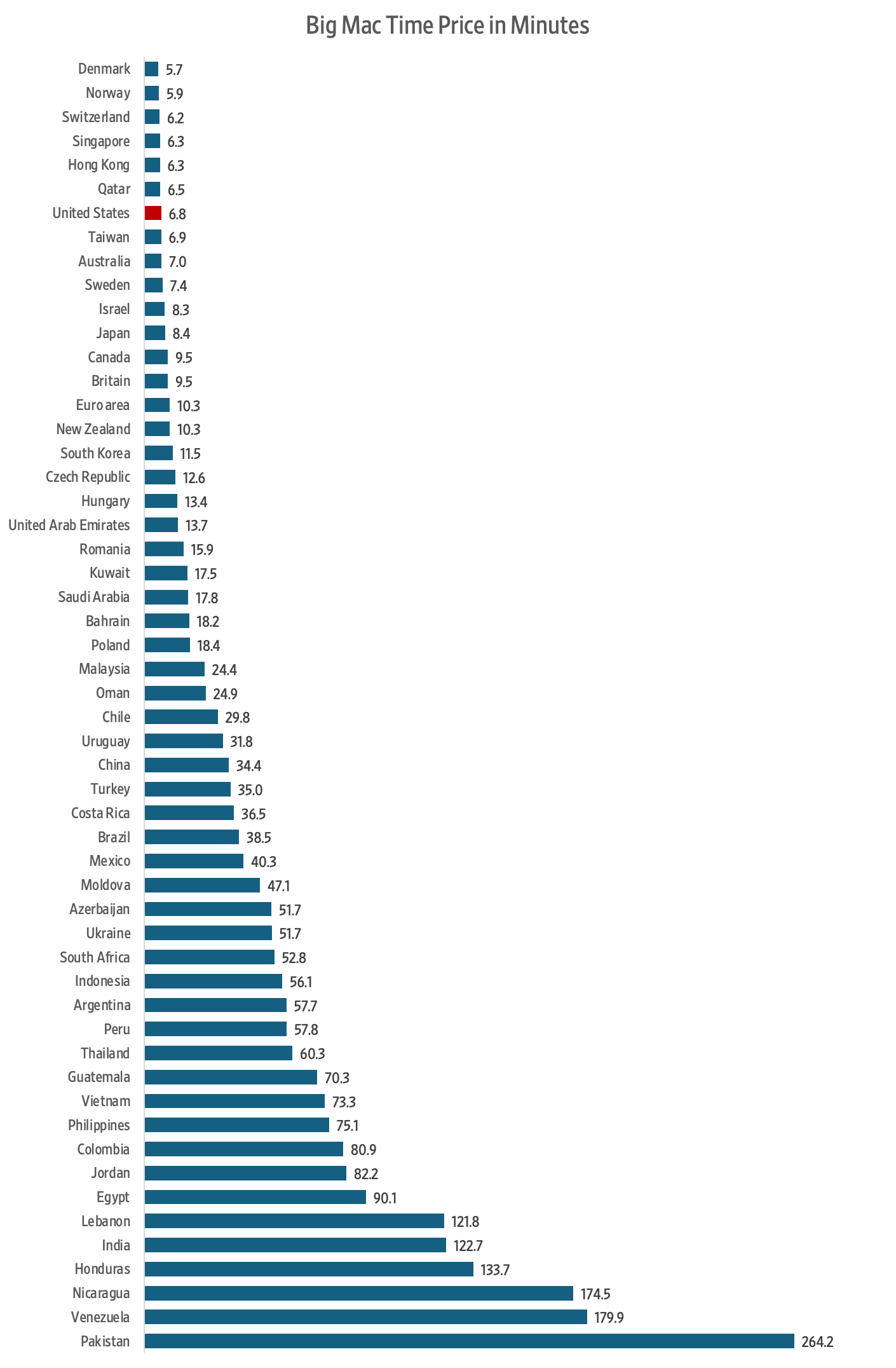
We start with the nominal price of a Big Mac in each country, converted to U.S. dollars, and then compare it to average hourly earnings. Since average hourly earnings data are not available for all countries, GDP per capita divided by annual hours worked serves as a reasonable proxy for relative wages between countries.

This transforms the question from “What does it cost?” to “How long do you have to work to get it?” A Big Mac can be more expensive in money but less expensive in time, depending on where you live.

A Big Mac in Taiwan costs only $2.38, compared to $7.99 in Switzerland, but after adjusting for hourly earnings, the time prices are very similar. In Pakistan, a Big Mac costs $3.77, but hourly earnings are $0.86, putting the time price at 4.4 hours. In Denmark, the price is $5.49, but hourly earnings are $57.60, so the time price is under six minutes. For the time it takes a worker in Pakistan to earn enough to buy one Big Mac, workers in Denmark can buy more than 46.
The Big Mac doesn’t just measure currencies; it measures the spread of knowledge.

What looks like inequality in dollars is often a difference in productivity, learning, and institutional capacity. The real divide is not between rich countries and poor countries—it is between places where knowledge compounds and places where it is constrained.

When a sandwich falls from four hours of work to four minutes, something profound has happened—not to the burger, but to the growth and sharing of knowledge.

The story of abundance is not written in dollars. It is written in time.

Find more of Gale’s work at his Substack, Gale Winds.

Presidencia RD | Malnutrition

Dominican Republic Exits FAO Hunger Map

“President Luis Abinader recalled that this goal went from an aspiration to becoming a priority of his government and stressed that the Dominican Republic reduced the prevalence of undernourishment from 21.3% in 2006 to less than 2.5% in 2025.

‘And today I appear before you with an emotion difficult to express. My country, the Dominican Republic, has officially left the FAO Hunger Map,’ he told representatives of the international body that meet in the Italian capital.

The head of state said that behind these statistics there are millions of people whose living conditions have improved, so he stressed the importance of continuing to promote public policies that allow families to access sufficient and nutritious food…

The president explained that the fight against hunger has been developed through two lines of action: increasing the availability of food and improving household incomes. Between 2004 and 2024, the rate of per capita food production grew by 122.3%, while between 2015 and 2025 the real income per capita of households increased by 43.7%.

It also noted that during that period, monetary poverty fell from 41.1% to 17.3 %, while extreme poverty increased from 8.7 % to 2.2 %.”

From Presidencia RD.

Imagen Radio | Food Consumption

Fewer Mexican Households Went Without Food

“Fewer homes in Mexico were left without food due to lack of money © 2026 Imagen – Excélsior. Todos los derechos reservados. El contenido de este sitio y de la edición impresa está protegido por la Ley Federal del Derecho de Autor. Prohibida la reproducción total o parcial sin autorización previa y por escrito. El material de terceros conserva sus propios derechos.

Of the country’s 39.7 million inhabited dwellings, only 6.5 per cent of them had the case that they were once without access to food in the past three months due to a lack of money or resources, according to the Inegi’s 2025 Intercensal Survey.

This proportion of households was lower than that observed in 2020, when 9.2% of households in the country suffered from the situation described, and also compared to 2010, when the proportion was 9.8%.”

From Imagen Radio.

Phys.org | Food Production

Norway’s Automated Farm Sends Lettuce to Stores

“Norway's first fully automated facility for vegetable production was put into operation last fall. This spring, the first products hit store shelves…

'In this facility, no one touches the lettuce from the time it is sown, grown and packaged until it ends up on the store shelf and is finally opened by the customer at home in their kitchen,' says SINTEF researcher Ottar Bakås.”

From Phys.org.

Phys.org | Cultivated Areas

US Irrigation Avoids More Emissions Than It Emits

“Irrigating U.S. crops prevents higher greenhouse gas emissions by avoiding land conversion, new research by Colorado State University shows. Agricultural irrigation allows the United States to grow more food on less land. If irrigation were suddenly shut off, the land-use change required to make up for lost yields would produce significantly more greenhouse gas emissions than irrigation emits—363 times more.

CSU scientists estimate the emissions saved by avoiding land-use change would equate to 363 years' worth of today's U.S. annual greenhouse gas emissions from irrigation.

Converting natural ecosystems to agricultural use releases carbon stored in soil and vegetation. Land use and land conversion for agriculture to produce food, fiber and fuel contribute nearly a quarter of global greenhouse gas emissions, making the sector a key priority for emissions reductions, the study published in Proceedings of the National Academy of Sciences states.”

From Phys.org.