01 / 05
The New Right Manufactures Misery | Podcast Highlights

Blog Post | Human Development

The New Right Manufactures Misery | Podcast Highlights

Marian Tupy interviews Yaron Brook about the pessimistic populism of the New Right.

Listen to the podcast or read the full transcript here.

Today I’m going to be joined by Yaron Brook, host of the very popular Yaron Brook show and a prominent advocate of free markets, individual liberty, and Objectivism.

Yaron, I want to talk to you this morning about a recent tweet by Matt Walsh, a very prominent American conservative. He’s the host of the Matt Walsh show and appears very frequently on the Daily Wire.

Here is what Matt Walsh posted on his Twitter: “It’s an empirical fact that basically everything in our day to day lives has gotten worse over the years. The quality of everything, food, clothing, entertainment, air travel, roads, traffic, infrastructure, housing, et cetera, has declined in observable ways. Even newer inventions, search engines, social media, smartphones, have gone downhill drastically. This isn’t just a random old man yells at clouds complaint. It’s true. It’s happening. The decline can be measured. Everyone sees it. Everyone feels it. Meanwhile, political pundits and podcast hosts, speaking of things that are getting worse, focus on anything and everything except these practical, real-life problems that actually affect our quality of life.”

So, Yaron, when you first read that tweet, what did you make of it? What was your first reaction?

Well, this was not new to me. I’ve been talking about Matt Walsh and the general populist attitude to human progress for the last 40 years. It’s a theme that the left used to advocate for. Now the populist right seems to have agreed on the idea that the 1970s were some kind of utopia where income was maximal, women didn’t have to work, you could buy a home, and everybody was happy.

I think Matt Walsh is just reflecting that deep-seated pessimism that exists today across the entire political spectrum. And of course, my response is that he’s wrong about almost all of the examples he gives.

Let’s first talk about this concept of American pessimism. What do you attribute it to?

One of my theories is that we’re experiencing a negative emotional contagion driven by competition within the media. We know that each additional negative word in a headline increases the click-through rate by about two and a half percent. And now you have traditional media competing with internet outfits, so if you want to get people’s attention, pessimism sells.

That’s definitely part of the problem, but I don’t think it’s the fundamental problem.

I believe that we are shaped by ideas, and therefore, we’re shaped by our intellectuals. And the intellectual class has completely betrayed Americans. They have rejected capitalism, which is the system that made us rich.

If you were a steelworker in Cleveland and you lost your job in the 1980s, what were you told? You weren’t told what we were told in America traditionally, which was “get in your car, drive to northwest Arkansas, and get another job.” You were told, “No, don’t worry, we’ll write you a check, and we’ll keep you on welfare while we, the intellectuals and the politicians, work on getting your job back.”

This has been the story that politicians have been telling workers for a long time. They’re lying; the steel job will never come back. And they’re destroying the worker’s self-esteem, that self-reliance that’s so core to the American ideal. So, 20 years go by, and the steel job doesn’t come back, and this person and the culture around him develop real resentments against the system.  And intellectuals have told Americans that their job loss is a consequence of capitalism, that capitalism caused the great financial crisis, and that they’re looking for an alternative, something to replace free markets, private property, and the dynamism of the marketplace.

One area in which America really is declining is in education. We have K-12 education that teaches kids to trust their emotions rather than their reason. We saw this maybe 10, 15 years ago with microaggressions and political correctness, and then that evolved into the woke phenomenon, which was all about avoiding hurt feelings or causing offense. So, we’ve created generations of people who are very attuned to their emotions but can’t really think, and as a consequence, rely on their primitive human instincts.

People don’t understand the world because they haven’t been taught how to think about it conceptually, so they revert to perceptions. They’re afraid because perceptions don’t lead them to knowledge, and when people are afraid, they join tribes. There’s comfort in tribes. So, you get tribalism and perceptual-level mentality, and that combination is what drives this spiral of fear and pessimism.

Let me ask you questions specifically about the GOP.

Back in the day, during the Reagan Era, it was all about America being the shining city on the hill. That there was nothing that Americans could not do, and our best days lay ahead. Now all of that seems to be gone. What happened to the Republican Party and the conservative movement?

I think it’s a combination of two things, one ideological and one historical.

Ideologically, the GOP has changed its composition and who it’s trying to appeal to. And I think the change actually happened under Reagan, who made religion a crucial part of what it meant to be a Republican. And I think that religion undermines the ability to think about the future in a positive way. Many evangelicals, particularly when they see cultural phenomena like the gay movement, Roe versus Wade, and immigration, are afraid of the future. That fear was reinforced by three major events.

The first was 9/11, which was completely misinterpreted by the American right. Ultimately, the Bush administration lied to all of us and engaged in endless wars that didn’t achieve any of their goals. So, a lot of American idealism died in Afghanistan and Iraq. And then there was the great financial crisis, which collapsed the image of American capitalism as this amazing economic engine of prosperity. Instead of intellectuals coming out and saying, “Oh, no, you misunderstood. The crisis happened because of particular regulations and the Federal Reserve,” the intellectuals came out and said, “This was caused by capitalism. We need a new model.” And finally, we had COVID, which undermined the concept of America as the land of the free. We got locked up in our homes, and the political and expert class panicked and had no clue what to do except infringe on our individual rights.

Those three crises have led Americans to be skeptical of everything that’s uniquely American, and, in the GOP, revert to a kind of religiosity that they imagine the Founding Fathers had. Michael Knowles, for example, who is also on the Daily Wire, has said, “I want a culture of 1220.” So there’s a certain medievalism in some people on the right today. They long for the certainty of religious dogma and simple life, and none of this exposure to foreign cultures or people with different sexual orientations.

Evolutionary psychologists tell us that there are certain permanent aspects of human nature. And amongst the things evolutionary psychologists say are pretty firm in human nature are tribalism and zero-sum thinking. You already argued that the right is deeply tribalist, and the left is clearly very driven by zero-sum thinking.

So, are promoters of freedom and capitalism simply fighting a losing battle against human nature?

Absolutely not. And the evidence for this is in the work you do at Human Progress. Look how far we’ve come. Look at how rich we are. It’s stunning. We were hunter-gatherers once, and we established cities, agriculture, philosophy, mathematics, and science. Every single step in those achievements was a consequence of the rejection of tribalism and zero-sum thinking. Every single step came from the use of reason. So I think human history repudiates the idea that we have to be tribal and zero-sum.

Now, it’s true that when people don’t think, when they refuse to put in the effort to actually use their mind, the default is zero-sum. Tribalism and zero-sum thinking are defaults people revert to when they’re overwhelmed by emotion. And when you have an educational system and intellectuals who undercut reason and elevate emotion above all, you get zero-sum thinking and tribalism.

To me, it’s all about the intellectuals. The intellectuals shape culture. It’s not an accident that America is a consequence of an intellectual movement called the Enlightenment. The Enlightenment sowed certain ideas, and those ideas flowered into the Industrial Revolution and the great wealth that we have since benefited from. Our intellectual class, though, has worked hard to undermine the Enlightenment for more than 200 years, basically since the Enlightenment ended. It is amazing how much we have progressed despite such lousy intellectual guidance.

So we need a new set of intellectuals who can guide Americans, and really all of humanity, towards an understanding of their own potential as thinkers, as reasoners, as builders and creators. And at whatever intellectual level you have, whatever IQ or whatever measure you use, you can produce, and you can be happy. If we can dominate the intellectual sphere, the world will change. But right now, what’s dragging us down are people like Matt Walsh and other intellectuals who are constantly feeding the public the exact opposite message: defeatism, anti-reason, anti-freedom, and anti-capitalism.

Well, the old intellectual lead has certainly disgraced itself and is on its way out because of Iraq, COVID, the great financial crisis and so forth. The problem is that the intellectuals who are waiting in the wings to replace them are worse. We are talking about people like, I’m sorry to say, Matt Walsh, Adrian Vermeule, and Curtis Yarvin.

Now we have to give the devil his due and talk about specifics. So, Yaron, is food in America now worse than it was in the 1970s?

It’s just funny to me to read something like that.

I mean, in the 1970s, the food was bland, and choices were minimal. Maybe there’d be one Chinese restaurant in the neighborhood. Now, the best of the best different foods from all over the world are available in any major city in the United States. I’m a foodie, so the joy of eating new foods with new flavors and in new combinations is just amazing. And we have restaurants that are super cheap. In LA, you can go buy tacos that are some of the most delicious in the world at a food truck. And if you go into a supermarket, you can get fruits and vegetables that only grow in certain regions of the world all year round, and at very reasonable prices.

So, we have such a variety and such a selection in the United States today, of all the things to pick on, food is comical.

Another point raised by Matt Walsh is air travel.

In the olden days, you simply didn’t travel by air. Holidays would be spent near where you lived. There’s a fantastic bit in Mad Men where these rich guys from New York decide to go to California and fly across the country, and it’s a big deal. The whole Office is talking about it, and they are bringing a bag of California oranges back to New York because you couldn’t get them otherwise.

Now, it is uncomfortable in economy class, yet tens of millions of people take economy class flights every year. They are voting with their wallets. What’s the tradeoff here?

The tradeoff is to get to where you want to go. The ability to travel, the ability to see the world. And it’s unbelievably cheap. In the 1950s and 60s, nobody could afford to take a cross-country trip by air. Today, almost everybody can afford to do that. In addition, air travel was not as safe back then. In America, except for that one accident at Reagan, we’ve had no fatal accidents for like 20 years. So, it’s super cheap, and if you want to pay more money, you can sit in business class and be more comfortable.

And there are discount airlines that specialize in bare-bones service and very uncomfortable seats, yet they’re always full.

There is this meme about the ability of the American worker to support a family on one income. But even today, you can have a 1950s or 1960s lifestyle on one income. It will mean that you are never going to fly across the country. It will mean that you are going to be living in a much smaller home without basic appliances. It will mean that you will have access to 1950s or 1970s health care. So, the point is, people opt to have two-income families because life is just so much more amazing that way.

Matt Yglesias had a really good essay on this, in which he found a house that is the same size as it was in the 1950s—about 1500 square feet, versus today’s over 3000—and yeah, it’s easily affordable on one income. When I grew up, there were six of us, four kids and two parents, with one bathroom. If you want every kid in their own bedroom and bathrooms, two or more cars, and to travel to Europe and see the world, then yeah, you need two incomes.

But there’s something even more important than that: the 1950s really, really sucked if you were a woman. You were stuck at home. You didn’t have many employment opportunities. There was real discrimination against women. And because there were no washers and dryers and dishwashers and all of that, women spent a lot of time taking care of the house.

Now, the opportunity cost for them to stay home is huge. They have an opportunity to build a career, go to school, develop themselves, and pursue the life they want. The consequence of that is two-income families that raise the standard of living. It’s shocking to me that people think that there’s something wrong, A, with women pursuing their own dreams and B, with people actually being richer and living in bigger homes.

You’ve already noted housing, and maybe that is the subject that we can end on.

If you look at what Mark Perry from the American Enterprise Institute calls The Chart of the Century, it shows that housing relative to income is about 10 percent cheaper than it was 20 or 25 years ago. That means wages have been increasing faster than housing prices. So, even though housing is much more expensive than it used to be, wage growth has been higher and, consequently, housing is actually more affordable on average in America.

Another thing that people do not account for is the great improvement in housing. They also focus far too much on particular problems in metropolitan areas such as New York City, whereas in the rest of the country, things are going pretty well. What’s your take on all that?

First of all, there is massive geographic diversity. You can find relatively affordable homes in Florida, Alabama, Mississippi, and in much of the center of the country. Certain metropolitan areas have oppressive laws that have made it very difficult to build, and, as a consequence, rents have gone through the roof. I made a lot of money on homes in California, not because I’m a speculator—I believe housing should be a consumption good, not an investment—but because nobody was building in the neighborhoods that I lived in. Demand was high because of the weather and economic opportunities. So prices just took off. Why isn’t supply matching demand? We know that when demand increases, prices will go up, then supply will enter, and prices will come back down. That doesn’t happen in these areas for political reasons. Homeowners don’t want new houses built, so they vote for people who ensure no new supply is added.

But there are also lots of places in the country where it’s hard to sell a home because nobody wants to live there, or there are plenty of homes. You know, rents and home prices have been dropping significantly in Austin, Texas. During COVID, demand in Austin increased significantly, and supply couldn’t match it immediately because it takes time to build a home. So, prices went up a lot. Then supply came online, and since then, prices have been drifting downwards. And you see that in a number of cities across the country where politics don’t severely restrict housing supply.

The second thing you mentioned is that houses are very different today. They’re dramatically bigger. The average home in America today is over 3,000 square feet with amenities that you couldn’t have imagined in the 1970s. Three-car garages, air conditioning, dishwashers, and so on. The construction quality is also much better. For example, houses are far more resistant to fire. Many more people died from home fires in the 1970s than today because we’ve figured out how to make cheaper fire-resistant materials.

So Matt Walsh could be talking to America about the great successes in GOP-dominated states where housing was deregulated, and rents and house prices are actually coming down. He could be promoting those successes and saying, “Look, if this can be done in Right America, it can also be done in Left America.” But instead, he’s embraced negativity.

The modern American right doesn’t want to highlight those things because that would highlight the successes of freedom and capitalism. The new right are not freedom lovers. Freedom scares them. I think they see that if you advocate for economic freedom, why stop with economics? Shouldn’t individuals be free to make all kinds of choices in their lives? What god to worship or not to worship, who to love. If they can’t tolerate freedom in the realm of personal choices, long-term, they’re not going to tolerate freedom in economic choices. That’s what we’re seeing with the right today. They used to only want to regulate our social choices, and now they want to regulate everything, just like the left.

The great tragedy of America right now is that there’s really nobody in politics who represents freedom in both the personal and economic realms.

Blog Post | Progress Studies

Critiques of Progress, Pt. 1: The Revolt against Modernity

Some say the modern world could be better. Others say it is rotten at the core.

Today marks the launch of a new series of essays on HumanProgress.org written by Dr. Steven Davies titled Critiques of Progress. Each of the fifteen essays in this monthly series will examine the origins, nature, and validity of recurring critiques of the modern world. This introductory essay distinguishes between two broad critiques of modernity and explains which one this series will address and why.


Today’s world is one of liberal modernity, the result of a transformative process dating back to the end of the 17th century. This process has brought enormous benefits to everyone alive today, as well as many who lived during the three centuries leading up to today. The most obvious benefit is the dramatic rise in average incomes over that period, especially globally. This rise in real incomes (and therefore living standards and material conditions) has no precedent in human history. It also started slowly and in a limited part of the globe, but it has accelerated and spread to almost every location, not steadily, but nonetheless in a progressive fashion.

However, while liberal modernity has improved human life, rising living standards are foundational but not the most important. More significant are the second-order consequences of economic growth and rising living standards, which are related but distinct. Second-order effects include a dramatic increase in the range of life options and ways of life available to ordinary people, a decline in crime and violence, a transformative change in the status and life experience of women, and improved health outcomes for people of all ranks and positions. Independent but related benefits include the enormous increase in our knowledge about, and understanding of, the natural world, and the increased sociability that comes from the shift from a rural society where most lived in small communities to a majority urban society where an increasing share of the global population lives in large cities or towns.

All of that is a transformation in the extent and variety of human flourishing. It is, by many ethical standards, the biggest improvement in human life in recorded history. Nevertheless, the modern world has as many critics as celebrants, in fact even more so. For every author or artist celebrating that things are better for most people than ever before, several complain and paint the contemporary world, or parts of it, in dark colors. At first glance, this chorus of criticism might seem united and singular, but a closer look reveals something more interesting.

On examination, criticisms of the modern world fall into two broad categories. The first are those we could call “Yes, but…”. In these arguments, critics accept the modern world as good, or at least better than what came before. Critics argue that, despite that, the modern world is deeply flawed: it is marked by deep inequality or injustice, harms the environment, or is plagued by persistent poverty, for example. In these arguments, the positive agenda is to say that the modern world needs to do better or radically reform in some way to realize its promise. It is better than the pre-modern world but has a foundational flaw that needs correction (private property and capitalism are the most common examples, but critics also cite the continued existence of the state and systemic advantages and disadvantages). These criticisms of modernity can be described as radical (or, in their milder versions, reformist).

The obvious example is Marxism. For the German philosopher Karl Marx, capitalist modernity was undoubtedly progressive at first and a clear improvement on feudalism, let alone slavery. He saw the modern world of his time as transitional, moving toward a truly liberated future where all human potential would be realized. The point of his criticisms of bourgeois society and modernity was that they had inherent contradictions and injustices that would be resolved through a dialectical process of historical development. That made the modern world unjust and flawed but also necessary and, in many ways, progressive. It was the contrast between the actuality of the modern world and what he saw as its potential that sparked his ire. He never had anything but the deepest contempt, forcefully expressed, for the apologists of the pre-modern world (as also for those whose objections to the modern world were founded in ethics rather than a ‘scientific’ approach like his own).

However, from the very first intimations of the modern world in the 1690s and 1700s, a second category of critiques emerged, of a very different type. These analyses and polemics argue that something about modernity is at least deeply regrettable, or (more often) profoundly bad. They argue that key aspects of modernity, including the ones listed earlier, should be morally condemned because of their harmful consequences for people and the natural world. The point is that these arguments don’t argue that the modern world is good but flawed, or potentially good but failing to realize that potential. Instead, they reject the modern world tout court and see the modernization process as a tragic wrong turn for all of humanity. That is a much more fundamental critique than the first type.

This second category is also more widespread, though you might not realize it because these critiques and the movements they inspire either attract little attention from scholars or are misrepresented as belonging to the first category. In reality, critiques, movements, and analyses of this kind appear in every society that begins to modernize and seem to be one of the most universal responses to that process. What is striking is how the same specific themes and arguments recur across contexts and societies that are otherwise wildly different. Ian Buruma and Avishai Margalit captured that in a remarkable little book, Occidentalism, published in 2004. They framed their work as a response to Edward Said’s Orientalism and presented the ideas and movements they analyzed as driven by a negative stereotype of “the West.” In reality, what they identified was the recurring tropes and arguments of anti-modernity (their framing came from the notion that modernization was identical to westernization – understandable but incorrect).

Buruma and Margalit captured how movements such as anti-imperialism, Japanese nationalism, 19th-century romanticism, and fascism, as well as individual intellectuals of many kinds, produced similar arguments against the world the modernization process produced and even employed similar rhetoric. This suggests that the shock of modernity triggers a similar response and analysis across traditional or pre-modern societies, regardless of how different those societies might be. These responses and arguments are not limited to political arguments and polemics. In fact, they are even more widespread in literature, historiography, and the arts. Many of the most important cultural figures of the last two centuries are associated with them; one could point to Wagner, Dostoyevsky, Ruskin, and T. S. Eliot, for example. In more popular culture we could cite authors such as Lovecraft, C. S. Lewis, Tolkien, or any number of writers of fantasy and adventure fiction.

The point is that this second category of criticisms of modernity attacks the very idea and foundational features of the modern. What most people, including the first kind of critic, would celebrate is seen as something to regret or deplore. A common theme is that the modern world, or main and essential aspects of it, are incompatible with human nature, with what it is to be human and to live a truly human life. If the more familiar kinds of critique can be labelled “radical” then these can be described as “conservative” or “reactionary.” We should be cautious about those terms, however. Although many of the exponents did indeed see themselves as conservatives or reactionaries, many did not.  They are not often seen as radical opponents of the status quo – although increasingly, as time passed, that is what they were. Many also regret modernity but see it as irreversible and argue for “reactionary modernism,” in which high technology and science combine with deeply anti- or pre-modern beliefs and social structures. This kind of view is found in people as varied as fascists and Nazis, ante-bellum fire-eaters, and many nationalist movements.

What are some examples of the family of arguments we are speaking of here? To give a few: that the modern world is godless and denies the transcendent; that it degrades the nature and meaning of personal relationships, making them ephemeral and insignificant; that it destroys the concept of honor and a whole range of virtues, replacing them with base materialism; that it undermines true connection between people and true community for a deracinated individualism; that it destroys excellence in the name of bland equality and uniformity; that it separates humans from the natural world; that it destroys true masculinity and femininity and the proper relations between men and women; and that it cuts the connection between people and places, rendering all of us rootless.

Over the next fourteen essays, we will explore the second kind of critique of progress and other arguments, examining what lies behind them, the forms they take, and why they are sometimes factually incorrect and usually grounded in false moral principles. We are familiar with the first kind of critique, but increasingly we need to address these more foundational and fundamental ones.

Blog Post | Communications

What If Smartphones Aren’t Killing Romance, but Saving It?

Smartphones did not start the decline in dating and fertility, but they may help reverse it.

Summary: Smartphones are often accused of weakening romance and contributing to falling birth rates, even though many of these trends began before smartphones became widespread. Most new couples now meet online, and digitally formed relationships can be just as stable and satisfying as those formed offline. As AI improves matchmaking, smartphones may become even more effective at bringing compatible partners together.


My husband and I met in the same academic building where my parents first met decades earlier as students.

When we recently returned to that spot around our 10th wedding anniversary, we joked with our children that if they attended the same college, perhaps they’d meet their future spouses in that very building, too. Part of me hopes they do. It would make for a cute family story across generations.

But statistically, I know they’re far more likely to one day find love with the help of an online matchmaker. That doesn’t make me sad. I think of the couples I know who met online. They were brought together by an algorithm, yet their marriages are no less happy, and their children are no less loved because of it.

Some, however, lament this new mode of family formation. Others contend, more despairingly, that humanity is about to “scroll its way out of existence,” believing that smartphones are a drag on fertility. Are these devices replacing in-person interaction, romantic relationships, and children?

Most Couples Meet Online

The available research suggests smartphones have become the most common way couples meet, which makes them one of the most powerful matchmaking technologies ever built.

According to research from Stanford University, in 2021 more than 50% of new U.S. couples met online, a category that includes meeting through digital forums, social media and dating apps.

That may actually understate the role of technology as an effective matchmaker. The Stanford data also appear to show a post-2010 rise in couples first meeting in “bars and restaurants,” but according to the researchers, that “is due entirely to couples who met online and subsequently had a first in-person meeting at a bar or restaurant.”

A 2024 survey of nearly 8,000 newly engaged couples similarly found dating apps were the single most common way they met, ahead of every offline route. That survey, from The Knot, an online wedding services platform, found couples first connected through a variety of different dating apps including Hinge, Tinder, Bumble, OkCupid, Match, Plenty of Fish and eHarmony.

Technology has long been blamed for inadvertently hindering family formation. Recent research from Northwestern University suggests the typewriter may have lowered birth rates by bringing more women into the workforce. Yet the same research also suggests the typewriter led to many “office romance” marriages — and, presumably, many children.

Today, technology continues to bring couples together. Smartphones are increasingly accused of fueling the global decline in fertility, but the evidence that smartphones reduce fertility is weaker than many think. For example, some economists point out that most of Italy’s fertility decline preceded smartphone adoption.

Studies on average marital satisfaction between couples who met online and offline show mixed results, but some research suggests slightly higher marital satisfaction among the former as well as slightly less separation and divorce. Digital introductions can lead to lasting partnerships, and divorce rates are at their lowest point in half a century. That trend is driven by highly committed married millennials, many of whom met their spouse online.

Although dating apps and other online mechanisms are the leading way couples first connect, there is still significant room for improvement. Rates of couple formation (and, consequently, fertility) declined across many countries, even though most single young adults say they are aspiring toward marriage.

Some would blame the phones. Yet, some data shows a decline in teen dating that predates smartphones, starting in the early 1990s. And research suggests the widespread adoption of online dating between 2008 and 2021 had remarkably little effect on individuals’ romantic preferences or selectivity — that is, their pickiness — to the researchers’ surprise. Nonetheless, many singles still struggle to meet the right person.

Traditional matchmakers are expensive, but AI holds the promise of dramatically lowering the cost and democratizing access to high-quality, personalized matchmaking as well as enhancing matchmaking through higher success rates.

The race is already on to harness AI to improve digital courtship. For example, the company Keeper AI bills itself as “AI-assisted matchmaking for serious, long-term relationships” and claims that with their app, “1 in 10 first dates lead to marriage.” Other new AI-powered dating platforms include Known and Overtone.

Older dating apps also aim to improve their effectiveness with AI. Earlier this year, Bumble introduced an AI-powered profile guidance feature providing users with feedback on their bios, and plans to entirely replace swiping with AI-based matchmaking later this year in select markets. Meta similarly says its AI assistant for Facebook Dating helps users optimize their profiles and highlight their best qualities to appeal to potential matches.

Smartphones and dating apps are frequently criticized for undermining traditional courtship and contributing to declining fertility. Yet if they were to suddenly disappear, couple formation would likely suffer, given that most couples now first meet online. Smartphones, perhaps paradoxically, act as vital family-formation infrastructure in the modern world.

This article appeared on Deseret News on August 23, 2026.

Blog Post | Human Development

From Stone Tablets to Solid-State Drives

Civilization has advanced by learning to preserve more knowledge with less matter.

Summary: Human progress depends not only on discovering knowledge but also on preserving and transmitting it. From stone tablets to printed books and solid-state drives, storage media have become vastly lighter, denser, and faster. Over five thousand years, humanity has increased data density by trillions, making accumulated knowledge cheaper and more accessible than ever.


The astonishing conveniences and prosperity of modern civilization rest on two pillars: our mastery of energy and our relentless discovery of knowledge. Yet, discovering new knowledge alone was not enough for civilizational progress. To accumulate and build on discoveries across generations, humanity needed a way to encode knowledge onto a medium outside of our collective nervous system. From etching hieroglyphs into stone to digitally controlling electrons in modern solid-state drives (SSDs), humanity’s advancement in creating affordable, lightweight, and reliable data storage is astonishing.

Before the invention of written language, people usually transmitted knowledge orally. Fables and other knowledge had to be memorized and accurately recited to pass from one generation to the next. Transmitting knowledge this way, where data is stored only in the human mind, risks significant data loss. When Joe Huntergatherer, the only member of the tribe who had memorized the story of the Great Elder, was killed by an arrow, that story was forever lost. The fragility of oral transmission is why almost all human history, spanning hundreds of thousands of years, is lost to the erosive sands of time.

The invention of writing, the ability to etch, carve, or paint characters onto clay tablets, stone, and cave walls, allowed humans, for the first time, to store information outside the brain. The first clay inscriptions with readable script date from ~3,400 B.C. So long as another person was trained to interpret the inscribed hieroglyphs, characters, or letters, that knowledge was no longer subject to fallible human memory. However, stone inscriptions had relatively low information density.

To create a formula to measure the data density of storage media over time, I convert characters (letters and punctuation) into bits of information, then divide by the number of grams of matter needed to encode that information. A bit is a single binary digit, a zero or one, and roughly eight bits make up a single character. (View these calculations not as precise figures, but as order-of-magnitude approximations, since data density varies considerably from stone to book to drive.)

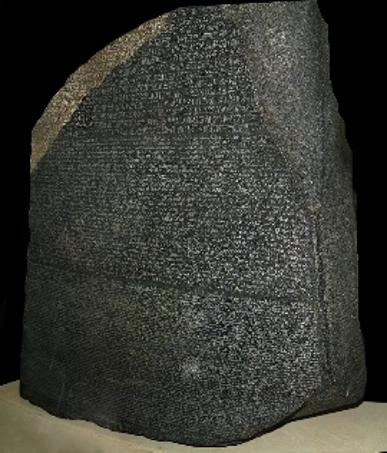
Let’s begin with stone engravings, using the famous Rosetta Stone as an example. The Rosetta Stone weighs roughly 750kg and contains the same text in three languages: Ancient Egyptian hieroglyphs on top, Egyptian Demotic script in the middle, and Ancient Greek on the bottom. To estimate the data density, I focused on the Greek portion of the stone, which accounts for roughly 1/3 of the stone’s total weight (about 250kg).

No source I could find provided a reliable count of the surviving Greek characters, so I calculated it twice independently. First, I compared a 19th-century publication’s line-by-line count with a high-resolution photo of the stone, which puts the original, undamaged text at about ~7,290 characters. Adjusting that figure for the approximately 20 percent of the stone that’s damaged or missing gives an estimated ~5,832 surviving characters. Second, I ran an AI optical character count directly off the damaged stone, which returned ~5,800. The two methods are close, so I use ~5,800 characters going forward.

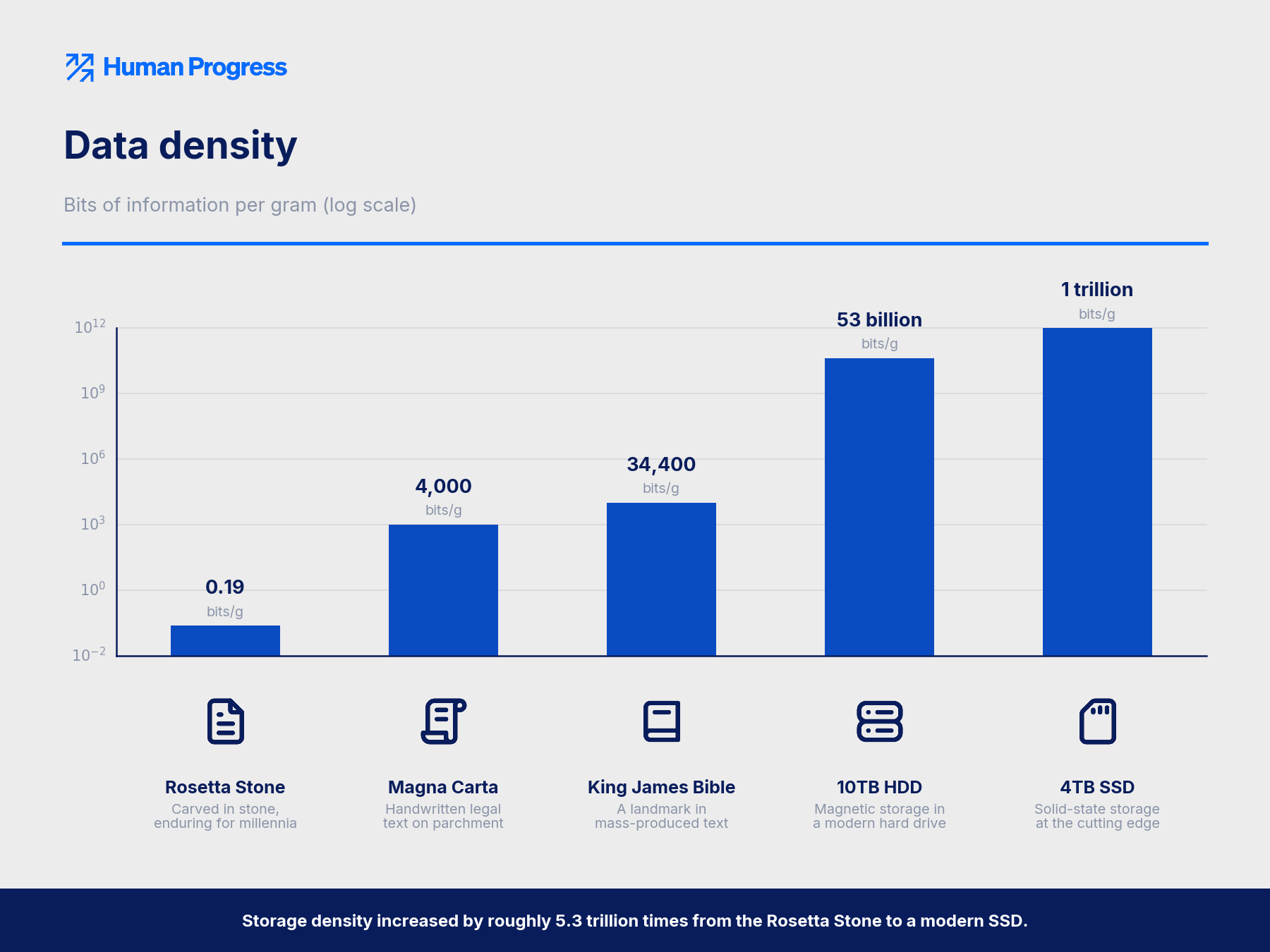
Since a single character of text equates to about 8 bits of information, the surviving 5,800 characters store 46,400 bits of data. Divided by the 250kg weight of the Greek portion, we arrive at a data density for the Rosetta Stone of ~0.19 bits/g.

With the discovery of agriculture and the rise of agrarian civilizations, the demands for knowledge storage and transmission media grew. The human population expanded, and a small but notable fraction began to congregate in small towns. As social and economic complexity grew, so did administration, trade, tax, and legal systems. Humans needed an easy way to perform and store the outputs of mathematical calculations, record taxes, and codify rules and regulations for personal and business conduct. Agrarian civilization, in short, demanded a storage medium with higher information density and faster read/write speeds (throughput). Enter papyrus, parchment, and paper.

Early forms of “paper” included papyrus and animal-skin materials like parchment and vellum. Papyrus was made from the papyrus plant, which grew in the Nile Delta in ancient Egypt. To make papyrus, strips of the plant were cut, laid into overlapping layers, and then pressed and dried into sheets. Papyrus was first used for writing as early as 2,500 B.C. and was one of the primary writing materials for thousands of years. Compared with stone, papyrus was far more data-dense; we could fit more characters on a given surface area, the substrate was lighter, and it could be folded or rolled into a scroll.

Parchment, made from cleaned and stretched animal skin, was developed long after papyrus and, thanks to its superior durability, quickly became the medium of choice for important documents. The Magna Carta, made from parchment, contains about 3,500 words or ~25,000 characters, which equates to about 200,000 bits of information. Medieval parchment weighs about 100–180 g/m², meaning the Magna Carta weighs roughly 50 grams. Using our formula, the Magna Carta’s data density comes out to around 4,000 bits/g.

Even the Magna Carta pales in comparison to modern paper with printed text. “Paper”, the flexible plant-fiber sheets we know of today, was invented in China as far back as the 2nd century B.C.. It took centuries for it to spread outside China. Paper could be made thinner and lighter than parchment or papyrus, and the printing press made it possible to fit more words on a sheet. The King James Bible, for instance, contains around 789,000 words. That’s roughly 4.3 million characters, or 34,400,000 bits of data. A standard hardcover Bible weighs about 1 kg. Even if we conservatively include the weight of the binding, the information density comes to ~34,400 bits/g, about 8.6 times the density of the Magna Carta.

Our eyesight is limited, and text can only be so small before we can no longer resolve it. The next revolution in data storage came in the form of more exotic “machine-readable” media. Examples include magnetic storage such as hard drives and magnetic tape. Here, data is encoded on magnetized material directly as bits of information – ones and zeros – by carefully controlling the polarity of magnetic domains. This technology was a wondrous breakthrough, and it’s still improving. Today, for a few hundred dollars, you can purchase a hard drive that can store tens of terabytes of data! A commercially available 10TB HDD that weighs ~1500 g can store ~80 trillion bits of data, a data density of ~53 billion bits/g, 1.54 million times higher than the King James Bible.

Yet today, hard disk drives already feel antiquated. Instead, most phones, desktops, tablets, and external drives use solid-state storage (SSDs). It’s easy to see why SSDs have become so dominant in recent years; they are ideal for mobile devices. They have no moving parts, are more durable, use less energy, and still have higher data density. Solid-state media store data by trapping electrons in a grid of floating-gate transistors to represent bits of information. A commercially available 4TB (~32 trillion bits) SSD weighs 32 grams; a data density of 1 trillion bits/g, about 19 times higher than a comparable hard drive, or about 5.3 trillion times the data density of the Rosetta Stone!

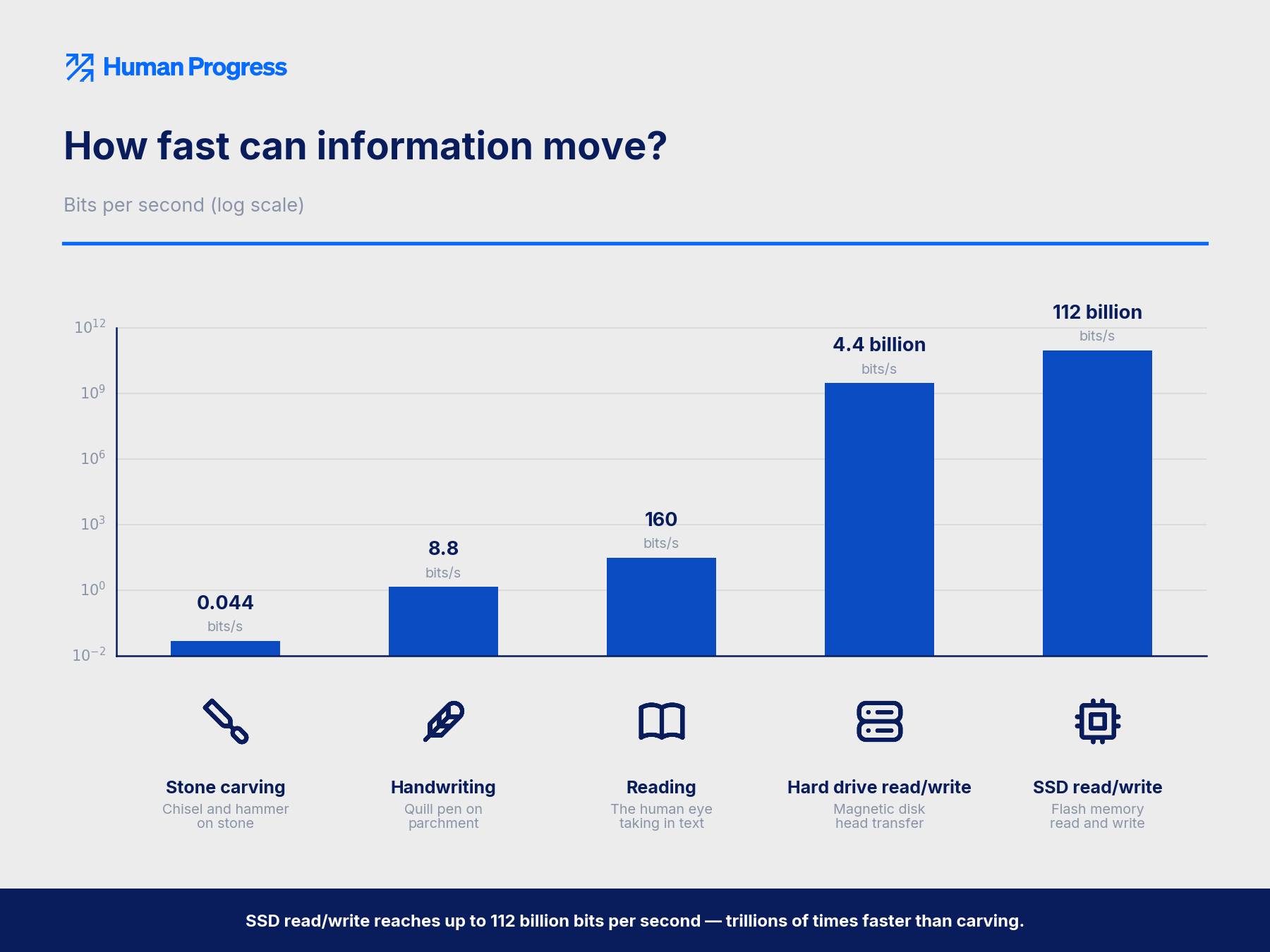
Commensurate with improvements in data density came higher read/write speeds, or “throughput.” People read about 4 words a second and with an average word length of around 5 characters; that’s about 160 bits per second. A professional stone carver might be able to write up to 20 letters an hour, or about 0.044 bits per second. Paper and paper-like media dramatically increased writing speed. A human writes about 1.1 characters per second, or roughly 8.8 bits per second – 200 times faster than carving into stone, though still slower than reading. Printing machines, of course, could print text far faster than any human could write by hand.

But none of this compares to magnetic storage, such as modern hard drives, where read/write speeds (which are similar) are currently about 4.4 billion bits per second. SSDs are faster still, reaching read/write speeds up to 112 billion bits per second. That’s about 700 million times faster than reading, and nearly 13 billion times faster than writing by hand, roughly 2.5 trillion times faster than carving into stone!

In roughly five thousand years, we’ve pushed the density of our storage media up by a factor of trillions, and the leaps keep coming faster. It took five millennia to get from stone to the printed page, representing a 180,000-fold gain in data density. In the seventy years since the invention of the hard drive, and with SSDs, humanity has multiplied that density by another 29 million times. For perspective, the text of the King James Bible carved in stone would weigh around 185 tons, nearly as much as a Boeing 747 (without fuel). On an SSD, it weighs less than a grain of sand.

Blog Post | Happiness & Satisfaction

First-World Problems Were Once an Emperor’s Problems

Stoicism is even more relevant now that abundance has become commonplace.

Summary: Marcus Aurelius faced temptations that feel surprisingly modern: comfort, excess, distraction, and uncertainty about how to use freedom well. His reflections offer one way to think about the psychological challenges of abundance, including the difficulty of balancing pleasure, purpose, and responsibility. As prosperity makes scarcity less central to everyday life, people must find new sources of meaning in work, relationships, service, and self-directed goals.


“In the morning when thou risest unwillingly,” Marcus Aurelius instructed himself, remember that “I am rising to the work of a human being.”

The most powerful man in the world did not want to get out of bed.

Book Five of Meditations begins with the Roman emperor and Stoic philosopher arguing with himself under the covers. Staying warm is more pleasant, he admits. Rest is necessary too. But nature has placed limits on rest, just as it has on eating and drinking. The problem, Marcus observes, is that he exceeds those limits when pleasure is involved and “stoppest short” when there is work to do.

Strip away the second-century diction, and this could be a transcript of someone bargaining with an alarm clock before a morning workout. Marcus tells himself to get up, stop overeating, do his job, and quit pretending that comfort is the purpose of life. Two thousand years later, we buy books and download podcasts that tell us the same things.

That helps explain Stoicism’s extraordinary revival. Annual sales of Meditations reportedly rose from around 12,000 copies in 2012 to 100,000 in 2019. Modern Stoic writer Ryan Holiday has sold millions of books to an audience spanning professional athletes, politicians, technology executives, and ordinary people trying to exercise before work. An ancient philosophy of self-command has found a mass market because the problems of self-command have found a mass market.

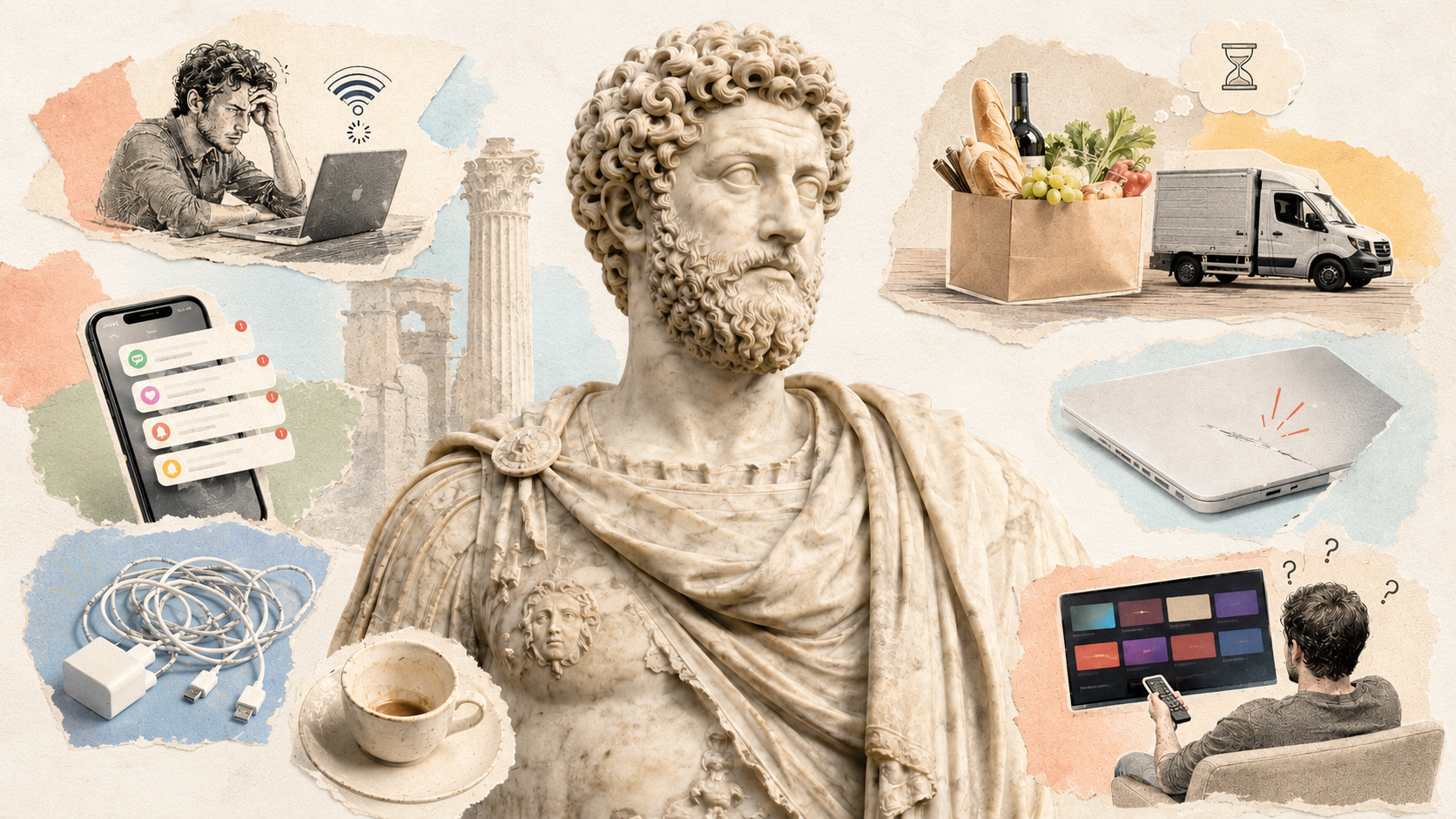
Marcus did not live an easy life. He ruled during frontier wars and the Antonine Plague. Several of his children died young. Much of Meditations was written to and for himself, apparently while on military campaign. But he also experienced a class of surprisingly recognizable “first-world problems” back when they were much rarer: too much food, too little movement, diffuse anxiety, irritation with other people, uncertain purpose, and the temptation to let comfort consume a life.

First-world problems were once emperor-world problems.

Marcus practiced a form of what psychologists today call cognitive reappraisal: changing an emotional response by changing how one thinks about something. When confronted with an elaborate meal, he reminded himself it is just a dead animal. Falernian wine, among the most prized luxuries in Rome, is “only a little grape juice.” Imperial purple, Rome’s finest clothing material, is just sheep’s wool stained with shellfish blood. The exercise, he explained in Book Six, was to strip away the prestige surrounding an object and see it clearly.

Marcus needed the Stoic operation because he inhabited an unusual ecology of evolutionary mismatch, much like that found in the developed world today.

For nearly all human history, calories were costly, physical exertion was unavoidable, and rest conserved energy that might be needed later. Today, the time prices of food are so low that many can afford a day’s worth of calories in under an hour of labor, all while working sitting down in an indoor climate-controlled environment. Many of us pay for gyms and manufacture strenuous movements that resemble pointless labor because ordinary survival no longer supplies enough activity.

The same principle extends beyond food and exercise. Humans evolved to monitor threats in a local environment. For most of history, only emperors and a small governing elite received a steady stream of dispatches from distant lands. Couriers and envoys brought Marcus news of wars, revolts, epidemics, and political intrigue from across the known world. Now a phone or TV news channel supplies every catastrophe on Earth in real time. And in economic life, we apply evolved intuitions built for small-group scarcity and zero-sum rivalry that fail to scale to modern global markets.

In 1930, John Maynard Keynes foresaw these problems of prosperity. Writing during the Great Depression, he predicted that technological improvement and compound growth could raise living standards to such a degree that we would be free from material scarcity. Once the absolute needs were met, humanity would confront what he called its “real, permanent problem”: how to use freedom from pressing economic cares “to live wisely and agreeably and well.”

Brink Lindsey borrows Keynes’s phrase for his recent book, The Permanent Problem. Lindsey argues that wealthy liberal democracies now occupy an awkward territory between mass plenty and mass flourishing. Food, shelter, safety, education, and medicine are more available than ever, but people still need status, purpose, belonging, and the sense that their efforts matter.

Imperial wealth solved the economic problem for one man nearly eighteen centuries before markets and technology began solving it for whole populations. Once freed from many ordinary constraints, Marcus encountered the permanent problem early. What should he do with comfort? How much pleasure was enough? Why work when others could work for him? How could he remain useful when status had removed the need to prove himself useful?

Critics sometimes find it amusing that a philosophy of indifference to wealth attracts wealthy executives. But Stoicism’s new popularity is less paradoxical than it seems. Stoicism developed among people living close to power and abundance because power and abundance exposed problems that scarcity had concealed. The philosophy of an emperor becomes more relevant when ordinary people begin living, in important respects, like emperors.

Poverty has not disappeared. But the characteristic problems of affluent societies increasingly concern regulating access rather than enduring absence: eating less of the food surrounding us, moving more despite labor-saving technology, limiting entertainment, directing attention, choosing among options, and finding commitments strong enough to organize freedom.

Stoicism offers a useful set of psychological tools for the task of finding meaning and navigating abundance. Its distinction between what is and is not under our control redirects threat monitoring toward action. Its practice of stripping luxuries down to their physical components weakens the stories that amplify craving. Voluntary discomfort teaches the nervous system that cold, hunger, exertion, and inconvenience are tolerable. Gratitude resets the comparison point against which abundance otherwise becomes invisible. Remembering death makes us appreciate life’s finitude.

But Stoicism was never only a collection of tricks for feeling calmer or becoming more productive. Marcus did not drag himself from bed merely to clear his imperial inbox. He was rising to fulfill a human purpose, which for a Stoic meant acting rationally, socially, and for the common good. Meaning came from duty voluntarily embraced and service to something beyond appetite.

That fits the evolutionary account. Humans are not built only to consume calories and conserve energy. We also evolved to cooperate, master difficult skills, earn esteem, care for kin, reciprocate favors, contribute to groups, and navigate moral concerns that sometimes pull in different directions. The pragmatic response is to choose ecologies that activate the better angels of our nature: difficult work with visible progress, physical exertion, face-to-face relationships, responsibility for others, and problems whose solutions improve a community. Realistic progress works with evolved psychology instead of pretending human beings are blank slates.

Historically, only a tiny elite had enough food to struggle with gluttony, enough leisure to struggle with lethargy, and enough freedom to struggle with what freedom was for. Marcus repeatedly reminded himself that pleasure, technology, wealth, or leisure were not vices themselves. The problem was surrendering judgment to them. He could enjoy the palace without becoming its slave. Likewise, we can enjoy the supermarket, smartphone, washing machine, and weekend, while recognizing the new, preferable challenges that abundance creates.

Emperor-world problems are still problems, but it is a triumph that they are increasingly part of ordinary life.