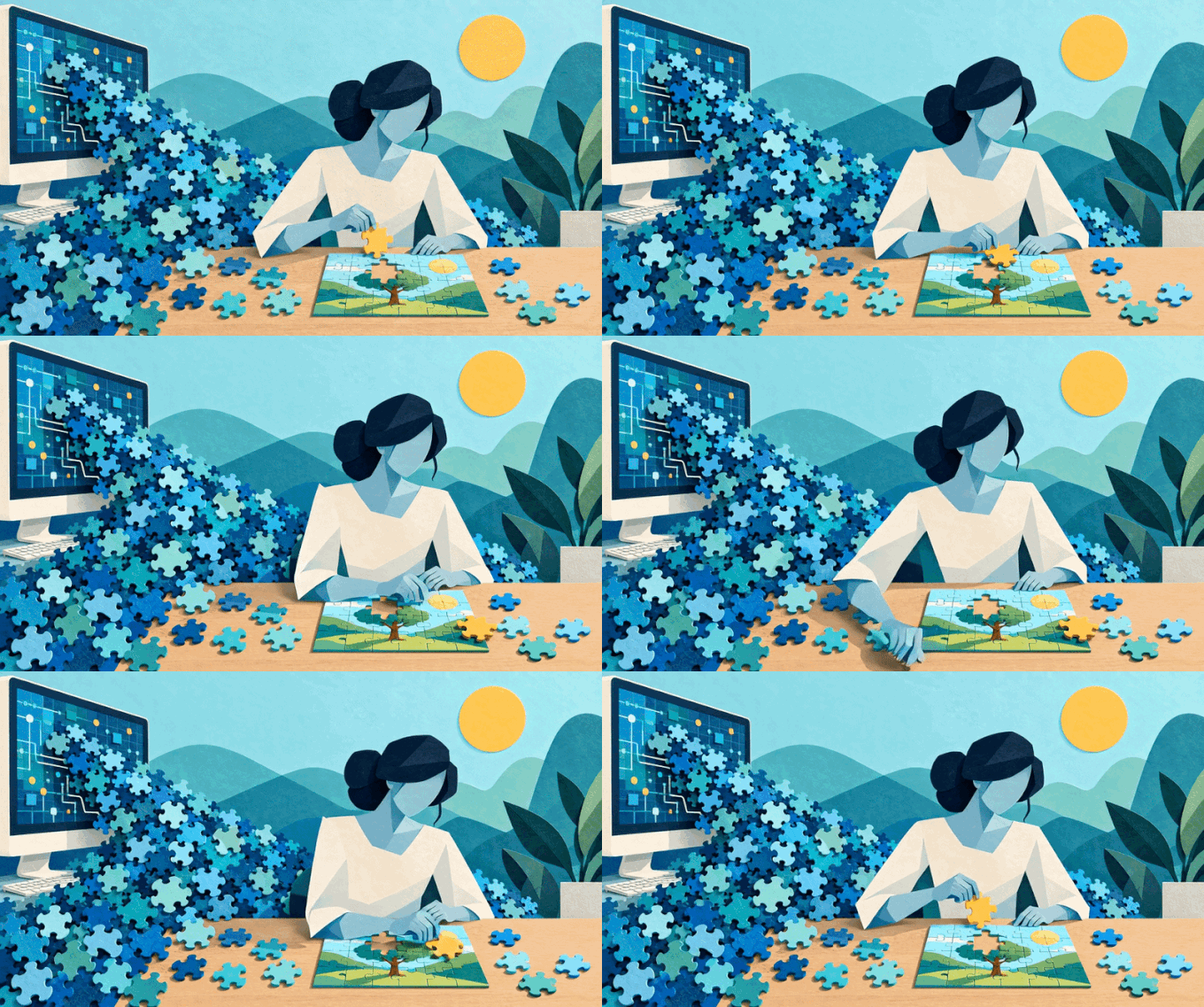
Summary: Recent AI breakthroughs invite the question of whether human minds are still the “ultimate resource,” as Julian Simon claimed. AI can generate answers far faster than humans can check them, but Joel Mokyr’s distinction between knowing that something works and knowing why shows that both kinds of knowledge must advance together. Candidate proofs are not theorems, and predictions are not findings. That is why the age of AI calls for more educated minds, not fewer.
Last week, OpenAI published more than 370 mathematical results spanning algebra, theoretical computer science, and mathematical logic. Most came from a single prompt and about three hours of computing time. “If a human did this, it would be an instant Fields Medal, no questions asked,” wrote Alex Kontorovich, a professor of mathematics at Rutgers University.
In his 1981 book, economist Julian Simon called people “the ultimate resource” because nothing else can create new ideas. Simon argued that new human ideas lead to innovation, and innovation drives economic growth and underpins modern prosperity. Forty-five years on, and with announcements of AI breakthroughs dominating headlines almost every week, it’s easy to be skeptical of Simon’s claim.
OpenAI announced last month that after 88 hours of work, its AI had cracked the Navier-Stokes existence and smoothness puzzle, one of the seven Millennium Prize Problems that has baffled mathematicians for almost a century. On the same day, Google DeepMind released AlphaGenome Atlas, which maps the predicted molecular effects of all nine billion possible single-letter changes to human DNA. If the nature of innovation is changing, are we still “the ultimate resource”?
Ideas, as the science writer Matt Ridley wrote in 2010, “have sex.” In The Rational Optimist, Ridley argued that innovation is not the work of solitary geniuses but happens when human minds come together. As societies become increasingly open and specialized, more people with different expertise meet, discuss, and recombine ideas. The result is what Ridley called the “collective brain”: the knowledge spread across society that no individual holds.
For recent AI breakthroughs, every system runs on humanity’s collective brain. OpenAI’s agents worked from a cached copy of the internet, and AlphaGenome was trained on thousands of experiments on human and mouse DNA, all of it somebody’s lab work. For years it was implied – simply because no alternative existed – that for ideas to have sex, both partners had to be human. If ideas no longer need two human minds to have sex, as Ridley put it, one might conclude the collective brain has found a replacement for humans altogether.
That assessment is overly pessimistic, however. Since these breakthroughs recombine ideas humans had already written down (albeit at inhuman speeds), the machines look less like second parents and more like a very fast medium through which human ideas meet and get down to business. One-nil, humans.
Beyond depending on existing human knowledge, OpenAI’s breakthrough also relied on human methods. To tackle Navier-Stokes, OpenAI ran about 10,000 agents at once, divided into groups that explored different areas and talked among themselves. As groups made progress, the most useful insights were consolidated and fed back to the other agents. Roughly 2.7 million messages were exchanged before an answer emerged.
Many rival agents working in parallel, immense specialization, most of them failing while the rest built on what was most valuable. Free market galore!
Humanity is surely better off with the additional knowledge AIs produce. Yet whether it is agents creating mathematical proofs that could solve centuries-old problems, or my own AI delivering thousands of words of research reports I haven’t found time to read, the bottleneck to innovation still lies with us.
In DeepMind’s case, AlphaGenome Atlas can predict what genetic variants can do, but it doesn’t comprehend the biology beneath them. A list of predictions settles nothing on its own. A human mind must decide which subset to study, and Atlas’s predictions are not findings until somebody in a laboratory confirms them. Knowing that a DNA variant matters isn’t the same as knowing why.
In OpenAI’s case, mathematicians worldwide are still assessing the proof’s validity. Three days after the announcement, without naming any company, 25 Fields Medal winners published an open letter about AI and the discipline of mathematics, noting that “solving problems is only a tool and proxy for achieving the primary goal of conceptual understanding and insight.” The signatories note that AI can accelerate mathematical work, but human understanding produces the next question worth asking.
The gap between output and understanding predates AI. The economic historian Joel Mokyr, who won the 2025 Nobel, distinguishes two types of knowledge. “Prescriptive knowledge” is knowing that something works. Think Edward Jenner knowing that exposure to cowpox provides immunity against smallpox, long before anyone knew why. “Propositional knowledge” is understanding why something works, such as comprehending the underlying science or natural laws. Mokyr’s answer to why the Industrial Revolution did not stall like earlier golden ages is that Europe got both types of knowledge moving together.
The latest wave of AI discoveries could make one pessimistic about humanity’s role in the future of innovation. But Mokyr’s point is that the two types of knowledge should move together, and understanding why something works matters just as much as knowing that it does. Candidate proofs are not theorems, and predictions are not findings.
AIs can crunch statistical correlations, draw on what humans already know, and generate prescriptive knowledge far faster than any human mind can convert the output into something verified, trusted, and useful. That is why we need more educated minds, not fewer. The scarce resource, indeed the ultimate resource, is still us.
A version of this article was first published in the Washington Examiner on 10/13/2026.