01 / 05
Moral Progress Is Hidden in Plain Sight

Blog Post | Culture & Tolerance

Moral Progress Is Hidden in Plain Sight

We're not getting worse, we just want better.

Summary: Every generation believes it is living through a moral decline, yet the evidence tells a different story. While people often perceive society as growing more selfish or rude, they see kindness and integrity in those closest to them. In reality, cooperation, generosity, and moral progress have grown over time. Our tendency to focus on the negative simply makes it harder to recognize how far we’ve come.


Every generation thinks it’s witnessing humanity’s moral collapse. New York Times columnist David Brooks claims that “we inhabit a society in which people are no longer trained in how to treat others with kindness and consideration.” But are these timeless claims now true? This time, are we really living in the most immoral era?

Moral panic and pessimism appear to be largely illusory. In a study conducted by psychologists Adam Mastroianni and Daniel Gilbert of Harvard University, they found that every generation perceives moral decline. By consolidating survey data covering 235 questions about morality over a 70-year period, and with more than 12 million participants, Mastroianni and Gilbert found that people collectively believed that their generation and successive generations are morally declining compared to previous ones.

But here’s the paradox: When people rated those close to them (neighbors, coworkers, friends, and family), the perception of moral decline disappeared. In some cases, they viewed people they knew as more moral than the population at large. Thus, people hold inconsistent beliefs: Everyone is becoming more selfish, rude, and dishonest—except the people they know best.

Mastroianni and Gilbert attribute this mistaken perception of moral decline to two psychological biases working in tandem. First, we overvalue, seek out, and focus on negative information. When we witness immoral behavior, this information becomes especially memorable, skewing our beliefs about human morality.

Second, we view the past through rose-colored glasses, remembering earlier times as better across many measures. Because of this bias, we naturally assume that people in previous generations were more moral and virtuous than they actually were.

“Moral behavior” is difficult to quantify, never mind track over time. As argued by Steven Pinker in The Better Angels of Our Nature, the modern world has experienced a severe decrease in homicide, slavery, and torture. Such historic moral improvement, Pinker argues, can be attributed to the advent of liberal society and the acceptance of Enlightenment values.

But the evidence for moral progress extends beyond these dramatic historical shifts. Social trust appears to be increasing as well. In a meta-analysis of social dilemma surveys from 1956–2017, psychologist Mingliang Yuan of Anhui Agricultural University and fellow researchers found that, in America, the “level of cooperation among strangers has increased” over the 61-year period. Moreover, they found that increases in urbanization and societal wealth correlated with greater social trust and cooperation.

This growing cooperation between strangers may help explain the increase in our charitable giving to people we’ll never meet. With the rise of the Information Age and global connectivity, we now have instant access to news about poverty and suffering worldwide, and we respond with unprecedented generosity.

According to Giving USA, in partnership with the University of Indiana School of Philanthropy, American charitable giving increased 3.3 percent (when adjusted for inflation) to $592.50 billion in the past year. The largest increase was in “international affairs” philanthropies, many of which aim to improve the well-being of the global poor.

The growth in charitable donations over the last decade has even inspired more evidence-based charities. One of these, GiveWell, publishes comprehensive research on the cost-effectiveness of the global health and development charities they fund. GiveWell even goes so far as to publish their mistakes, should a program or charitable organization prove to be less effective than expected, or if GiveWell’s research methods prove to be defective. They’re not only trying to maximize moral impact, but doing so with unusual transparency and self-correction.

Contrary to this evidence of generosity and the historic trends of moral progress, many still believe that the virtue of humanity is decaying. Some recent data seem to support their pessimism: The Understanding America Survey from the University of Southern California found in 2025 that conscientiousness (a tenet of the Big Five personality traits) is in decline. John Burn-Murdoch, at the Financial Times, speculates that this survey data on the decline of conscientiousness can be partially explained by technology enabling our ability to ghost and abandon social commitments. 

But we should interpret these findings carefully. The survey data on conscientiousness is self-reported: how people perceive their own conscientiousness. In a new global culture focused on self-optimization that rewards dieting, perfectionism, and prestige in higher education, it’s perhaps no surprise that we see ourselves as less dependable, less industrious, and not nearly as conscientious as our grandparents.

Even if we fall prey to thinking of our generation as less moral than our predecessors, we need not let this pessimism make us pessimistic. In Mastroianni’s paper, “Things Could Be Better,” he conducted seven studies asking participants to imagine various events, institutions, and objects to be different. In every experiment survey participants routinely thought of how it “could be better” and not how things “could be worse.” Thus, they were less likely to appreciate the ways humanity has progressed. Mastroianni noted in an interview, “When it comes to moral progress, we may be less grateful that we won’t get stabbed by a spear when we walk down the street, instead we feel like there’s moral decay when someone gives us a weird look on the bus.” 

We tend to overlook our moral progress and focus on how things could be better, which keeps us imagining a more virtuous world. Yet historical evidence shows we’re living in a time of unprecedented moral advancement; people are more cooperative, generous, and concerned for others than in any previous generation. We want to improve, and we want moral progress so much that at times we miss the forest for the trees.
Blog Post | Income & Inequality

Why Humans Care More About Rank Than Riches

Wealth Isn't Zero-Sum. Status Is.

Summary: Wealth creation is not inherently zero-sum: fortunes can grow through innovation, investment, and expanding prosperity rather than by taking from others. Yet human psychology remains highly sensitive to relative status, often valuing rank over absolute gains and even accepting personal losses to reduce perceived inequality. This tendency can misclassify productive success as exploitation, turning economic comparisons into moral and political conflict.


This summer Elon Musk became the first trillionaire in history. Supporters celebrated the trillions in market value and the thousands of jobs he helped create pioneering electric cars and reusable rockets. Critics treated the milestone as a referendum on inequality. Bernie Sanders invoked the “greed and power of a ruling class.” Alexandria Ocasio-Cortez and Elizabeth Warren renewed demands to tax extreme wealth. Then SpaceX shares fell back below their IPO price and Musk’s fortune dropped to a humble $850 billion, down from its brief peak of $1.4 trillion.

The decline provoked almost no commentary. When Musk “gained” hundreds of billions in unrealized wealth, politicians spoke as if the money had been taken from everyone else. When more than half a trillion dollars disappeared, no one proposed that wealth had been restored to the public. If anything, millions of shareholders, including blue-collar employees holding equity and the retirement accounts of ordinary Americans, lost money.

Economists can explain the difference between income and equity, paper wealth and spendable cash. But the real dispute is psychological. Humans dislike inequality even when a rising tide lifts all boats. If every centibillionaire donated over 99 percent of their net worth to charity and kept a single billion, people would still lament that billionaires exist.

Wealth can be created. That is why the economy grows every year and why most people can afford basic goods like refrigerators that were once luxuries. But status is zero-sum. If one person moves up in rank, everyone below moves down by definition.

Social psychology experiments consistently show that people care more about rank than wealth. Many will take a smaller income if it places them above their neighbors over a larger one that places them below, and their health and happiness track relative standing more than absolute income.

People will even pay to close a gap. When one person proposes how to split $100, and the other can only accept it or kill the deal for both, a lopsided offer is routinely rejected, the responder giving up a real $20 to stop a stranger from pocketing $80. The asymmetry appears early in development. Five-year-old children will even sacrifice some of their own reward to preserve an advantage over a peer.

Envy is not a free-floating vice. It is a system for detecting consequential differences in rank and resources. Humans evolved in groups that were both cooperative and competitive. Food sharing and reciprocal exchange produced mutual gains, but access to land, allies, and mates was limited, and a rival’s rise could shrink one’s own share. Monitoring who had more was adaptive.

The trouble begins when the system cannot distinguish extraction from creation. A fortune won by inventing something useful should be celebrated, not interpreted as a threat.

Musk does not hold a trillion dollars in food, houses, or currency. He owns stakes in companies whose prices reflect what investors expect them to produce. Comparisons between one man’s fortune and the combined wealth of whole populations translate an opaque balance sheet into a familiar problem: one member of the band appears to have claimed the communal kill.

Zero-sum belief also converts personal comparison into coalitional morality. A man who resents a richer neighbor feels small. A man who resents a class of exploiters feels righteous. The English writer George Orwell noticed the pattern: socialism is often motivated more by hatred of the rich than by love of the poor.

Musk may regain his fourth comma or shed another few hundred billion. His rank can swing violently without any matching change in everyone else’s circumstances. That is why the gains produce outrage and the losses silence. The number is being read as a status score.

ScienceDirect | Trust

People Overestimate the Actual Dishonesty of Others

“Do people believe that others are similarly, more, or less dishonest than they truly are? The accuracy of dishonesty beliefs is not only important for psychological knowledge, but also has implications for organizations and policymaking. In this paper, Study 1 presents a research program on moral decision-making comprising 31 different effects from 11 experiments, where participants could anonymously lie for personal gain. Crucially, participants were also asked to estimate what percentage of other people would lie in the same situation. An internal meta-analysis summarizing all belief-behavior comparisons revealed that people substantially overestimate others’ dishonest behavior (g = 0.61; k = 31; N = 8126), by 13.6 percentage points on average. This effect holds across study contexts and participants’ own behavior, and 63.5% of participants overestimated dishonesty by 5 percentage points or more (only 25.4% underestimated it). We then examined potential consequences of biased dishonesty beliefs in three pre-registered follow-up studies. Study 2 (N = 981) found that providing correct information about actual honesty levels enhanced general prosocial expectations (e.g., trustworthiness, fairness). Study 3 (N = 285) revealed that professional managers have pessimistic beliefs also about people’s real-world dishonesty (e.g., insurance fraud, workplace theft), and moral pessimism predicted greater support for freedom-restrictive countermeasures to reduce dishonesty (e.g., surveillance). Study 4 (N = 741) demonstrated that providing managers with correct information about actual honesty levels causally reduced their support for freedom-restrictive countermeasures. In conclusion, the pessimistic bias in dishonesty beliefs about others is robust, and it shapes prosocial expectations and policy preferences.”

From ScienceDirect.

Blog Post | Trust

Why Free Economies Are Honest Economies

Market freedom rewards honesty. Regulation breeds corruption.

Summary: Many people assume that markets breed dishonesty, but the opposite is true. Commerce depends on trust. Repeated exchange and reputation make honesty not just virtuous, but profitable. When trade is open and competition thrives, deceit is punished and integrity is rewarded. By contrast, heavy regulation invites corruption and favoritism. A truly commercial society, grounded in voluntary exchange and mutual accountability, is also a more honest and trustworthy one.


In my previous essays, I argued that a trade society is both a prosperous and trust-based society. Trust and trustworthiness in society revolve around norms of honesty. Dishonesty breeds distrust and frays the threads of our social fabric. Some may worry that dishonesty is the lifeblood of a commercial society: a system that runs on lies, with an every-man-for-himself attitude and shady opportunists around every corner. In fact, greater honesty is best achieved through reputational pressures and the mutual accountability that is fostered by frequent exchange; frequent exchange is enabled by the removal of corrupting restrictions.

In his Lectures on Jurisprudence, the Scottish economist Adam Smith described the commercial society in the following terms:

Whenever commerce is introduced into any country, probity and punctuality always accompany it . . . Of all the nations in Europe … the most commercial, are the most faithfull to their word … A dealer is afraid of losing his character, and is scrupulous in observing every engagement … When people seldom deal with one another, we find that they are somewhat disposed to cheat … When the greater part of people are merchants they always bring probity and punctuality into fashion, and these therefore are the principal virtues of a commercial nation.

In Smith’s view, fear of reputational damage and unemployment prevents fraud and dishonesty. He believed that success within a commercial society stems from “prudent, just, firm, and temperate conduct” and “almost always depends upon the favour and good opinion of … neighbours and equals; and without a tolerably regular conduct these can very seldom be obtained. The good old proverb, therefore, that honesty is the best policy, holds, in such situations, almost always perfectly true.” For Smith, the market in many ways makes us accountable to each other: repeated dealings and fear of reputational damage incentivize honest behavior. And plenty of empirical evidence supports his outlook.

Laboratory experiments demonstrate that trade teaches participants whom to trust and whom not to. Dishonest behavior is punished in the marketplace, providing an incentive for participants to be honest in their dealings. For example, one study found that adding market competition to the experiment reduced sellers’ over-diagnosis of high-quality treatment (when lower-quality would suffice) and increased buyer trust. Another experiment found that introducing market competition into one-off exchanges boosted trust and efficiency to match that of trading networks built on repeated interactions. Adding market competition and private reputation information in one experiment tripled trust and trustworthiness while increasing efficiency tenfold. By practicing honesty to protect their reputations, trade participants eventually internalize honesty as a habit.

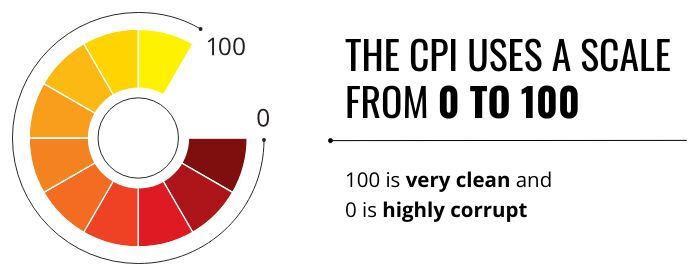
Conversely, trade restrictions lead to greater dishonesty. For example, Transparency International’s Corruption Perceptions Index (CPI) measures the perceived levels of public sector corruption across numerous countries using multiple surveys of business people and country experts (Figure 1). Various studies that rely on the CPICPI have shown that a greater amount of international trade and foreign direct investment and low levels of state control of the economy curtail corruption. High levels of regulation—including regulation on trade—tend to be a strong predictor of corruption. Even seemingly small adjustments to trade procedures can make a difference. For example, the World Bank’s 2020 Doing Business report found that “economies that have adopted electronic means of compliance with regulatory requirements . . . experience a lower incidence of bribery.” That includes digital trade reforms such as electronic single-window systems, e-payments, paperless clearance, online certificate issuance, and more.

Figure 1. Corruption Perceptions Index scale

More recently, a 2023 study looked at firm-level data across 138 countries and confirmed that the imposition of more red tape in public services—such as import licenses—is associated with a greater tendency to pay bribes, particularly in nondemocratic countries. Similarly, a recent study found that India’s trade liberalization since the early 1990s, especially tariff reductions, significantly reduced the economic advantages of politically connected firms by decreasing their reliance on political favoritism. It appears that the friendlier a nation’s economy is to trade, the less corrupt it tends to be. Economic restrictions and regulations allow corruption to grow, instead of the economy. By reducing barriers, more trade is unleashed, which in turn promotes the “probity and punctuality” that Smith described.

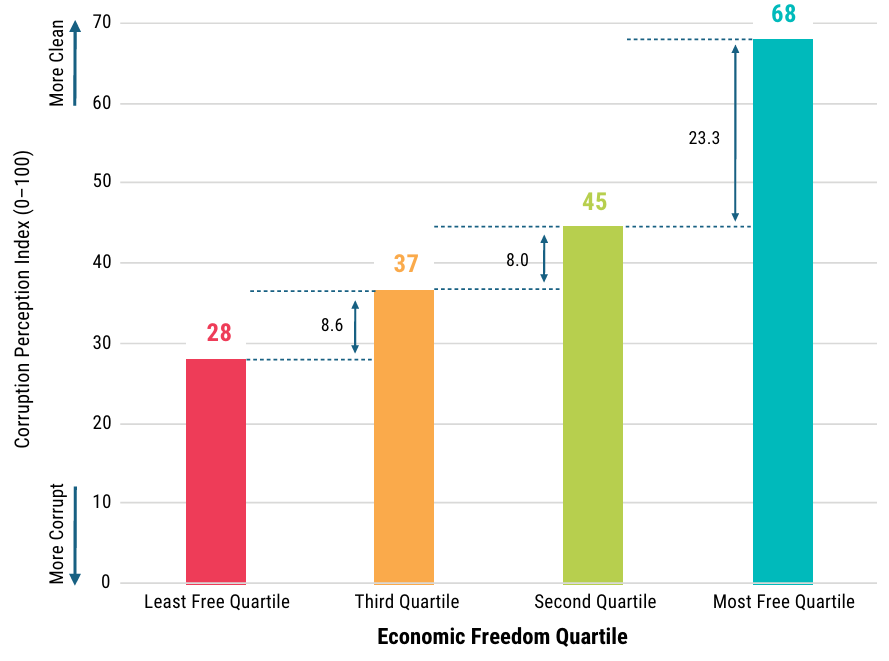
When the level of economic freedom within countries is compared to their level of corruption, economically-free countries come out looking relatively clean. And the scores of the freest countries are more than twice as high as those of the least free countries (Figure 2). That’s because various aspects of economic freedom—including trade openness—are associated with less corruption. Freer trade makes reputation king, mitigating corrupt incentives and embedding honest norms throughout society.

Figure 2. Economic freedom and corruption

Source: Robert Lawson, Ryan Murphy, and Matthew D. Mitchell, “Economic Freedom of the World in 2022,” in Economic Freedom of the World: 2024 Annual Report, eds. James Gwartney, Robert Lawson, and Ryan Murphy (Fraser Institute, 2024), p. 33. Higher CPI scores denote less corruption.

As a case in point, East Germany suffered under severe trade restrictions prior to the fall of the Berlin Wall. After testing randomly selected German citizens on their willingness to cheat at a die-rolling game, researchers found that those who had East German (communist) roots were significantly more likely to cheat compared to those with West German (capitalist) roots. It was also shown that the longer the person had exposure to communism and its trade barriers (i.e., those who were at least 20 years old when the Berlin Wall fell in 1989 compared to those who were only 10 years old), the greater their likelihood to cheat.

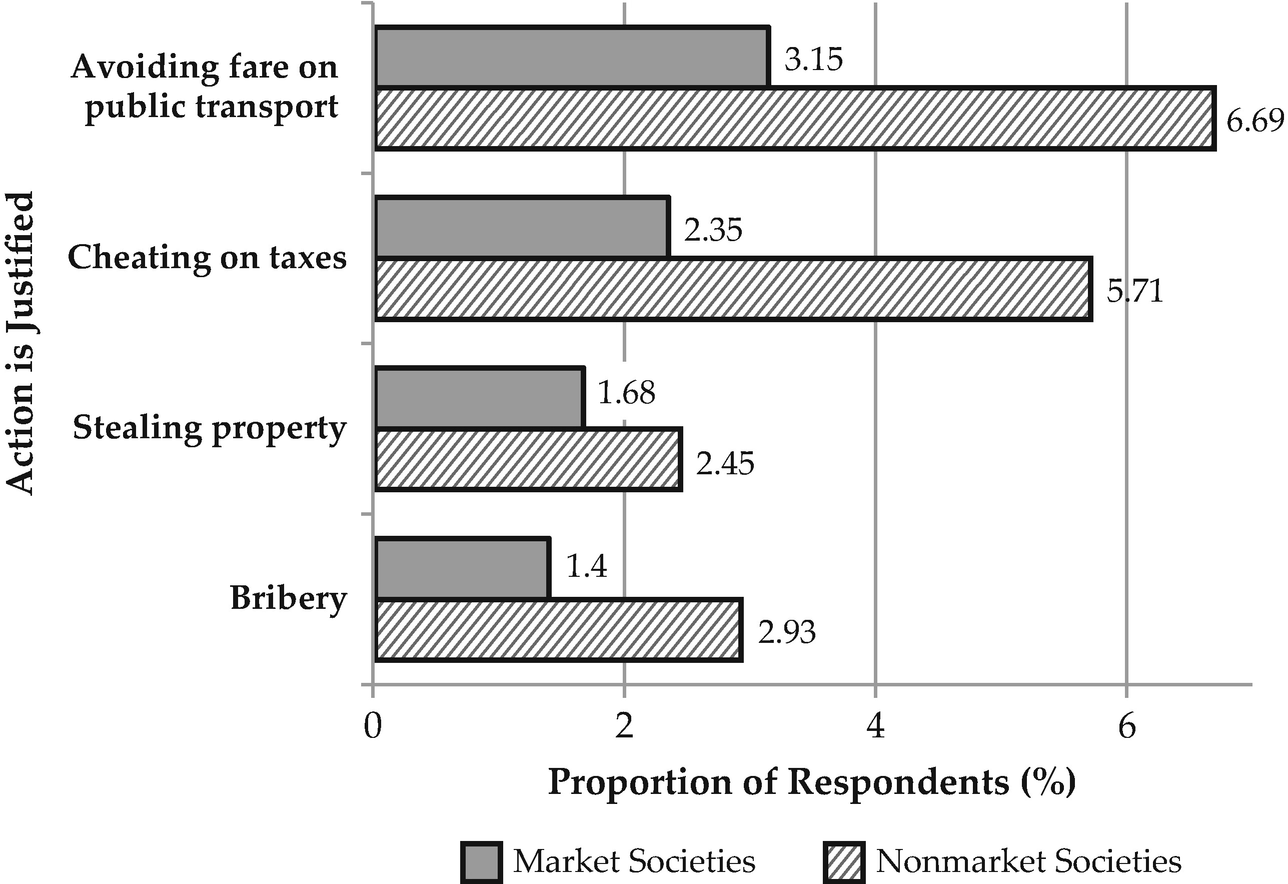
These findings are supported by the work of the Mercatus Center’s Virgil Storr and Ginny Choi, who discovered a significant difference in attitudes between members of nonmarket and market societies: More than double the number of nonmarket residents versus market residents believe that avoiding fares on public transport, cheating on taxes, and bribery are justifiable. Those from nonmarket societies are also more accepting of theft compared to those from market societies (Figure 3).

Figure 3. Market versus nonmarket societies on dishonest behavior

Source: Virgil Henry Storr and Ginny Choi, Do Markets Corrupt Our Morals? (Palgrave Macmillan, 2019), p. 172.

Follow-up studies by other researchers have drawn similar conclusions about market societies and honest behavior. For example, a 2023 study surveyed residents in both market and nonmarket societies on their attitudes toward claiming government benefits to which they are not entitled, avoiding fares on public transport, and cheating on taxes. After controlling for a number of variables, they found that those with greater exposure to markets were less likely to justify these dishonest actions. What’s more, individuals who preferred markets (“market thinking”) were also less likely to justify dishonesty. The researchers concluded that there is “a universal association between markets and morality” and “a robust association between an increase in market exposure and an increase in civic morality.”

Even within communist countries, research shows that the more trade-oriented areas tend to be the least corrupt. A study in China Economic Review employed the National Economic Research Institute (NERI) Index of Marketization, which measures five major fields of Chinese marketization with 23 indicators. Examining different provinces in China, the authors’ analysis found that deregulation and trade reduce corruption: a 1 percent increase in the marketization index leads to a 2.72 percent reduction in corruption. Regions that increased trade openness by 1 percent experienced a 0.35 percent reduction in corruption.

Overall, the evidence overwhelmingly suggests that open economies stifle the spread of corruption and reinforce honest habits through reputation-building exchange. The removal of trade barriers allows for more commerce to take place and, consequently, more reputations to be a stake—a powerful incentive to keep honorable reputations intact. The most enduring way to achieve this is through genuinely honest conduct. A commercial society is, at its core, a society of integrity: it limits the opportunities for corruption and encourages honest behavior in the process. The norms of commerce—Smith’s “probity and punctuality”—settle in like a kind of glue, helping to bind society together.

Blog Post | Culture & Tolerance

What You Need to Know About Humans to Advance Human Progress

Neither nature nor nurture can be ignored.

Summary: Human progress depends on understanding human nature to some degree. Our blended capacities for cooperation, competition, empathy, and aggression cannot necessarily be ignored or overwritten by social engineering. Sustainable progress arises when institutions and innovations work with our evolved psychology rather than against it, channeling our instincts toward creativity, cooperation, and flourishing.


“Nature versus nurture” is a debate older than the field of psychology itself. Are we born with fixed traits, or are we shaped entirely by our upbringing? Of course, this is a false dichotomy. Both genes and environment shape most psychological traits. The real question is not nature versus nurture, but how much each contributes to different outcomes.

This question matters deeply for thinking about human progress. Any attempts at improving the human condition must be compatible with human nature, or they will risk creating more problems—such as the collapse of communist and socialist economies, for example—than they solve. And understanding human nature means grappling with our biological constraints and evolutionary history. Progress for squirrels might mean a world devoid of natural predators, where every tree grows acorns year-round. But human progress is a distinctly human concept.

As a psychologist, I am interested in the psychological foundations of human progress. To understand and sustain human progress, we must first understand the nature of the humans who are progressing. Strangely, the beings most capable of reflecting on our own values are also the most skilled at obfuscating them, as my graduate advisor, Harvard University psychologist Steven Pinker, has explored at length in his books The Blank Slate and Rationality. Many influential thinkers throughout history have questioned or outright denied the concept of human nature. 

Superficially, that makes sense. Unlike some animals, which can walk and forage minutes after birth, human infants are born helpless and remain dependent on others for years. We are not born with language, and the languages we learn to speak depend entirely on the environment we were brought up in. As the English philosopher John Locke noted, all knowledge appears to come from experience, whether firsthand or taught by others. The human mind, at birth, is seemingly a true blank slate.

The blank-slate view was profoundly influential on the Enlightenment philosophy that set the stage for the miraculous forms of human progress in the coming centuries. If every baby starts out essentially the same, only advantaged or disadvantaged by their environment, then the case for equality becomes not just moral, but empirically necessary. It suggests that no one is born inherently superior, and that differences in status, intelligence, or virtue are all shaped by experience, not destiny. If all minds begin equally blank, then all individuals are capable of reason, learning, and democratic self-governance.

The idea that human nature was endlessly flexible fueled optimism, but it also began to cast blame on modern society. If we are all a product of our environments, then violence, poverty, and inequality were the results of a manipulated system. This philosophy was most famously embodied by the Enlightenment philosopher Jean-Jacques Rousseau, who believed that humans were born fundamentally good and were corrupted by society. In his view, the natural state of humanity was one of egalitarian peace, disrupted only by the emergence of social institutions that fostered competition and inequality.

The English philosopher Thomas Hobbes, in stark contrast, believed the default state of human life was solitary, poor, nasty, brutish, and short. For Hobbes, society constrained the worst of our innate impulses, and a strong legal system made crime more dangerous than cooperation. While Hobbes’s vision was often caricatured as bleak or authoritarian, modern psychology has increasingly validated his core insight. Humans are not born peaceful and rational, but possess a mix of impulses—some prosocial, others aggressive, impulsive, and self-serving. As the Canadian developmental psychologist Richard Tremblay has shown, the most aggressive humans are, in fact, toddlers. Although they cannot inflict real harm, most toddlers hit, steal, and lie as soon as they are capable. As all parents know, these innate antisocial behaviors must be patiently weaned out of children through healthy socialization and repeated instruction.

These two visions—Rousseau’s romanticism and Hobbes’s realism—have shaped centuries of thought about human nature and the role of institutions. One sees society as the source of our problems; the other sees it as the solution. Both, in their extremes, miss the full picture. We are born capable of both empathy and cruelty, cooperation and tribalism, innovation and superstition. Society both nurtures us and constrains us. Different aspects of different ideologies and institutions both facilitate and prevent human progress.

Institutions are not just abstract systems—they are extensions of human psychology. Their success or failure often hinges on how well they accommodate and channel our evolved tendencies. When institutions align with human nature, they can guide self-interest into cooperation, aggression into justice, and tribalism into civic identity. When they ignore it, they risk collapse, corruption, or unintended negative consequences.

Consider the market economy. At its best, it transforms individual ambition into mutual benefit. Entrepreneurs seek profit, but in doing so, they create goods, services, and jobs. This is not a triumph over human nature—it is a clever use of it. As the Scottish economist Adam Smith noted, “It is not from the benevolence of the butcher, the brewer, or the baker that we expect our dinner, but from their regard to their own interest.” Contrast that with utopian communes that attempt to erase hierarchy, suppress competition, or eliminate private property. These experiments often fail because they ignore deep-seated human drives for status, autonomy, and reciprocity. When institutions deny these drives, they invite dysfunction.

Successful democracies are not built on the belief that humans are all born the same, but that our differences can complement each other, given sufficient freedom and equality before the law. Checks and balances, the rule of law, and free speech are not just moral principles, but safeguards against the psychological realities that humans are fallible, competitive, and prone to power-seeking. Progress is not achieved by transcending our psychology, but by building systems that align with our best impulses and constrain our worst.

Despite these self-evident truths, discussions of progress often neglect human nature in favor of nurture. Whether arguing for government intervention in the market, increased social welfare spending, or profound cultural change, advocates of such positions share a commitment to reshaping our environments. Yet even in identical environments, outcomes vary dramatically depending on psychological factors such as trust, optimism, gratitude, and self-control. These are not variables that can be socially engineered. Instead, they are traits that arise from genetic inheritance, individual beliefs, decisions, and cultivation of habits.

Even in this almost miraculous age of superabundance—characterized by unprecedented material wealth, a high degree of freedom, and technological sophistication—many people feel lost, cynical, and devoid of purpose. To improve people’s psychological outlook, a deep understanding of human nature is necessary. That consists of considering not only our environments but also human nature itself. Without that understanding, progress can lead to unintended, sometimes negative, consequences. Material abundance can breed obesity and lethargy; excess freedom can lead to decision paralysis; technological progress can erode attention spans and lead to addiction. History shows that we are not blank slates who can be remolded into something we are not.

My role at Human Progress will be to not just examine the psychological aspects of progress—mental health, optimism, rationality, cooperation, creativity, and productivity—but to understand how progress interfaces with human nature and leads to human flourishing. In the words of the American economist Thomas Sowell, there are no solutions, only trade-offs. Progress is a negotiation between our aspirations and our nature—between what we were built to be and what we hope to become. The most enduring advances come not from denying our instincts, but from designing systems that guide them toward constructive ends.