
01 / 05
Human in the Loop: Why Technology Destroys Jobs and Creates Better Ones

Blog Post | Employment

Human in the Loop: Why Technology Destroys Jobs and Creates Better Ones

Past waves of automation have kept humans in the loop, and AI is unlikely to be different.

Summary: Job losses in individual industries can accompany a growing, increasingly prosperous economy. By lowering costs and increasing purchasing power, technology expands demand and supports employment elsewhere in the economy. AI is likely to follow this pattern, raising productivity while sustaining demand for human judgment and physical skills. Although some workers face painful transitions, history offers reason to expect higher wages and better working conditions.


In one scene in John Steinbeck’s The Grapes of Wrath, set in Oklahoma in the mid-1930s, a tractor arrives, and one man on a machine suddenly does the work of a hundred people. Families of farm workers, like the Joads, the novel’s protagonists, are driven off the land, and tragedy follows as the family heads west, where promised work proves scarce to come by. Today, as AI spreads across the economy, the old fear of machines putting humans out of work is running high once again.

However, technology has advanced for centuries, shuffling workers among occupations, industries, and regions without making human labor obsolete. As machinery pushed millions of Americans away from farming over the past century, most workers moved to factories, towns, and cities. They ended up with more comfortable lives than their predecessors plowing the fields. The AI economy will likely follow the same path: destroying jobs while creating better ones.

In the vocabulary of AI engineering, a “human in the loop” is a person who reviews, approves, or corrects what an automated system does. The phrase also fits a much larger pattern. Tools and machines keep saving human labor, yet humans stay in the loop, doing what machines still can’t, and more work remains as machines raise total output. The economist Joseph Schumpeter called the process of technology destroying old jobs, firms, and industries while creating new ones “creative destruction.” Workers in a dynamic economy need to be adaptable, yet history gives us reason to feel more excitement than fear about AI-driven job loss.

The Great Declines in Farm and Factory Work

Technological job loss is real, and farms are Exhibit A. In 1800, about three-quarters of American workers were farmers. The farm share of the workforce fell over the 19th century, but the number of farm workers continued rising, reaching 11.6 million in 1910 in one historical series. Then farm employment entered a long decline. Between 1948 and 2017 alone, it fell 81 percent, even as agricultural output nearly tripled. By 2022, direct on-farm employment accounted for just 1.2 percent of US jobs. Americans today eat more and spend far less of their income on food. In 1929, buying food accounted for 23.4 percent of an average person’s disposable income and only 9.7 percent in 2025.

Three forces drove declining farm employment. Technology was the biggest: tractors, combine harvesters, better seeds, pesticides, and fertilizer let farms grow more with far less labor. Rising wages sped things up. As factories bid up labor costs, machines that were too expensive when hired hands were cheap became a bargain. Rising demand for food pulled in the opposite direction, toward the need for more farm jobs, but only mildly. People buy more food as they get richer, but not that much more, because there’s only so much a person can eat, and more of each food dollar goes to factory processing and restaurants.

Steinbeck’s story captures a real collapse in the farming sector, but the Joads’ miseries owed less to tractors than to the Great Depression, which technology didn’t cause. Milton Friedman traced its severity to a catastrophic monetary contraction in 1929–1933. Jobs in town disappeared. Farm employment actually rose in the early 1930s as jobless city dwellers retreated to the land. In normal times, farm workers drifted steadily into factory and town jobs that were more comfortable and better paid.

Manufacturing followed a similar path decades later. Factory employment peaked at 19.6 million in 1979, drifted down until 2000, and then fell by nearly six million jobs in a decade, driven by trade and productivity growth. However, it has since regained about one million. One Ball State University study attributed about 88 percent of the decline in US manufacturing employment between 2000 and 2010 to productivity growth, rather than foreign trade. Factories have become Exhibit B for technology-driven job loss.

These transitions weren’t painless. Some displaced workers never regained their former earnings, and some towns have emptied. My grandmother grew up in Osgood, Idaho, then a community of potato farmers. When I visited in 2024, little of that community was left. But most displaced workers, and especially their children, went on to do better-paid and more comfortable work somewhere else.

Who’s next? Self-driving vehicles may take millions of drivers’ jobs, and AI is already displacing substantial amounts of customer service work. What’s new about AI is that it threatens highly educated workers who never expected to be automated. Software engineers, writers, and translators are feeling the disruption now, and doctors, lawyers, and professors are wondering whether a machine could do their jobs better. But the disappearance of particular jobs does not mean the disappearance of work.

Where the Lost Jobs Go

To see why work will remain, follow the money. When technology cuts costs on the farm, food gets cheaper, and people buy more of it, but they also have more money left to spend on something else, like health care, travel, restaurant meals, education, and new gadgets. Jobs multiply in sectors with elastic demand or slower productivity growth.

Looking only at the industries that shed workers and concluding that work is disappearing is what economists call a “fallacy of composition.” What’s true of some of parts of the economy may not be true of the whole. The typical pattern is for technology to shrink employment in one industry, or several industries, even as the purchasing power it releases supports jobs elsewhere, and the total number of jobs increases.

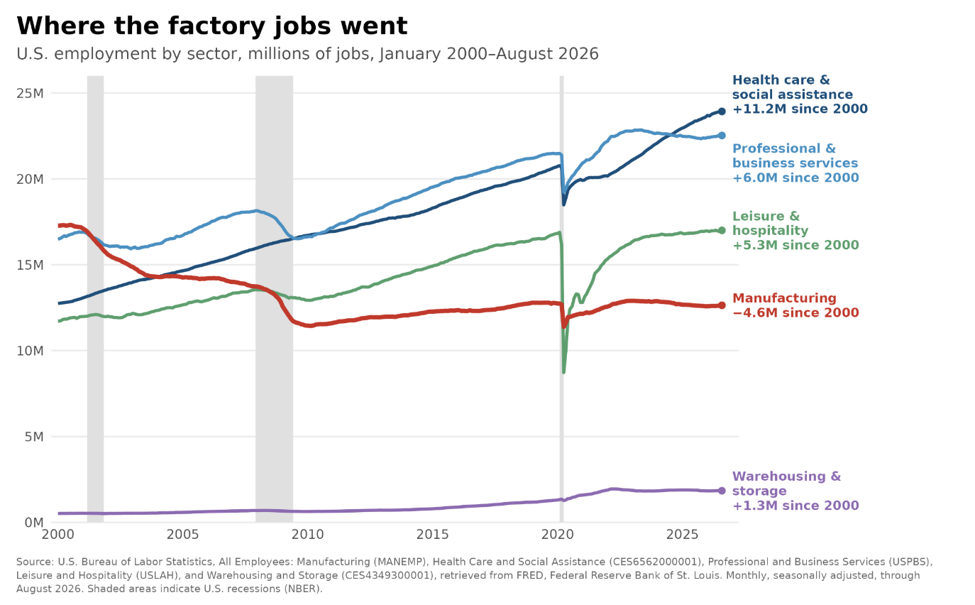
Since 2000, as the United States lost about 4.6 million factory jobs, just four sectors added nearly 24 million. New jobs in health care and social assistance, professional and business services, leisure and hospitality, and warehousing and storage have far outpaced factory job losses. Employment in all of these sectors grew faster than population growth, jointly adding more than five jobs for every factory job lost (Figure 1).

Figure 1
How Jobs Get Better

Jobs don’t just return; they improve over time. When a major new technology raises productivity across many industries at once, as AI is expected to, the whole economy grows richer. As real incomes rise, demand grows fast enough that many industries sell far more and need more workers, not fewer. Because each worker produces more, employers can and must compete harder for workers, offering higher pay, shorter hours, and safer, more pleasant conditions.

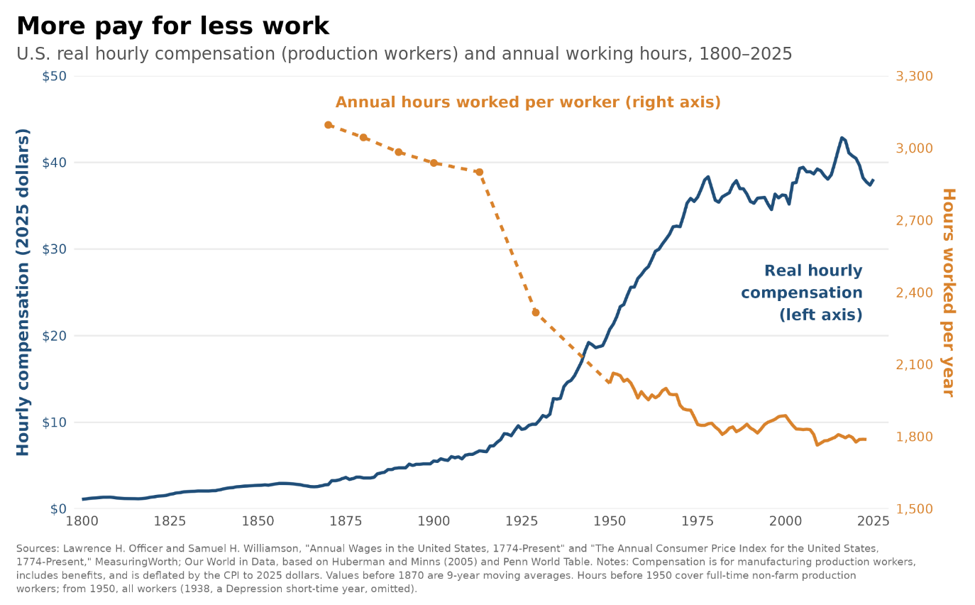
Henry Ford’s Model T is the classic example of this dynamic. Its nominal price fell from about $825 in 1909 to under $300 by the mid-1920s, and sales soared into the millions. In inflation-adjusted terms, the price drop was even steeper. In 1914, Ford famously doubled wages to $5 a day to attract and keep workers. From the late 19th century through the mid-20th century, as railroads, cars, electricity, telephones, and assembly lines spread through the economy, many industries followed that pattern. For workers, the result was dramatic: far higher pay for far fewer hours of work (Figure 2).

Figure 2
Pay and hours aren’t the only gains from creative destruction. Work has also grown far safer: by the time the Occupational Safety and Health Administration was created in 1971, worker fatalities had already fallen by roughly two-thirds from their pre-World War I levels. Machines have taken over much of the drudgery, leaving people with more work that calls for judgment and creativity.

Measured wage growth slowed beginning in the 1970s, along with productivity growth, though HumanProgress’s time-price analysis finds that an hour of work still buys about 20 percent more goods and services than it did in 2000. That statistic, along with Figure 2, likely understates recent gains because both use the Consumer Price Index, which likely overstates inflation. Still, the fast wage growth of the mid-20th century hasn’t returned. A powerful new general-purpose technology like AI should, if anything, end what economist Tyler Cowen calls “the Great Stagnation” and bring fast wage growth back.

The Future Flourishing of Human Labor

In May 2025, Anthropic CEO Dario Amodei warned that AI could wipe out half of all entry-level white-collar jobs and push unemployment to 10–20 percent within one to five years. Goldman Sachs estimates that 15 million workers, or nine percent of the workforce, will be displaced over the next decade. History casts doubt on these forecasts. Still, displacement over a decade differs from unemployment at any one time. Workers move on to new jobs.

Humans will stay in the loop for two reasons. First, AI still depends on people for initiative, judgment, creativity, and critical thinking. Second, as the roboticist Hans Moravec observed, computers find tasks that are intellectually “hard” far easier than physically “easy” tasks that almost anyone can do. Right now, investment in AI training data centers is creating thousands of construction jobs. A 2024 study from Virginia’s Joint Legislative Audit and Review Commission estimated 35,000 direct jobs from AI, mostly in construction, supported by the data center industry. Similarly, a Goldman Sachs analyst forecast 500,000 net new jobs by 2030, especially for construction workers and electricians, as power-generation capacity expands to meet the needs of growing data centers. The Economist reports an AI jobs boom. As AI makes the economy richer, the wealth it creates keeps pulling workers back into the loop at higher wages.

Steinbeck’s story deserves to be remembered, not as a prophecy or even a cautionary tale, but as a reason to be grateful that we’ve left it behind. The Joads took to the road in search of work, a home, and a better future for their children, and found only disappointment. Today’s workers face much better fortunes, even if a few surprises and setbacks are likely. Despite everything, human labor is already thriving as never before, and the work of the future will be even better.
Pangram | Computing

Pangram Introduces New AI Image and Video Detectors

“A few months ago, we released Pangram Image as a research preview. We are now proud to announce Pangram Image 1.0: The state-of-the-art in both AI image and AI video detection. We would like to thank the whole community for taking the time to try it and find its weaknesses, and for holding us to a high standard to make a better detector for everyone…

We tested our Pangram Image 1.0 model against several commercial and academic AI image detectors. We created synthetic mirrors of 100 real photos using 12 frontier state of the art AI image generators, using prompts that closely matched the original photo for a total of 1,200 synthetic images. Our model achieves 99.96% accuracy on this evaluation set…

A recent academic study, DF26, showed that humans are barely better than random when it comes to telling real videos from AI videos of people talking. Modern detectors were not much better. This is why we are very excited to release Pangram Image Flash 1.0, a faster model that particularly excels at frontier AI video detection. On DF26 it scores 98.7%, a 29-point leap over the next best detector.”

From Pangram.

OpenAI | Computing

Prototype Finds Linux Kernel Flaws at Scale

“Vulnerability discovery is becoming easier to scale, but prioritization and validation remain operational bottlenecks. We built a prototype to look for security flaws in the Linux kernel inside a controlled research environment. Our prototype identified and analyzed 2,308 candidate Linux kernel findings, dynamically reproduced 1,724 vulnerabilities, and produced 948 local privilege escalation (LPE) exploits that could allow an unprivileged local user to gain root access.

We used this evidence to prioritize vulnerabilities for reporting and developed candidate patches for maintainer review. Following guidance from the Linux kernel community, we began with critical vulnerabilities and are working with Patch the Planet partners on further reports and patches.”

From OpenAI.

Bloomberg | Computing

Former German Nuclear Sites Could Host AI Data Centers

“Germany’s idle nuclear plants could find a new life as data centers, with operators looking for ways to redevelop the sites while dismantling of the reactors continues.

German energy firm PreussenElektra GmbH is working with US chipmaker Nvidia Corp. to assess whether former nuclear plant sites could be turned into data centers, the firm said Wednesday, without giving further details.

Former power-plant sites are particularly attractive for data centers because they already have grid connections and much of the necessary infrastructure in place. Selling the sites can also generate additional revenue for utilities, with RWE AG and Uniper SE having identified several former coal-plant sites for potential sales.”

From Bloomberg.

Blog Post | Innovation

The Costs of Holding Back AI | Podcast Highlights

Kristian Stout explains what's holding back AI innovation and why slowing its development could be costly.

Listen to the podcast or read the full transcript here.

Joining me on the Human Progress podcast today is Kristian Stout, Director of Innovation Policy at the International Center for Law and Economics. His work addresses competition, telecommunications, and artificial intelligence policy—very big topics these days.

Let’s start with a big-picture overview. Can you sketch out the history of AI and data centers for us before we dive into the current debates?

AI feels like something very new. When the computer starts talking to you, that’s unusual. But it’s really part of a longstanding trend in computer science. As far back as the 1940s, there were researchers trying to understand how you could model, for instance, human neurons inside of computers.

So, the whole project of computing is trying to introduce more intelligence to computing, and what we have today is the result of compounding developments over many decades. In the 1970s, you started getting some more sophisticated algorithms being deployed. The ones that consumers are most familiar with are things like autocomplete and search engines. Those are all forms of artificial intelligence.

Then, around 12 years ago, we started really focusing on machine learning. For a long time, the news was about “big data.” All of the investment money was going to big data and different machine learning techniques. That was artificial intelligence. Nobody was writing news articles about it as artificial intelligence. There were some anxieties surrounding it about, for instance, what that augmentation meant for labor and the future of work. But we didn’t frame it in terms of Skynet taking over. Today, because you can interact with the computers in a way that feels very human-like, it’s become popular to think about AI that way.

It’s a similar story with the data centers. Data centers have been with us since the 1950s, albeit at a very small scale. IBM’s mainframe model, where researchers would share information over long distances with phone lines, was an early form of data center. The data centers that we think of now as “the cloud” really started being built around 2005, when the scale of the internet really was taking off, and we needed a lot more computing support. So what we’re dealing with, when it comes to both AI and data centers right now, is a scale difference, not a kind difference.

That scale difference has brought with it some interesting political debates. The public’s view of data centers has seemingly soured even as people are using AI more and more. And we’ve been seeing more and more political moves to ban or restrict the construction of data centers.

What is your take on this development?

I think all of your viewers are going to be familiar with the idea that people’s true feelings do not always match what they say in public opinion polls. You will get a different result if you ask something like, “What do you think about data centers?” versus “How do you feel about an industrial project in your area that might bring jobs and might have these costs and benefits?”

It’s the same thing with AI. The CEO of Anthropic, Dario Amodei, goes out and says something about how AI could kill us in 10 years. So when you poll people, “What do you think about AI?” well, “I would like it not to kill me in 10 years.” But if you then had a poll asking something like, “How would you feel about a computer technology that enables you to do all of your week’s work in two days?” you might get a more positive result.

Part of it is a categorical thinking problem. As human beings, we look at the environment and create groups of things that allow us to make very fast decisions. That decision-making process is often not complete enough for us to actually answer complicated modern questions. I think most people, if you actually drill down into the questions with them, have a more nuanced opinion about these technologies.

I think that there are understandable concerns about what AI will mean for the future of work. Personally, from the research I look at and from interacting with these technologies, I don’t think AI is going to cause mass layoffs. I think employment will go up. Workers will be expected to be even more productive, and we will invent new forms of consumption that we need to satisfy.

However, it is very hard to predict what that future economy will look like. AI is what researchers call a general-purpose technology. It’s like electricity. It’s a platform that people are going to use to develop new ways of doing things. So we won’t know exactly what AI will be used for until the market discovers it. That creates some understandable anxiety. But one of the nice things about this particular technological revolution is that it helps us have cognitive adjuncts. AI itself can help us figure out how to onboard more people more quickly and more seamlessly into this new intelligence revolution in a way that previous technological revolutions couldn’t.

You said that you believe with AI, employment will go up. Can you elaborate on that?

If you take human nature seriously, we have an unlimited amount of desire. For hundreds of thousands of years, humans have been looking at their environment and thinking, “I can do a little bit better. I would like to eat more; I would like to have more mating opportunities. I would like to have more of everything.”

There are tons of spiritual traditions around the world that try to help us learn how to tame those desires. So far, they have not been very successful. Instead, when a new opportunity presents itself, our desire fills the volume you provide to it. So if there’s a technology that lets you finish your workweek in a day, I don’t think people are going to stop working on Monday.

Another thing to keep in mind is that we’re status-driven creatures. The reason why we value money or other resources is not just the resources themselves, but also the status that those resources provide us relative to other people. That means there’s never enough. If someone else is perceived as having more status, we’re always going to want to increase our own status.

Modern wealthy people in the United States compete on their investment in their children, right? When I was a kid in the 1980s and 1990s, no one went to anybody’s practices. Now, sports and extracurriculars are a kind of social event where people vie to be the most involved. AI is going to lead to something similar. It’s going to enhance our productivity, but the things that we value are going to expand in turn, and we’re going to fill that time with more value-seeking opportunities. And that might not look like sitting at a desk for 40 hours a week, but it will still exist, and there will still be employment and resource opportunities within those new activities.

Some of the anxiety around AI is inspiring policies that could slow down the industry. There’s a big difference, for example, between Europe’s technology industry and the relatively less regulated technology industry in the US. Could you talk a bit about how the policy environment affects the ability of the AI industry to continue to innovate?

The European area, before it was the European Union, was one of the leaders in pharmaceutical production throughout the 20th century. They’re still developing these drugs and they’re still innovative, but over the last 30 years, because of policy choices they’ve made, America has just blown past them because we have a relatively pro-innovation regulatory environment when it comes to pharmaceuticals.

There’s definitely a similar risk with AI regulation. First off, China is becoming a very innovative place, and I don’t believe they’re going to slow down AI innovation. They’re standing up their own chip producers to get around our export controls, and some of the early returns on their chips look very promising. I myself run a lot of the open-source models that come out of China. They’re fantastic. They do a great job.

In Europe, they’re largely a consumer of our technology products. They don’t need to be. There are brilliant people in Europe. They’re constrained by the regulatory environment. The cost to Europe is that they’re six months behind us, say. The United States gets a product first, and then a team of lawyers has to figure out how to deploy it in Europe. And then Europeans eventually will get some form of it.

That’s a serious cost. I read a lot of science fiction as a kid, and I really loved cyberpunk novels. One of the concepts in those novels was that everyone had personalized AI defensive measures. Your AI is essentially supposed to go out and be your agent, to go out and do the things you need it to do. And part of that is defending you from the bad AIs.

The future could look something like that. You may have an AI agent whose job is to protect you and advance your interests. It might check your identity theft exposure, check your financial risk exposure, go out and make sure that the opportunities in your professional life are being maximized, and so on. If we lose the race to AI because we have bad policy, the cost could be becoming de facto citizens of Chinese AI infrastructure in the future.

I want to get your take on the recent AI Safety Accord. So this is a matter of self-regulation. Some have critiqued it because it’s non-binding. What’s your take on the AI Safety Accord and this idea of industry self-regulation?

There’s no such thing as self-regulation anymore. We do not live in a laissez-faire environment. We live in a highly regulated environment, even in the United States. And regulation is not just someone at the FTC sitting down and designing a code of conduct. The legal system itself is a regulatory apparatus. The United States has a common-law approach, where we have adjudication through different court levels. And we also have pseudo-courts within the regulatory system. That backdrop means that there are liability rules operating in the background of every firm that will potentially destroy your company if you run afoul of them.

But I guarantee you AI companies have counsel inside warning them to be careful. You could see negligence liability emerging based on the way consumers use these products, the way you’re selling them to people. There are all kinds of exposure for liability. It’s only a matter of time before you start to see more settlements and cases emerge.

So by saying we’re encouraging them to do self-regulation, we’re not saying AI companies can get away with whatever they want. We’re saying they need to take the first crack at helping us understand how to understand AI and how it fits in society. And when something goes wrong, a court or regulator is going to look at what their efforts were and whether they were good enough. If they weren’t, AI companies are going to face massive liability.

What do you see as some of the most damaging roadblocks, even in the United States’ relatively pro-innovation environment, that could potentially cost us the AI race?

Great question. There are two broad classes of problems right now. The first one is the state versus federal distinction. The second one would be the data center pushback.

Because the federal government has not been able to enact something like a federal framework for how we want to think about AI regulation, we are seeing a lot of states rushing to fill the gap. If states end up having different requirements for training a model, safety testing a model, and offering it to consumers, that would definitely put the brakes on AI development.

The received wisdom right now is that Chinese models are about six months behind American frontier models. Maybe a little less in some areas. If you were able to introduce enough regulatory friction in the United States that major labs felt like they needed to severely slow down their deployment, you could easily see China match us or even start to outpace us at the frontier level.

The other major roadblock is data center permitting.

One problem is zoning at the local level. A hyperscaler or somebody who wants to build a big data center comes into a community, and the local council is like, “What questions do I ask? What data can you give me?” The public processes that the states have in place can be opaque, and it’s not clear how to get the exact answers. At what point do the jobs that the data centers bring in materialize? How do you judge those things? Frequently, local councils don’t know how to answer these questions.

I think state governments need to create a regular process that someone who wants to build a data center has to go through to expose all of the information that the local communities need. Without that information, some residents will be like, “Why would you do this? You’re trying to do some shady backroom deal.” It’s usually not, but without that information, it’s hard to justify.

The other side of it is the permitting side. We have this long-standing problem in the telecommunications area where providers need to go in and get permissions in each locality they operate in to deploy their infrastructure. Energy suffers from a similar problem. Right now, in some areas, connecting a new data center to the grid can take up to seven years, which is why a lot of these places are starting to look at putting in their own on-site energy production.

So we have a very fragmented and inefficient way to get the energy into these data centers. We have a fragmented and inefficient way to build the necessary telecommunications networks. And then we have the legitimate problems at the local level.

What are you most optimistic about regarding AI or AI policy?

So Meta has these Ray-Ban glasses with the cameras and the AI that you can talk to, right? People get upset about them because they don’t want to have their picture taken in public, and we’re still working through the privacy issues there. But think about what this does for people who are visually impaired: they now have, on their face, something that helps them navigate the world. This person can now participate in society in a way that they couldn’t before.

It’s the same thing with AI. People of below-average intelligence do okay in life. They’re able to scrape by. Now they have a personal assistant who helps them understand the incredibly complicated modern world. So AI is obviously going to help us do even more impressive stuff at the frontier of human knowledge and capability. But it’s also going to allow more people to participate more fully in society. That can only be for the benefit of society, in my opinion.