01 / 05
How Robot Housekeepers Could Spark a New Baby Boom

Blog Post | Science & Technology

How Robot Housekeepers Could Spark a New Baby Boom

The potential of technology to free humanity from the burden of household labor deserves more attention.

Summary: Early household robots like NEO may look unimpressive today, but they have great long-term potential. As birth rates fall and the burdens of parenting loom large, technologies that reduce everyday household labor could make family life far more manageable. Just as past innovations transformed domestic work and reshaped society, robotic housekeepers may one day help free time and ease parenthood.


The debut of the robot butler NEO has drawn widespread ridicule. Unable to perform many chores without a remote human operator, the machine has become a target of social media backlash. Videos circulating online show the robot struggling with basic tasks, such as closing a dishwasher.

But don’t underestimate the potential of robotic housekeepers just yet.

The technology is dawning at an opportune time. Consider the growing concerns about plummeting birth rates. Last year saw the lowest fertility rate ever recorded in the United States, below 1.6 children per woman.

Could robots help to reverse the trend by relieving the burden of household drudgery associated with child-rearing?

The question has broad implications because the United States’ low fertility is no anomaly. Global fertility decline is speeding up, doubling between the 2000s and 2010s and again this decade. This means the world’s population will almost certainly peak earlier than experts projected, and at a much lower level. Many countries are contemplating expensive taxpayer-funded efforts to spark a new baby boom, despite the poor track record of such policies.

There is much disagreement on what caused the 1950s baby boom, but one theory is that the rise of time-saving technologies played a key role. Between the 1920s and 1950s, domestic responsibilities were transformed as the number of households equipped with electric appliances, including refrigerators, stoves, vacuums and washing machines, rose dramatically. The new machines lessened the burden of household labor, freeing up time and making parenthood easier.

In the present era, technology is once again freeing up more time for many people, and not just by reducing commute times through remote or hybrid work. While reading about the latest breakthroughs, one might get the impression that machines are only learning to perform enjoyable and creative tasks, such as writing or drawing, rather than tending to the menial household chores that many would prefer to automate. One internet user expressed the sentiment this way: “I don’t want AI to do my art so I can do my laundry and dishes. I want AI to do my laundry and dishes so I can do my art.” Many would gladly welcome Rosey the robot maid into their homes.

The potential of technology to free humanity from the burden of household labor deserves more attention. Perhaps no group would benefit more than parents. The more children one has, the more laundry piles up and dishes fill the sink.

Various companies are racing to offer the public affordable robots to do housework. Robotic housekeepers might be here sooner than you think — even if NEO is seemingly not yet able to live up to its creator’s vision of a robot butler able to effortlessly empty the dishwasher, water house plants and do other chores. Tesla’s Optimus robot can fold laundry and take out the garbage, among other tasks. There are even robots that can wash dishes as fast as a human can.

If such technologies become widely available, everyday life will be far easier, and so will parenthood.

There are already robotic lawn mowers. In fact, a 2025 survey found that 13% of U.S. homes own a robotic lawn mower. And robot vacuums have become so common as to be unremarkable. In the United States, 15% of households now own a robotic vacuum, according to a YouGov poll. In the United Kingdom, one in 10 households owns one, while one in seven households reportedly plans to buy one within the next 12 months.

I remember when my family purchased a robot vacuum. We watched, mesmerized, as it zigzagged across the nursery carpet. Our toddler oohed and followed it around. Our awe reminded me of a touching account of a grandmother who had painstakingly scrubbed clothes by hand her whole life and then watched with wonder as her new laundry machine completed the task for her. One of the reasons I have more children than most is that I’m a techno-optimist, and I believe that my children will inherit a world with less toil and more joy. (My husband and I are expecting our fourth child.)

Of course, outsourcing all household chores to robots wouldn’t guarantee higher fertility. One lesson from the history of demographic forecasting is the need for humility.

After all, birth rates have dropped faster than demographers anticipated. But one thing is clear: Technological advancements have the potential to raise the standard of living, free up time and allow people to pursue their dreams. For many, this means having children.

This article was originally published at Deseret News on 11/29/2025.
Financial Times | Mineral Production

Diamond Prices Fall as Lab-Grown Diamonds Gain Ground

“De Beers is halting production at South Africa’s biggest diamond mine, as consistently depressed conditions in the market for the precious stones weigh on the company that mining major Anglo American is trying to sell.

The diamond group said on Monday that it would pause production for two years at its Venetia mine, which employs about 3,500 people and accounts for about 10 per cent of the company’s production, to cut costs. It will also reduce capital expenditure for the site.

The mine accounts for 40 per cent of South Africa’s annual diamond production…

Diamond prices have fallen because of slowing demand, especially in China, and competition from lab-grown gems that can be made and sold much more cheaply than natural stones.

WWW International Diamond Consultants’ rough diamond price index is down about 50 per cent from the record highs of 2022.”

From Financial Times.

Blog Post | Cost of Material Goods

Jeff Bezos Earned His Amazon Fortune

The Amazon founder’s innovations save customers 22 hours a year on average, giving them the gift of time.

Summary: Amazon’s immense value may be better understood not through Jeff Bezos’s fortune, but through the time Amazon saves for consumers and businesses. Entrepreneurs capture only a small fraction of the value they create. Amazon has generated trillions of dollars in social benefit through greater convenience, lower transaction costs, and improved access to goods and services. By reducing the time people spend shopping, managing inventory, and building technological infrastructure, Amazon has created substantial consumer surplus that far exceeds Bezos’s wealth.


Amazon founder Jeff Bezos recently made a point that every critic of billionaire wealth should confront: “If I do my job right, the value to society and civilization from my for-profit companies will be much, much larger than the good that I do with my charitable giving.”

To see if he is correct, consider the one resource that is truly finite: time. Modern debates about wealth start in the wrong place. They begin with the fortune. They should begin with customers and their time. Mr. Bezos is worth roughly $275 billion. That number offends many people because they assume wealth must have been taken from someone else. But Amazon didn’t become valuable by force. It became valuable because hundreds of millions of people chose to use it.

Consumers weren’t forced to buy books, batteries, diapers, cables, razors, tools, groceries or printer ink from Amazon. They did so because Amazon saved them time, money, effort or uncertainty. Sellers weren’t forced to use Amazon’s marketplace. They did so because it gave them access to demand. Firms weren’t forced to use Amazon Web Services. They did so because renting computing power was cheaper than building and maintaining their own information-technology infrastructure. That is capitalism: People get rich by creating something others value enough to buy.

The Bezos fortune looks large because it is visible. The value Amazon created is harder to see because it is dispersed. A mother who doesn’t drive to a store to buy diapers doesn’t appear in an economic headline. A small business that reorders supplies in two minutes doesn’t make the evening news. A rural customer who gains access to goods once available only in cities doesn’t receive a subsidy check with Amazon’s logo on it. Yet each transaction saves time, and time is limited.

Consider the arithmetic. Suppose an hour of labor is worth about $64, roughly the average gross domestic product per hour worked in the countries in which Amazon operates. If Mr. Bezos’ fortune corresponded to the total value that Amazon created, his $275 billion would represent about 4.3 billion hours of saved time. Divided among Amazon’s more than 300 million active customers, the saving comes to about 14 hours per customer over Amazon’s life. That’s nothing. Many customers save that in a month.

But entrepreneurs don’t capture all the value they create. The Nobel Prize-winning economist William Nordhaus estimated that innovators keep only a small share of the social value—roughly 2%—produced by their innovations. Under that assumption, Mr. Bezos’ $275 billion fortune implies that Amazon created about $13.8 trillion in total value for society.

At $64 an hour, that means Amazon has saved its customers about 214 billion hours. Across 300 million customers over roughly 32 years (Amazon was founded in 1994), the saving equals about 22 hours per person a year. That is 25 to 26 minutes a week, or a little less than four minutes a day.

So the question isn’t whether Mr. Bezos has too much money. It is whether Amazon has saved the average customer four minutes a day. The answer is yes. A single avoided trip to a store can save 30 minutes. Finding a product online instead of driving to three retailers can save an hour. Reading reviews can reduce the chance of buying the wrong product. Automatic reordering can save repeated errands. Price comparison can save money and time. Fast delivery can substitute for inventory kept in closets, garages, offices and warehouses.

The savings extend beyond retail. Amazon Web Services lowered the cost of starting and scaling companies. It gave firms computing capacity without the old capital expense. That made experimentation cheaper. Some firms failed faster. Others grew faster. Both outcomes matter. Cheap failure is part of progress.

Amazon also forced competitors to improve. Walmart, Target, grocery chains, hardware stores, logistics firms and online retailers responded with better websites, faster delivery, wider selection and lower search costs. Even people who dislike Amazon benefit when its competitors become better because Amazon raised consumer expectations.

Charity can do good, but Mr. Bezos is right: Business can do better. Charity moves existing resources toward chosen ends. Business, when it works, creates new value by reorganizing labor, capital, knowledge and logistics. Enterprise can improve how hundreds of millions of people spend their time every week. Some people will spend the extra time earning money to buy things they previously couldn’t afford, helping their communities, enjoying the company of their loved ones, taking a holiday or relaxing.

That distinction is often lost. Critics praise entrepreneurs when they give money away, but condemn the process that made the money possible. That is backward. The social contribution of an entrepreneur usually occurs before the charitable foundation is created. It occurs when customers gain, workers earn,  suppliers sell, competitors improve, and resources move to better uses.

None of this means Amazon is perfect. No large company is. Amazon can make errors. But that doesn’t cancel the basic fact: Amazon created enormous consumer surplus.

The moral case for Mr. Bezos’ wealth doesn’t require blind admiration of his business acumen. It requires arithmetic. If Amazon saves each customer 22 hours a year, Mr. Bezos’s fortune passes the Nordhaus test. If it saves more than that, society receives far more than he keeps.

It is easy to resent the billionaire. It is easy to ignore the saved hours. But the hours matter because time is limited. It is our most precious resource. Count the time saved, and Mr. Bezos’ fortune becomes less mysterious and much more defensible.

A previous version of this article appeared in the Wall Street Journal on 5/26/2026.

Reuters | Cost of Material Goods

Kia CEO Signals Price Cuts in Europe to Compete with China

“Starting this year, Kia has narrowed its vehicle price gap with Chinese models in Europe to 15-20% from 20-25% previously depending on markets, Song said, according to ​a recording of the event obtained by Reuters.

The move highlights how Europe has become a key battleground between legacy ​automakers and Chinese electric vehicle firms such as BYD, as they pursue rapid overseas expansion amid ⁠flagging sales in China and effective exclusion from the U.S. market.”

From Reuters.

Blog Post | Cost of Material Goods

Two Centuries of Increasing Paper Abundance

If we're running out, why is it so cheap?

Summary: Paper has become dramatically more affordable over the last two centuries. Abundance comes not primarily from conservation or recycling but from improved knowledge and technology. The increasing efficiency of turning plentiful trees into paper is a good example of that.


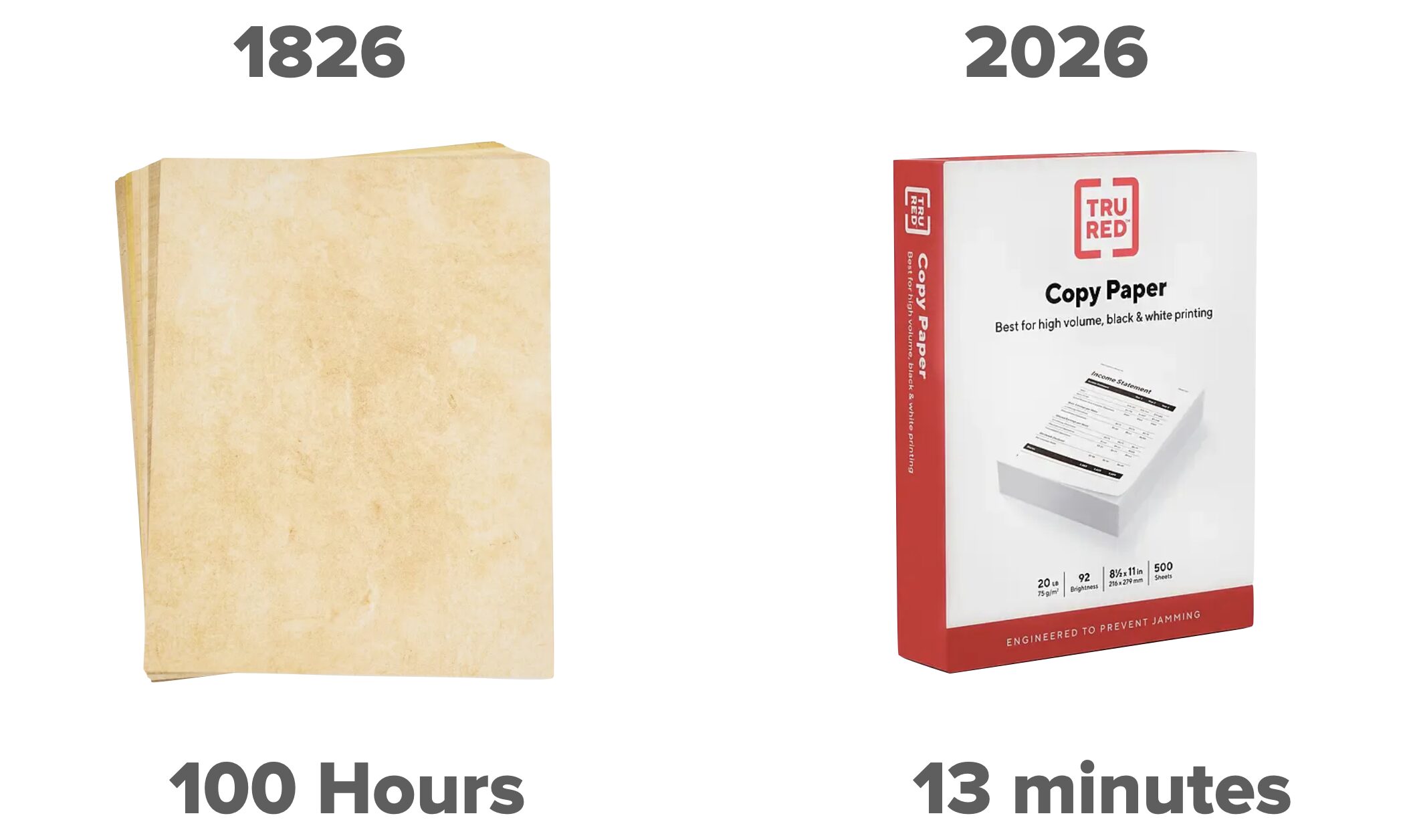
In 1826, a ream of 500 sheets of paper cost about $5.00. With average wages near five cents an hour, the time price was 100 hours. Paper was precious because modern papermaking techniques had yet to be invented—we had yet to discover the knowledge needed to innovate the product.

Today, a ream of 500 much higher-quality sheets sells for $7.99 at Staples. With average wages around $36.86 an hour, the time price is just 13 minutes.

The time price of paper has fallen by 99.78 percent over the last 200 years. For the time required to earn the money for a single sheet in 1826, a worker today can obtain 461 sheets. Scarcity didn’t disappear because we conserved paper, but because we learned how to transform abundant trees into even more abundant paper.

What About Recycled Paper?

Many people assume that recycling paper saves resources. If that were true, why is recycled paper about 85 percent more expensive than virgin paper? The answer is that the United States has roughly 300 billion trees, while recycling itself consumes substantial energy, labor, and capital.

A useful question whenever someone warns that we’re “running out” of something is simple: If it’s so scarce, why is it so cheap?

Remember, abundance doesn’t come from good intentions; it comes from innovation. Over two thousand years, paper has migrated from papyrus to cotton and linen rags to wood pulp—each transition a triumph of human ingenuity over scarcity. What we consume is not trees or fibers, but knowledge encoded in matter. And the more we consume, the more we discover. That is why paper is plentiful, pencils are cheap, and light is abundant. Wealth is learning made visible, and abundance is the dividend of ideas.

Find more of Gale’s work at his Substack, Gale Winds.