01 / 05
How a Century of Progress Changed Christmas

Blog Post | Cost of Material Goods

How a Century of Progress Changed Christmas

Why O. Henry would be shocked by holiday giving in 2025.

Summary: A century ago, Christmas gifts often required major sacrifice, as most families devoted much of their time and income to basic survival. Today, material progress has transformed gift-giving into something easily affordable. While the meaning of generosity endures, Christmastime has been changed from a season defined by scarcity into one shaped more by choice and plenty.


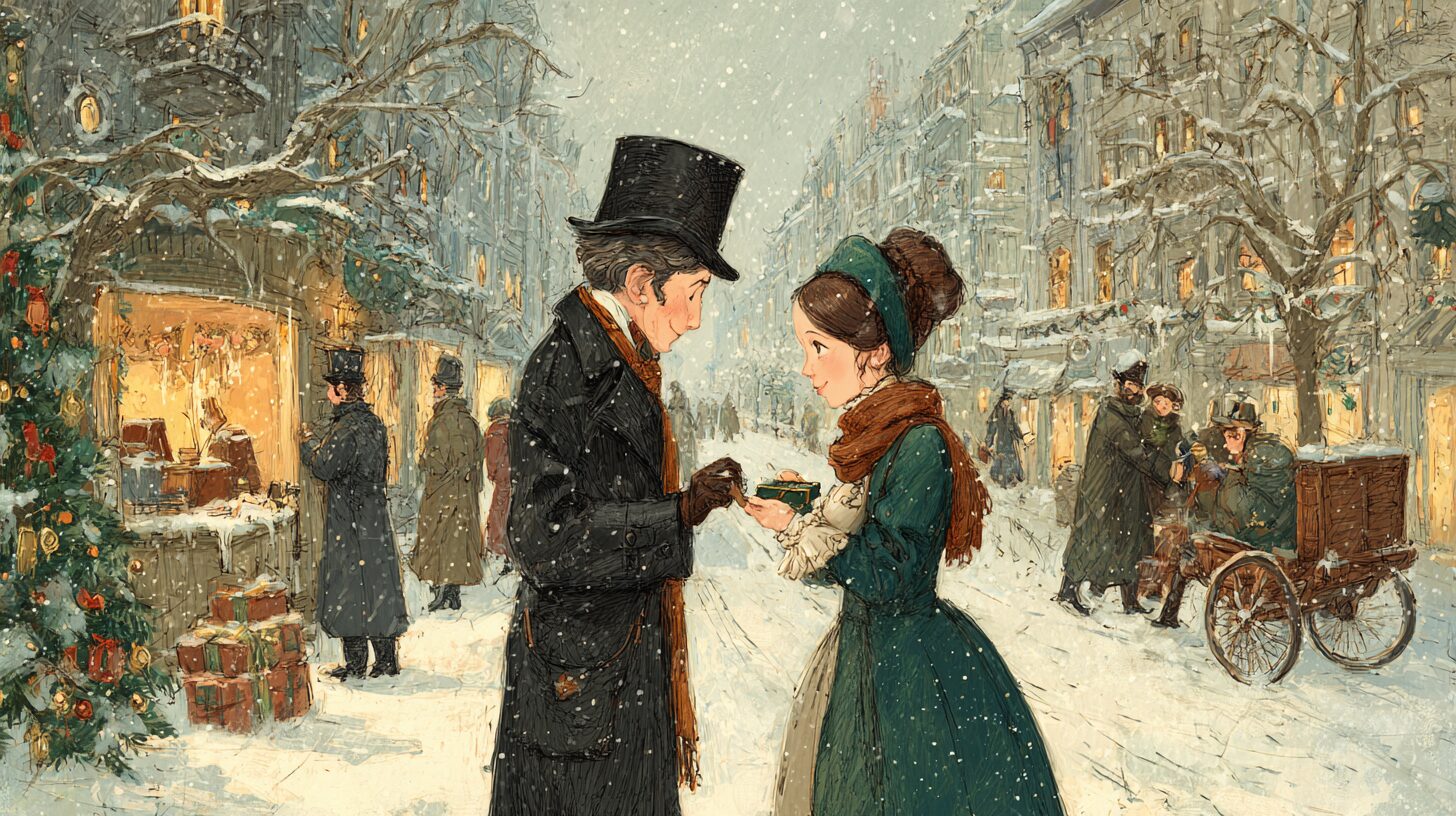
On a cold December day in 1905, the American writer O. Henry (William Sydney Porter) introduced the world to two poor young lovers with hearts of gold. In “The Gift of the Magi,” Della cuts her beautiful knee-length hair to buy her husband Jim a gold chain for his watch. Meanwhile, Jim sells his watch, a magnificent family heirloom, to buy his wife a set of ornate combs for her hair. Their love for each other motivated them to sacrifice their prized possessions in the spirit of Christmas giving.

We still read the story because the emotion is timeless, but the material world its characters inhabit has almost vanished. In 1905, the average American household did not have electricity or running water, let alone the opportunity to buy gifts manufactured worldwide with two-day Amazon delivery. Light came from candles or kerosene. Water was carried or pumped. Heat required daily labor and fuel. Most time and wages went towards basic survival.

According to the U.S. Bureau of Labor Statistics, households on average spent over 42 percent of their average wages on food in 1901. In O. Henry’s story, Jim is said to have spent $8 of his $20 weekly income, or an additional 40 percent, on renting not a whole home or apartment, but a mere furnished room for him and his wife. That left $3.60, or $132 in 2025 dollars, for everything else—firewood or coal for heating and cooking; candles or kerosene for lighting; soap, lye, and cleaning supplies; replacement shoes and work clothes as they wore out; basic medical care and medicines; postage and newspapers; and the ever-present risk of emergency expenses. And, of course, Christmas gifts.

Before modern manufacturing, the most basic items required many hours of work. A comb could cost half a day’s labor—a watch chain, several days’ worth. Contrast that with today, when the very ease of gift-giving can feel almost embarrassing. The time price of a comb—once measured in hours—is now measured in minutes. A watch chain that would have taken a week of labor to afford in 1905 can now be purchased with a single hour’s wages.

Material abundance has accelerated so dramatically that some of us now worry not about whether we can give but whether we are giving too wastefully—plastic toys used once, novelty items that break by New Year’s, and holiday packaging that fills recycling bins to the brim. Where Jim and Della confronted problems of scarcity, we confront problems of prosperity.

Today, because material goods demand so little labor, the most meaningful gifts often return to the immaterial: a sentimental note, a memorable experience, or a handcrafted gift. That doesn’t mean you shouldn’t wish for those noise-canceling headphones or a virtual-reality headset. The modern economy offers goods that would have been fantastical luxuries or science fiction for our ancestors. But goods as gifts become even more meaningful when their purchase involves saving, budgeting, and sacrifice. Thankfully, buying a meaningful gift rarely requires giving up one of the few prized assets a household owns.

This Christmas, during a season when gifts can be purchased in minutes and delivered in hours, it is worth remembering O. Henry’s landscape of scarcity. Our world is richer not only in goods but also in freedom and choice.

Financial Times | Mineral Production

Diamond Prices Fall as Lab-Grown Diamonds Gain Ground

“De Beers is halting production at South Africa’s biggest diamond mine, as consistently depressed conditions in the market for the precious stones weigh on the company that mining major Anglo American is trying to sell.

The diamond group said on Monday that it would pause production for two years at its Venetia mine, which employs about 3,500 people and accounts for about 10 per cent of the company’s production, to cut costs. It will also reduce capital expenditure for the site.

The mine accounts for 40 per cent of South Africa’s annual diamond production…

Diamond prices have fallen because of slowing demand, especially in China, and competition from lab-grown gems that can be made and sold much more cheaply than natural stones.

WWW International Diamond Consultants’ rough diamond price index is down about 50 per cent from the record highs of 2022.”

From Financial Times.

Blog Post | Cost of Material Goods

Jeff Bezos Earned His Amazon Fortune

The Amazon founder’s innovations save customers 22 hours a year on average, giving them the gift of time.

Summary: Amazon’s immense value may be better understood not through Jeff Bezos’s fortune, but through the time Amazon saves for consumers and businesses. Entrepreneurs capture only a small fraction of the value they create. Amazon has generated trillions of dollars in social benefit through greater convenience, lower transaction costs, and improved access to goods and services. By reducing the time people spend shopping, managing inventory, and building technological infrastructure, Amazon has created substantial consumer surplus that far exceeds Bezos’s wealth.


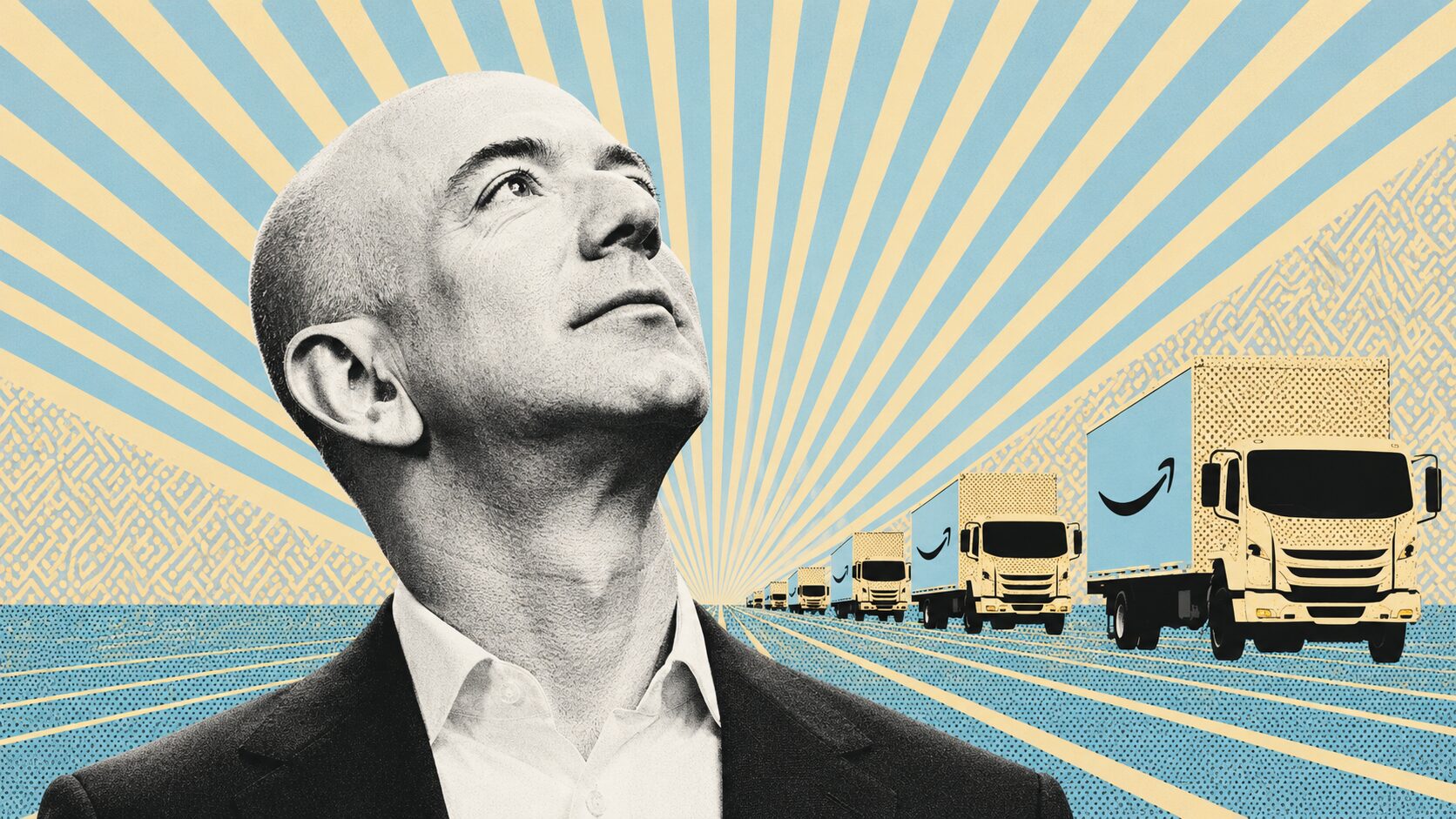
Amazon founder Jeff Bezos recently made a point that every critic of billionaire wealth should confront: “If I do my job right, the value to society and civilization from my for-profit companies will be much, much larger than the good that I do with my charitable giving.”

To see if he is correct, consider the one resource that is truly finite: time. Modern debates about wealth start in the wrong place. They begin with the fortune. They should begin with customers and their time. Mr. Bezos is worth roughly $275 billion. That number offends many people because they assume wealth must have been taken from someone else. But Amazon didn’t become valuable by force. It became valuable because hundreds of millions of people chose to use it.

Consumers weren’t forced to buy books, batteries, diapers, cables, razors, tools, groceries or printer ink from Amazon. They did so because Amazon saved them time, money, effort or uncertainty. Sellers weren’t forced to use Amazon’s marketplace. They did so because it gave them access to demand. Firms weren’t forced to use Amazon Web Services. They did so because renting computing power was cheaper than building and maintaining their own information-technology infrastructure. That is capitalism: People get rich by creating something others value enough to buy.

The Bezos fortune looks large because it is visible. The value Amazon created is harder to see because it is dispersed. A mother who doesn’t drive to a store to buy diapers doesn’t appear in an economic headline. A small business that reorders supplies in two minutes doesn’t make the evening news. A rural customer who gains access to goods once available only in cities doesn’t receive a subsidy check with Amazon’s logo on it. Yet each transaction saves time, and time is limited.

Consider the arithmetic. Suppose an hour of labor is worth about $64, roughly the average gross domestic product per hour worked in the countries in which Amazon operates. If Mr. Bezos’ fortune corresponded to the total value that Amazon created, his $275 billion would represent about 4.3 billion hours of saved time. Divided among Amazon’s more than 300 million active customers, the saving comes to about 14 hours per customer over Amazon’s life. That’s nothing. Many customers save that in a month.

But entrepreneurs don’t capture all the value they create. The Nobel Prize-winning economist William Nordhaus estimated that innovators keep only a small share of the social value—roughly 2%—produced by their innovations. Under that assumption, Mr. Bezos’ $275 billion fortune implies that Amazon created about $13.8 trillion in total value for society.

At $64 an hour, that means Amazon has saved its customers about 214 billion hours. Across 300 million customers over roughly 32 years (Amazon was founded in 1994), the saving equals about 22 hours per person a year. That is 25 to 26 minutes a week, or a little less than four minutes a day.

So the question isn’t whether Mr. Bezos has too much money. It is whether Amazon has saved the average customer four minutes a day. The answer is yes. A single avoided trip to a store can save 30 minutes. Finding a product online instead of driving to three retailers can save an hour. Reading reviews can reduce the chance of buying the wrong product. Automatic reordering can save repeated errands. Price comparison can save money and time. Fast delivery can substitute for inventory kept in closets, garages, offices and warehouses.

The savings extend beyond retail. Amazon Web Services lowered the cost of starting and scaling companies. It gave firms computing capacity without the old capital expense. That made experimentation cheaper. Some firms failed faster. Others grew faster. Both outcomes matter. Cheap failure is part of progress.

Amazon also forced competitors to improve. Walmart, Target, grocery chains, hardware stores, logistics firms and online retailers responded with better websites, faster delivery, wider selection and lower search costs. Even people who dislike Amazon benefit when its competitors become better because Amazon raised consumer expectations.

Charity can do good, but Mr. Bezos is right: Business can do better. Charity moves existing resources toward chosen ends. Business, when it works, creates new value by reorganizing labor, capital, knowledge and logistics. Enterprise can improve how hundreds of millions of people spend their time every week. Some people will spend the extra time earning money to buy things they previously couldn’t afford, helping their communities, enjoying the company of their loved ones, taking a holiday or relaxing.

That distinction is often lost. Critics praise entrepreneurs when they give money away, but condemn the process that made the money possible. That is backward. The social contribution of an entrepreneur usually occurs before the charitable foundation is created. It occurs when customers gain, workers earn,  suppliers sell, competitors improve, and resources move to better uses.

None of this means Amazon is perfect. No large company is. Amazon can make errors. But that doesn’t cancel the basic fact: Amazon created enormous consumer surplus.

The moral case for Mr. Bezos’ wealth doesn’t require blind admiration of his business acumen. It requires arithmetic. If Amazon saves each customer 22 hours a year, Mr. Bezos’s fortune passes the Nordhaus test. If it saves more than that, society receives far more than he keeps.

It is easy to resent the billionaire. It is easy to ignore the saved hours. But the hours matter because time is limited. It is our most precious resource. Count the time saved, and Mr. Bezos’ fortune becomes less mysterious and much more defensible.

A previous version of this article appeared in the Wall Street Journal on 5/26/2026.

Reuters | Cost of Material Goods

Kia CEO Signals Price Cuts in Europe to Compete with China

“Starting this year, Kia has narrowed its vehicle price gap with Chinese models in Europe to 15-20% from 20-25% previously depending on markets, Song said, according to ​a recording of the event obtained by Reuters.

The move highlights how Europe has become a key battleground between legacy ​automakers and Chinese electric vehicle firms such as BYD, as they pursue rapid overseas expansion amid ⁠flagging sales in China and effective exclusion from the U.S. market.”

From Reuters.

Blog Post | Cost of Material Goods

Two Centuries of Increasing Paper Abundance

If we're running out, why is it so cheap?

Summary: Paper has become dramatically more affordable over the last two centuries. Abundance comes not primarily from conservation or recycling but from improved knowledge and technology. The increasing efficiency of turning plentiful trees into paper is a good example of that.


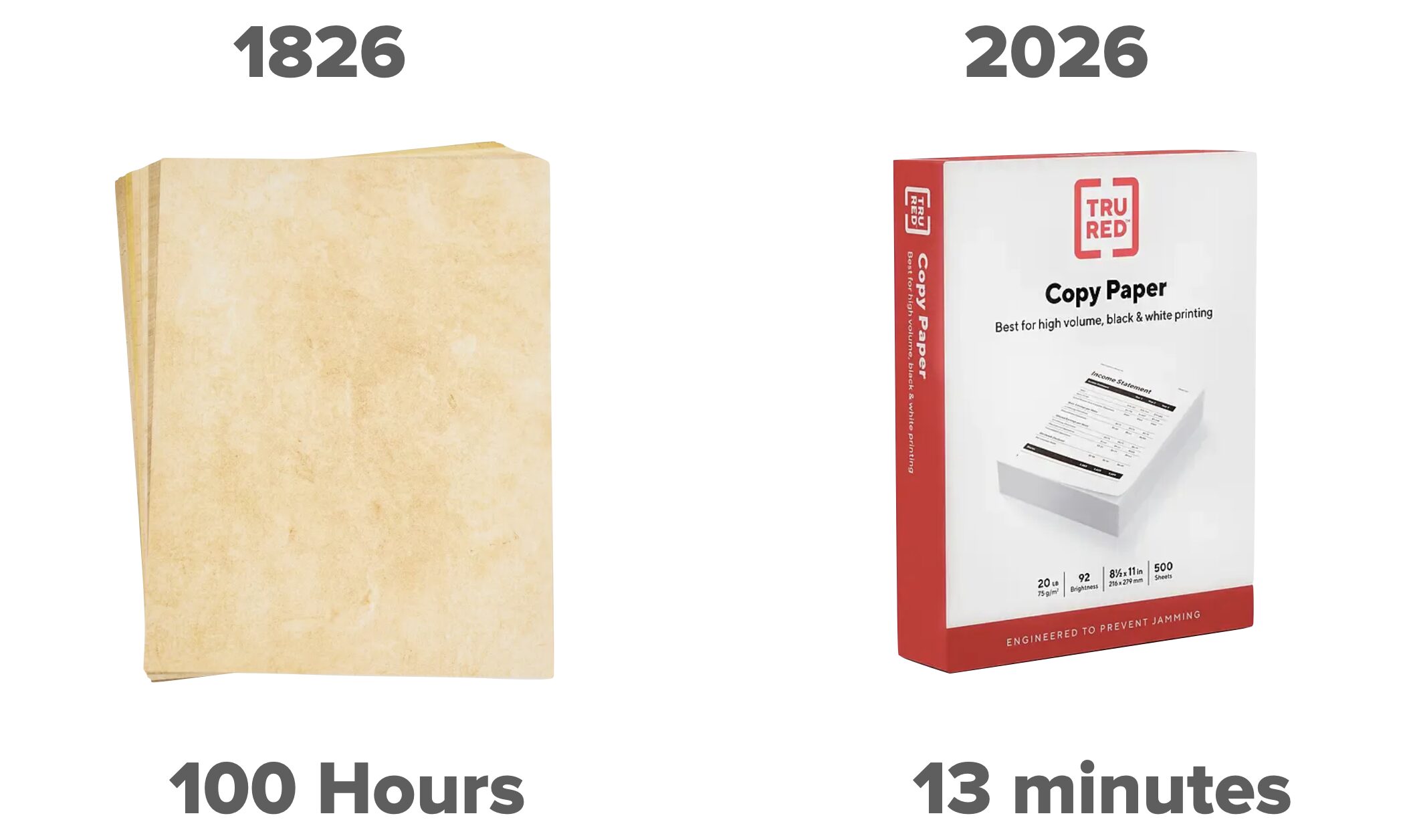
In 1826, a ream of 500 sheets of paper cost about $5.00. With average wages near five cents an hour, the time price was 100 hours. Paper was precious because modern papermaking techniques had yet to be invented—we had yet to discover the knowledge needed to innovate the product.

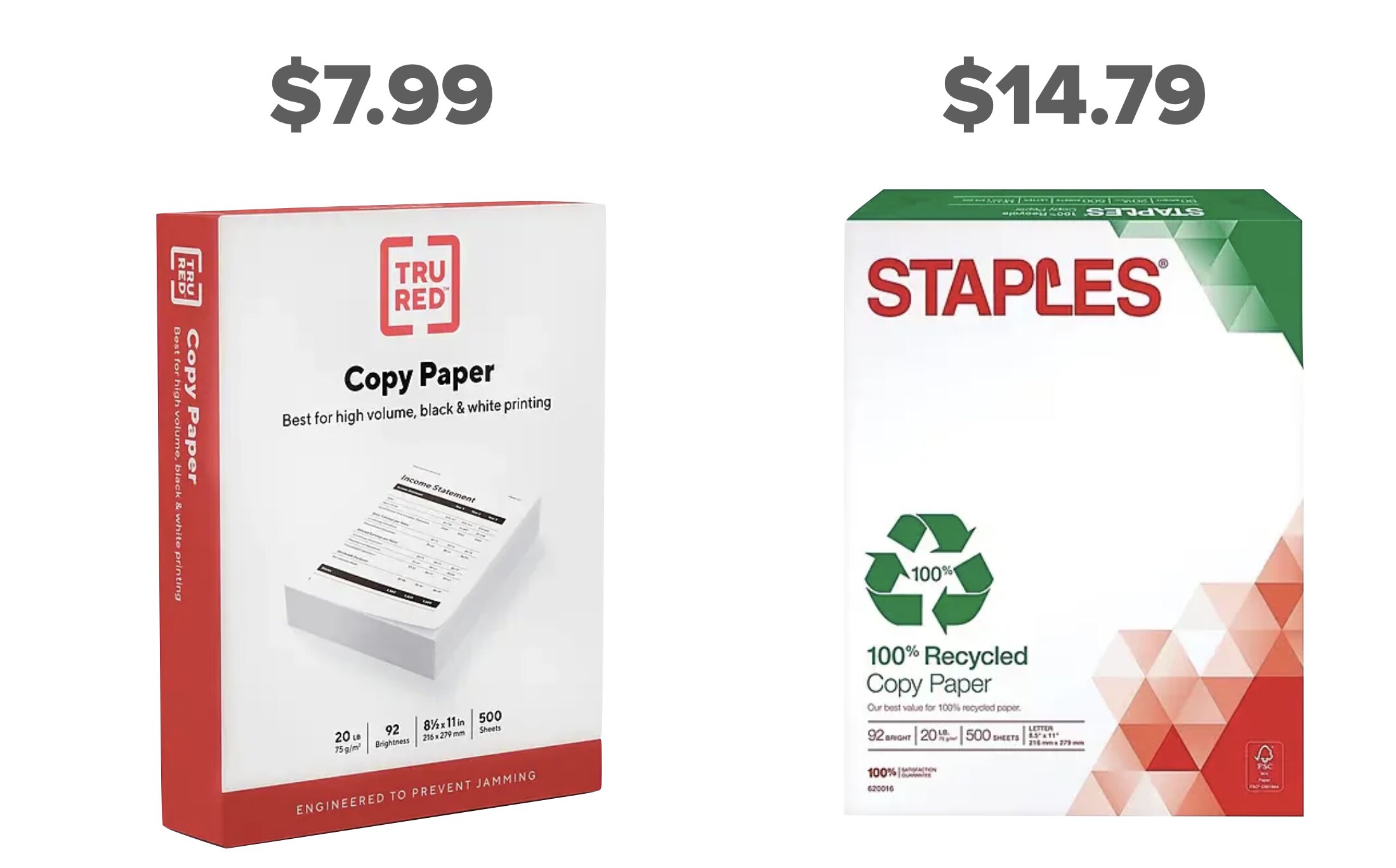
Today, a ream of 500 much higher-quality sheets sells for $7.99 at Staples. With average wages around $36.86 an hour, the time price is just 13 minutes.

The time price of paper has fallen by 99.78 percent over the last 200 years. For the time required to earn the money for a single sheet in 1826, a worker today can obtain 461 sheets. Scarcity didn’t disappear because we conserved paper, but because we learned how to transform abundant trees into even more abundant paper.

What About Recycled Paper?

Many people assume that recycling paper saves resources. If that were true, why is recycled paper about 85 percent more expensive than virgin paper? The answer is that the United States has roughly 300 billion trees, while recycling itself consumes substantial energy, labor, and capital.

A useful question whenever someone warns that we’re “running out” of something is simple: If it’s so scarce, why is it so cheap?

Remember, abundance doesn’t come from good intentions; it comes from innovation. Over two thousand years, paper has migrated from papyrus to cotton and linen rags to wood pulp—each transition a triumph of human ingenuity over scarcity. What we consume is not trees or fibers, but knowledge encoded in matter. And the more we consume, the more we discover. That is why paper is plentiful, pencils are cheap, and light is abundant. Wealth is learning made visible, and abundance is the dividend of ideas.

Find more of Gale’s work at his Substack, Gale Winds.