
01 / 05
US Housing Abundance Has Increased Dramatically

Blog Post | Housing

US Housing Abundance Has Increased Dramatically

Compared to the early 1970s, we get 74 percent more square feet of housing per person, per percent of household income.

Summary: Over the past 50 years, Americans have seen a dramatic increase in housing quality and space. While housing costs appear to have risen, today’s homes offer more value per dollar. We can see this by adjusting for household size and improvements like air conditioning, garages, and extra bathrooms. We now get more housing for the same share of income.


The Bureau of Labor Statistics (BLS) conducts consumer expenditure surveys, collecting data on a wide variety of products and services.
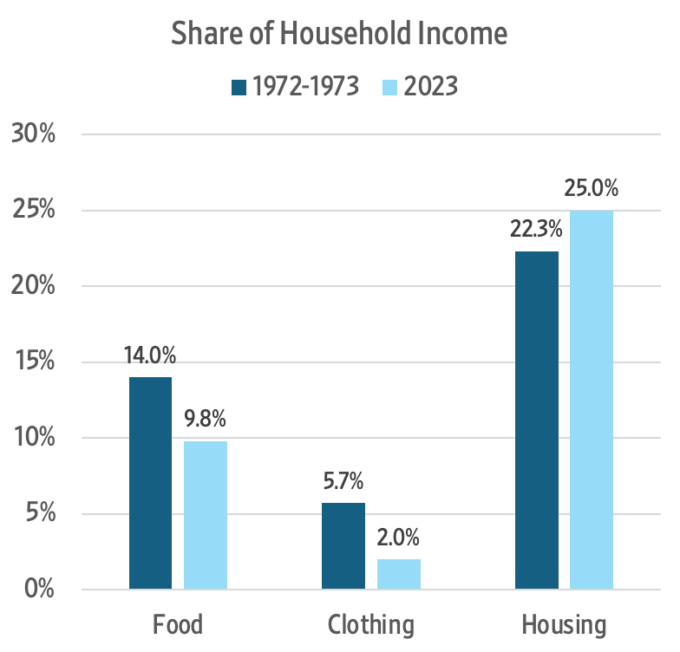
Over the past 50 years, the percentage of household income spent on food fell 30 percent, and spending on clothing has dropped by 64.9 percent, yet housing costs have increased by 12.1 percent. What explains this rise? At least six key differences between homes in the early 1970s and in 2023 help account for the change:

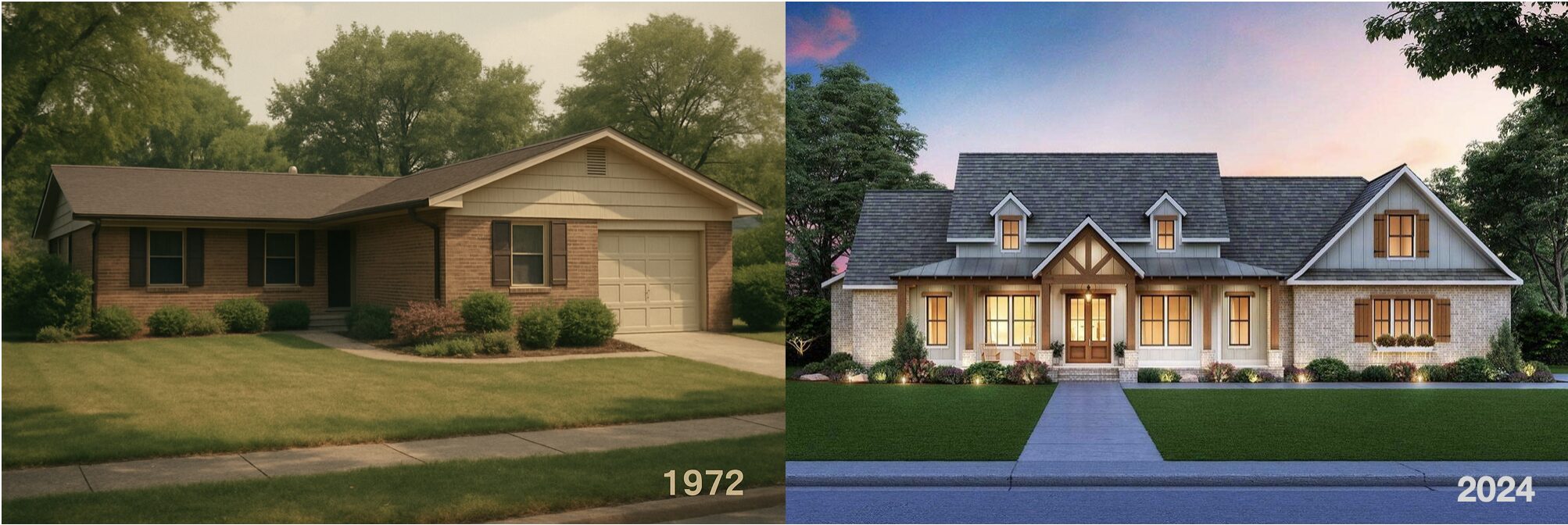
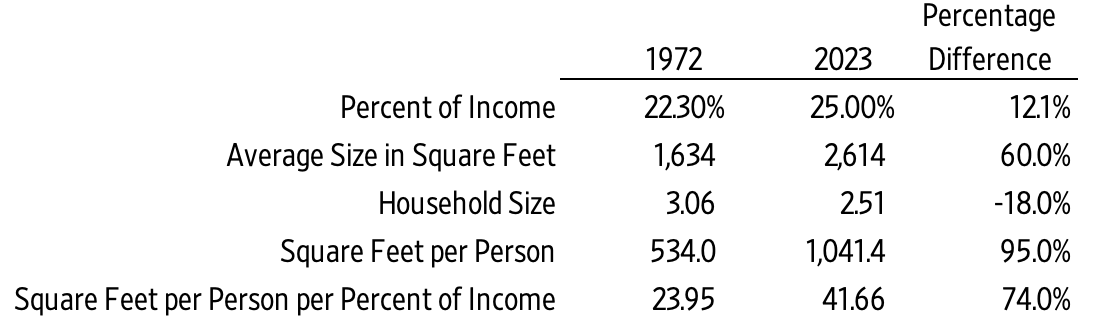
  1. Size: The average home in 1972 measured 1,634 square feet, compared to 2,614 square feet in 2023—a 60 percent increase (980 additional square feet).
  2. Household Size: Average household size declined from 3.06 persons in 1972 to 2.51 in 2023, an 18 percent decrease. We’re buying more house per person.
In 1972, the average living space per person was 534 square feet; by 2023, it had nearly doubled to 1,041.4 square feet. In terms of affordability, one percent of household income bought 23.95 square feet of housing in 1972, compared to 41.66 square feet in 2023. We’re getting 74 percent more housing per person for the same share of income.
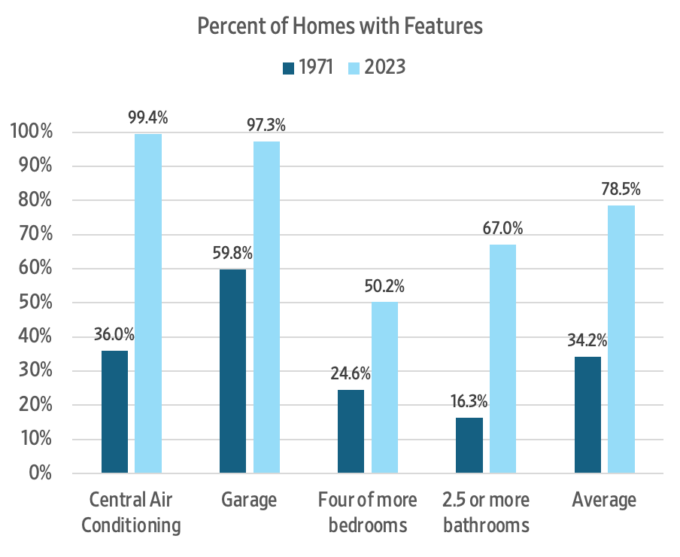
Four other factors also help explain the difference:

  1. Air Conditioning: In 1971, only 36 percent of homes had central air; by 2023, that number had reached 99.4 percent.
  2. Garages: The share of homes with garages rose from 59.8 percent in 1971 to 97.3 percent in 2023.
  3. Bedrooms: In 1971, only 24.6 percent of homes had four or more bedrooms; in 2023, 50.2 percent did.
  4. Bathrooms: The percentage of homes with 2.5 or more bathrooms increased from 16.3 percent in 1971 to 67 percent in 2023.
After adjusting for increased square footage and smaller household size, the share of household income spent on housing falls to 14.3 percent. If we further account for improvements—such as the addition of air conditioning, garages, extra bedrooms, and bathrooms—a modest 25 percent quality adjustment brings the rate closer to 10.7 percent. In effect, we’re now spending less than half as much of our household income on basic housing compared to the early 1970s.

We also see this phenomenon clearly when comparing automobiles from the early 1970s to those of today. While both have four wheels, modern cars deliver vastly superior fuel efficiency, comfort, safety, reliability, and performance.

The real question is: how much would someone have to pay you to trade your 2023 home and 2023 car for their 1972 counterparts?

Tip of the Hat: Jeremy Horpendahl

Find more of Gale’s work at his Substack, Gale Winds.

New York Times | Housing

US Homelessness Fell the Most in Nearly Two Decades

“The United States last year had the largest decline in homelessness since an annual count began nearly two decades ago, the Department of Housing and Urban Development announced late Friday.

The drop of more than 6 percent was the second consecutive year that the figure had fallen, and reduced the number of homeless people by more than 47,000. Homelessness still far exceeds prepandemic levels.”

From New York Times.

The Pew Trusts | Housing

More US States Adopt Reforms to Enable Homebuilding

“In 2026, about one-third of states, from North Carolina to Idaho and from New York to Kansas, passed significant housing policy reforms. Some enacted policies aimed at enabling the construction of housing near commerce. Others sought to encourage construction of apartments, accessory dwelling units (ADUs), and starter homes. Several states sought to allow churches and other nonprofits to build on land they already own. And many sought to simplify building codes and permit processes to streamline the development process.

The continued growth of reform efforts, led by bipartisan groups of lawmakers and diverse coalitions, reflects a broadening consensus that housing shortages, high rents, unattainable homeownership, and historically high homelessness are not inevitable but instead result from policy choices that states have the authority to address. Although states took different approaches, the reforms have common themes: They allow construction of a broad array of homes, make better use of land near commerce, pare back inflexible mandates, and lower administrative barriers that add time and cost to development.”

From The Pew Trusts.

Wall Street Journal | Housing

New US Housing Law Could Lower Factory-Built Home Costs

“Homes built in factories have long been stuck at the fringe of the U.S. housing market. Now, supporters are cheering a new federal housing law that should make it easier and cheaper to build modular and manufactured homes.

Modular homes are built in pieces at a factory and assembled on site, and they often appear quite similar to traditional, stick-built houses. Manufactured homes—often referred to as mobile homes or trailers—are built entirely at a factory and shipped whole to their destination.

The new law aims to slash some of the red tape associated with both these alternative housing types.

One provision, which removes the requirement that manufactured homes come with the permanent steel frame used for transporting the houses, means that they can be built for roughly $5,000 to $10,000 less than before, according to Andrew Justus, a housing policy researcher at the Niskanen Center.

For some homes, those savings to home buyers could equal more than 10% of the original cost.”

From Wall Street Journal.

The Housing Frame | Housing

US Housing Market Shows Signs of Recovery After 2022 Slump

“Here’s the state of play for housing heading into the latter part of 2026. The two weakest states coming into the year – Florida and Texas – have signs of life. In Florida, inventory is down and sales are up. In Texas, inventory is stable and Austin is quickly getting “less bad.”

Nationally, inventory levels are stable. There are still fewer homes for sale now than there were prior to the pandemic. Most of the North and Midwest never even had a slump and still don’t have enough homes. The rise in mortgage rates is holding back improvement but generally not making conditions worse.

Both homebuilders and apartment managers showed more optimism this quarter than they have in years. Builders have reason to believe incentives have finally peaked and profit margins have bottomed. For apartments, occupancy is up and there’s no glut of supply coming any time soon.

And at the high end of the market, stock market wealth means it doesn’t matter where mortgage rates are.

But pockets of weakness remain. Cities like Seattle are still struggling. The entry-level market remains tough. Some metros and submarkets have a glut of inventory. Affordability obviously remains challenging for people who aren’t already rich.

But the housing recession that began in early 2022 is over.”

From The Housing Frame.