01 / 05
Climate Litigation Can’t Fix the Past, but It Can Hinder the Future

Blog Post | Environment & Pollution

Climate Litigation Can’t Fix the Past, but It Can Hinder the Future

Dealing with climate change requires technological innovation and economic growth, not legal warfare between nations.

Summary: The International Court of Justice has suggested nations could be held liable for historic greenhouse gas emissions, opening the door to lawsuits over centuries of industrial activity. Yet this approach risks punishing the very innovations that lifted billions out of poverty and advanced human health and flourishing. Lasting progress on climate challenges will come not from courtroom battles, but from technological solutions and continued economic development.


The International Court of Justice’s advisory opinion purporting to establish legal grounds that would allow nations to sue one another over climate damages represents judicial overreach that ignores economic history and threatens global development. While the opinion was undeniably legally adventurous, the framework it envisages would be practically unworkable as well as economically destructive.

The ICJ’s ruling suggests countries can be held liable for historical emissions of planet-warming gases. That creates an accounting nightmare that no legal system can resolve. How does one calculate damages from coal burned in Manchester in 1825 versus emissions from a Beijing power plant in 2025? How does one stack up the harm caused by a warming world against the benefits of industrialization?

Britain began large-scale coal combustion during the Industrial Revolution, when atmospheric CO2 concentrations were 280 parts per million and climate science did not exist. Holding Britain liable for actions taken without knowledge of consequences violates basic principles of jurisprudence. The same applies to the United States, whose early industrialization occurred during an era when maximizing economic output was considered unambiguously beneficial to human welfare.

Critics of historical emissions ignore what those emissions purchased. British coal combustion powered textile mills that clothed much of the world, steam engines that revolutionized transportation, and factories that mass-produced goods previously available only to elites. American industrialization followed, creating assembly lines, electrical grids, and chemical processes that form the backbone of modern civilization.

These developments were not zero-sum exercises in resource extraction. They created knowledge, infrastructure, and institutions that benefited everyone. The steam engine led to internal combustion engines, which enabled mechanized agriculture that now feeds 8 billion people. Coal-powered steel production made possible skyscrapers, bridges, and the infrastructure that supports modern cities, where most humans now live longer, healthier lives than their ancestors.

The data on human welfare improvements since industrialization began are explicit. Global life expectancy increased from approximately 29 years in 1800 to 73 years today. Infant mortality rates fell from over 40 percent to under 3 percent. Extreme poverty, defined as living on less than $2.15 per day in purchasing power parity terms, declined from over 80 percent of the global population in 1800 to under 10 percent today.

Nutrition improved dramatically. Caloric availability per person has increased by roughly 40 percent since 1960 alone, while food prices relative to wages fell consistently. Height, a reliable indicator of childhood nutrition, increased significantly across all regions. Educational attainment expanded from literacy rates below 10 percent globally in 1800 to over 85 percent today.

These improvements correlate directly with energy consumption and industrial development. Countries that industrialized earliest experienced these welfare gains first, then transmitted the knowledge and technology globally. The antibiotics developed in American and European laboratories now save lives worldwide. The agricultural techniques pioneered in industrialized nations now feed populations that would otherwise face starvation.

The International Court of Justice’s liability framework threatens to undermine the very mechanisms that created these welfare improvements. Innovation requires investment, which requires confidence in property rights and legal stability. If successful economic development subjects countries to retroactive liability, the incentive structure tilts away from growth and toward stagnation.

Consider current developing nations. Under this legal framework, should India or Nigeria limit their industrial development to avoid future liability? Should they forgo the coal and natural gas that powered Western development? That creates a perverse situation where the legal system penalizes the exact processes that lifted billions from poverty.

The framework also ignores technological solutions. The same innovative capacity that created the Industrial Revolution is now producing renewable energy technologies, carbon capture systems, and efficiency improvements that address climate concerns without sacrificing development. Market incentives and technological progress offer more promise than legal blame assignment.

Which emissions count as legally actionable? All anthropogenic CO2 remains in the atmosphere for centuries, making every emission since 1750 potentially relevant. Should liability begin with James Watt’s steam engine improvements in 1769? With the first coal-fired power plant? With Henry Ford’s assembly line? The temporal boundaries are arbitrary and politically motivated rather than scientifically determined.

Similarly, which countries qualify as defendants? The largest current emitters include China and India, whose recent emissions dwarf historical American and British totals. China alone now produces more CO2 annually than the United States and Europe combined. Any coherent liability framework must address current emissions, not just historical ones.

And where would the money go? This aspect of the case was brought up by Vanuatu. If the island nation receives compensation from the UK and the US, should it not be obliged to pay the British and the Americans for a plethora of life-enhancing Western discoveries, including electricity, vaccines, the telephone, radio, aviation, internet, refrigeration, and navigation systems?

Climate adaptation and mitigation require technological innovation and economic growth, not legal warfare between nations. The countries that industrialized first possess the technological capacity and institutional knowledge to develop solutions to today’s problems. Channeling resources toward litigation rather than innovation represents a misallocation that benefits lawyers while harming global welfare.

The ICJ opinion reflects wishful thinking rather than practical policy. Legal frameworks cannot repeal economic reality or reverse the historical processes that created modern prosperity. Instead of seeking retroactive justice for emissions that enabled human flourishing, policymakers should focus on technologies and institutions that sustain development while addressing environmental concerns. The alternative is a world where legal systems punish success and innovation while offering nothing constructive in return.

The original version of this article was published in National Review on 8/12/2025.

Reuters | Food Prices

UK Food Inflation Falls Despite Energy Shock

“Britain's food industry warned in February that soaring energy costs following U.S. and Israeli strikes on Iran could push food price inflation towards 10% by Christmas.

Six months later, food ​inflation has instead fallen to a near two-year low, as fierce supermarket competition, consumers' resistance to further price rises and better hedging by suppliers helped absorb ‌the shock.”

From Reuters.

Blog Post | Food Prices

Time Pricing the Fourth of July Cookout

Independence and abundance.

Summary: The dollar price of a traditional Fourth of July cookout has increased since 2016, but rising wages have more than offset those higher prices. As a result, Americans spend less time working to earn this year’s Independence Day meal than they did a decade ago. Measured in time rather than dollars, the data show that abundance has continued to grow as the population has increased.


Every year, the American Farm Bureau Federation estimates the cost of a traditional Independence Day cookout. The basket includes summer cookout staples such as cheeseburgers, chicken breasts, pork chops, potato chips, pork and beans, fresh strawberries, homemade potato salad ingredients, fresh-squeezed lemonade ingredients, chocolate chip cookies, and ice cream.

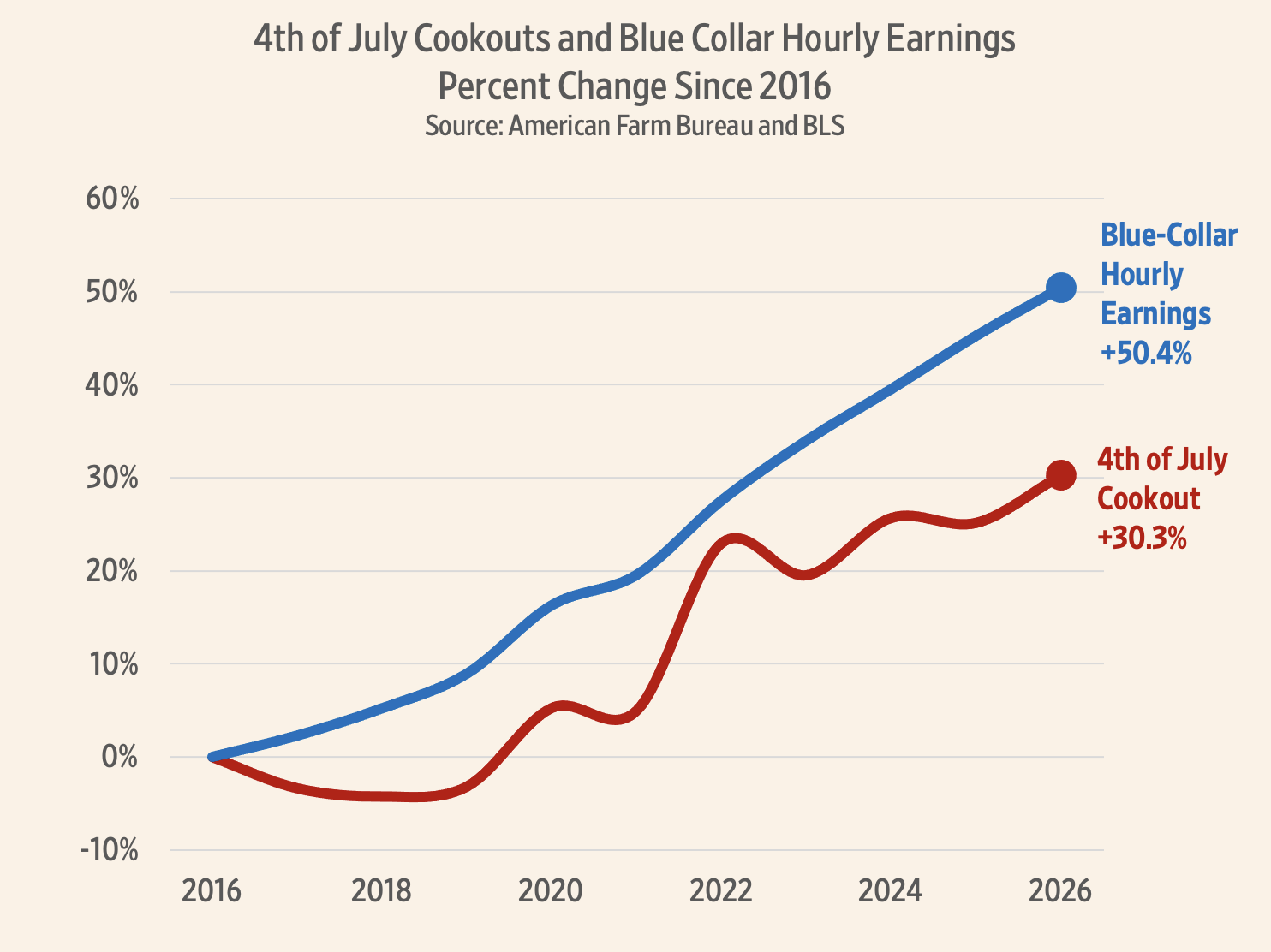
Since 2016, the dollar cost of this basket has risen 30.3 percent, from $56.67 to $73.82. At first glance, that suggests celebrating the Fourth of July has become significantly more expensive.

But money prices tell only half of the story. The real question is not how many dollars the meal costs, but how much time people must work to earn those dollars. Since 2016, blue-collar worker hourly earnings increased 50.4 percent, from $21.48 to $32.31 per hour.

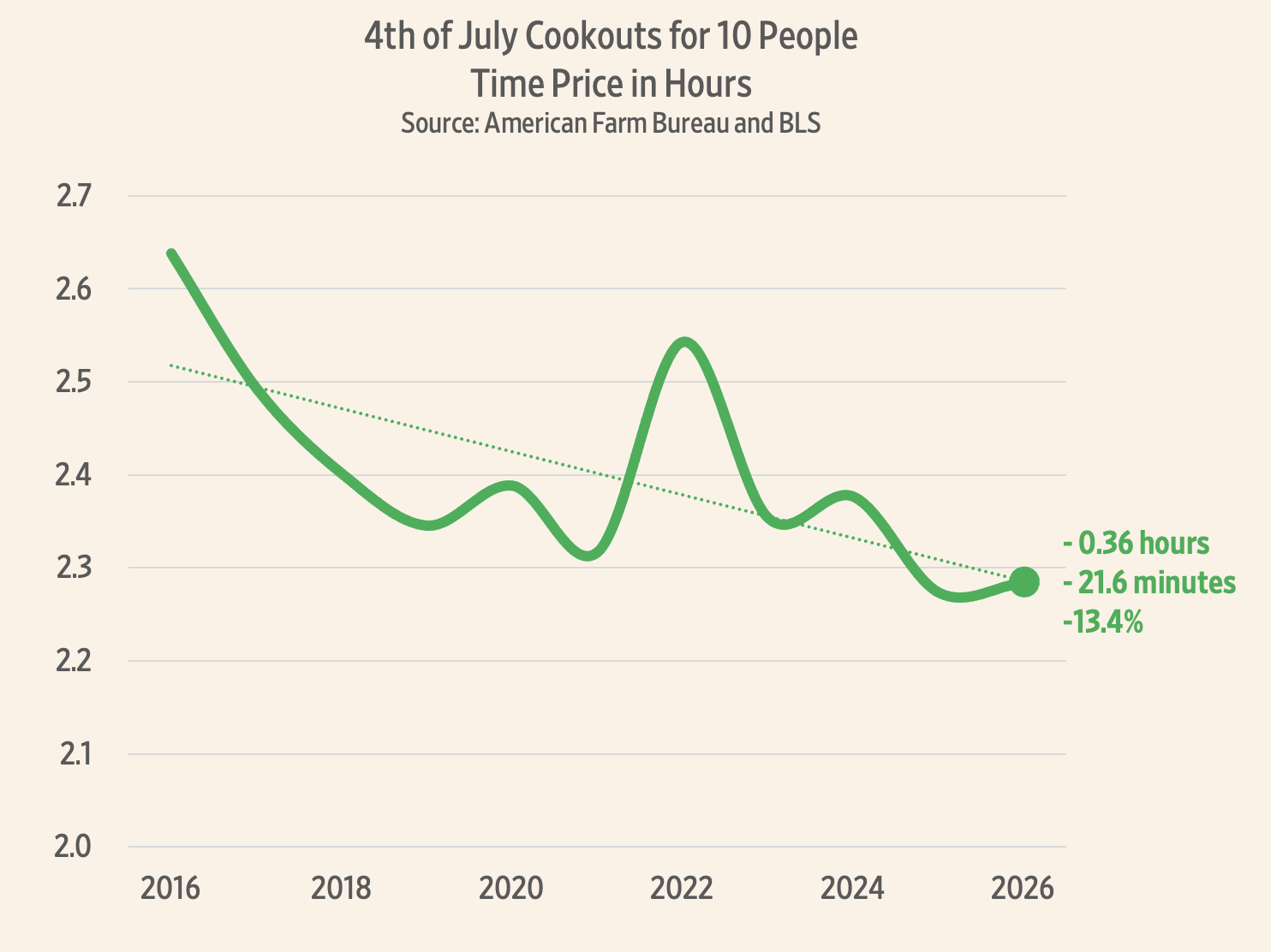
Because wages rose faster than prices, the time price of the cookout actually fell 13.4 percent—from 2.64 hours of work in 2016 to just 2.28 hours today, a savings of 21 minutes.

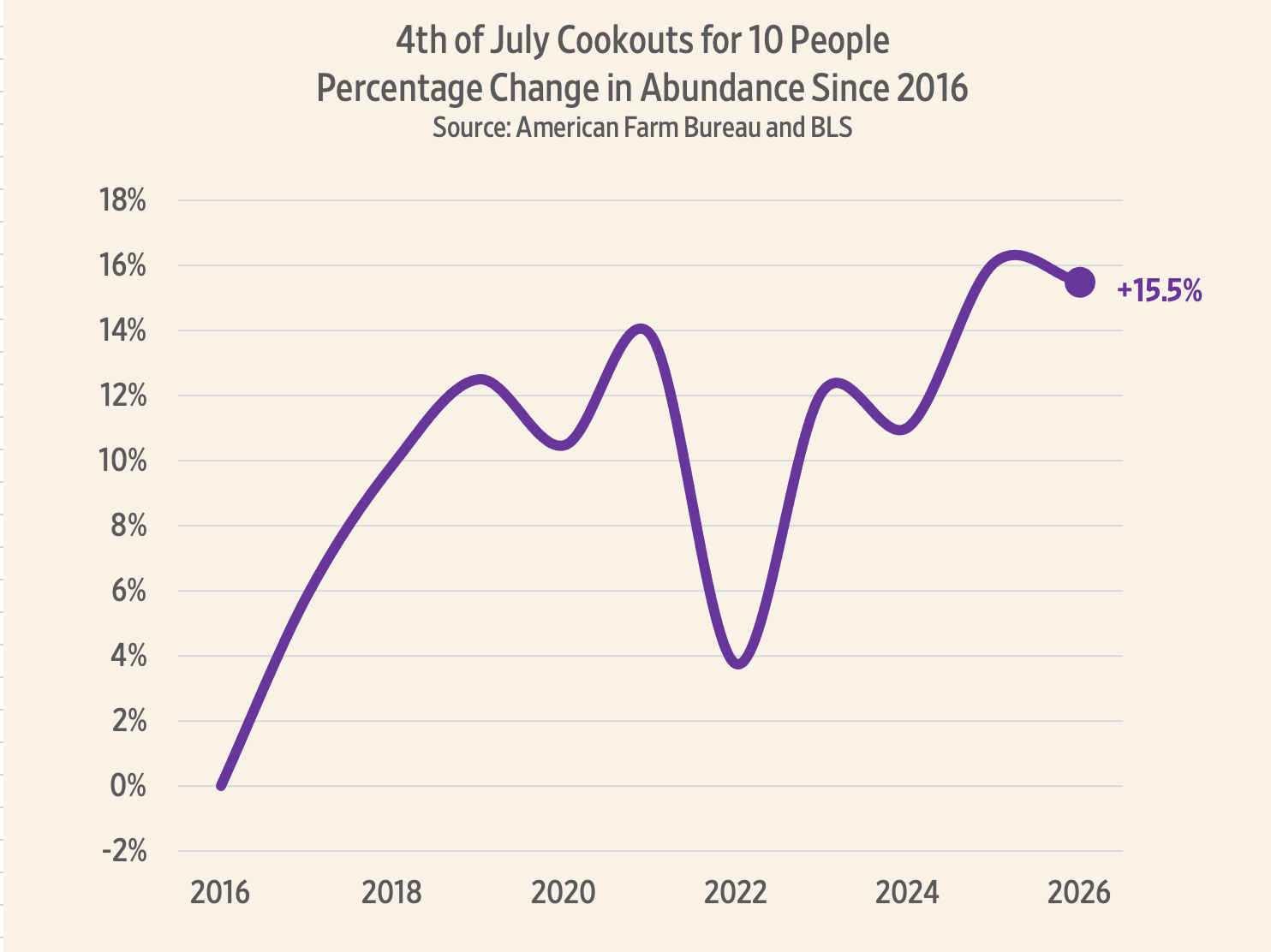
Another way to measure progress is to ask: How much more does the same hour of work buy? We call this the abundance multiplier. Compared with 2016, the same amount of work today buys 15.5 percent more.

America added 22 million people between 2016 and today, a population increase of 6.8 percent. Yet abundance didn’t merely keep pace with population—it grew 2.28 times as fast. Every 1 percent increase in people produced a 2.28 percent increase in cookout abundance. That’s the signature of superabundance: on average, every additional person contributes more than they consume. Even though there are 22 million more of us, we’ll actually spend 7.5 percent less time working as a country to pay for our celebration compared with 2016.

Americans may spend more dollars, but they spend less of their lives earning this year’s Independence Day feast.

Government money printing during the COVID-19 pandemic did cause a temporary spike, but we have returned to the long-term trend of decreasing time prices and increasing abundance.

This year saw a slight reversal. Compared with the record-low time price in 2025, food prices increased 4.1 percent while blue-collar hourly earnings rose 3.5 percent. As a result, the time price of the cookout edged up by just 0.5 percent—less than one minute of additional work. Even after that small increase, the Independence Day cookout remains substantially more affordable in time than it was a decade ago.

Find more of Gale’s work at his Substack, Gale Winds.

Economist Writing Every Day | Food Prices

Berries Are Probably Not Making Parents Go Broke

“The Washington Post recently ran a fun, data-filled article on berry consumption and parenting. Lots of good tidbits in the article, including that Americans eat a lot more berries than in the recent past, and that a lot of the availability is thanks to foreign trade and imports. But despite being somewhat light-hearted, the article does seem very negative, especially in the title and introduction, about how parents are spending a lot of money on berries…

Relative to median wages, berries of all kinds are now more affordable than a decade ago. Parents may still feel squeezed by all the berries their kids are eating, but in terms of affordability and share of the family budget, there is probably no need for a Berry Panic.”

From Economist Writing Every Day.

Blog Post | Food Prices

Time Pricing Big Macs Around the World

Even if a Big Mac is more expensive in money, it can be less expensive in time.

Summary: Big Mac prices across countries can be better understood by measuring them in terms of time rather than money—specifically, how long people must work to afford one. Comparing time prices reveals meaningful differences in wages and productivity that aren’t obvious from currency values alone.


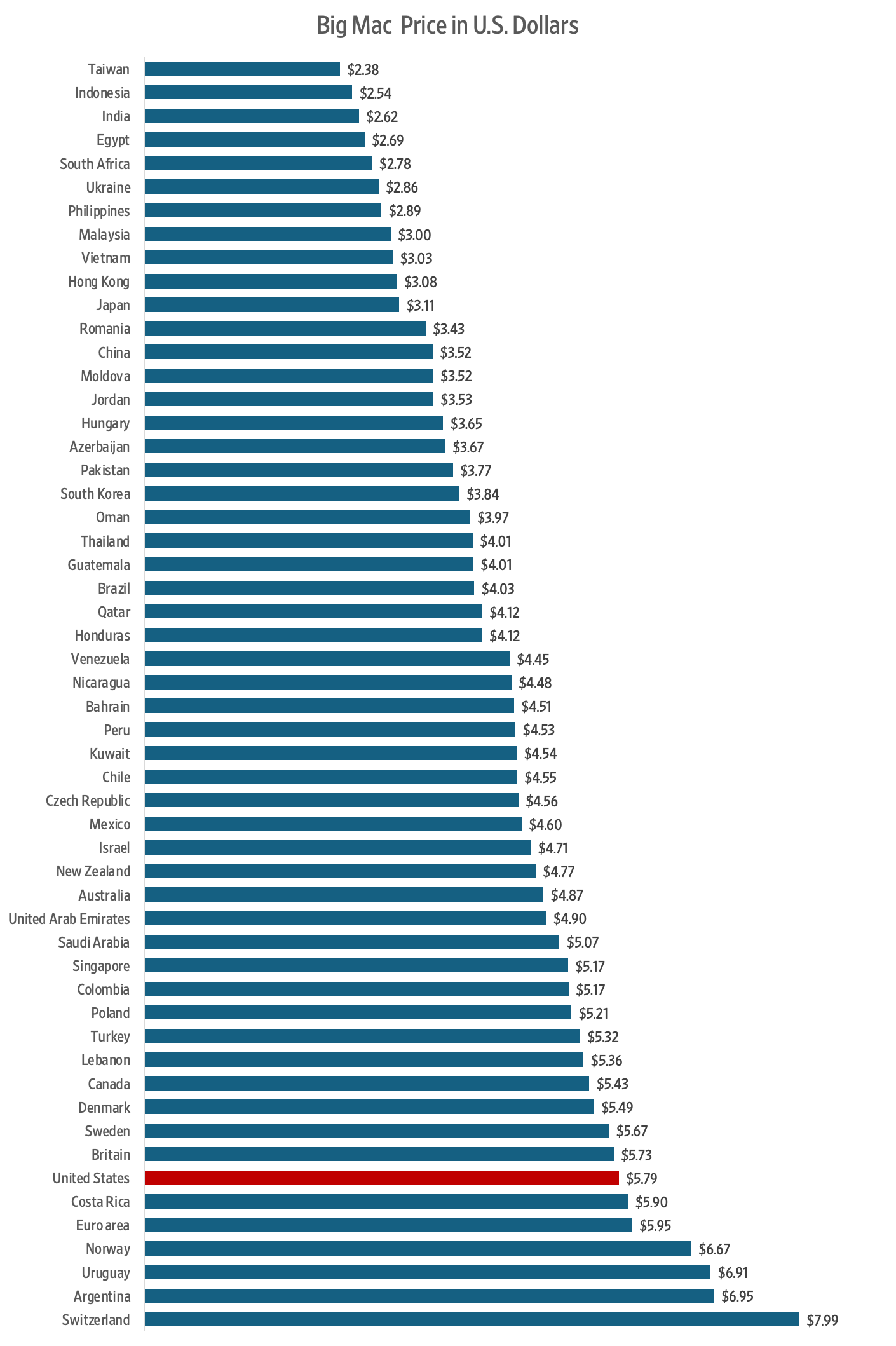
McDonald’s operates in over 100 countries worldwide. Since 1986, The Economist magazine has published the Big Mac Index, built on the theory of purchasing power parity (PPP)—the idea that exchange rates should equalize the price of an identical basket of goods across countries. The following shows the dollar price of a Big Mac in each country, sorted by price:

But we can go one step further.

Instead of comparing currencies, we can compare time.

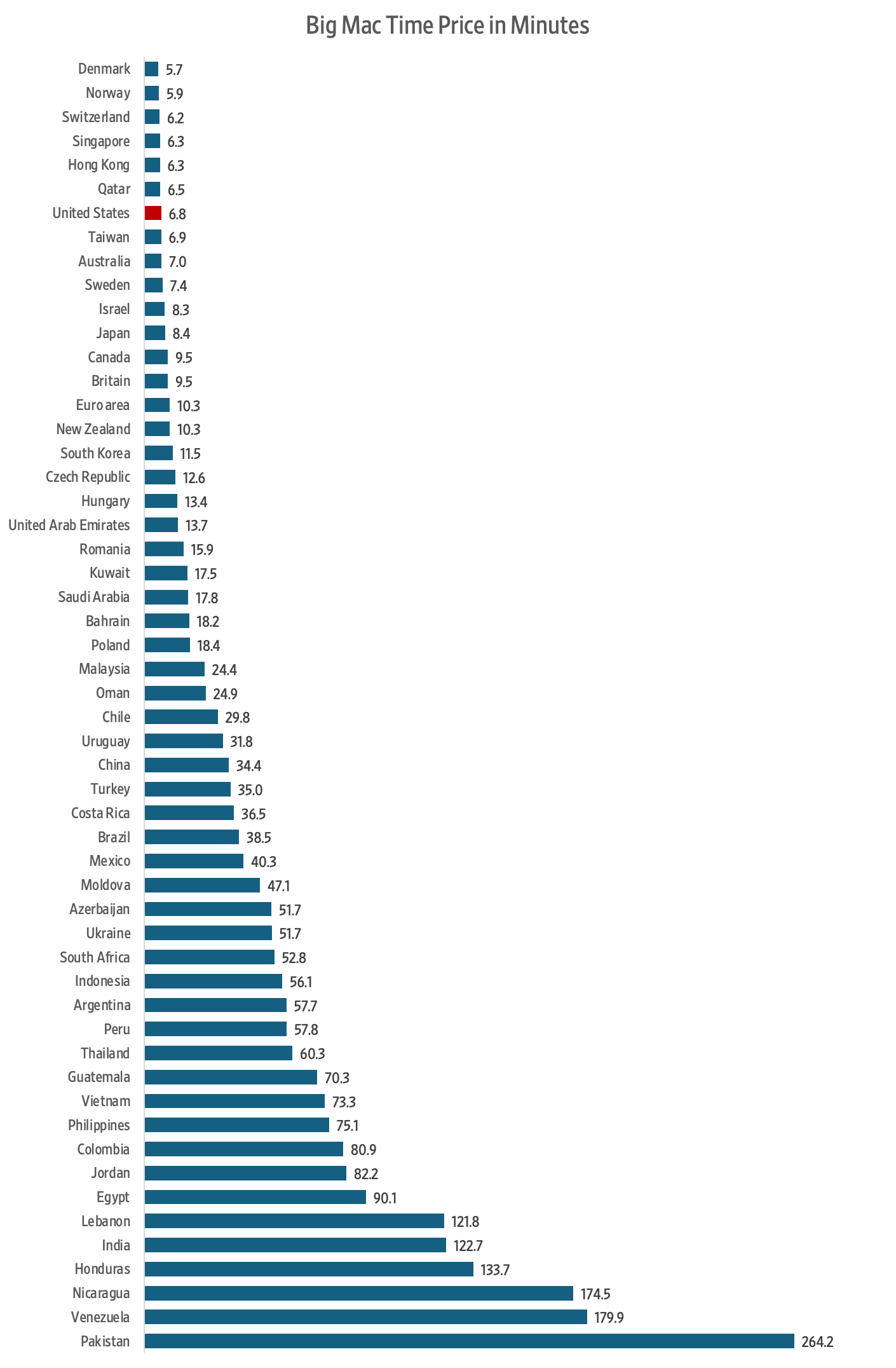
We start with the nominal price of a Big Mac in each country, converted to U.S. dollars, and then compare it to average hourly earnings. Since average hourly earnings data are not available for all countries, GDP per capita divided by annual hours worked serves as a reasonable proxy for relative wages between countries.

This transforms the question from “What does it cost?” to “How long do you have to work to get it?” A Big Mac can be more expensive in money but less expensive in time, depending on where you live.

A Big Mac in Taiwan costs only $2.38, compared to $7.99 in Switzerland, but after adjusting for hourly earnings, the time prices are very similar. In Pakistan, a Big Mac costs $3.77, but hourly earnings are $0.86, putting the time price at 4.4 hours. In Denmark, the price is $5.49, but hourly earnings are $57.60, so the time price is under six minutes. For the time it takes a worker in Pakistan to earn enough to buy one Big Mac, workers in Denmark can buy more than 46.

The Big Mac doesn’t just measure currencies; it measures the spread of knowledge.

What looks like inequality in dollars is often a difference in productivity, learning, and institutional capacity. The real divide is not between rich countries and poor countries—it is between places where knowledge compounds and places where it is constrained.

When a sandwich falls from four hours of work to four minutes, something profound has happened—not to the burger, but to the growth and sharing of knowledge.

The story of abundance is not written in dollars. It is written in time.

Find more of Gale’s work at his Substack, Gale Winds.