01 / 05
From Stone Tablets to Solid-State Drives

Blog Post | Human Development

From Stone Tablets to Solid-State Drives

Civilization has advanced by learning to preserve more knowledge with less matter.

Summary: Human progress depends not only on discovering knowledge but also on preserving and transmitting it. From stone tablets to printed books and solid-state drives, storage media have become vastly lighter, denser, and faster. Over five thousand years, humanity has increased data density by trillions, making accumulated knowledge cheaper and more accessible than ever.


The astonishing conveniences and prosperity of modern civilization rest on two pillars: our mastery of energy and our relentless discovery of knowledge. Yet, discovering new knowledge alone was not enough for civilizational progress. To accumulate and build on discoveries across generations, humanity needed a way to encode knowledge onto a medium outside of our collective nervous system. From etching hieroglyphs into stone to digitally controlling electrons in modern solid-state drives (SSDs), humanity’s advancement in creating affordable, lightweight, and reliable data storage is astonishing.

Before the invention of written language, people usually transmitted knowledge orally. Fables and other knowledge had to be memorized and accurately recited to pass from one generation to the next. Transmitting knowledge this way, where data is stored only in the human mind, risks significant data loss. When Joe Huntergatherer, the only member of the tribe who had memorized the story of the Great Elder, was killed by an arrow, that story was forever lost. The fragility of oral transmission is why almost all human history, spanning hundreds of thousands of years, is lost to the erosive sands of time.

The invention of writing, the ability to etch, carve, or paint characters onto clay tablets, stone, and cave walls, allowed humans, for the first time, to store information outside the brain. The first clay inscriptions with readable script date from ~3,400 B.C. So long as another person was trained to interpret the inscribed hieroglyphs, characters, or letters, that knowledge was no longer subject to fallible human memory. However, stone inscriptions had relatively low information density.

To create a formula to measure the data density of storage media over time, I convert characters (letters and punctuation) into bits of information, then divide by the number of grams of matter needed to encode that information. A bit is a single binary digit, a zero or one, and roughly eight bits make up a single character. (View these calculations not as precise figures, but as order-of-magnitude approximations, since data density varies considerably from stone to book to drive.)
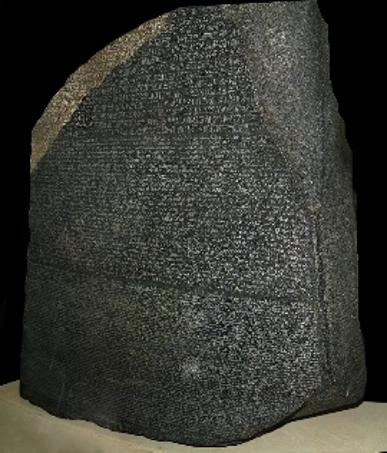
Let’s begin with stone engravings, using the famous Rosetta Stone as an example. The Rosetta Stone weighs roughly 750kg and contains the same text in three languages: Ancient Egyptian hieroglyphs on top, Egyptian Demotic script in the middle, and Ancient Greek on the bottom. To estimate the data density, I focused on the Greek portion of the stone, which accounts for roughly 1/3 of the stone’s total weight (about 250kg).

No source I could find provided a reliable count of the surviving Greek characters, so I calculated it twice independently. First, I compared a 19th-century publication’s line-by-line count with a high-resolution photo of the stone, which puts the original, undamaged text at about ~7,290 characters. Adjusting that figure for the approximately 20 percent of the stone that’s damaged or missing gives an estimated ~5,832 surviving characters. Second, I ran an AI optical character count directly off the damaged stone, which returned ~5,800. The two methods are close, so I use ~5,800 characters going forward.

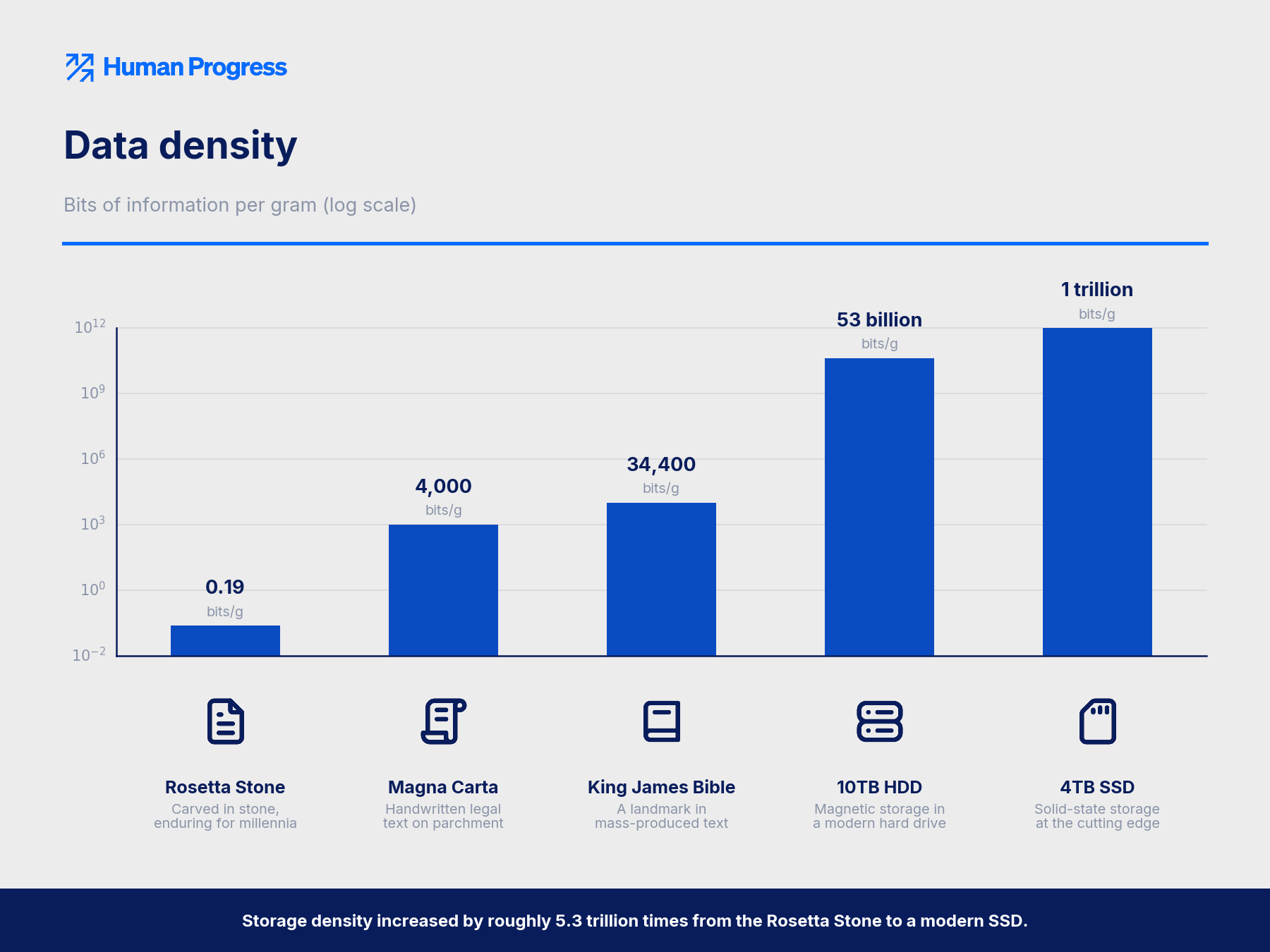
Since a single character of text equates to about 8 bits of information, the surviving 5,800 characters store 46,400 bits of data. Divided by the 250kg weight of the Greek portion, we arrive at a data density for the Rosetta Stone of ~0.19 bits/g.

With the discovery of agriculture and the rise of agrarian civilizations, the demands for knowledge storage and transmission media grew. The human population expanded, and a small but notable fraction began to congregate in small towns. As social and economic complexity grew, so did administration, trade, tax, and legal systems. Humans needed an easy way to perform and store the outputs of mathematical calculations, record taxes, and codify rules and regulations for personal and business conduct. Agrarian civilization, in short, demanded a storage medium with higher information density and faster read/write speeds (throughput). Enter papyrus, parchment, and paper.
Early forms of “paper” included papyrus and animal-skin materials like parchment and vellum. Papyrus was made from the papyrus plant, which grew in the Nile Delta in ancient Egypt. To make papyrus, strips of the plant were cut, laid into overlapping layers, and then pressed and dried into sheets. Papyrus was first used for writing as early as 2,500 B.C. and was one of the primary writing materials for thousands of years. Compared with stone, papyrus was far more data-dense; we could fit more characters on a given surface area, the substrate was lighter, and it could be folded or rolled into a scroll.

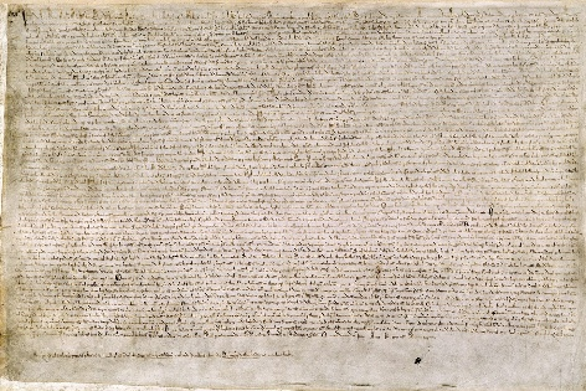
Parchment, made from cleaned and stretched animal skin, was developed long after papyrus and, thanks to its superior durability, quickly became the medium of choice for important documents. The Magna Carta, made from parchment, contains about 3,500 words or ~25,000 characters, which equates to about 200,000 bits of information. Medieval parchment weighs about 100–180 g/m², meaning the Magna Carta weighs roughly 50 grams. Using our formula, the Magna Carta’s data density comes out to around 4,000 bits/g.
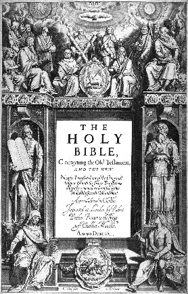
Even the Magna Carta pales in comparison to modern paper with printed text. “Paper”, the flexible plant-fiber sheets we know of today, was invented in China as far back as the 2nd century B.C.. It took centuries for it to spread outside China. Paper could be made thinner and lighter than parchment or papyrus, and the printing press made it possible to fit more words on a sheet. The King James Bible, for instance, contains around 789,000 words. That’s roughly 4.3 million characters, or 34,400,000 bits of data. A standard hardcover Bible weighs about 1 kg. Even if we conservatively include the weight of the binding, the information density comes to ~34,400 bits/g, about 8.6 times the density of the Magna Carta.

Our eyesight is limited, and text can only be so small before we can no longer resolve it. The next revolution in data storage came in the form of more exotic “machine-readable” media. Examples include magnetic storage such as hard drives and magnetic tape. Here, data is encoded on magnetized material directly as bits of information – ones and zeros – by carefully controlling the polarity of magnetic domains. This technology was a wondrous breakthrough, and it’s still improving. Today, for a few hundred dollars, you can purchase a hard drive that can store tens of terabytes of data! A commercially available 10TB HDD that weighs ~1500 g can store ~80 trillion bits of data, a data density of ~53 billion bits/g, 1.54 million times higher than the King James Bible.

Yet today, hard disk drives already feel antiquated. Instead, most phones, desktops, tablets, and external drives use solid-state storage (SSDs). It’s easy to see why SSDs have become so dominant in recent years; they are ideal for mobile devices. They have no moving parts, are more durable, use less energy, and still have higher data density. Solid-state media store data by trapping electrons in a grid of floating-gate transistors to represent bits of information. A commercially available 4TB (~32 trillion bits) SSD weighs 32 grams; a data density of 1 trillion bits/g, about 19 times higher than a comparable hard drive, or about 5.3 trillion times the data density of the Rosetta Stone!
Commensurate with improvements in data density came higher read/write speeds, or “throughput.” People read about 4 words a second and with an average word length of around 5 characters; that’s about 160 bits per second. A professional stone carver might be able to write up to 20 letters an hour, or about 0.044 bits per second. Paper and paper-like media dramatically increased writing speed. A human writes about 1.1 characters per second, or roughly 8.8 bits per second – 200 times faster than carving into stone, though still slower than reading. Printing machines, of course, could print text far faster than any human could write by hand.

But none of this compares to magnetic storage, such as modern hard drives, where read/write speeds (which are similar) are currently about 4.4 billion bits per second. SSDs are faster still, reaching read/write speeds up to 112 billion bits per second. That’s about 700 million times faster than reading, and nearly 13 billion times faster than writing by hand, roughly 2.5 trillion times faster than carving into stone!
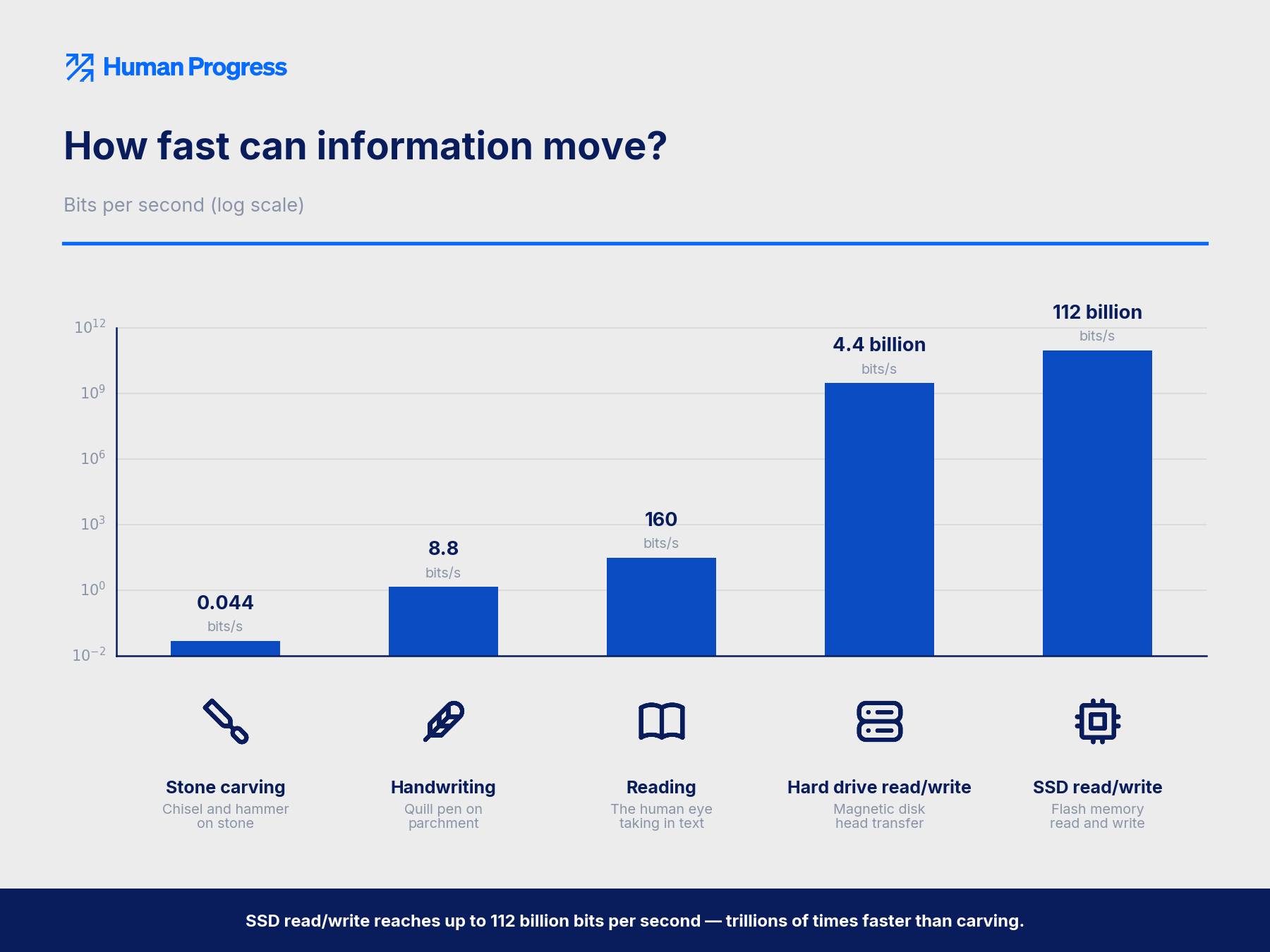
In roughly five thousand years, we’ve pushed the density of our storage media up by a factor of trillions, and the leaps keep coming faster. It took five millennia to get from stone to the printed page, representing a 180,000-fold gain in data density. In the seventy years since the invention of the hard drive, and with SSDs, humanity has multiplied that density by another 29 million times. For perspective, the text of the King James Bible carved in stone would weigh around 185 tons, nearly as much as a Boeing 747 (without fuel). On an SSD, it weighs less than a grain of sand.
Epoch AI | Scientific Research

LLM Use Nears AI Tool Use in Biology Preprints

“The share of biology preprints acknowledging large language model (LLM)

use has grown exponentially since 2023. In three years, LLM use

acknowledgments have nearly caught up to acknowledgments of specialized AI

tool use (17% versus 19%), which have climbed steadily since 2021.

Specialized AI tools include models for protein structure and design, image

analysis, single-cell sequencing, and genomics. The most commonly

acknowledged is AlphaFold, which predicts protein structure. It became

publicly available in July 2021 and is acknowledged in about half of all

preprints acknowledging specialized AI tool use. LLM usage is more varied,

including literature review, writing, and coding assistance. About 4% of

biology preprints in September 2026 acknowledged LLM use for research or

analysis, up from about 1% at the start of the year.”

From Epoch AI.

Blog Post | Happiness & Satisfaction

Critiques of Progress, Pt. 2: Anomie and the Loss of Meaning

Modern life has not emptied the world of meaning; it has given more people the freedom to create their own.

Summary: Today marks the second installment of a new series of essays on HumanProgress.org written by Dr. Stephen Davies titled “Critiques of Progress.” Each of the fifteen essays in this monthly series will examine the origins, nature, and validity of recurring critiques of the modern world. This essay examines the old complaint that modern life has drained the world of meaning and argues that, where this complaint holds at all, it is a result of prosperity and freedom. You can read the first part of this series here.


One of the recurring arguments made against the modern world is that it is marked by an intensifying loss of meaning. The argument is not that the natural world or human life and society are actually objectively emptied of meaning but that they are increasingly perceived and understood as such. This is, in other words, an argument about a pervasive state of mind and mental outlook, supposedly produced by the experience of living in the modern world and by the impact of modernity’s essential and predominant ways of thinking on the collective mentality of people. The argument is that people increasingly experience what is often called “anomie” (literally “normlessness”), a state of mental exhaustion, drift, and feeling that nothing means anything and that there is no point to life or to any human action or choice.

That, it is argued, has extensive and harmful effects on the way people live and act, and on the wider culture and ways of life. Anomie creates paralysis and lassitude that are paradoxically combined with restlessness and agitation. The feeling of futility and pointlessness leads to harmful and destructive actions and behaviors such as suicide or substance abuse, producing what are now called “deaths of despair.” Anomie is often claimed to be the source of reluctance to have children or to commit to the future. In culture and the arts, anomie is seen as producing work that is either trivial and shallow or dark and tormented.

The diagnosis of this widespread state of mind and the actual term anomie was classically formulated by the French sociologist Émile Durkheim, in his 1897 book Suicide. That book, however, was inspired by an earlier work in 1881, Suicide and the Meaning of Civilisation by Thomas Garrigue Masaryk (later the first president of Czechoslovakia). Masaryk argued that suicide was an individual response to a wider crisis of meaning and purpose in modern civilization. The main cause of anomie for Masaryk and Durkheim was the breakdown of structures and rules that constrained personal choice, combined with a loss of belief in formal religion, which meant that the idea of the universe as a whole and particular entities within it having a telos or goal that determined people’s proper existence (the final cause in classical philosophy) disappeared. Instead, they argued, people faced an overwhelming range of choices with no structure to guide them, and no idea of life’s ultimate purpose other than their own personal preferences or choices.

Durkheim and Masaryk were only two of many who arrived at this diagnosis. Other authors made similar cases in the late nineteenth and early twentieth centuries, after which this kind of argument became a standard part of the anti-modernist repertoire. Prominent examples include Fyodor Dostoevsky (notably in The Brothers Karamazov but also elsewhere), Friedrich Nietzsche, and Thomas Hardy. Anomie is also a main theme in the work of French philosopher Albert Camus, particularly in The Stranger. Interestingly, not all of the authors saw the loss of meaning as the inevitable and inescapable result of living in modernity. Both Nietzsche and Camus, for example, believed that one could escape anomie through conscious choice at the individual level, although neither thought there was a collective solution to the problem. Masaryk, by contrast, thought that such an escape could be achieved through the development of new forms of collective purpose. Most, however, followed Durkheim in concluding that the anomic state of mental affairs was an inevitable result of how people now lived and of the disenchantment of the world by rationalism and utilitarianism.

How and why, though, was this state of despair and lack of meaning connected to the modern world, for its diagnosticians? Their answer was that anomie was the inevitable result of core features of the modern world. The main one for many such features was loss of religious faith and its supplanting by materialism and (in moral philosophy) utilitarianism. However, several other reasons were given. A prominent one was urbanization and the way that cities supposedly cut people off from the natural and the sublime. Another was the artificial routine produced by modern work, which forced people into a repetitive way of living that had no obvious goal or purpose for most, since it was work oriented towards someone else’s purpose — that of the capitalist, for example. One common argument was that the modern world was too comfortable and lacked challenge or danger, since the latter truly gave life meaning.

This argument led to positions and arguments in the later nineteenth century that will now strike many as bizarre or wrongheaded. Most notably, it led to a valorizing of war as something that created meaning for those caught up in it, even if it came at the cost of death or injury. One classic exposition of this view was German soldier and author Ernst Jünger’s account of his experiences on the Western Front, Storm of Steel, but he was one of many. Another example was the Irish patriot and revolutionary Patrick Pearse, who argued (in 1915!) that young men were lucky to have been born at that time because they had the chance to escape the stultifying boredom and meaninglessness of bourgeois society for the danger and heroism of war. Even after the horrors of the World Wars and other conflicts, authors such as Michael Easter and Anna Lembke still argue that modern life lacks challenge and, therefore, meaning.

In addition to secularization, two other arguments were made. First, that the modern world created too many choices between options that had no substantive difference, so that the choice itself had no real consequence. This range of choice overwhelms people, and the effect of being confronted with choices with no significance (such as choosing between 23 different types of deodorant, in Bernie Sanders’ famous quip), it is argued, undermines the very idea of meaningful or purposive action. Second, that the modern condition both created and valorized individualism and personal autonomy. For the critics, that meant that people were no longer part of a social structure that provided them with meaning and purpose, even though by its nature this social integration also restricted individual expression. That was Durkheim’s principal argument, although, interestingly, he also argued that too much integration and collective rules would ironically produce similar results to the lack of rules. This argument, of meaninglessness as a product of a lack of generally accepted rules and norms, is why the term anomie came to be widely used.

What to say about all that? One obvious comment is that the phenomena in question fall under the heading of what we now call “first world problems.” Worrying about a lack of meaning produced by too much choice and comfort, and the lack of clear rules, is not a problem for those wondering where their next meal is coming from, how to get food and shelter, or living under the kind of strict rules enforced historically by religious authorities and the state. Much of the argument can be described fairly as “luxury complaints”: the kinds of difficulty one might face when actual serious and life-limiting or threatening problems have been dealt with. In other words, to the extent that many people do feel that their life is lacking in meaning or purpose, we can fairly describe this as a problem of success — the kind of problem that it is good to have in many ways.

Second, it is not at all clear that there is anything particularly modern about anomie. Philosophers and religious thinkers from the Stoics and the Buddha onwards have been making the point about the lack of inherent or transcendent meaning in life and the world and suggesting ways of dealing with it. The psychological phenomena described were extensively written about by ancients and Christians under the heading of “accidie,” a term that interestingly is making a comeback in popular psychology as well as theology and moral philosophy. The Christian sin of sloth also corresponds to the feeling of pointlessness and the state of lassitude that it produces (a sin because it rejects the joy and purpose that God offers). In the seventeenth century, before modernity, Robert Burton examined the state of mind described earlier in his massive 1621 work The Anatomy of Melancholy. Clearly, this kind of state of mind and being was not unknown before the modern world.

The critics’ response, of course, is that it has now become more widespread, even normal, as opposed to unusual and pathological. Even if, for the moment, we grant that, it does not follow that anomie is inescapable as a cost of modernity, much less that anomie is a ground for rejecting the benefits of modernity. As several of the authors who diagnose this malady argue, there are ways of dealing with it, most of which involve either simply accepting the lack of transcendent meaning and getting on with living (this was English philosopher Bertrand Russell’s position, for example) or creating meaning in life through one’s own deliberate choices and valuations (the view of Nietzsche and existentialists such as Camus, for example).

The last is the key point. What these complaints share is the belief that human beings are not equipped to bear the burden of full autonomy, and that meaning can only ultimately come from outside the individual, either from God and revelation, or from a collective entity (which mysteriously turns out to consist of flesh-and-blood humans who do the actual choosing). There is actually no reason to accept the case granted pro arguendo above that this existential anxiety is widespread. Most people seem to feel that their life and their relations are perfectly meaningful and do not suffer the angst described. We should remember that suicide, which Durkheim and Masaryk treated as the ultimate expression of a supposed crisis of meaning, is a rare event that’s becoming rarer in most rich countries. Quite simply, the modern world is in many ways founded upon the belief that it is choice and purposeful action by individuals that is the source of meaning, along with relations with other people. The thesis that meaning can only come from outside the individual is rejected. The empirical evidence that secular and open societies are happier supports this view.

Modern life values personal choice and increases the range of choices open to ordinary people. In modernity, the quest for meaning and purpose is fulfilled through individual and voluntary collaborative action. As such, we should reject the complaints of anomie and, to the extent that they have a foundation, regard it as a problem of success.

Pangram | Computing

Pangram Introduces New AI Image and Video Detectors

“A few months ago, we released Pangram Image as a research preview. We are now proud to announce Pangram Image 1.0: The state-of-the-art in both AI image and AI video detection. We would like to thank the whole community for taking the time to try it and find its weaknesses, and for holding us to a high standard to make a better detector for everyone…

We tested our Pangram Image 1.0 model against several commercial and academic AI image detectors. We created synthetic mirrors of 100 real photos using 12 frontier state of the art AI image generators, using prompts that closely matched the original photo for a total of 1,200 synthetic images. Our model achieves 99.96% accuracy on this evaluation set…

A recent academic study, DF26, showed that humans are barely better than random when it comes to telling real videos from AI videos of people talking. Modern detectors were not much better. This is why we are very excited to release Pangram Image Flash 1.0, a faster model that particularly excels at frontier AI video detection. On DF26 it scores 98.7%, a 29-point leap over the next best detector.”

From Pangram.